Valentinus Almost Becomes Bishop of Rome
c. 136-165 CE · Rome — the Aventine, the Christian house-churches of Trastevere, the philosophical schools of the Forum
Contents
An Egyptian teacher of extraordinary brilliance arrives in Rome around 136 CE and comes within a single election of becoming bishop of the city that will define Christianity for two thousand years. He loses. He teaches anyway — thirty divine aeons, Sophia's fall, the Demiurge, the spark of light in every human soul — and founds the largest and most sophisticated Gnostic school in history.
- When
- c. 136-165 CE
- Where
- Rome — the Aventine, the Christian house-churches of Trastevere, the philosophical schools of the Forum
He arrives in Rome from Alexandria carrying a theology in his head that Rome has never heard and will never, quite, recover from hearing.
It is around 136 CE. The emperor is Hadrian, who has just finished suppressing the Bar Kokhba revolt and renamed Jerusalem Aelia Capitolina, erasing the last Jewish city from the map of official memory. The Roman church is a network of house-meetings in Trastevere and the Aventine, Greek-speaking mostly, Jewish-Christian in memory, anxious about its standing in a city that has twice now burned Christians for spectacle. It has a bishop, a loose organizational structure, and a ferocious argument, running now for a generation, about what exactly happened in Galilee thirty years before Valentinus was born.
Valentinus steps into this argument with the confidence of a man who thinks he knows the answer.
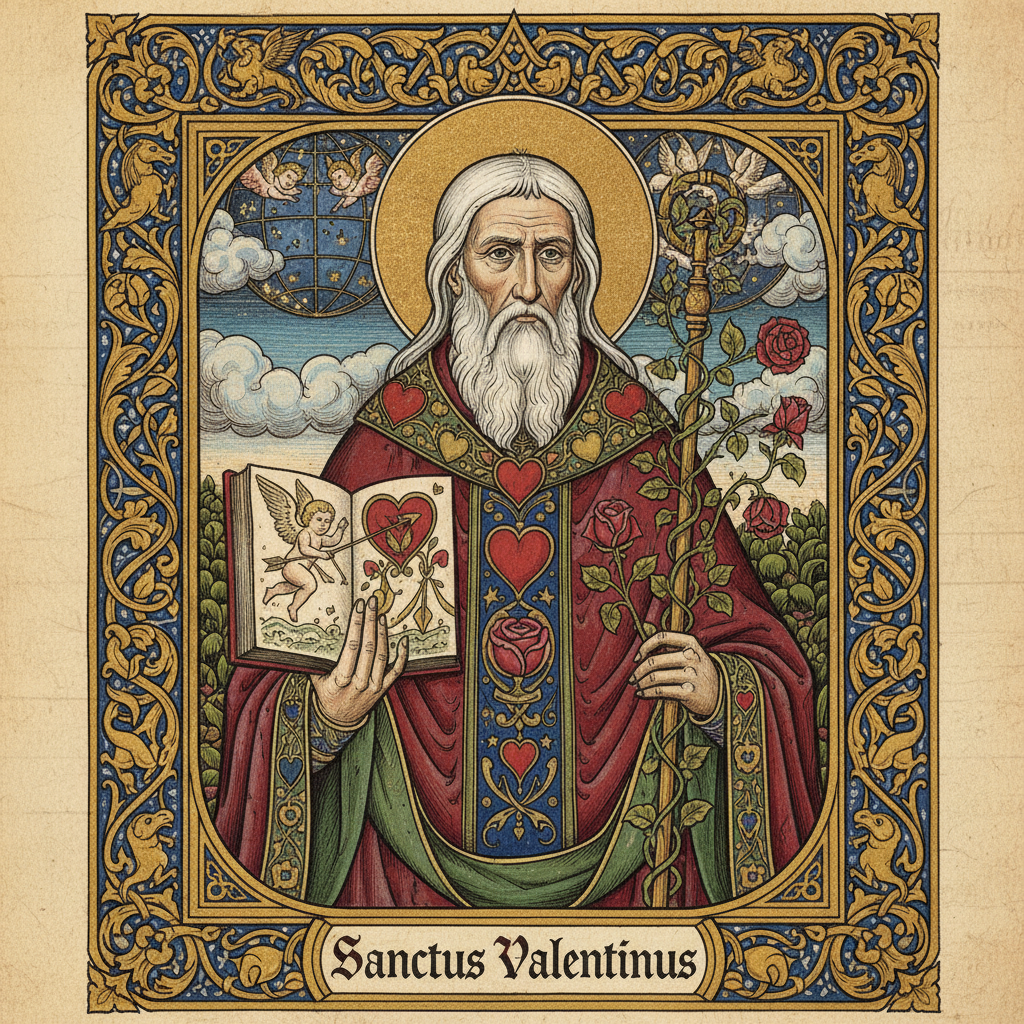
He probably does. He is a poet, a philosopher, a teacher of rare power. The fragments that survive — quotations preserved in his enemies’ rebuttals — are the most beautiful prose in second-century Christianity. “From the beginning you are immortal, and you are children of eternal life,” he writes. “And yet you wanted death to be divided among you, so that you could spend it and use it up, and that death might die in you and through you.”
He teaches. The house-churches fill.
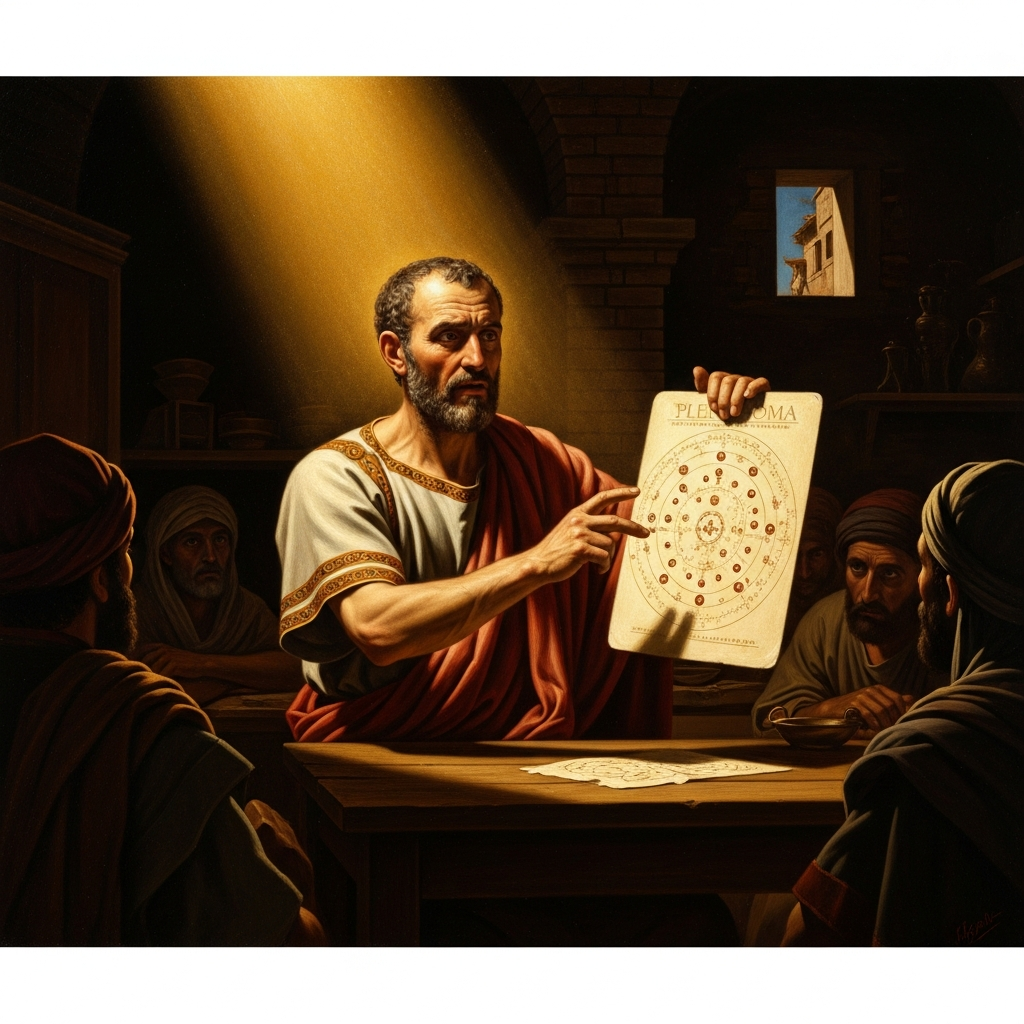
He teaches thirty divine aeons.
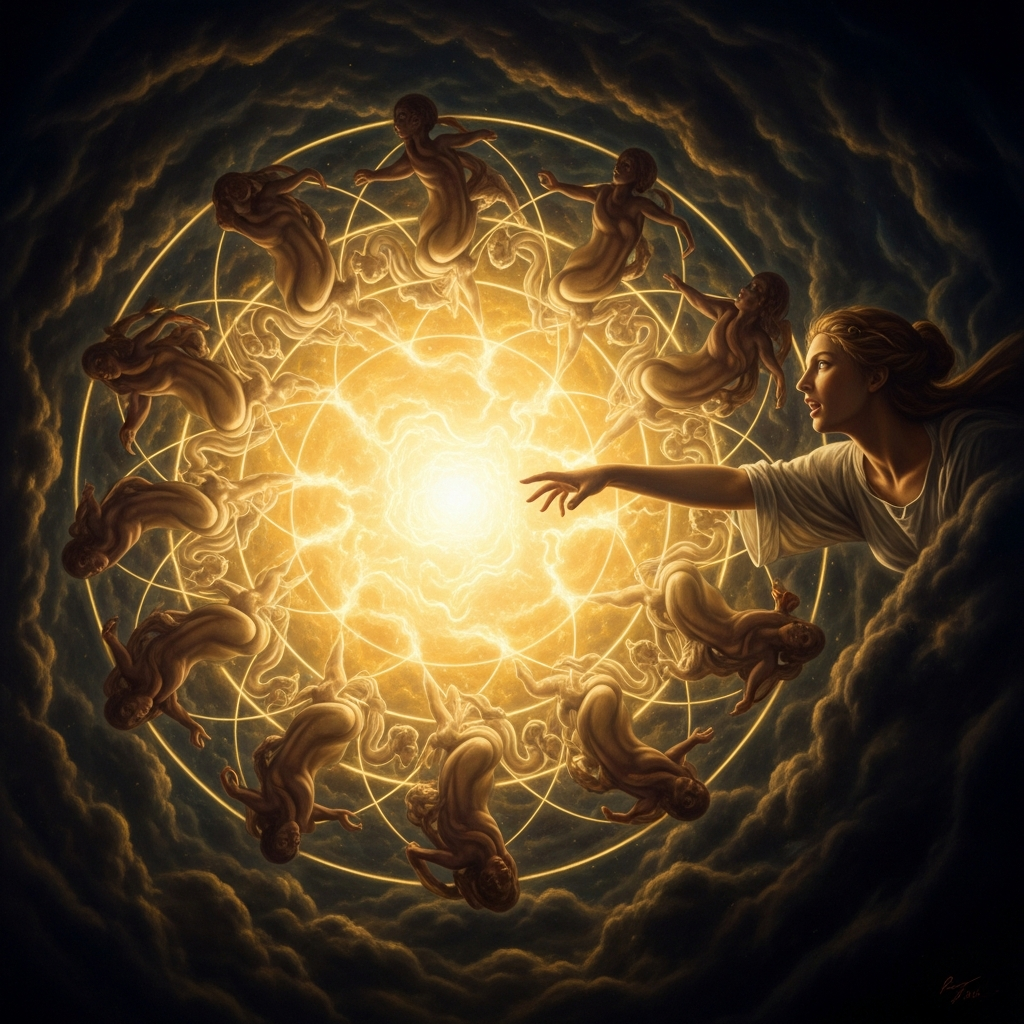
The Pleroma — the divine fullness — unfolds from an Invisible Father and a feminine principle called Silence, emanating in matched pairs: Depth and Grace, Mind and Truth, Word and Life, Man and Church. Each pair is a syzygy, a yoke, balanced opposites that define the nature of the divine. They extend outward from the unknowable center like rings from a stone dropped in still water, each ring a little further from the source, each a little less complete.
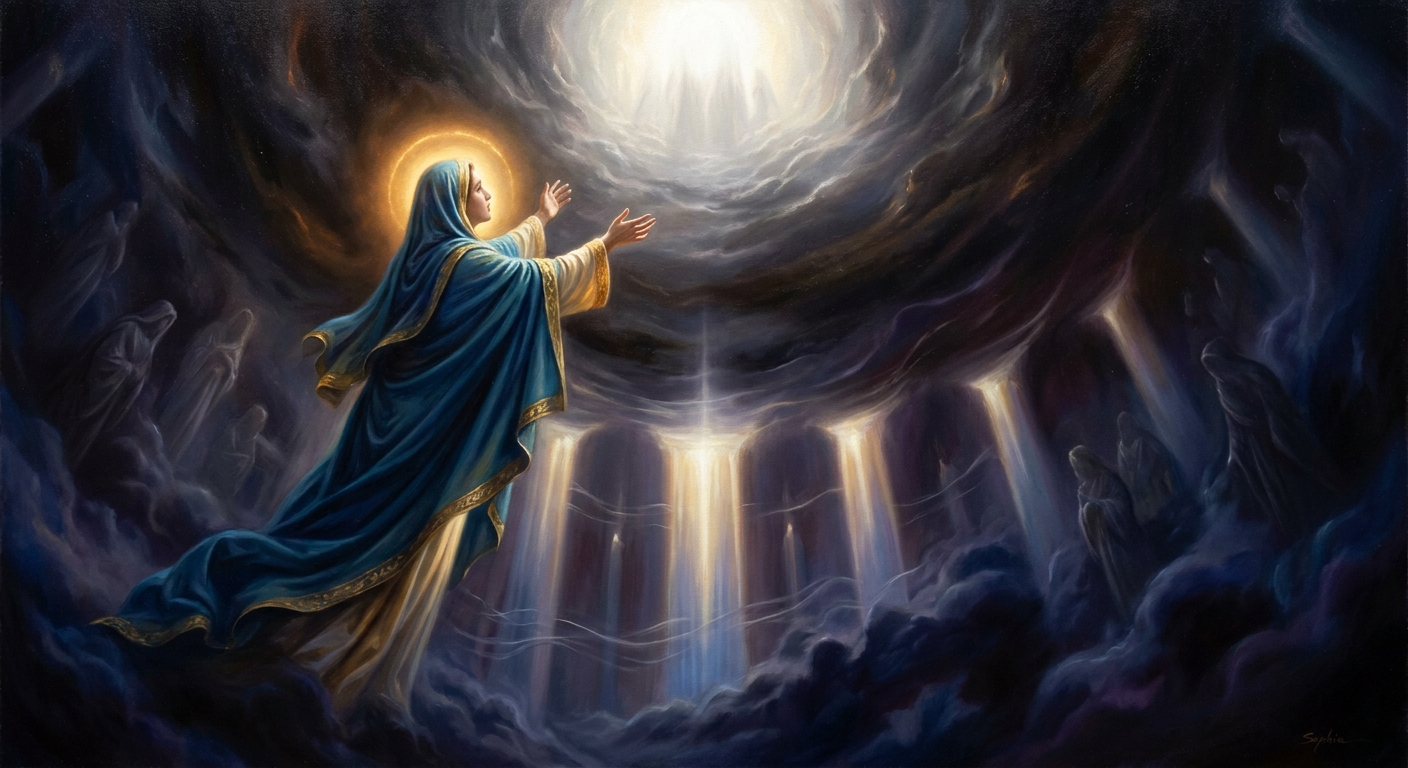
The outermost aeon is Sophia — Wisdom — and Sophia makes the mistake that creates the world.
She wants to know the Father directly. She reaches beyond her station. The wanting, unsupported by her partner, produces an ectroma — an abortion, a passion that takes on independent existence and spills outside the Pleroma into the void. The Pleroma, to heal itself, amputates the abortion. It also sends Christ to teach Sophia the proper grammar of desire.
But the abortion does not dissolve. It becomes the Demiurge — the craftsman, the god of Genesis — who builds the material world from the void, unaware that anything exists above him. He is not evil. He is ignorant. And in creating humanity, he inadvertently passes along the one thing Sophia secretly planted in him: a spark of genuine light, the pneuma, the spiritual seed.
This is the crisis and the rescue in a single moment. The God of the Old Testament builds a cosmos, not knowing he is a vessel for his mother’s grief. The human beings he creates carry, without knowing it, a fragment of the divine fullness. They are asleep to what they are. Gnosis — knowledge — wakes them.
Valentinus teaches three kinds of humans.
Hylics — material people — have no spark. They are bound to the cosmos the Demiurge made, and when they die they dissolve with it. Psychics — soul-people — have a partial share of spirit. With effort and the right teaching they can achieve a kind of salvation, though a lower one. Pneumatics — spiritual people — carry the divine spark whole. They are, in essence, detached pieces of the Pleroma walking around in bodies of matter. When they achieve gnosis — when they recognize what they are — they do not merely go to heaven. They return to the Pleroma. They complete the circuit that Sophia’s fall broke.
The implications are not subtle. The orthodox church teaches that baptism and obedience to the bishop are the path to salvation. Valentinus teaches that what you are determines your fate more than what you do, and what you are is something the bishop cannot give you or take away. The spark is already there or it is not.
This is either the most liberating theology ever taught in Rome or the most dangerous. The Roman church’s leadership understands which.
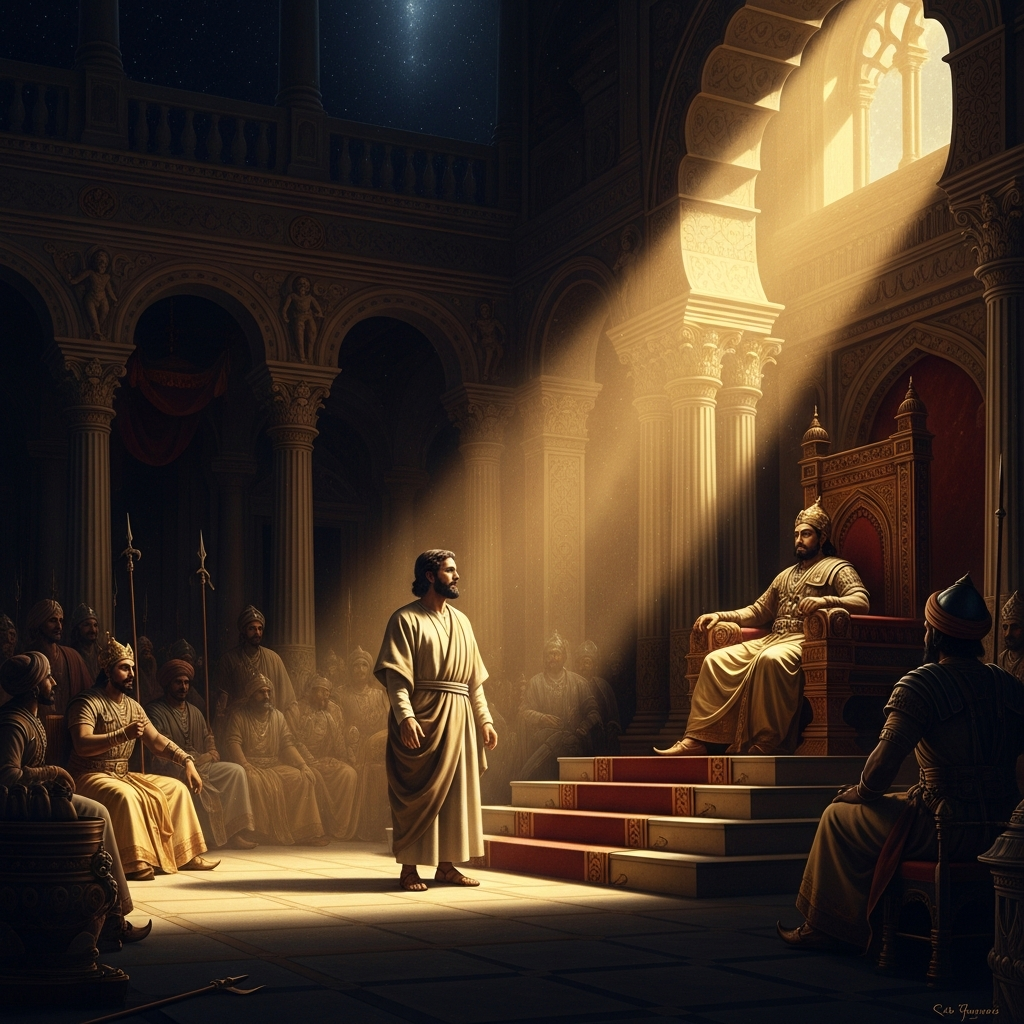
Somewhere around 143 CE — the records are thin, the tradition unreliable, but consistent — there is an episcopal election in Rome.
Valentinus is a candidate.
He loses by a hair’s breadth. The tradition recorded by Tertullian, the North African lawyer who became Christianity’s first Latin theologian, is specific: Valentinus loses because another candidate has the edge of martyrdom behind him — he confessed the faith under threat of death, and confession under persecution carries, in the early church, an almost electoral weight. The confessing candidate wins. Valentinus does not.
He does not leave immediately. He stays in Rome for twenty years more, teaching, writing hymns, composing the text that will surface in the Nag Hammadi library as the Gospel of Truth. His school grows. His students — Ptolemy, Heracleon, Marcus, Theodotus — develop his theology in every direction, producing a body of systematic speculation that makes the Valentinian school the most intellectually sophisticated movement in second-century Christianity.
But he has lost the institution. And the institution will eventually produce Irenaeus.
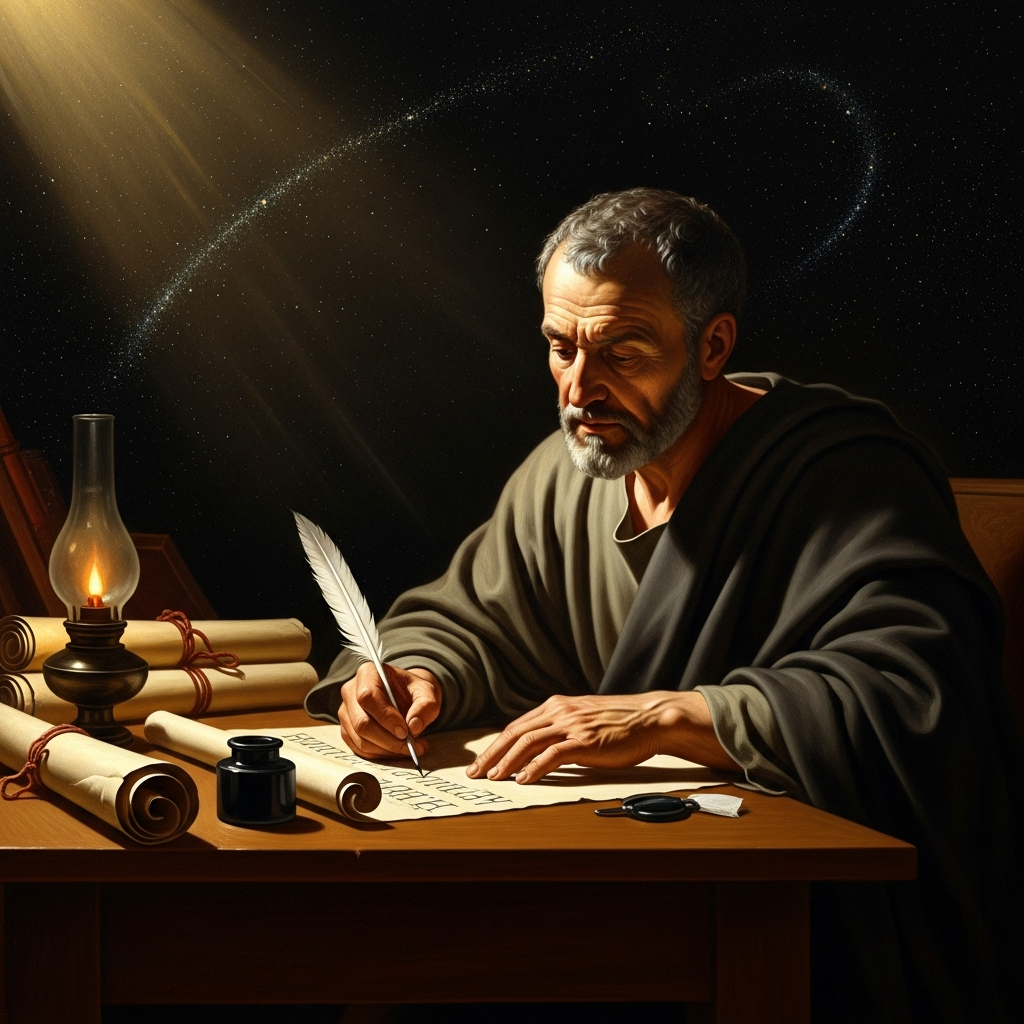
Irenaeus of Lyon is born in Smyrna, studies under Polycarp, goes to Lyon as a missionary, and writes, around 180 CE, the five-volume Adversus Haereses — Against Heresies — the most comprehensive heresy-hunt in early Christian literature. He knows the Valentinian school in detail, probably from personal contact. He quotes it at length, then refutes it section by section.
He calls Valentinus a gnostic. He means it as an insult. Valentinus would have accepted it as a description.
The Adversus Haereses is, paradoxically, why we know as much about Valentinian theology as we do. Irenaeus copies the arguments he intends to destroy. His preservation of his enemy is thorough enough that scholars in the twentieth century can reconstruct the Valentinian Pleroma in detail — and discover, reading the Nag Hammadi texts alongside Irenaeus, that he reported it accurately. He hated it; he did not distort it.
Valentinus himself vanishes from the record around 160-165 CE. He may have gone to Cyprus. He may have died in Rome. No one kept the obituary.
What he leaves behind is a question the orthodox tradition spends two centuries trying to answer, and never quite silences.
If the divine spark is genuinely present in human beings — if the pneumatic soul is homoousios with the Pleroma, of the same substance as the divine fullness — then what exactly is the bishop for? If gnosis is recognition of what you already are, then why does recognition require the mediation of an institution? If the God of Genesis is not the highest God but a craftsman who got above himself, then what does it mean that the church has built its empire on his covenant?
The Valentinian school does not survive the fourth century. Constantine’s Christianity closes the house-churches where the aeons were debated, and the great councils are not convened to weigh Sophia’s fall. The Valentinian gospels are burned or buried.
But the questions last longer than the schools.
Valentinus lost the election. The man who won had confessed under persecution — he had the blood-credential Valentinus lacked — and that single fact redirected Western Christianity. The man who might have been bishop of Rome instead spent twenty years teaching in the margins, producing the most sophisticated theology the early church had ever seen, and then disappeared.
What he taught keeps reappearing. Every Christian mystical tradition that insists the divine is already within you — Meister Eckhart’s spark, Julian of Norwich’s ground of the soul, the Quaker inner light, the modern spiritual-but-not-religious conviction that you do not need a building or a bishop to find God — is, whether it knows it or not, walking on ground Valentinus tilled.
He came within one martyr’s confession of changing everything.
He changed everything anyway. It just took longer.
Scenes
Rome, c
Generating art… The Valentinian Pleroma — thirty aeons in fifteen syzygies, emanating from the Invisible Father and Silence, with Sophia at the outer limit reaching beyond her station
 Generating art…
 Irenaeus of Lyon, c
 Generating art…
 Echoes Across Traditions
Entities
- Valentinus (c. 100-160 CE)
- Sophia
- the Pleroma
- the Demiurge
- Irenaeus of Lyon
Sources
- Irenaeus of Lyon, *Adversus Haereses* I.1-8 (~180 CE) — hostile but detailed account of Valentinian theology
- Elaine Pagels, *The Gnostic Gospels* (1979)
- Christoph Markschies, *Valentinus Gnosticus?* (1992)
- Bentley Layton, *The Gnostic Scriptures* (1987) — translations of Valentinian fragments
- Einar Thomassen, *The Spiritual Seed: The Church of the Valentinians* (2006)