Contents
The philosopher Valentinus, meditating alone in Alexandria, receives a vision of the Logos as a newborn child — and in that luminous face reads the entire architecture of the Pleroma, the thirty divine Aeons, and Sophia's catastrophic fall. This is the moment Gnostic Christianity's most complete cosmology is born.
- When
- c. 135 CE · Alexandria, Egypt
- Where
- Alexandria, Egypt
He is meditating on John’s prologue when the child appears.
Not reading — meditating. He has read it so many times the Greek letters have worn grooves into his mind, and he no longer needs the scroll. In the beginning was the Word. He is lying on the mat in his study in Alexandria’s Jewish quarter, the oil lamp guttered to a thread of flame, and the night outside is the dense, warm black of the Egyptian coast, salt-smell through the shutter. He has been still for an hour, or three, or six. His students have gone home. The city has gone quiet. There is only the Word, ho Logos, and the particular darkness behind his closed eyes.
The child appears in that darkness.
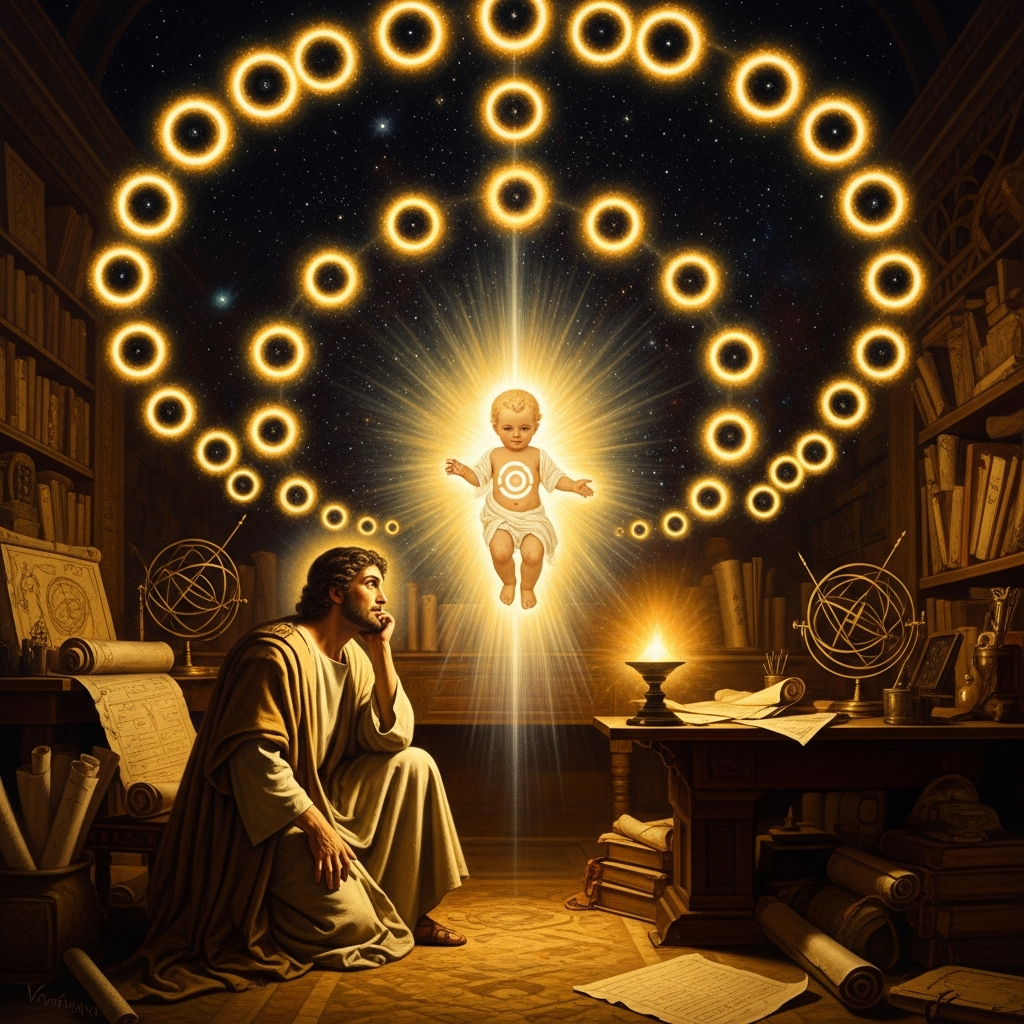
It does not descend from a direction. It is simply there, as though it had always been there and he had only now learned to see it: a newborn, luminous, floating in the darkness of his mind’s interior the way a lamp floats in a night harbor. It makes no sound. It does not move. But from its face — if face is the right word for something that is light shaped into the suggestion of a face — Valentinus understands, in a single suspended moment, everything he has been trying to understand for thirty years.
The child is the Logos. The Word. Not the word spoken. The word as the speaking itself, before sound, before air, before the breath that carries sound. He is looking at thought before it becomes language, at meaning before it becomes metaphor.
And in looking, he sees the world that stands behind the world.
He was a child in Egypt, probably at Phrebonis, near the Nile delta — he remembers mud the color of bronze, and the smell of the river’s annual flood, and the particular quality of light on water that never fully leaves a person who grew up beside moving water. He came to Alexandria young, to the schools. He was gifted in a way that made teachers both proud and uncomfortable: he asked the question after the answer. He could absorb a system of thought and immediately see through to the floor of its foundations, the places where the weight was not being held.
He came to the Christians. He read their texts carefully — Paul above all, whose cosmological language bent toward something larger than the Jerusalem church seemed to recognize: the God of this age, principalities and powers, a wisdom hidden among the mature, the fullness — pleroma — of him who fills all things in all ways. Paul’s Greek was the Greek of a man who had seen something and was struggling with available language to describe it. Valentinus recognized that struggle. He had the same one.
He studied also with a man who claimed to have studied with a student of Paul himself. This may have been true. It may have been the kind of claim that accumulates around a great teacher’s memory the way silt accumulates in a delta. What Valentinus learned from him was not facts but a way of reading — anagoge, the upward reading, the practice of treating every visible text as a shadow of an invisible referent. The text means what it says and also what it points to, and what it points to points to something else, and the chain of pointing ends only at the Unspeakable.
He prayed, in those years. He meditated. He read. He walked the harbor at dusk and watched the fishing boats come in. He taught small groups of students who came to him because they had heard he could show them something the other teachers could not. He was not yet the head of a school. He was not yet anything except a man who was very sure that the universe was more than it appeared, and who was willing to be patient.
And then the child appeared in the darkness behind his eyes.
He does not call anyone. He does not light the lamp. He lies still on the mat while the child hovers in his interior darkness, and he reads it.
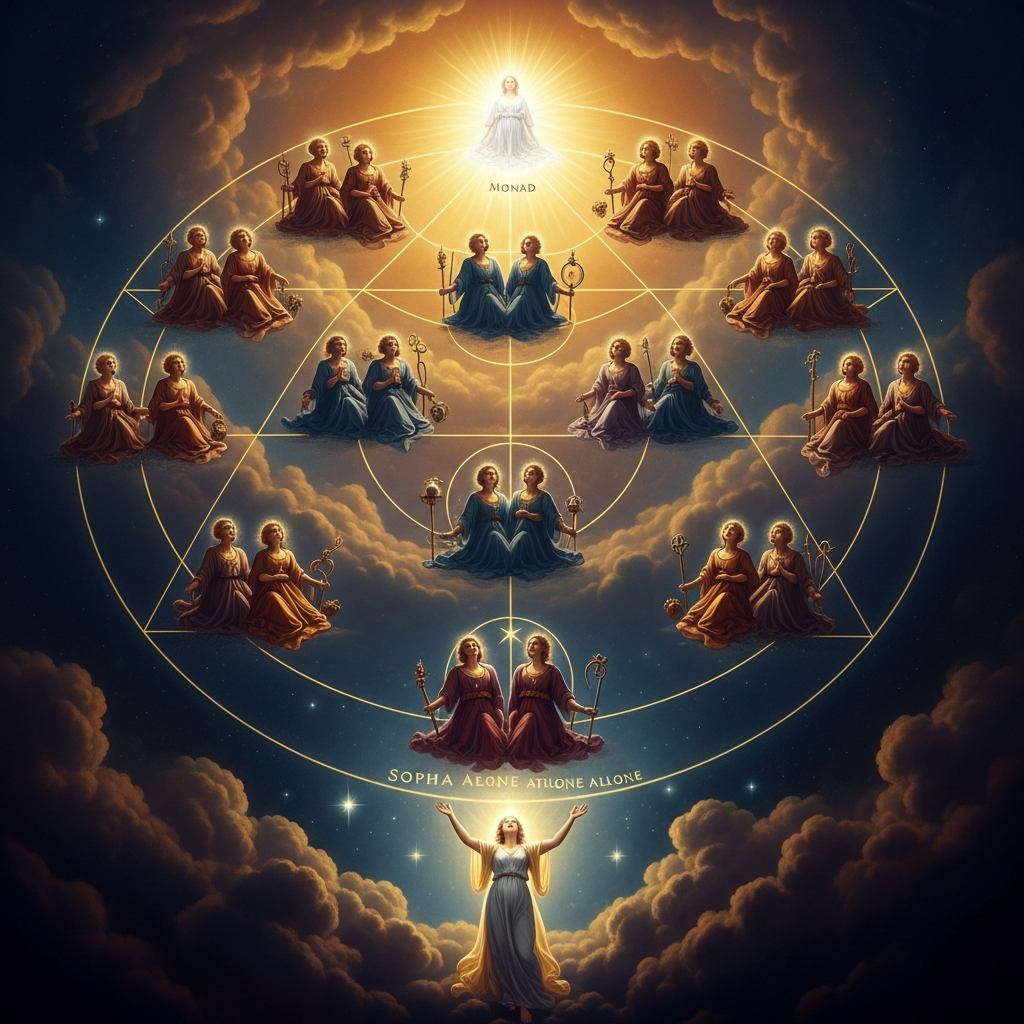
This is not a metaphor. He reads the child the way a physician reads a body — systematically, from the outermost to the innermost. From the luminous face he reads outward into the darkness and sees, arranged in concentric rings like ripples from a dropped stone, thirty forms. Fifteen pairs. Each pair a syzygy — a matched pair of divine attributes given shape: Mind and Truth, Word and Life, Man and Church, and then, cascading outward in progressively more differentiated forms, eleven more pairs down to the outermost edge of the divine fullness.
Pleroma. The fullness. The total self-expression of the Unknowable Father — not the Father himself, who cannot be named or approached or known, but the Father’s knowing of himself, which unfurls the way light unfurls from a fire. Each Aeon is a thought of the divine mind given eternal form. Together they constitute everything that can be said about the highest divinity.
Valentinus watches them and understands what he is watching: the architecture of heaven. Not the heaven of the popular imagination, the place where good people go. The Heaven that precedes goodness, that precedes the concept of going, that precedes the concept of place. This is the first thing. The thing before the things.
His hands are lying open at his sides, palms up, and he realizes he is not breathing for long intervals. He breathes. He keeps watching.
At the edge of the Pleroma, the outermost of the Aeons, he sees her: Sophia. Wisdom. The youngest of the thirty, brightest, most curious. He sees what she does with the clarity of a man watching something that has already happened a thousand times and will happen a thousand more: she reaches. She reaches past her paired partner, past the restraining principle that holds each Aeon in place, toward the center of the Pleroma, toward the Monad itself, the Unknowable Father, because she has decided she must know him directly.
She cannot.
The knowledge that she cannot does not stop her. She passes the boundary — horos, the limit — and what comes out of her is not knowledge. It is the shape of an unsatisfied desire, a longing that has been severed from its object, an affect without the answering affect that would have given it form. It falls. She tries to catch it. She cannot catch it. It falls outside the Pleroma, into the void below the divine fullness, and the darkness receives it, and it is not nothing. It is something. Something is worse.
What she has emitted outside the Pleroma will become the material world. Everything he can see, everything he can touch, the mud of the Nile delta and the limestone of Alexandria’s streets and the water-smell of the harbor — all of it is the residue of Sophia’s desire, her longing cast out of heaven and condensed into density and weight by the blind creator who will arise from it, who will mistake the darkness for the totality, who will look up at the void above the material world and see nothing there and decide he is, therefore, God.
Valentinus has been a Christian for twenty years and has never understood, until this moment, why the world is wrong.
The world is wrong because it was made by the wrong maker.
He begins to teach.
He does not announce a new religion. He announces a new reading. He tells his students that the texts they already know — Paul’s letters, John’s Gospel, the myths of Plato — are describing the same reality from different angles, and the reality they are describing is this: there is a God above the god of Genesis, and the god of Genesis does not know it, and the material world is the long, slow aftermath of a mistake made at the edge of heaven.
His students multiply. He goes to Rome — perhaps to seek the bishop’s chair; the sources hint at this but do not commit. He is a charismatic teacher, a brilliant writer. Some of his students will say he was the greatest mind among all the Gnostics. He writes hymns. He writes letters. He teaches in the way that the best Alexandrian teachers teach: not by dictating doctrine but by raising questions that become increasingly unbearable to leave unanswered.
The system that develops around him — worked out in detail by his students Ptolemy and Heracleon, refined through decades of argument and meditation — becomes the most intricate cosmology Christian theology has ever produced. The Pleroma with its thirty Aeons arranged in Dyads, the fall of Sophia, the emission of the Demiurge, the sowing of divine sparks into human bodies, the mission of Christ to wake those sparks, the final restoration of all things to the divine fullness: it is a system that holds everything and explains everything and requires a God who is larger, stranger, and more deeply hidden than anything the orthodox church is prepared to announce from a bishop’s throne.
The church calls it heresy. The church wins. Valentinus’s books are burned or copied only in fragments, preserved by mistake in the libraries of his opponents.
In the darkness of his study in Alexandria, the child in his vision does not fade. It waits the way a memory waits — not in the past, but in the part of the mind that holds what the mind has seen and cannot unsee.
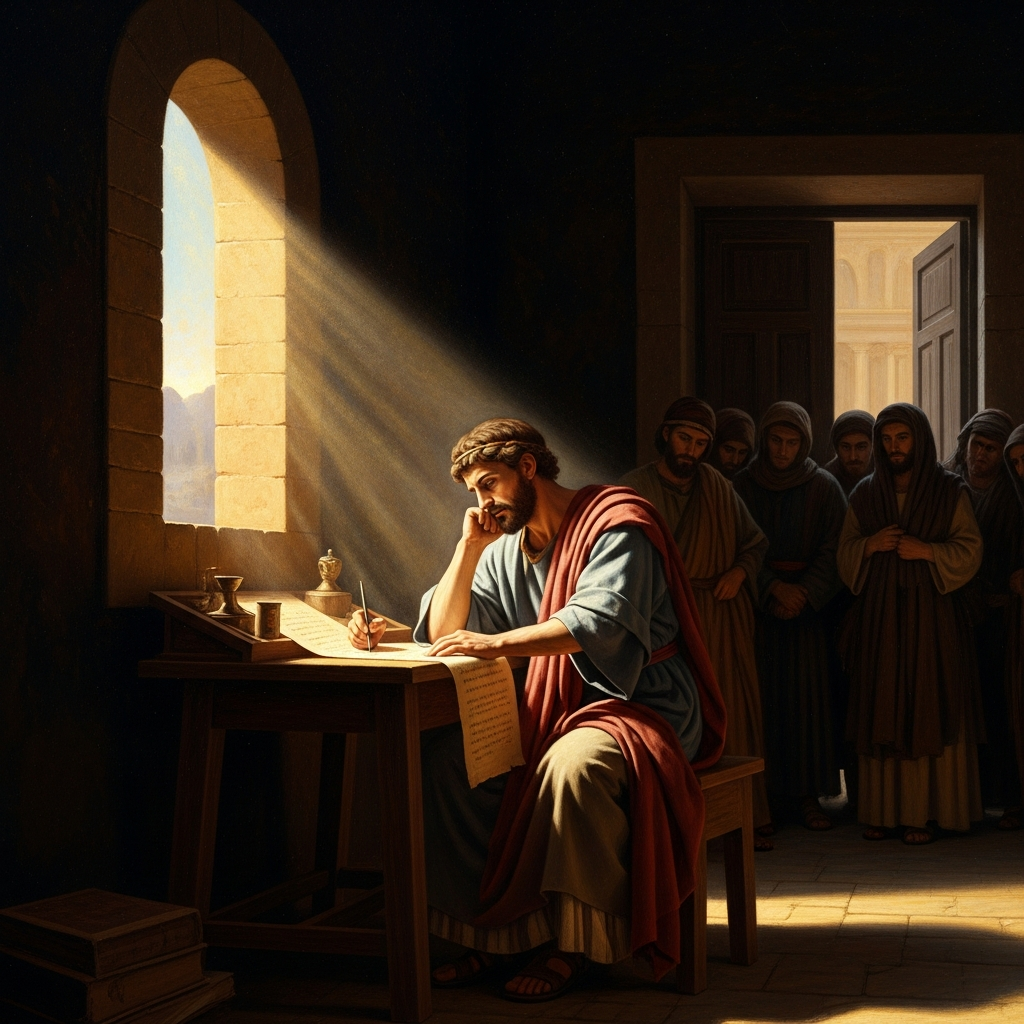
He picks up his pen. He writes: The Father is invisible. The Father is incomprehensible. The Father cannot be named. But from his incomprehensibility emanates the first understanding: his own self-knowing, which is also his self-saying, which is also the Logos, which is the first thing that can be said.
His student, who has appeared silently in the doorway, leans against the frame and listens. He is perhaps seventeen. He has been listening to Valentinus for two years and has not yet understood half of what he hears. He understands tonight, watching the teacher write by lamplight, that he is witnessing the beginning of something — not a movement exactly, not a religion exactly, but a way of reading the darkness that cannot be unlearned once it has been seen.
Outside, the harbor smells of salt and rotting fish and cedar resin. The stars of Egypt are the same stars they have always been: indifferent, enormous, impossibly far above the clay and the flesh and the blind creator who called himself the highest.
Valentinus writes. The child blazes in the dark behind his eyes.
The vision Valentinus received in that Alexandria study did not survive intact. What survived are the summaries of his enemies — Irenaeus, Tertullian, Hippolytus — who preserved his system in the act of refuting it. There is something fitting about this. Valentinus taught that divine light is transmitted through what appears to be darkness, that the spark survives inside the body of the thing that tried to suppress it.
His students spread across the Mediterranean. They wrote commentaries on John. They wrote prayers that ask the Father of truth to receive the scattered sparks and restore them to the Pleroma. They gathered in private houses and argued about which category of soul could be saved and which could not, and whether the material world would be destroyed or merely transfigured at the end.
The tradition was suppressed, burned, refuted. The Nag Hammadi texts, buried in a sealed jar in the Egyptian desert sometime in the late fourth century, were found in 1945. They include versions of Sophia’s fall, of the Valentinian prayer of Paul, of the Gospel of Truth, which may be Valentinus’s own hand. The child is still in those texts — radiant, newborn, waiting in the lamplight for whoever is willing to lie down on the mat and look.
Scenes
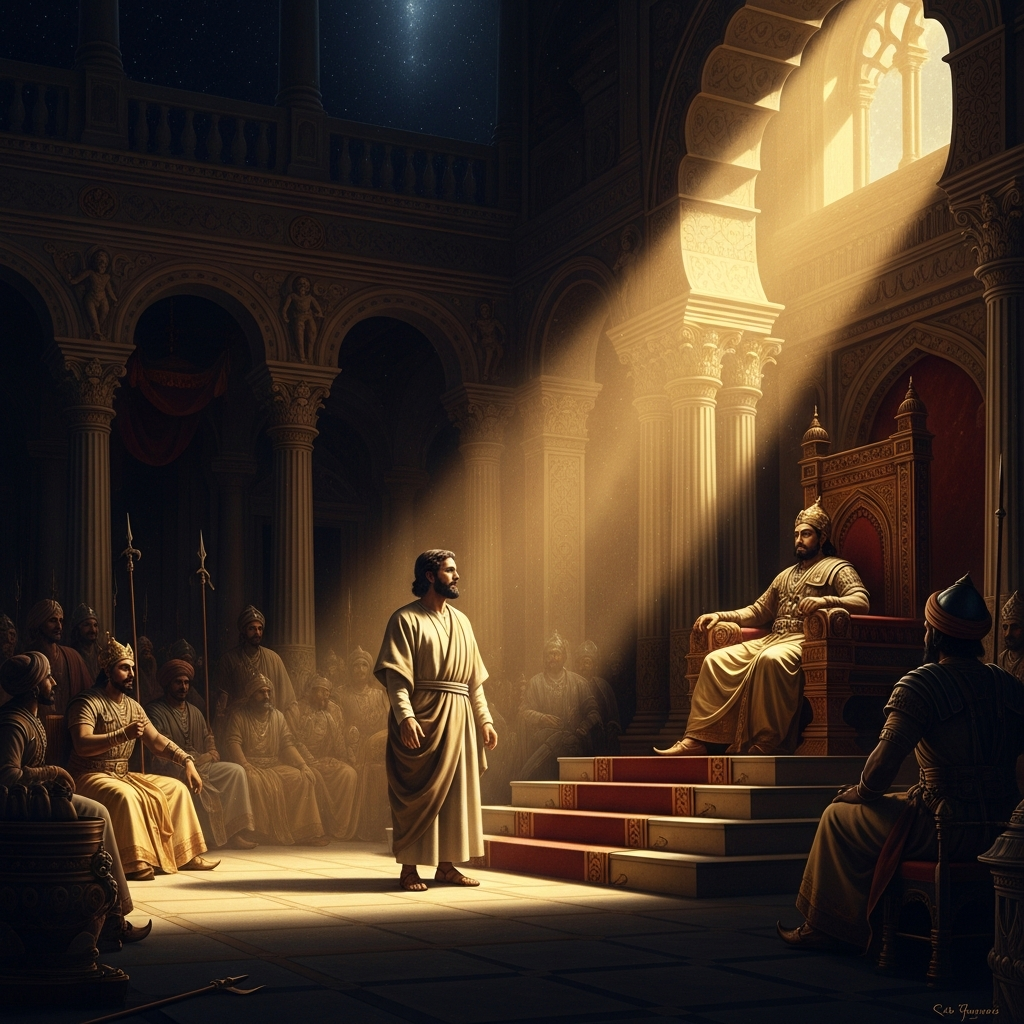
Valentinus kneeling in a lamp-lit Alexandrian study, a radiant infant hovering before him suspended in golden light — the Logos as newborn Word, thirty luminous forms unfolding behind it into darkness like concentric rings of fire
 Generating art…
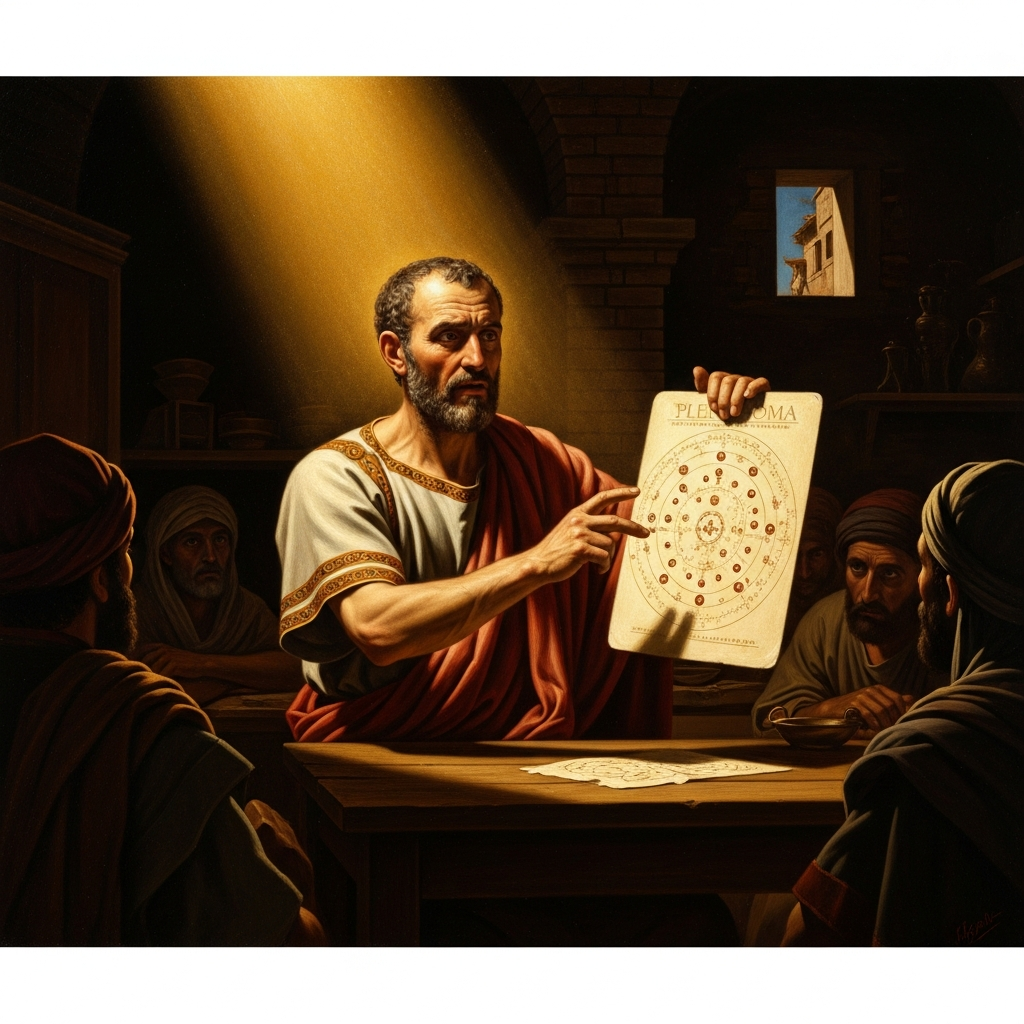
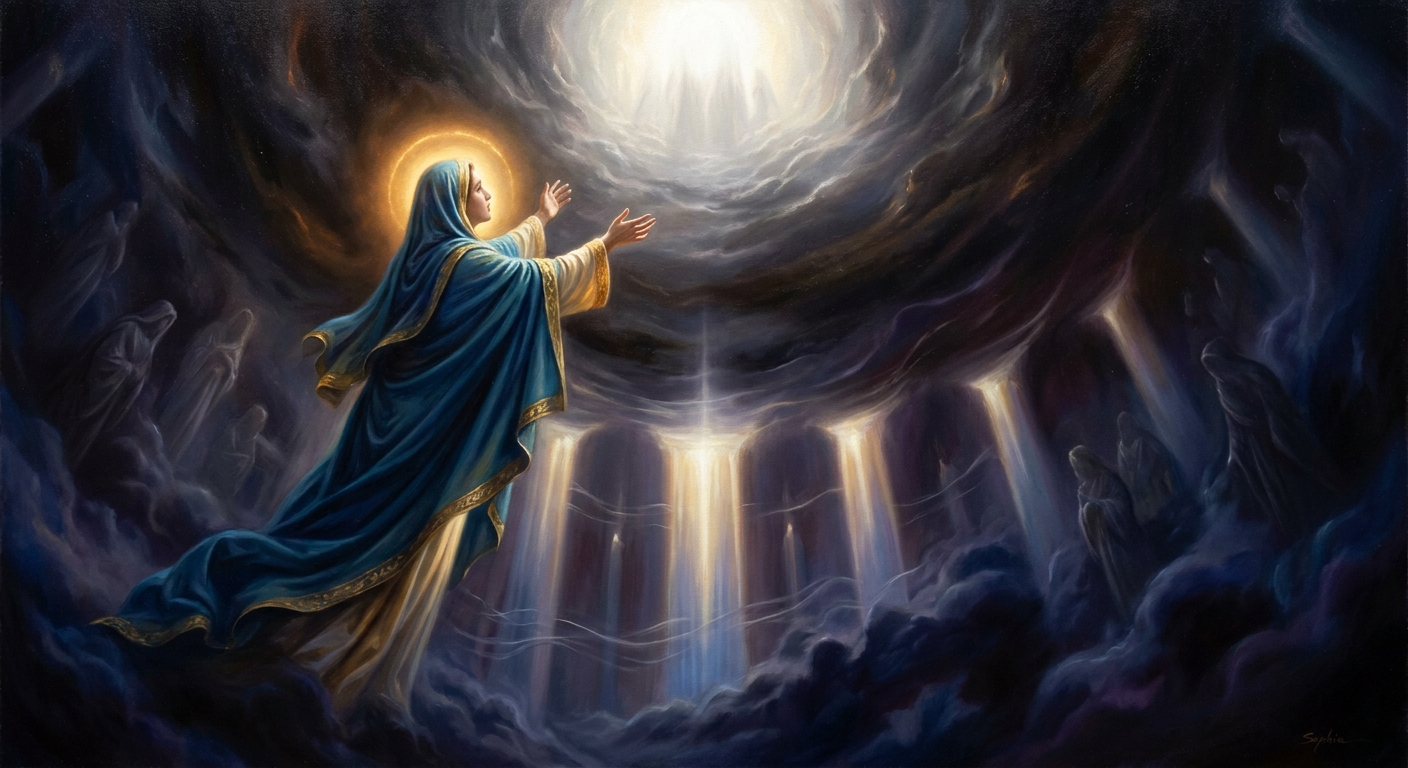
 A vast diagram of the Pleroma spread across the heavens: thirty Aeons arranged in matched pairs, the Monad at the summit blazing white, and at the bottom edge a single luminous figure — Sophia — reaching beyond the boundary alone into the void
 Generating art…
 Valentinus seated at a wooden writing table in Alexandria, dawn light through a narrow window, pen moving across papyrus while students gather at the doorway to listen — the cosmology being inscribed for the first time
 Generating art…
 Echoes Across Traditions
Entities
- Valentinus
- the Logos
- Sophia
- the Pleroma
- the Demiurge

Sources
- Irenaeus of Lyon, *Adversus Haereses* I.1-7 (c. 180 CE) — the Valentinian system preserved by its most detailed opponent
- Elaine Pagels, *The Gnostic Paul* (Fortress Press, 1975)
- Christoph Markschies, *Valentinus Gnosticus?* (Mohr Siebeck, 1992)
- Marvin Meyer (ed.), *The Nag Hammadi Scriptures* (HarperOne, 2007)
- Einar Thomassen, *The Spiritual Seed: The Church of the Valentinians* (Brill, 2006)