Simeon bar Yochai in the Cave
Roman Palestine · c. 135–148 CE — the cave years, in the immediate aftermath of the Bar Kokhba revolt and the Hadrianic persecution of Torah study · A cave near Peki'in (Piqi'in) in the Upper Galilee — limestone hills, olive groves, the spring still running there today, with the carob tree in the courtyard above the cave that pilgrims still photograph
Contents
Sentenced to death for speaking against Rome, Rabbi Simeon bar Yochai and his son flee to a cave in the Galilean hills, bury themselves in sand for twelve years, and emerge so spiritually charged that whatever they look at bursts into flame — until a heavenly voice sends them back for one more year, to learn how to live in the world without burning it.
- When
- Roman Palestine · c. 135–148 CE — the cave years, in the immediate aftermath of the Bar Kokhba revolt and the Hadrianic persecution of Torah study
- Where
- A cave near Peki'in (Piqi'in) in the Upper Galilee — limestone hills, olive groves, the spring still running there today, with the carob tree in the courtyard above the cave that pilgrims still photograph
The denunciation comes from a colleague.
This is the way these things travel in occupied Judea in the 130s. Three rabbis sit together — Rabbi Judah bar Ilai, Rabbi Yose ben Chalafta, Rabbi Simeon bar Yochai — and the conversation turns to the Romans. How fine are the works of this nation, says Judah. They have built marketplaces, they have built bridges, they have built bath-houses. Yose says nothing.
Simeon says: Everything they have built, they built for themselves. The marketplaces — for the prostitutes that work in them. The bridges — to collect the tolls. The bath-houses — for their own pleasure.
The remark gets out. The Talmud is precise about how — Judah ben Gerim, a third party who happened to overhear, tells his father, and his father tells someone, and within a few days it has reached the Roman governor of the province. The administrative response is immediate and graded. Judah, who praised, is promoted to a position of honor. Yose, who said nothing, is exiled to Sepphoris — a punishment, but a soft one. Simeon, who told the truth, is sentenced to death.
He has perhaps an hour before the soldiers come.
He takes his son Eleazar — a young man, perhaps twenty, already a serious student. They leave the village together. They walk into the Galilean hills and they look for somewhere to disappear.
They find a cave in the limestone country outside the village of Peki’in.
The cave is small. Limestone is cool in summer and damp in winter; this one is both. They go in. They have nothing with them — no provisions, no books, no clothes beyond what they are wearing. The Romans are presumably searching, and any movement out of the cave to find food or supplies risks being seen.
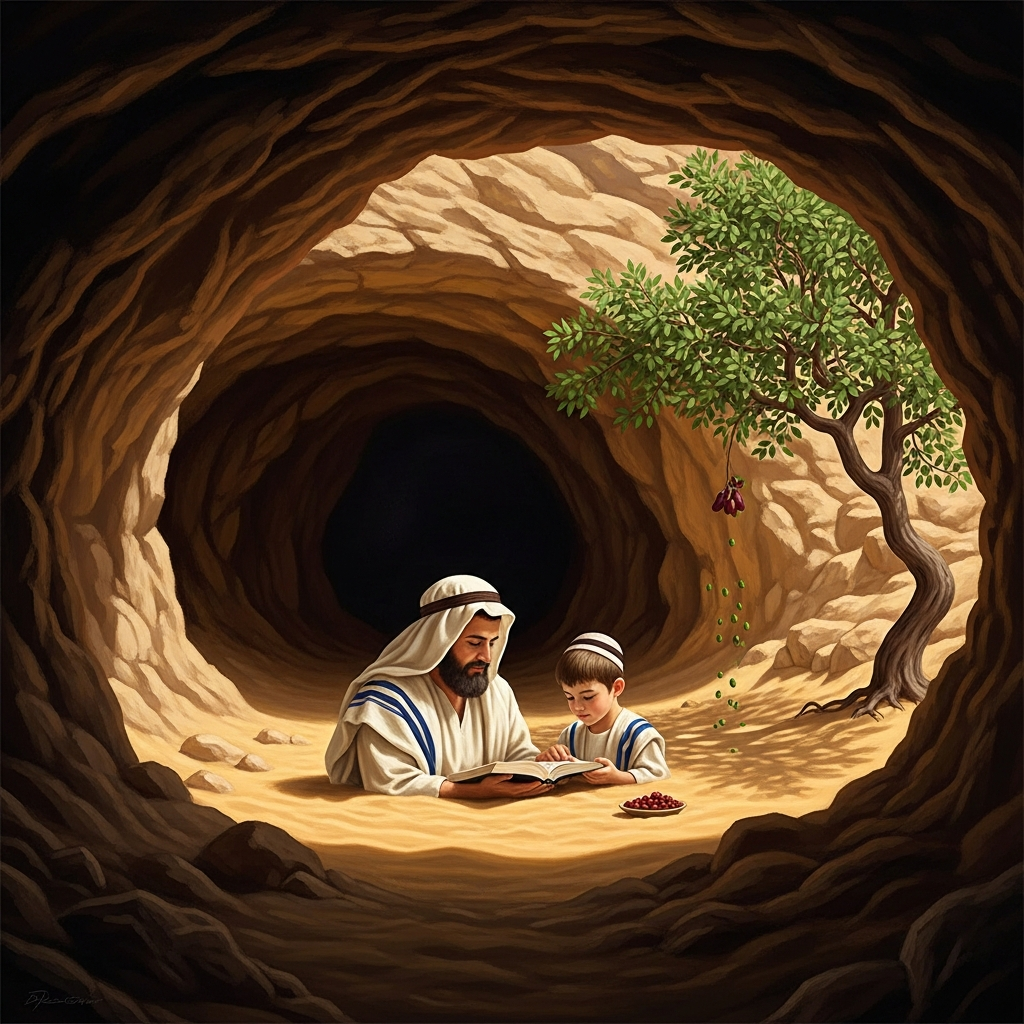
What appears, the Talmud says, is a carob tree. It grows at the mouth of the cave, fruiting. And a spring of fresh water rises in the cave floor.
Neither the carob nor the spring is recorded as a miracle in the same key as the parting of the Red Sea. The Talmud reports them as facts of the situation — the cave had a tree and a spring — and lets the reader decide whether the cave already had them and they were the reason father and son could survive there, or whether they appeared because father and son needed them. The narrative does not insist. It is content to let the reader hold both readings at once.
The clothes are the more interesting practical problem. Cloth wears out. They have one set of clothes between them, and they are going to be in the cave for a long time. Their solution — the Talmud is precise about this — is to undress entirely each morning and bury themselves in sand up to their necks. They study Torah in the sand. The sand keeps them warm. Their clothes, hung on a hook in the cave, are preserved. They emerge from the sand only for prayer at dawn and dusk, when they put their clothes on, recite the Shema and the Amidah, and then strip again and return to the sand.
Twelve years. The Talmud is precise about the number.
Twelve years of two voices in the dark. The father and the son. The Torah they have memorized between them and the carob outside and the spring underfoot and nothing else. The argument over a passage they have discussed ten thousand times, opening on the ten-thousandth time something neither of them had seen before. The slow grinding of the mind on the same texts, year after year, with no library, no academy, no community to interrupt or correct or distract.
Whatever they came in with becomes something else in twelve years.
On the day the Roman emperor dies — it is not clear whether the emperor is Hadrian or Antoninus Pius, the Talmud’s chronology is loose — a bath-qol, a heavenly voice, speaks at the cave mouth.
Go out.
They emerge.
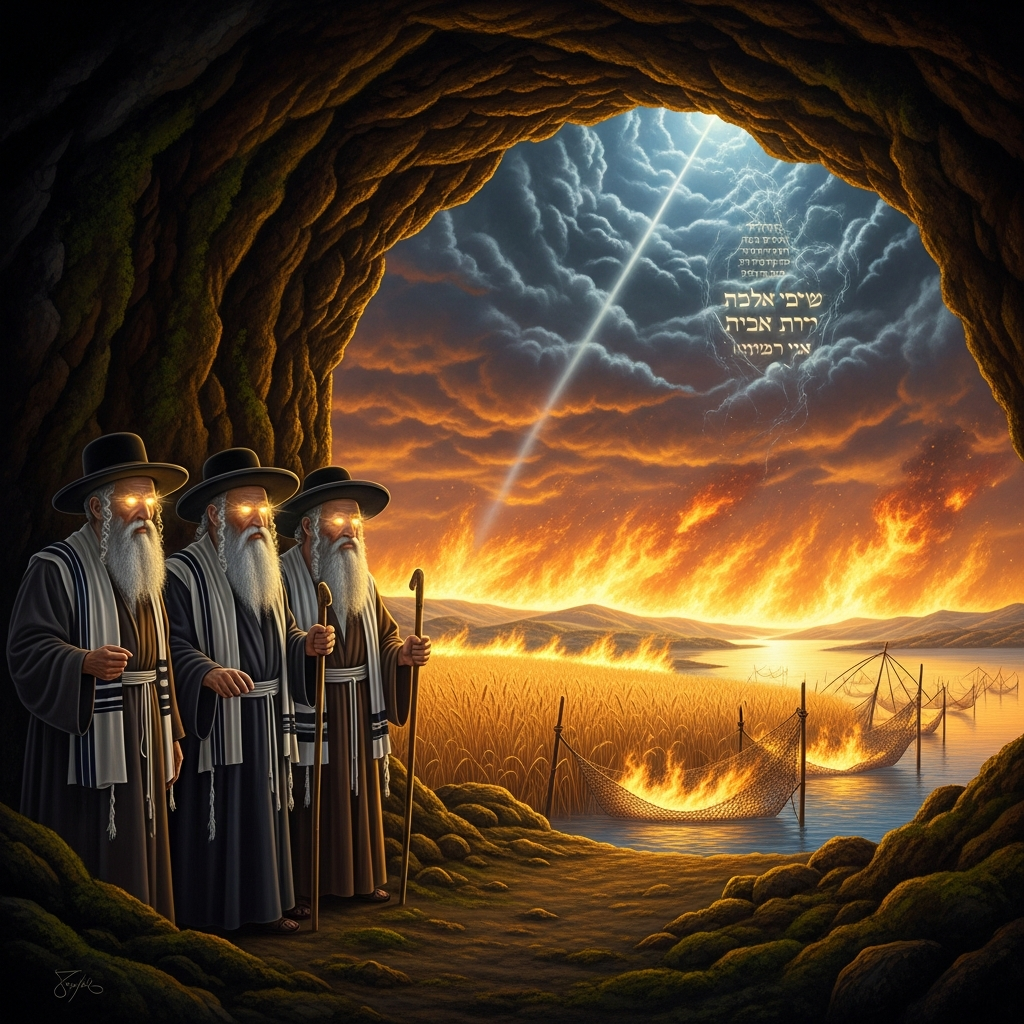
The first thing they see is a man plowing a field. They look at him. The Talmud’s verb is hibitu — they gazed. Whatever has accumulated in twelve years of buried-to-the-neck Torah study comes out of the gaze. The field catches fire. The crops are scorched. The plowman is presumably terrified.
The second thing they see is a fisherman drawing in his nets. The nets turn to ash.
Simeon understands before Eleazar does. We cannot be in this world, he says. The world cannot survive our gaze. He says this not with pride but with a kind of practical recognition. The forge is too hot for this kind of iron. The vessel cannot hold what they are carrying. They have spent twelve years accumulating spiritual force in absolute concentration, and the force is now incompatible with the daily life it was supposed to serve.
A second bath-qol speaks. Have you come out to destroy My world? Return to your cave.
They go back.
The second year is the harder year.
The first twelve years had a project. The first twelve years were study, were survival, were the work of two minds turning the same texts over together for so long that the texts began to glow. The second year is something else. The second year is learning to descend. Learning to come back. Learning to look at a plowman without scorching the field. The Talmud does not say what they did differently in the second year. It says only that, when they emerged the second time, they could.
Eleazar, the Talmud notes, was destabilized in this period. The son had embraced the cave’s intensity in a way the father had been able to modulate. When they emerged the first time, Eleazar’s gaze burned. When they re-emerged the second time, Eleazar’s gaze still tended to burn, and the father’s tended to repair. Whatever Eleazar’s eyes wounded, his father’s eyes healed. They were necessary to each other in this second year in a way they had not been in the first twelve. The son had to learn from the father how to come back.
What the cave teaches, in twelve years, is one thing. What the exit from the cave teaches, in one year, is the other thing — the harder one. This is the Talmud’s central insight, encoded in the asymmetry of the years.
When they emerge the second time, it is a Friday afternoon in the Galilee.
The light is long, the way Galilean light is long in late afternoon — slanting, gold, lengthening every shadow on the limestone hills. They walk down out of the cave country toward Tiberias. They are quiet. They are watching themselves, the way two men coming out of an intensive retreat watch themselves, to see whether the world will burn this time or not.
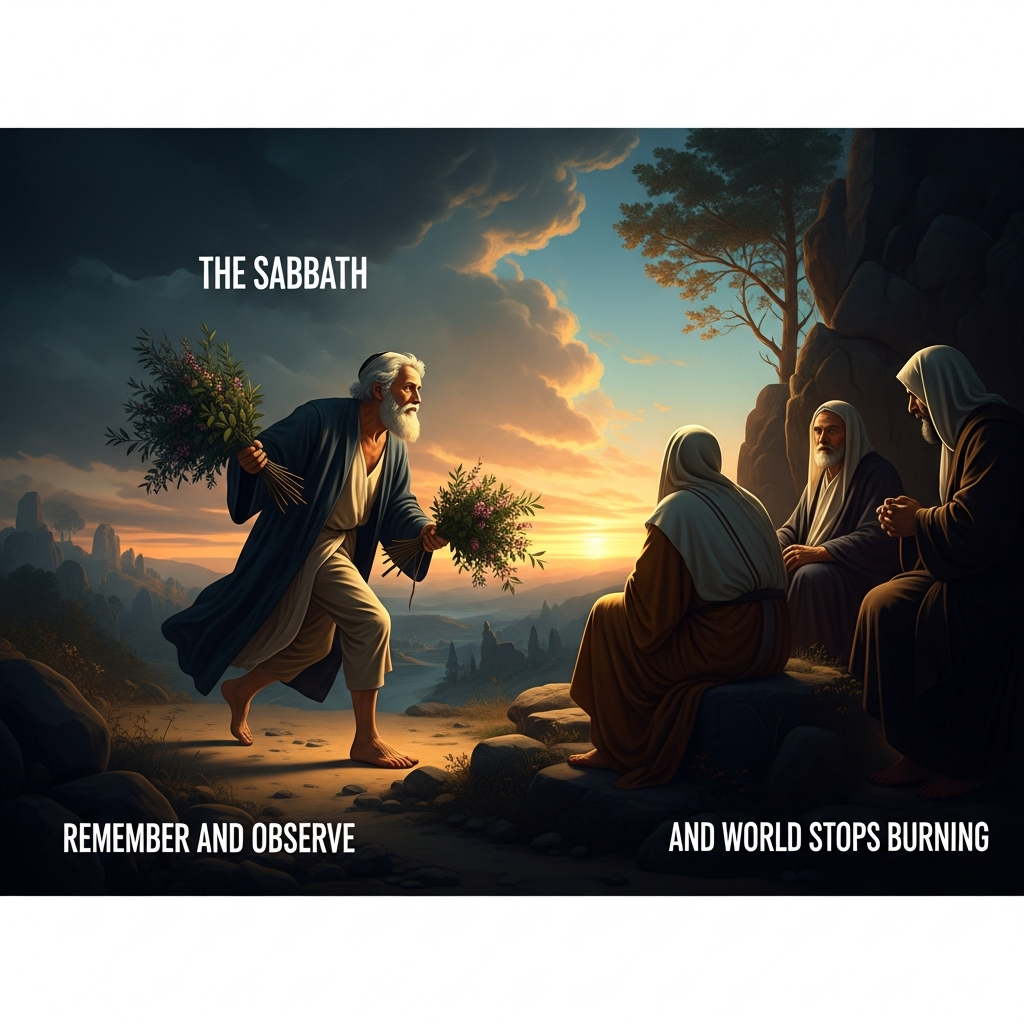
They see an old man running.
He is running with two bundles of myrtle in his hands, as fast as a man his age can run, in the direction of his village. They call out to him: Why are you running, old father?
The old man calls back: In honor of the Sabbath. The sun is setting and I want to bring these home.
One bundle would be enough, they say.
One is for Remember and one is for Observe, the old man says — naming the two versions of the Sabbath commandment, one in Exodus 20 (Remember the Sabbath day) and one in Deuteronomy 5 (Observe the Sabbath day) — and the rabbis taught that the two were uttered by God in a single utterance. So I bring both.
The Talmud records what Simeon said next — to Eleazar, quietly, watching the old man recede toward his village in the gold light: See how cherished the commandments are by Israel.
Their minds eased. The world was a plowman and a fisherman and an old man running with myrtle, and the old man running with myrtle was sufficient. The world had not abandoned the mitzvot in their twelve-year absence. The world was still pursuing them, ordinary fathers running on Friday afternoons. The fire receded.
They walked toward Tiberias in the long Galilean light, and nothing burned.
What Simeon carries out of the cave is not a book.
He carries a method. He carries a way of reading the Torah as if every letter conceals a living structure, as if the surface of the text is a skin over something breathing. He teaches this to a circle of disciples — the Talmud and the Zohar both call them the Companions, the Idra, the threshing house — who gather around him in the years following the cave to receive what twelve years of buried study had clarified.
He does not write it down. The Tannaitic period does not yet write things down; the rabbinic tradition is still oral, and will not be redacted until Rabbi Judah ha-Nasi compiles the Mishnah seventy years later. What Simeon transmits is transmitted in conversation, in walking discussions, in the Galilean roads under the Galilean sun.
The Zohar — the great mystical text that surfaces in late thirteenth-century Castile in the hands of Moses de León — presents itself as the record of these post-cave conversations. It assembles them as long discourses among Simeon and Eleazar and the Companions, walking from village to village in the Galilee, reading the Torah, the conversation spiraling into depths the plain text had concealed. The historical scholarship has demonstrated that the Zohar, as a written work, is medieval. The legend the Zohar tells about itself is that the cave is the source: that Simeon is the human channel through whom what was learned in the dark, in the sand, with the carob outside and the spring underfoot, has finally been written down.
Both things are true at the same time. Moses de León composed the Zohar. The cave produced what made the composition possible. The cave is where the heat that warms the Zohar was generated.
Simeon dies on Lag ba-Omer, the thirty-third day of the counting of the Omer between Passover and Shavuot.
The day becomes, centuries later, a festival of bonfires lit on hilltops across the Land of Israel and across the Jewish diaspora. On the night of Lag ba-Omer, in modern Israel, hundreds of thousands of pilgrims gather at Mount Meron, where Simeon is buried, to light a bonfire on the roof of his tomb and dance through the night. The bonfires burn in honor of the fire that was his signature — the fire of the cave’s accumulated charge, the fire that scorched the plowman’s field, the fire that the world eventually had to learn to contain.
The cave at Peki’in is still shown to pilgrims. The carob tree above it is still there, or the descendant of it, or the tree the locals will tell you is the descendant. The spring is still running. The stones are limestone and cool to the touch even in summer.
What is preserved is not, mostly, the doctrine. The doctrine has been written down many times, in many systems, by Maimonides on one path and by the Kabbalists on another, by the Lurianic kabbalists in Safed and by the Hasidim in Podolia and by the modern academics in Jerusalem. The doctrine has its long history, and the doctrine is contested.
What is preserved is the architecture. Twelve years in the dark, then one more year learning to come back. The retreat is the easier work. The descent is the harder work. The saint who has been too far must learn to bear ordinary life without scorching it, and the learning takes a year, and the year is what the bonfires do not celebrate, and the year is the secret interior of every mystical tradition that takes itself seriously: the descent is harder than the ascent. The plowman has to be allowed to plow. The old man has to be allowed to run with his myrtle. The world has to be permitted to be the world.
He went into the cave because the empire wanted him dead. He came out twelve years later carrying more than the cave was supposed to give. He had to be sent back for a year because the world could not survive the first version of him. He came out the second time and saw an old man running for the Sabbath and his mind eased. The bonfires on Lag ba-Omer commemorate the first emergence — the fire — and they should also commemorate the second, the year of learning restraint, the slow downward path back to a world where plowmen plow and fishermen fish and what the saint sees no longer burns. That is the part the tradition does not always remember to celebrate. It is the part Simeon’s son had to be taught.
Scenes
Buried to their necks in sand in the cool dark of the Peki'in cave, father and son study Torah in the dark — the carob tree dropping its fruit at the mouth of the cave at the moment they need to eat
Generating art… At first emergence after twelve years, whatever the rabbis' eyes fall upon catches fire — the plowman's field, the fisherman's nets — and the heavenly voice sends them back into the cave for another year
 Generating art…
 On the second emergence, an old man runs toward Sabbath at dusk with two myrtle bundles in his hand — *one for Remember, one for Observe* — and the rabbis see that the world has not abandoned reverence, and the world stops burning
 Generating art…
 Echoes Across Traditions
Entities
- Simeon bar Yochai (Rashbi)
- Eleazar bar Simeon (his son)
- Rabbi Judah bar Ilai
- Rabbi Yose ben Chalafta
- Elijah the Prophet
Sources
- Babylonian Talmud, *Shabbat* 33b — the primary narrative of the cave, both emergences, and the carob and spring
- Jerusalem Talmud, *Shevi'it* 9:1 — the parallel account, with significant variants
- Genesis Rabbah 79:6 — the Galilean midrashic version
- Gershom Scholem, *Jewish Gnosticism, Merkabah Mysticism, and Talmudic Tradition* (JTS, 1960)
- Moshe Halbertal, *Concealment and Revelation: Esotericism in Jewish Thought and Its Philosophical Implications* (Princeton, 2007)
- Yehuda Liebes, *Studies in the Zohar* (SUNY, 1993)