Rabbi Akiva and the Shema
Roman Palestine · c. 135 CE, in the suppression following the Bar Kokhba revolt under the emperor Hadrian · Caesarea Maritima — the Roman provincial capital on the Mediterranean coast, with its harbor of imported stone, its hippodrome, and its public square set aside for executions
Contents
On an iron comb in the Roman provincial capital, an old rabbi prolongs the word *One* until his soul leaves his mouth — turning his execution into the precise fulfillment of the verse he had spent fifty years trying to understand.
- When
- Roman Palestine · c. 135 CE, in the suppression following the Bar Kokhba revolt under the emperor Hadrian
- Where
- Caesarea Maritima — the Roman provincial capital on the Mediterranean coast, with its harbor of imported stone, its hippodrome, and its public square set aside for executions
He is eighty-five years old when they take him.
The procurator’s soldiers come for him at the academy at Bnei Brak — or the cell where he has been hiding, the sources do not agree — and they bring him north to Caesarea Maritima, the Roman provincial capital on the coast. The harbor is full of imported stone. The hippodrome is full of imported horses. The public square is full of the apparatus the Romans use for the kind of execution that is meant to be watched.
Tineius Rufus is the procurator. He is the man Hadrian has placed over Judea after the Bar Kokhba revolt has been crushed and the province has been renamed Syria Palaestina, an erasure encoded in cartography. Rufus has issued the decrees: no Torah study, no circumcision, no Sabbath. He has issued the decree under which Akiva is now condemned. The charge is that Akiva continued to teach.
He continued to teach.
That is the entire substance of the offense. The empire forbade it. He continued to teach. He gathered students in the marketplace. He gathered students in private houses. When the marketplace was watched and the houses were searched, he gathered them in fields and on rooftops. The students would come to him with the question of how to study Torah when Torah study had been forbidden, and Akiva would answer them with a parable about a fox and the fish, and the students would write the parable down, and the parable would be transmitted, and the transmission was itself the offense.
The question is what kind of execution.
The Romans have a vocabulary of execution. Crucifixion is one option, the standard option for political offenses, but the Bar Kokhba aftermath has saturated the trees of Judea with crucified Jews already — the testimony in the Talmud and in Cassius Dio is that the supply of wood ran out — and Rufus wants something more pedagogical for Akiva. Akiva is not a soldier. Akiva is the mind that built the legitimacy under which the soldiers fought. The execution should make a point about minds.
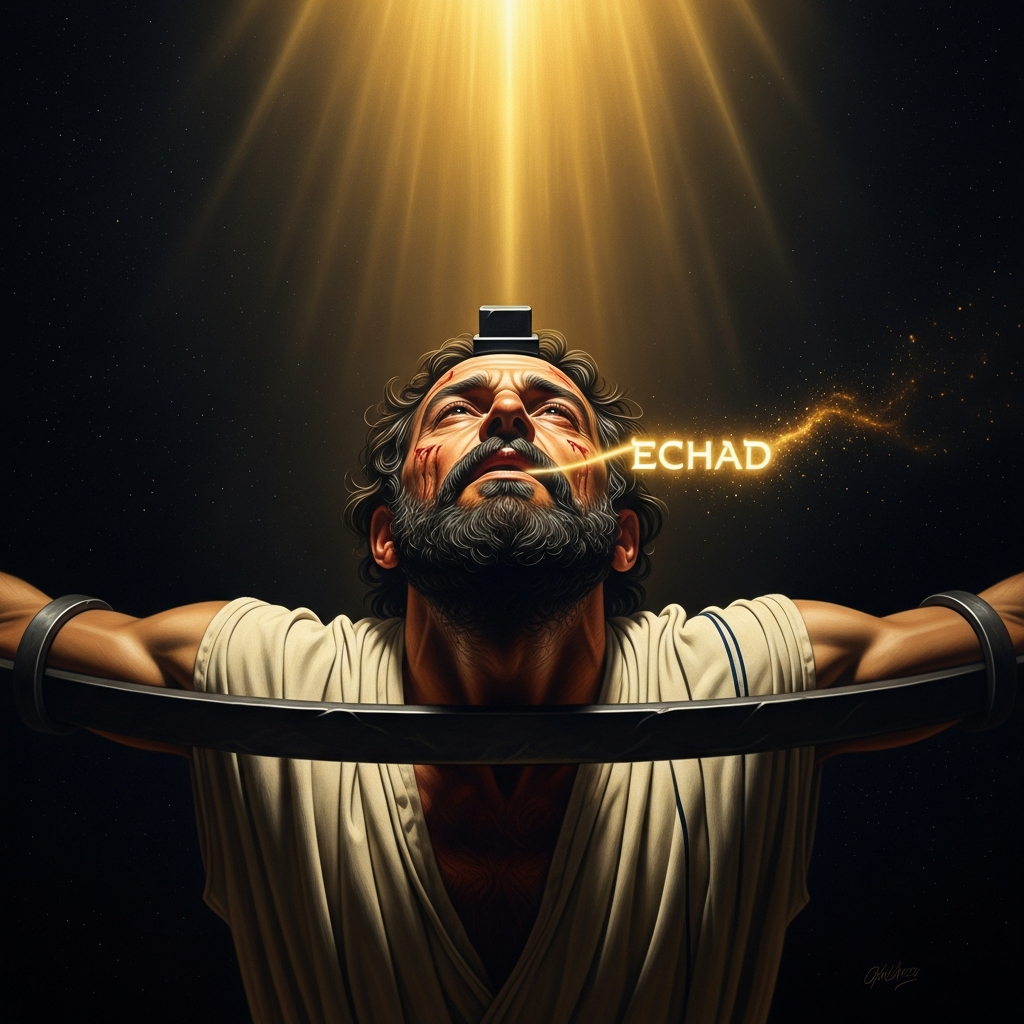
Rufus chooses the strigil — the iron comb that the Roman bath-houses use to scrape the skin, in a different application of the same instrument. They strip Akiva and bind him on a frame and they begin to comb the flesh from his bones. It is the slow form. It is meant to take hours.
The students are not permitted in the square, but the students hear. The students always hear. The Talmud preserves the dialogue.
He begins the Shema.
Shema Yisrael, Adonai Eloheinu, Adonai Echad.
Hear, O Israel: the Lord is our God, the Lord is One.
He has said this verse twice a day for seventy-five years — in the morning, in the evening, with the strict attention to the wording that the rabbinic tradition encodes as the fence around the verse. He has taught it to his students. He has explicated each clause. He has written the commentary on the commentary. He says it now in a voice that the soldiers do not interrupt — they are professionals, they have seen many men say many things on the strigil, and a Jewish prayer recited in a foreign language is one of the things they have heard before.
The students hear it through the wall.
One of them — the Talmud does not name him, the Talmud says simply his students — calls out: Rabbi, even now? Even to here?
And Akiva, on the comb, answers them. The answer is preserved in Berakhot 61b verbatim, because the students recorded it the moment they could write again, and they recorded it the way one records a deathbed teaching that is also a legal opinion that is also the resolution of a problem that has occupied the rabbi’s entire career.
All my life, he says — and you can hear the breath under the words, you can hear the iron working at his side — I have been troubled by this verse: And you shall love the Lord your God with all your heart, with all your soul, with all your might. I asked: when will I have the chance to fulfill it? With all your soul — even if He takes your soul. And now I have the chance.
He goes back to the verse.
Shema Yisrael.
He prolongs the word Echad.
One.
He holds the syllable. The students will say later that he held it longer than seemed possible for a man on an iron comb. He held it past what his lungs should have allowed. He held it the way a cantor holds the high note in the Kol Nidre, the way a man holds the last word of a sentence he has been rehearsing his whole life.
He dies on the syllable.
The soul leaves on the D.
A heavenly voice — a Bath-Qol, daughter of a voice, the residual prophecy that the rabbis say replaced direct prophecy after the prophets ceased — speaks in the square.
Happy are you, Akiva, that your soul departed with the word One.
The students hear that, too. Or the students compose it. The line between hearing and composing, in this tradition, is not the line a modern historian wants it to be.
He is eighty-five and he has had a strange life.
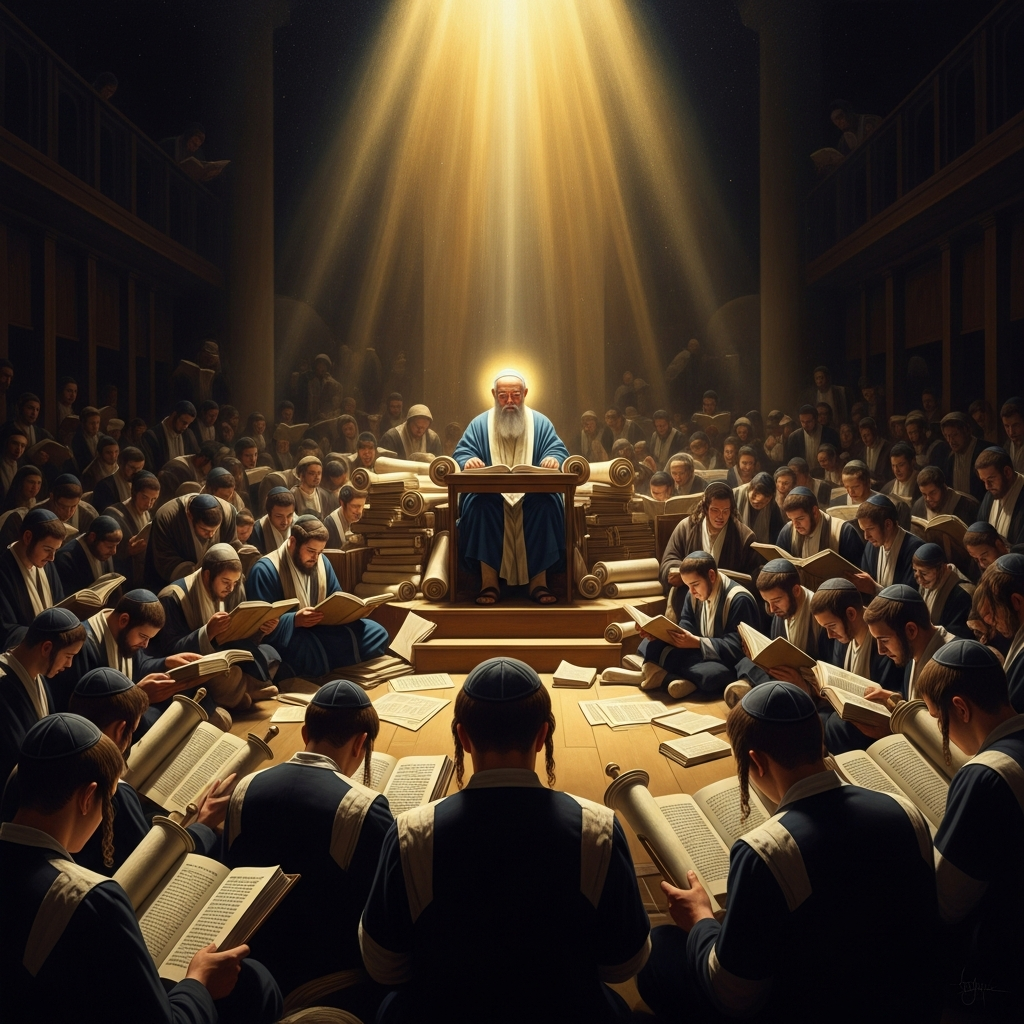
He started as a shepherd, illiterate at forty, married to a woman named Rachel who saw something in him no one else had seen. The story the Talmud tells — Akiva at the well, watching the rope wear a groove in the stone — is that he understood at forty that water can carve rock if it falls long enough, and that if water can carve rock, the words of Torah can carve a mind, and so he sat down with a child and learned the alphabet. He sat with the child for years. He would not be ashamed. He would not pretend to know what he did not know. He was the oldest student in the school in Lod, and then in the academy in Yavneh, and then he was the master, and then the master had twenty-four thousand students of his own.
The plague — or the war, the sources blur — killed twelve thousand pairs of them in a single Omer count, the period between Passover and Shavuot. The Talmud says they died because they did not show one another sufficient honor. The Talmud is teaching a moral lesson about the academy, but the body count is real. Akiva starts again with five remaining students. The rabbinic Judaism that survives is the rabbinic Judaism those five students transmit. The chain runs through them: through Rabbi Meir to Rabbi Judah ha-Nasi to the Mishnah, the legal compilation that becomes the foundation of every subsequent Jewish life.
He had endorsed Bar Kokhba.
This is the part that is harder to forgive, and the part the tradition has never quite known what to do with. When Simon bar Kosiba — the Galilean rebel commander whose forces took Jerusalem briefly in 132 — declared his messianic intentions, Akiva looked at him and said: This is the King-Messiah. He renamed him Bar Kokhba, Son of the Star, after the verse in Numbers — a star shall rise out of Jacob — which the rabbinic tradition had read for centuries as a messianic prophecy.
It was the wrong call. The revolt collapsed in 135. The Romans killed perhaps half a million Jews — Cassius Dio’s number, possibly inflated, certainly catastrophic. Jerusalem was depopulated and rebuilt as the colony Aelia Capitolina with a temple to Jupiter on the Temple Mount. The Jews were forbidden to enter the city on pain of death. Hadrian’s reorganization of the eastern empire was thorough.
And Akiva had said: This is the King-Messiah.
The Talmud preserves the dissent. Rabbi Yochanan ben Torta, his contemporary, told him to his face: Akiva, grass will grow in your cheekbones and the Son of David will still not have come. The line is famous because it is correct. The Talmud preserves it because the Talmud knows that even Akiva can be wrong about the largest possible question, and the tradition is the kind of tradition that records the wrongness of its great men.
But the same Akiva taught: Love your neighbor as yourself — this is the greatest principle of the Torah. It is the same man. It is the same career. The endorsement of the failed Messiah and the elevation of the love commandment are products of the same theological imagination, an imagination that wanted very badly for the redemption to be at hand and for the redemption to be available through the ethical life right now, in the marketplace, between any two people. Both impulses can be defended. Both impulses can be questioned. The tradition, two thousand years on, has not finished arguing about either.
What Akiva does on the comb settles one of the arguments.
He turns the execution into the verse. He makes the moment of dying the moment of fulfilling with all your soul, even if He takes your soul. He demonstrates, with his actual body, that the verse he has been teaching is a verse that can be performed all the way through, that the performance does not require a temple or a priesthood or a homeland, that the performance requires only a Jew and a moment of crisis and the breath to say Echad slowly enough.
This is the rabbinic Judaism that walks out of the second century: a Judaism that can be performed anywhere. A Judaism portable across exile. A Judaism whose central act of worship is the Shema recited twice a day, and whose central act of martyrdom is the Shema recited once and prolonged on the syllable One. He has packaged the religion for the diaspora that is about to begin and that is going to last very long.
The bonfires the Jewish communities will light for the rest of history — for the martyrs of Mainz in 1096, for the Marranos burned in Lisbon, for the Vilna and Warsaw and Lodz and Białystok of the twentieth century — are all, in some sense, lit from the syllable Akiva held on the iron comb in Caesarea.
His students collect his body. The Talmud says Elijah the prophet helped them — appeared, took up the body, carried it to the cave of burial. The Talmud says many things involving Elijah; the Elijah-helping-bury-the-righteous trope is a fixed feature of the genre. What is not a trope is that the body was buried, and the burial place was remembered, and pilgrims still go.
His grave at Tiberias — the traditional location, on the hillside above the lake — is one of the pilgrimage sites of religious Israel. On Lag ba-Omer, the thirty-third day of the Omer, when the plague that killed his twelve thousand pairs of students is said to have ended, candles burn there.
Two stones from his execution survive in the rabbinic memory: the strigil, and the syllable. The first is a Roman instrument and is not preserved. The second is preserved every time a Jew, anywhere in the world, says the Shema.
He had argued his whole life for the proposition that the most important verse in the Torah is the verse that commands love. He had endorsed a Messiah and gotten the country destroyed. He had sat with five students and rebuilt a tradition that would survive the destruction. And on the comb, at the end, he gave his students a final teaching: that the verse he had spent fifty years explicating could be performed all the way through, with the body, on the syllable One — and that performing it that way was the answer to the question the verse had been asking. The students wrote it down. They are still writing it down.
Scenes
Stretched on the iron *strigil* in the Caesarea square, Akiva begins the *Shema* — and prolongs the word *Echad*, *One*, until his soul leaves him on the syllable
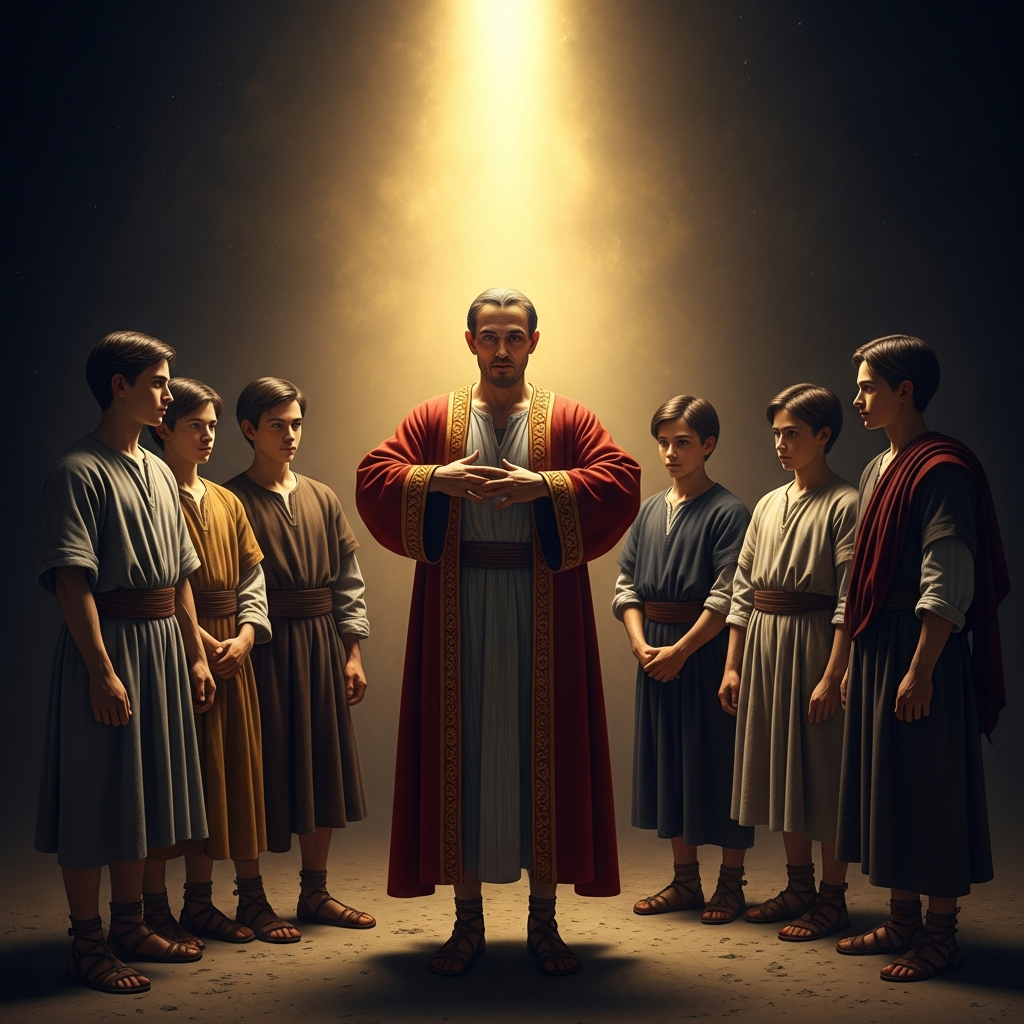
Generating art… At the height of his career, twelve thousand pairs of students fill the academies of Bnei Brak — the rabbinic Judaism that will survive the empire is being assembled in his lifetime, sentence by sentence
 Generating art…
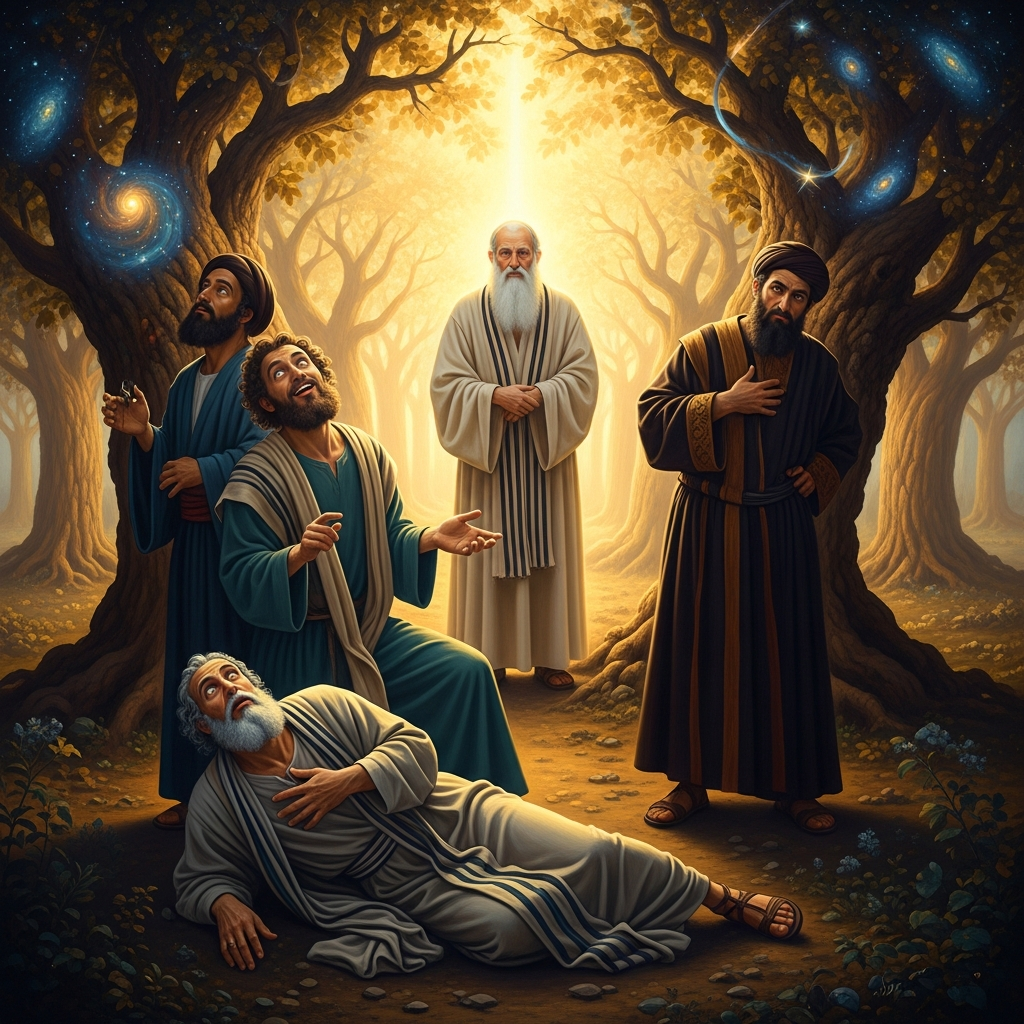
 Four sages enter the *Pardes*, the orchard of mystical speculation: one dies, one goes mad, one becomes a heretic, and only Akiva enters and leaves in peace
 Generating art…
 Echoes Across Traditions
Entities
- Rabbi Akiva ben Joseph
- Simon bar Kokhba
- The Roman procurator Tineius Rufus
- Rabbi Yishmael ben Elisha
- The Bath-Qol (heavenly voice)
Sources
- Babylonian Talmud, *Berakhot* 61b — the primary account of his death
- Palestinian Talmud, *Sotah* 5:7 and *Berakhot* 9:5
- Louis Finkelstein, *Akiba: Scholar, Saint and Martyr* (Covici-Friede, 1936)
- Yigael Yadin, *Bar-Kokhba: The Rediscovery of the Legendary Hero of the Last Jewish Revolt against Imperial Rome* (Random House, 1971)
- Jacob Neusner, *Invitation to the Talmud* (Harper & Row, 1973)
- Daniel Boyarin, *Dying for God: Martyrdom and the Making of Christianity and Judaism* (Stanford, 1999)