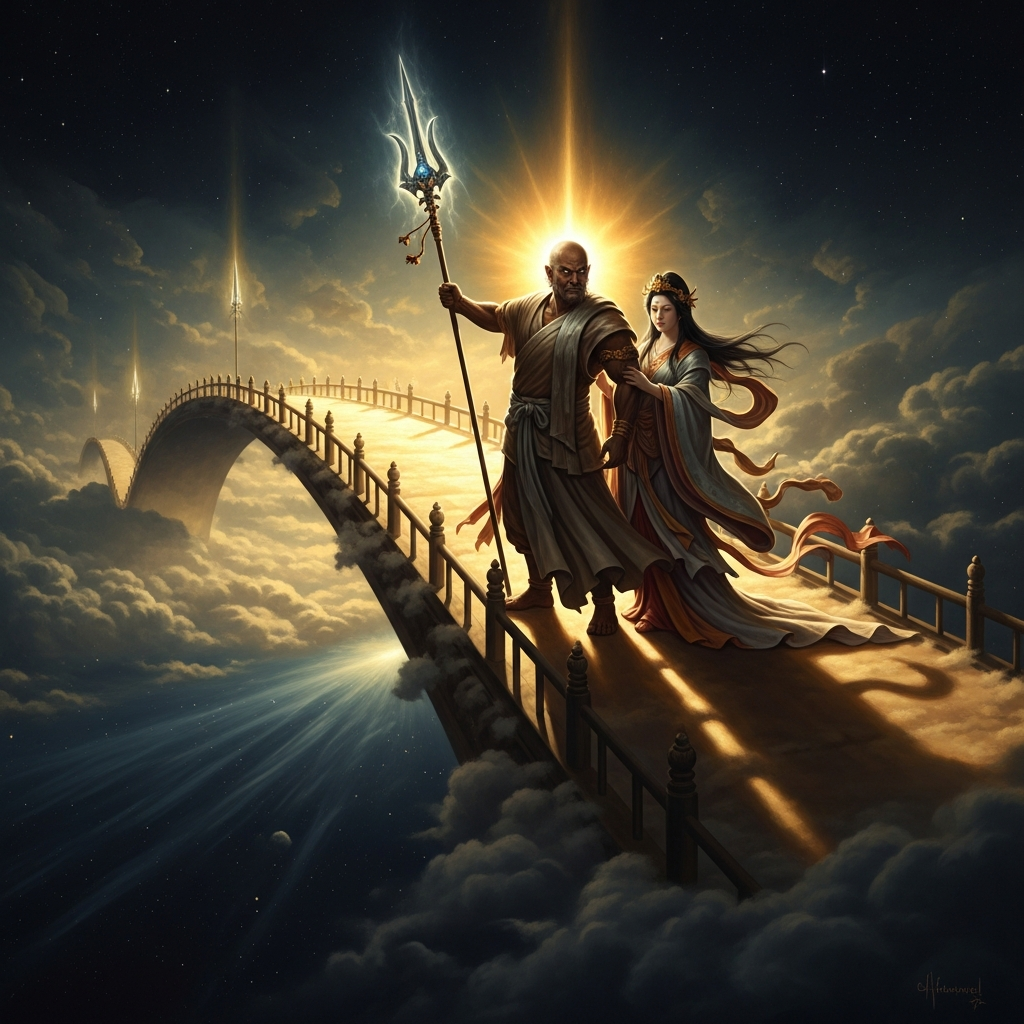
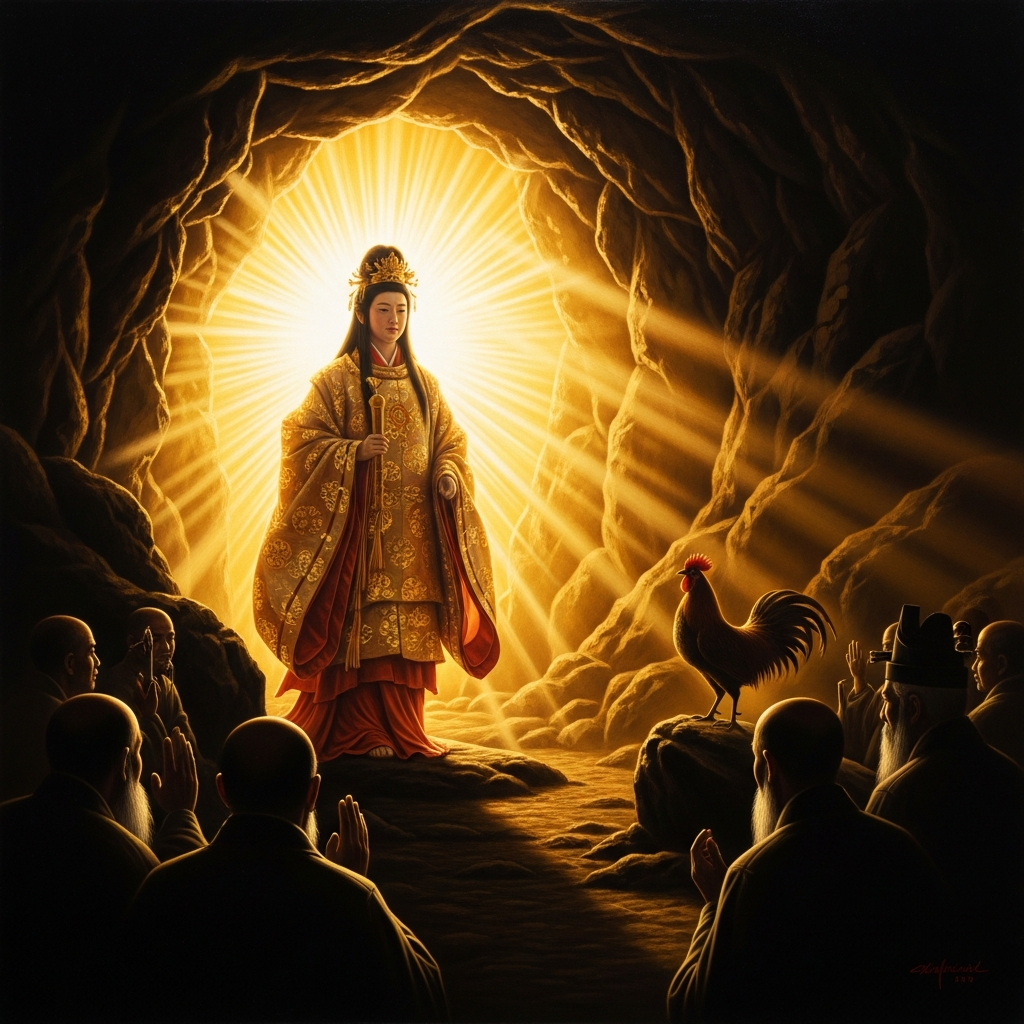
Yamato Takeru and the Grass-Cutting Sword
Legendary period, c. 1st–2nd century CE — the reign of Emperor Keiko · The Yamato court, Sagami plain, and Mount Ibuki
Contents
The imperial prince Yamato Takeru — too violent for his father to keep at court — is sent on mission after mission to die. The Kusanagi sword saves him when enemies set the grass afire. He conquers the east. Then he dies on Mount Ibuki, alone, stripped of divine protection. His soul becomes a white bird.
- When
- Legendary period, c. 1st–2nd century CE — the reign of Emperor Keiko
- Where
- The Yamato court, Sagami plain, and Mount Ibuki
His father sends him to kill his brother.
Not to arrest him, not to bring him to court — to kill him. Prince Ousu has been behaving badly at meals, dragging a senior noble from the room and tearing the man limb from limb, and the Emperor Keiko considers this unacceptable behavior. He summons his younger son — the one called Yamato Takeru, which means Valor of Yamato, though he has other names and none of them describe what he actually is — and asks him to discipline his brother.
Five days pass. Ousu does not appear at meals.
Keiko asks where Ousu is. Yamato Takeru says he caught him in the early morning and crushed him and pulled the limbs from the joints and wrapped the parts in straw matting and threw them away.
The emperor looks at his younger son for a long time.
Then he starts sending him on missions.
The missions are designed to kill him.
This is not subtext. The Kojiki is direct about it: Keiko is afraid of his son. The first mission sends Yamato Takeru to the land of the Kumaso brothers in western Japan — two powerful chieftains who have refused to submit to the Yamato court, men of great strength and considerable reputation, and the emperor’s calculation is that they will solve the problem of Yamato Takeru by killing him.
He disguises himself as a woman — the Kojiki records this without any sense that it requires explanation, the way myths record the expedient things their heroes do. He dresses in the robes of his aunt, the princess Yamato Hime, and enters the Kumaso brothers’ stronghold during a banquet. He serves the elder brother wine until the banquet reaches that stage of festivity where no one is watching the serving girls carefully. Then he takes his sword from inside his robes and drives it into the elder brother’s chest.
The younger brother runs. Yamato Takeru catches him by the collar. The younger brother says: I have heard there is a warrior in Yamato of surpassing valor. I did not know it was you. You have earned a name. He gives him the name Yamato Takeru — the valor of Yamato — and then Yamato Takeru kills him too.
He comes back. Keiko sends him east.
Before the eastern campaign, he goes to the Ise Shrine.
Yamato Hime is the priestess there — the woman who keeps the living fire for Amaterasu, who gave him her robes for the Kumaso mission. She is fond of her nephew, which is the Kojiki’s way of saying she is one of the only people who looks at him without being afraid. He tells her he is being sent east. He does not say his father is trying to kill him, but he says it in everything except words, and she hears it.
She gives him a sword. She gives him a bag to be opened only in extremity. He does not open the bag until the Sagami plain.
The sword is Kusanagi-no-Tsurugi — the Grass-Cutting Sword, which was drawn by Susanoo from the tail of the eight-headed serpent Yamata-no-Orochi, sent by Susanoo to Amaterasu, and kept at Ise since before the beginning of the Yamato court. Yamato Hime places it in his hands with the matter-of-factness of a woman giving her nephew something practical for a journey. Here, she says. Take this.
He conquers the east.
The Kojiki moves quickly through the campaigns because they go the same way: Yamato Takeru arrives, assesses the situation, and applies force in the correct direction at the correct moment, and the situation resolves. He crosses to the province of Kai, subdues the mountains and rivers of Shinano, pacifies the gods of the northern provinces. He is twenty years old, or he has the energy of someone who is twenty years old, and he is doing what he was built to do and he is good at it in the way that warriors in myth are good at things — completely, without fatigue, without the accumulation of cost that ordinary violence carries.
Then the chiefs of Sagami invite him to a plain to discuss terms.
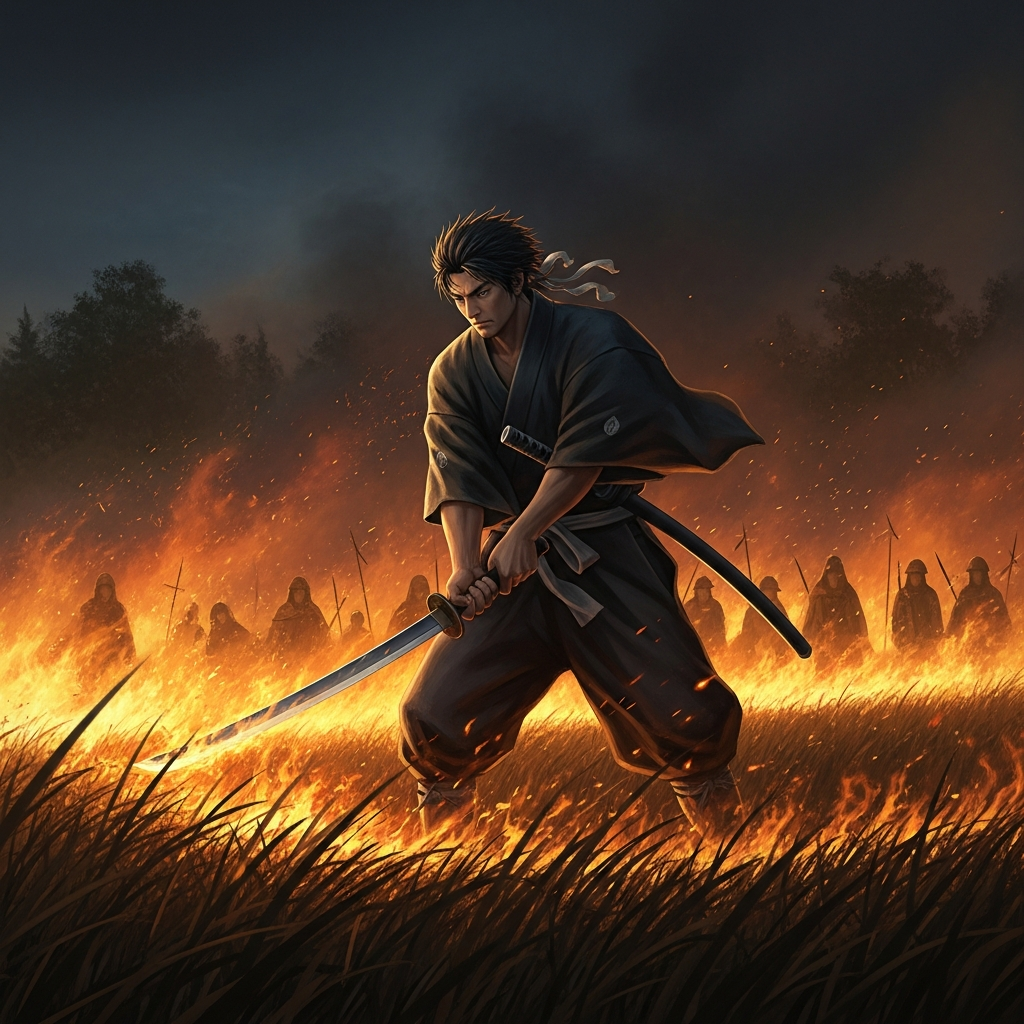
He goes. They set the grass afire.
It is not a small fire. The Sagami plain in late autumn, the dry grass reaching past a man’s waist, and the fire spreading in every direction — this is the chiefs’ calculation: he is one warrior, the fire is a circle, and the circle is closing. He opens Yamato Hime’s bag. Inside: a fire-striker.
He draws Kusanagi.
The blade swings of its own accord. This is not metaphor: the sword moves independently, cutting the grass, pushing back the fire on three sides. He uses the fire-striker to start a counter-fire on the fourth side. The fire turns back on the chiefs who set it. The Sagami plain burns, and Yamato Takeru is standing in the center of it, in the cleared ground the sword made, and everything around him is ashes.
He names the place Yaizu — the burning.*
He comes back from the east changed.
Not in the ways the Kojiki bothers to describe. But between the eastern campaign and Mount Ibuki, there is a stop at the home of Miyazu-hime, a woman he loves, and he leaves the Kusanagi with her when he sets out again. He will pick it up on the way back. He is going to climb Mount Ibuki alone — the god of Mount Ibuki has been troublesome — and he will not need a sword for a mountain god. He says this to people who might have advised him otherwise.
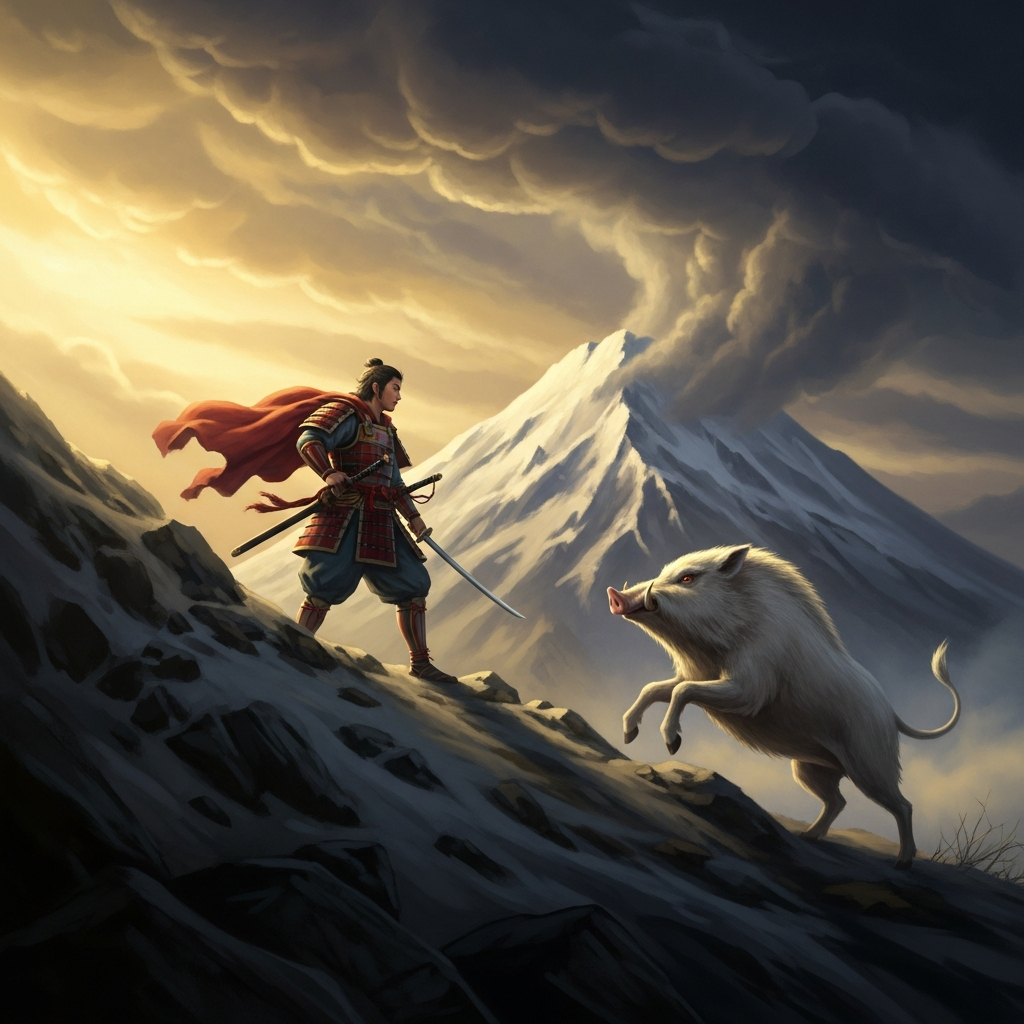
He climbs the mountain without armor. Without the sword. He encounters a white boar on the slope, large and still, and he makes the mistake that pride always makes — he says: that is a messenger of the mountain god, not the god himself; I will deal with the god on the way back down.
The white boar is the mountain god.
Cold strikes him on the descent. Not the cold of weather but the cold of divine displeasure, which in the Kojiki passes through flesh the way weather does not, which settles into the joints and behind the eyes and in the gut and does not lift. He reaches the spring at Tamagura and drinks. The spring is cold. He descends further and drinks from another spring and says: my heart is refreshed. There are springs on the route that still bear the name he gave them on this descent.
He reaches Nobo in Yamato. He composes a poem:
Yamato is the finest land — the land enclosed by blue hedges of hills. In Yamato, secluded among the mountains, how beautiful it is.
Then he lies down.
He dies at Nobo. The Kojiki says his illness is the illness from the mountain god, which is another way of saying he is dying from pride, from the decision to climb without the sword, from years of being the instrument of an empire that feared him enough to send him against every enemy it had but not enough to welcome him home.
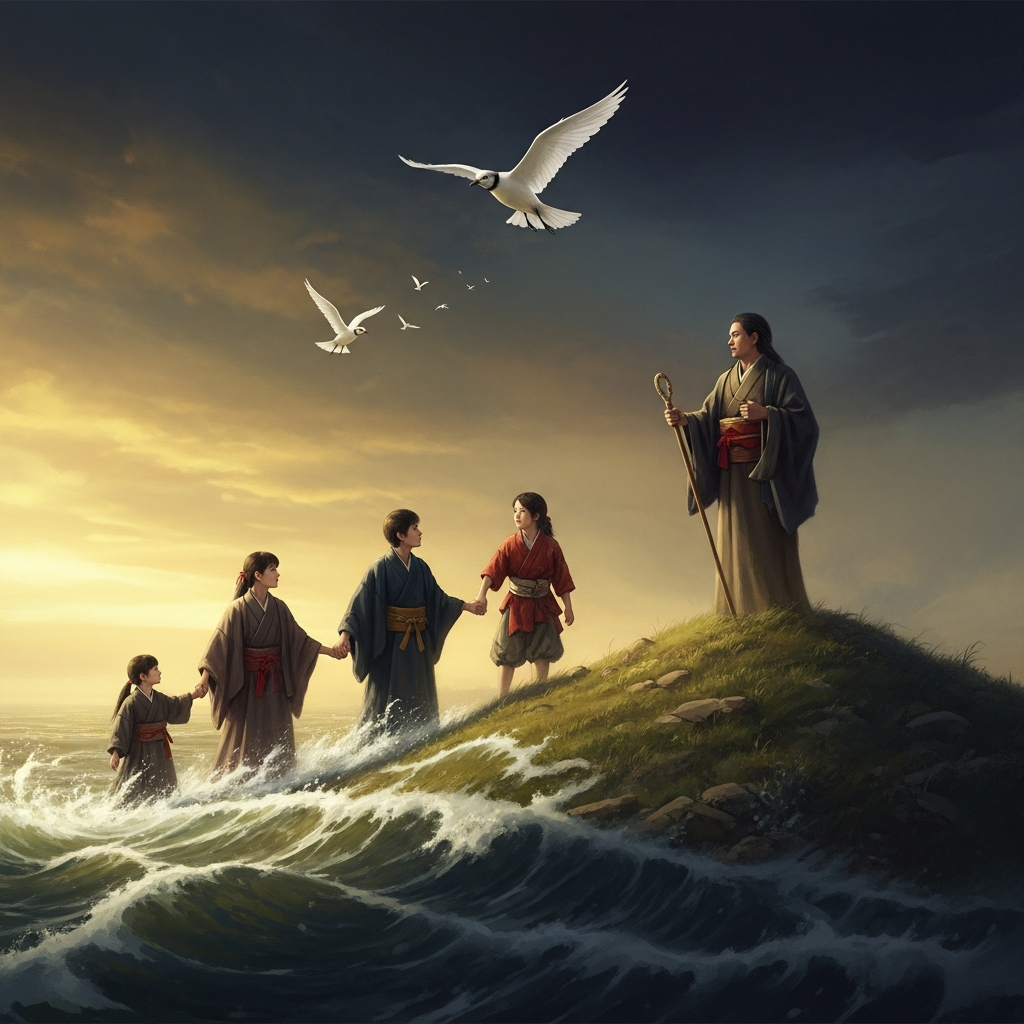
His soul becomes a white bird — a shiro-tori, a white plover — and lifts from the mounded tomb his family builds for him. His wives and children follow it, weeping, wading through fields and through the sea foam and reaching up toward the sky. The bird rises. It does not land.
The Kusanagi goes back to Ise. Eventually it goes to the Atsuta Shrine in Nagoya, where it is kept today in the inner sanctum, wrapped and unseen, one-third of the divine authority of the Imperial house. Priests have maintained the shrine for two thousand years. No emperor has held the actual blade since the seventh century. There is a belief, very old, that to look directly at Kusanagi causes death.
This may be true. Everything connected to Yamato Takeru has costs.
The emperor Keiko outlives his son by a generation. The Kojiki records that he mourned, which is the kind of thing that records record. Whether the mourning preceded or followed the realization that he had spent his son’s entire life trying to get him killed is not addressed.
Yamato Takeru asked for help once — at the court, before the eastern campaign, he said: why does my father want me dead? He said it in grief, not accusation. No one answered.
His real name is Ousu-no-Mikoto. His father had a son named Ousu whose behavior he found unacceptable, and he sent another Ousu to deal with it, and that is how Yamato Takeru was created: as a solution to a problem that looked like a son.
The white bird is still flying. The Kojiki does not say where it landed or whether it ever landed. It rises from the tomb and goes. His family follows as far as they can follow, which is not very far, because he was always moving faster than anyone around him could manage.
The sword stays. The sword always stays. The warrior is the thing that passes.
Scenes
Yamato Takeru stands in a field of burning grass on the Sagami plain
 Generating art…
 The prince climbs Mount Ibuki alone, without the Kusanagi he left with Miyazu-hime, without armor, contemptuous of the god of the mountain
 Generating art…
 At Nobo in Yamato, the white plover descends
 Generating art…
 Echoes Across Traditions
Entities
- Yamato Takeru
- Kusanagi-no-Tsurugi
- Yamato Hime
- Miyazu-hime
- Ibuki Myojin
Sources
- Donald L. Philippi (trans.), *Kojiki* (University of Tokyo Press, 1968)
- W.G. Aston (trans.), *Nihongi: Chronicles of Japan from the Earliest Times to A.D. 697* (Tuttle, 1972)
- Joseph Kitagawa, *Religion in Japanese History* (Columbia University Press, 1966)
- Donald Keene, *Seeds in the Heart: Japanese Literature from Earliest Times to the Late Sixteenth Century* (Columbia University Press, 1999)
- Carmen Blacker, *The Catalpa Bow: A Study of Shamanistic Practices in Japan* (Allen and Unwin, 1975)