The First King Who Walked Away
the Avasarpini — the current descending cosmic cycle (mythic time; Jain tradition places this before recorded history) · the realm of Jambudvipa — cosmic geography; the first kingdoms of the current world-age, understood as the Gangetic plain of deep antiquity
Contents
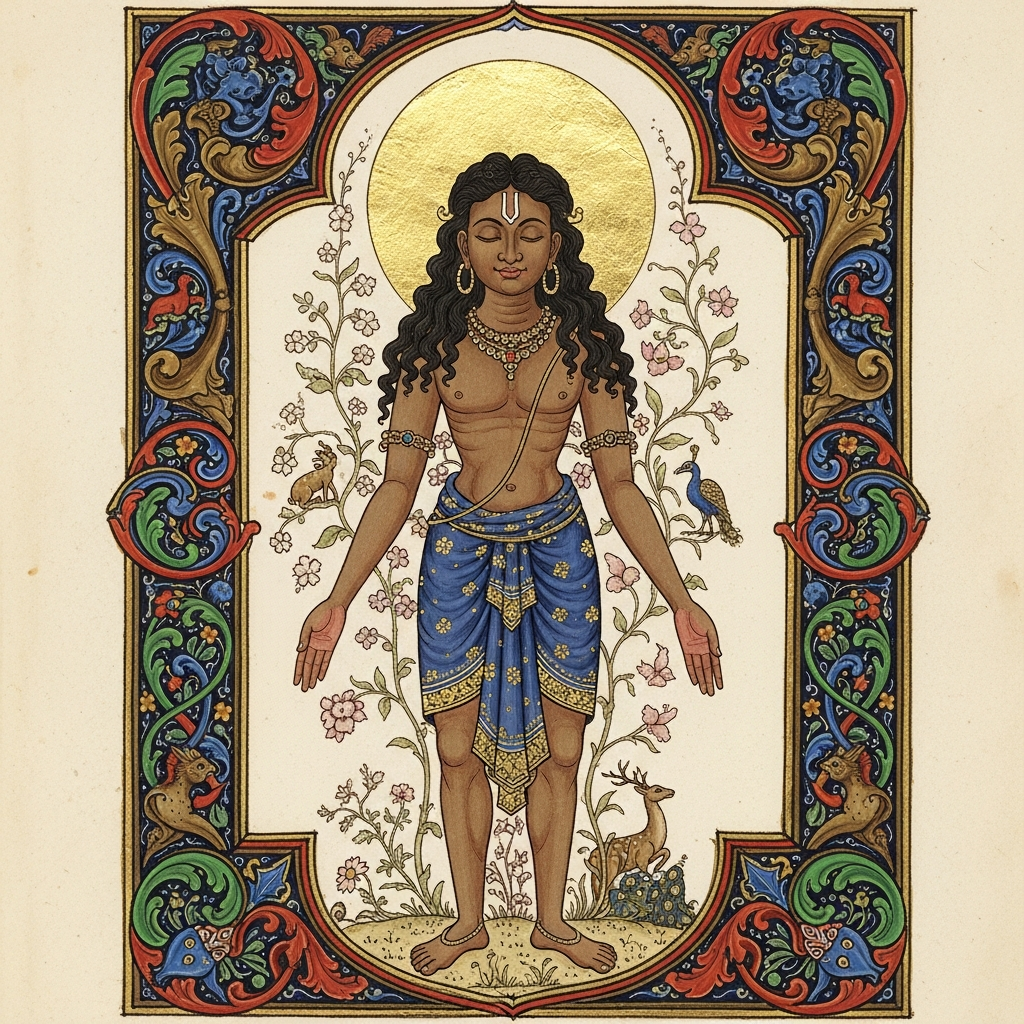
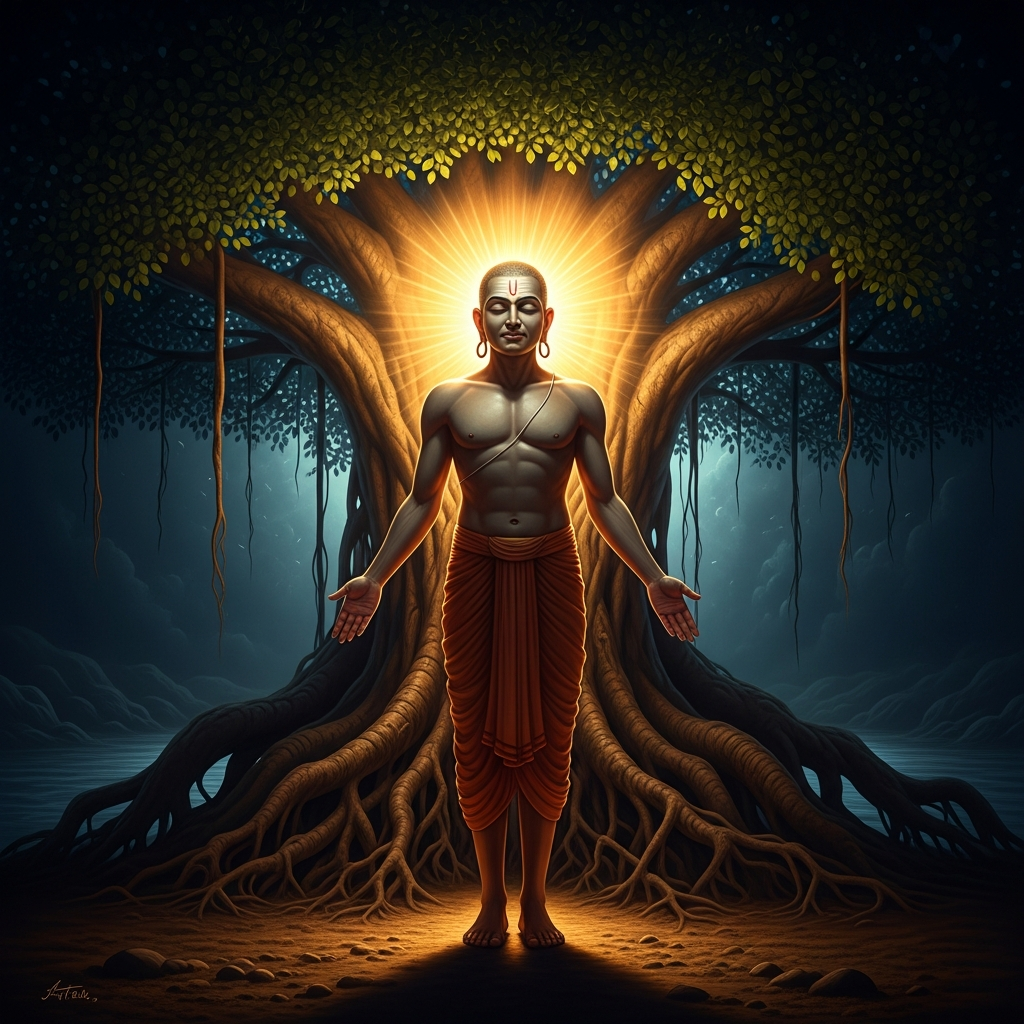
In the first age of the current cosmic cycle, Rishabhanatha — Adinatha, the First Lord — teaches humanity to farm, to write, to build cities, and to govern. He founds the first kingdoms and places his sons on their thrones. Then, when the age turns, he renounces every kingdom he built, walks naked into the forest, and achieves omniscience standing under a banyan tree. He is the first Tirthankara: the first person in this age to cross the river and come back to show where the ford is.
- When
- the Avasarpini — the current descending cosmic cycle (mythic time; Jain tradition places this before recorded history)
- Where
- the realm of Jambudvipa — cosmic geography; the first kingdoms of the current world-age, understood as the Gangetic plain of deep antiquity
In the beginning of this age, the trees give everything.
The Kalpavrkshas — wish-fulfilling trees — line the world in which Rishabha is born, and they provide whatever their people need without labor: food, clothing, shelter, light. Human beings then are taller than mountains, live for millions of years, and die without illness into rebirths that continue the gentle arc. The world is, in the precise Jain sense of the word, good — not paradise (Jains do not believe in paradise, only in cycles), but functioning, adequate, and not yet in need of rescue.
Then the age begins to turn.
The trees thin. The climate shifts. The forest floor that fed itself stops feeding. Rishabha, the sixteenth patriarch, watches his people standing in front of trees that no longer produce anything, holding empty hands, and decides that someone has to teach them what to do next.
He teaches them everything.
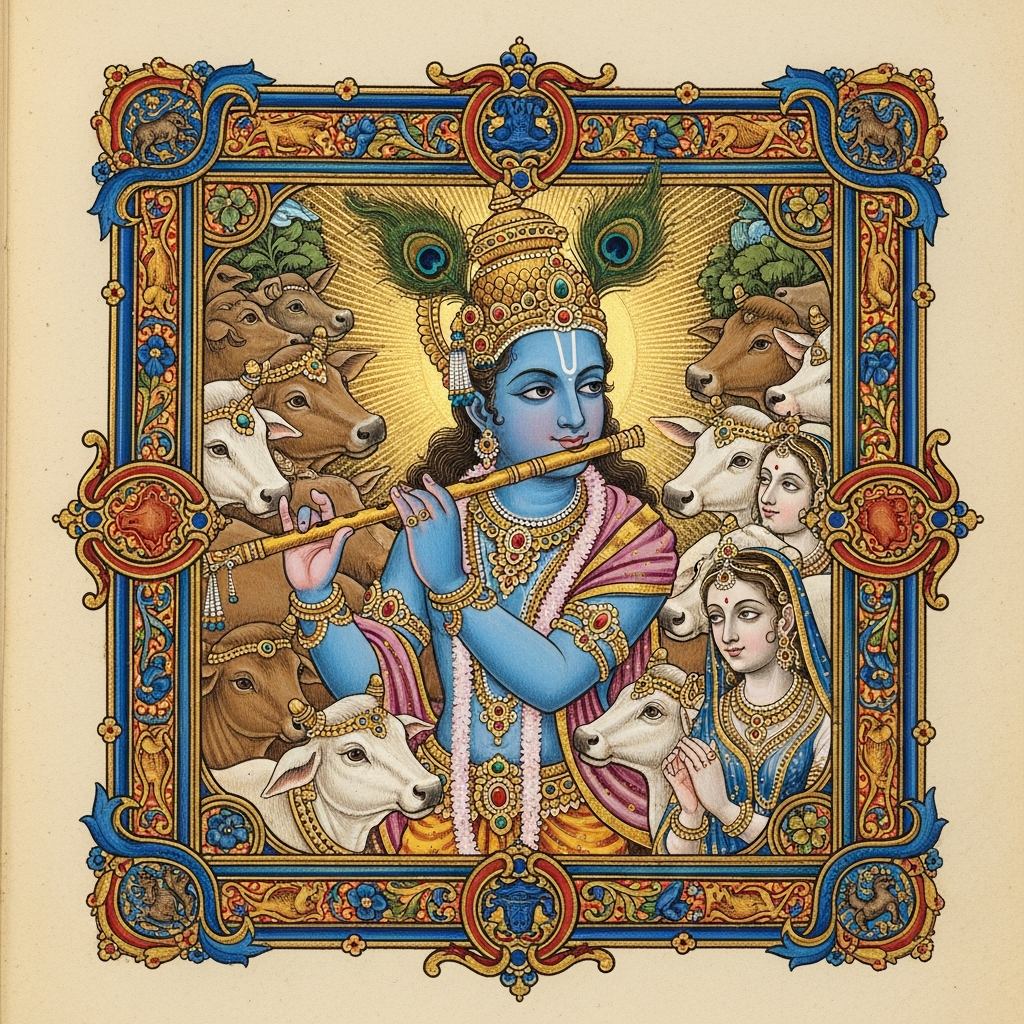
He stands at the center of the first civilization and names its parts: the plow and the oxen, the furrow and the seed, the water-channel and the irrigated field. He teaches pottery. He teaches them to fire clay and store grain against the dry months. He teaches writing — seventy-two scripts, the texts say, which means the seventy-two ways human language had already diverged in the first age. He teaches arithmetic. He teaches weaving. He teaches the processing of metals. He teaches medicine. He teaches the law: the niti-shastra, the principles of governance, the structure of courts and contracts and the adjudication of disputes. He names the four-fold social order — the castes, before they calcify — and demonstrates how they mesh.
He has one hundred sons. He places them on the thrones of the hundred kingdoms his teaching has made governable. His eldest, Bharata, becomes the emperor whose name — Bharata — the texts say is the origin of the name Bharatavarsha: India. His second son, Bahubali, becomes the subject of the great contest — arm-wrestling, wrestling, gaze-contest — in which Bahubali defeats Bharata and then, standing in the moment of his victory, feels the utter emptiness of it, releases the prize, and stands motionless in the field until creepers grow up his legs and termite-mounds build up around his feet and he achieves liberation without ever moving again.
The tree did not fall far from the forest.
Rishabha watches the age continue to turn.
The kingdoms function. The law holds. The granaries are full. The scripts are being used. Every art he taught has proliferated and been improved upon and in some cases been used for purposes he did not intend, which is the nature of civilization and which he accepts without revision. He has done what this age needed a founder to do. He has given people the instruments of material survival and the structures of collective life, and they are using them, and they will continue using them long after he is gone, which is precisely the condition under which he can leave.
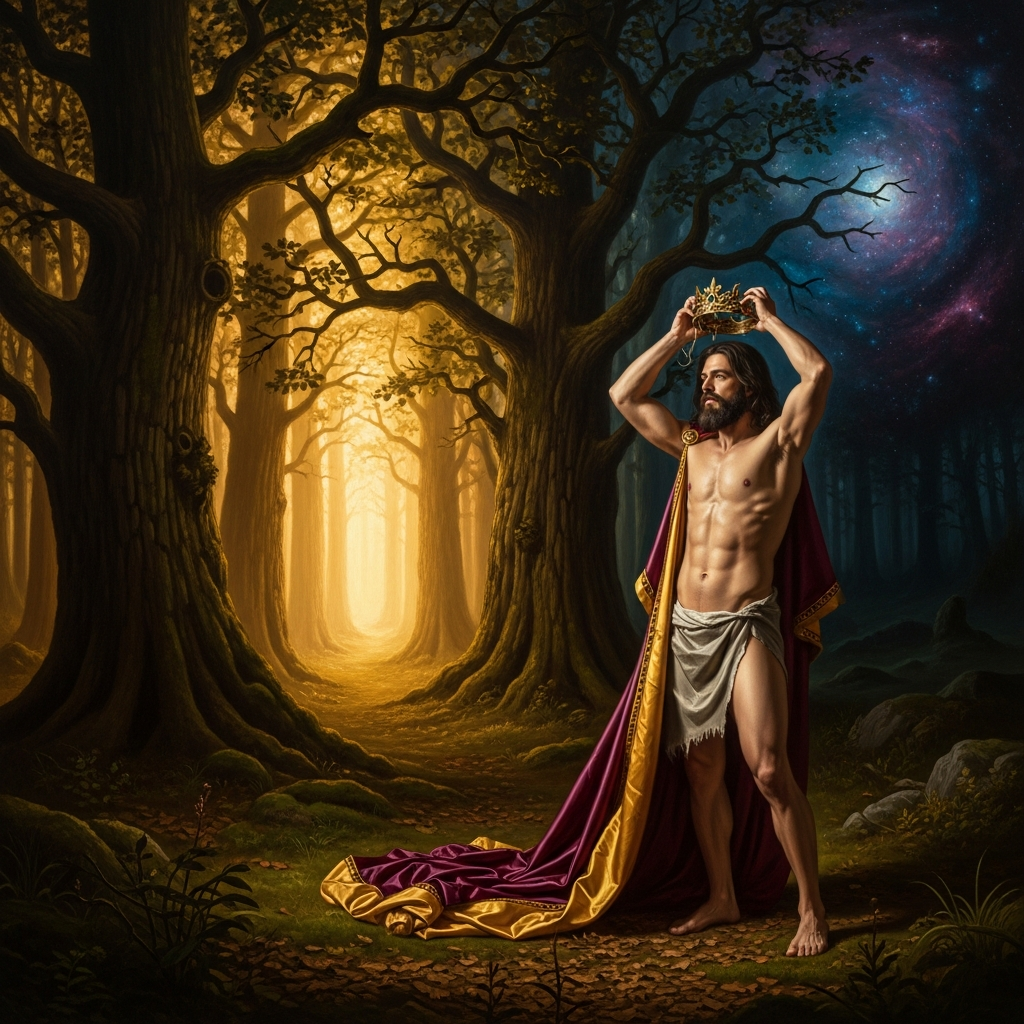
He calls his sons to court. He divides what remains to be divided. He removes the crown and places it on Bharata’s head without ceremony — it was always Bharata’s, which is why Bharata’s hands fit it so well. He removes the silk robes and the royal ornaments and the signet ring and the sandals, each object returned to the pile of things that were always on loan. He removes his hair — by the five-fisted method that Mahavira will repeat twenty-three Tirthankaras later. Indra descends for the occasion, the way Indra descends for every Tirthankara’s initiation, and stands by as witness while the first king of the world becomes the first naked ascetic.
He walks into the forest. He carries nothing. Not even a bowl.
The first year is the hardest, and not because of the austerity.
The austerity is straightforward — cold and heat and hunger and the discipline of silence and the practice of standing motionless until the body stops offering its objections. The hard part is the year he spends wandering without anyone knowing the protocol. He wanders through his own kingdom, and the people see their king — bare, emaciated, extraordinary — and do not know what they are supposed to do. The tradition of the monk-guest, of the householder who gives food to the wandering ascetic and thereby earns merit, does not yet exist. He invented everything this civilization runs on except the etiquette for feeding the man who built it.
For a full year he accepts no food, because no one understands how to give it to him. He finally reaches the city of Hastinapur, where his grandson Shreyansa is ruling. Shreyansa, prompted by a memory from a previous life that surfaces in him like an instinct rather than a thought, approaches with folded hands and a bowl of sugarcane juice and offers it exactly correctly — hands extended, the juice fresh and unstrained, offered without drama. Rishabha accepts. This is the parna — the breaking of the year’s fast — and it is the moment the tradition of giving food to Jain monks officially begins. Shreyansa becomes the first person to acquire merit in the current age by the correct practice.
He walks south and sits under a banyan tree.
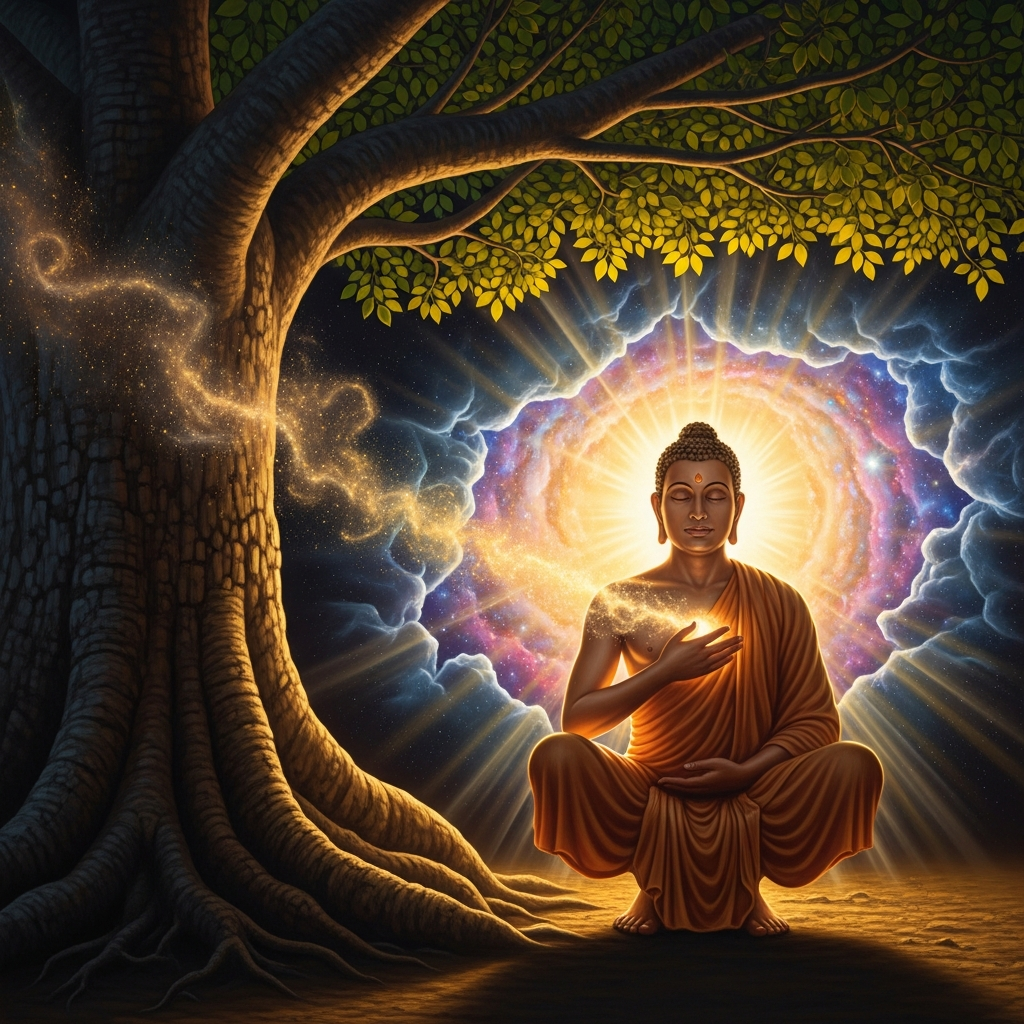
He stands — the posture is standing, not sitting; the kayotsarga, body-abandonment, arms hanging loose — under a banyan tree near the Shakatamukha forest. He has been doing this for a year, minus one cup of sugarcane juice, and his body has reduced itself to the minimum that still supports a soul. The soul underneath is clear now the way water is clear when silt settles. Every desire he ever had for the kingdoms he built, the sons he placed on thrones, the civilization he assembled piece by piece out of the tools he invented — each one of these has burned down to carbon and blown away.
Kevala-jnana opens.
Total knowledge, as it opens for every Tirthankara: every soul in every realm, every particle, every past and future moment, the entire cosmos held simultaneously without effort, without opinion, without the small personal weather of preference and aversion that the soul carries when it still has karma to work through. He holds it the way space holds everything — by being it.
He descends from the banyan and teaches for a thousand years.
His teaching is the path of the five great vows and the eleven pratimas, the stages of progressive renunciation available even to householders. He gathers eleven principal disciples. He establishes the fourfold community — monks, nuns, laymen, laywomen — that every Jain tradition maintains to the present day. His son Bahubali achieves liberation before him, standing in his field, and the fifty-seven-foot monolith carved in his likeness at Shravanabelagola — with the creepers on his calves and the termite-mound at his feet — is anointed every twelve years in a ceremony called the Mahamastakabhisheka that draws millions.
Rishabha himself achieves final liberation — nirvana, moksha, the complete departure of the soul from the cycle of births — at Mount Ashtapada (identified by the tradition with Mount Kailash, which he thus shares with the meditating Shiva). He is the first soul to leave the cycle in this cosmic age. He is the First Lord — Adinatha — and the path he cuts through the forest is the path every subsequent Tirthankara will follow, and the path every Jain monk has followed since.
The ford he found is still there. The river is still there. The crossing is still available — to anyone willing to put down the crown first.
Rishabha’s image appears in seals from the Indus Valley Civilization, four thousand years before Mahavira — a naked figure, arms hanging loose, in the posture of kayotsarga. Scholars debate the identification. The Jain tradition does not debate it: of course he was there. He was the first one.
Scenes
In the first age, the world's abundance is failing
 Generating art…
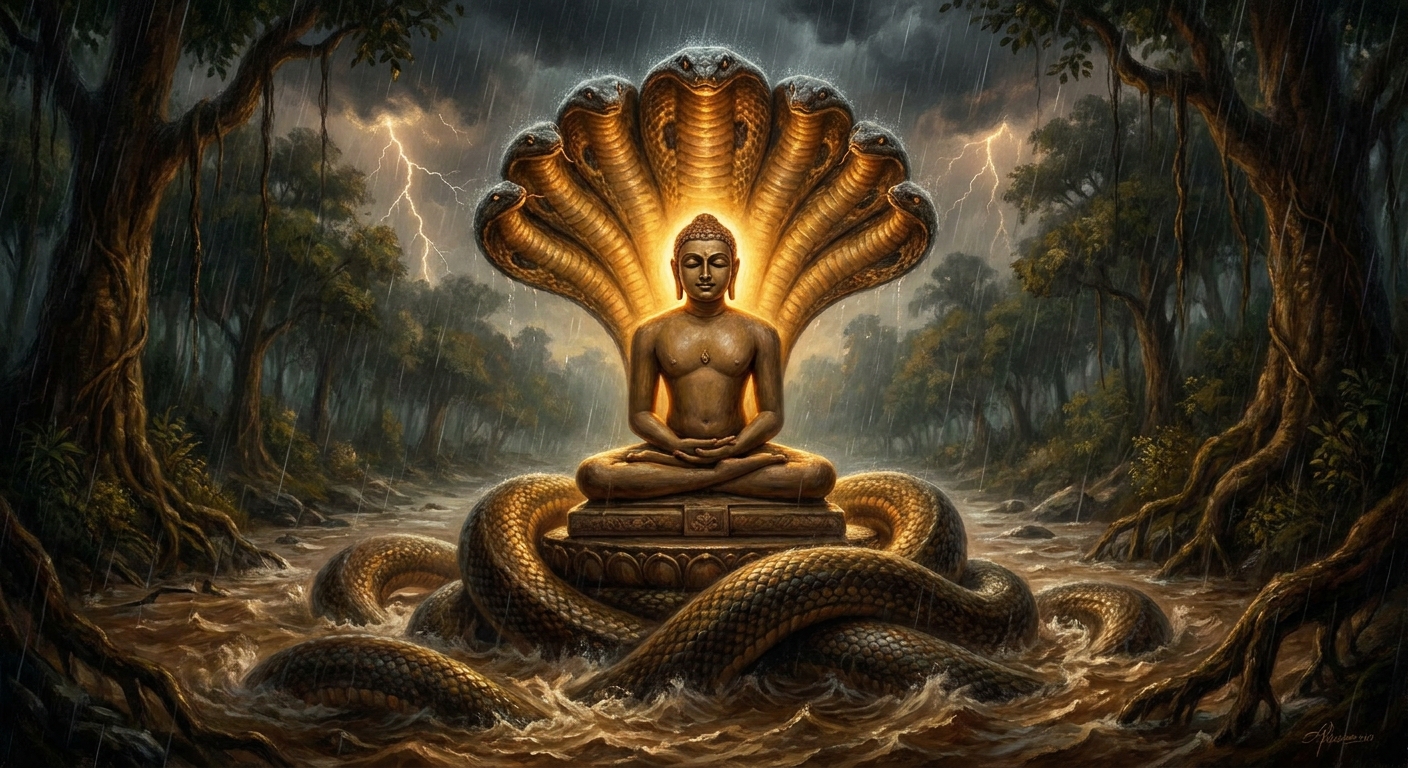
 Then the age turns
 Generating art…
 A year later, standing motionless under a banyan tree, in the posture every Jain monk still takes at death, omniscience opens in him and the first ford across the river of existence is cut
Generating art… Echoes Across Traditions
Entities
- Rishabhanatha (Adinatha)
- Bharata
- Bahubali
- Indra
- Marudevi (Rishabha's mother)
- the ninety-eight sons of Rishabha


Sources
- *Adigama* / *Adipurana* (Jinasena, 9th century CE) — the fullest Digambara account of Rishabha's life and civilization
- *Kalpa Sutra* (Bhadrabahu, c. 4th century BCE) — the life of the first Tirthankara
- *Bhagavata Purana* 5.3-5 (the Hindu account, where Rishabha appears as an avatar of Vishnu who teaches renunciation)
- Paul Dundas, *The Jains* (Routledge, 2nd ed. 2002), ch. 1
- Padmanabh S. Jaini, *The Jaina Path of Purification* (University of California Press, 1979), ch. 7
- John E. Cort, *Jains in the World* (Oxford University Press, 2001)