The Ancestors Walk Out of the Earth
Tjukurpa · the Dreaming, which is past, present, and future at once · The featureless earth — every continent of Australia, before there were continents
Contents
In the beginning the world is featureless and asleep, and the Ancestral Beings walk up out of it singing — and every rock and river and animal track is the trace of their song.
- When
- Tjukurpa · the Dreaming, which is past, present, and future at once
- Where
- The featureless earth — every continent of Australia, before there were continents
Before the Dreaming, the earth is asleep.
It has no shape. There are no rivers, because there are no places for rivers to run from or to. There are no hills, because the surface is one undifferentiated skin. There are no animals, because there are no tracks for them to leave. The earth is a body lying flat, breathing slowly, dreaming itself.
Beneath the skin, the Ancestral Beings are also asleep. They are not yet kangaroo or honey-ant or goanna or rainbow-serpent — they are the possibility of those things, curled in the dark of the under-earth like seeds before water. They have been asleep for a long time. The earth has been waiting for them to wake.
One of them stirs. Then another. Then a third. The skin of the earth pushes upward in places where they push.
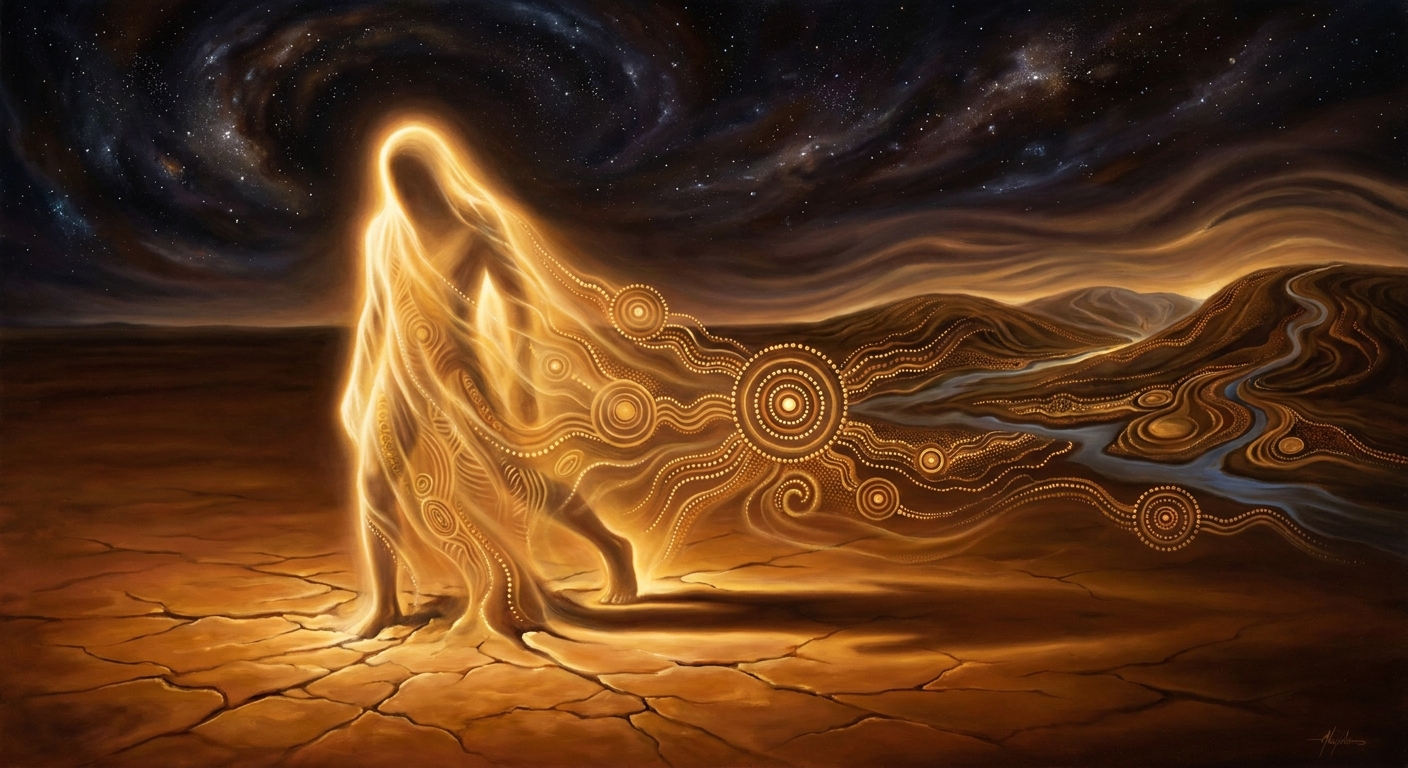
The first Ancestor walks up out of the ground.
She does not crack the earth open. The earth lets her through — softens beneath her, parts the way water parts for a hand, and closes again behind her once she is standing. She is not yet the kangaroo she will be, but she is shaped like a kangaroo would be shaped if a kangaroo were a person. She looks around at the featureless plain. There is nothing to look at. There is no horizon, only the same flat surface in every direction.
She begins to sing.
The song is not a song about anything yet. It is the song of her own body — the rhythm of her hips, the length of her stride, the weight of her tail in the dust behind her. As she sings, she walks. As she walks, the earth under her feet takes shape. A rock rises where her foot strikes hard. A small dip forms where her tail drags. The dust she kicks up stays in the air and becomes the first cloud.
She is making the world by walking it.
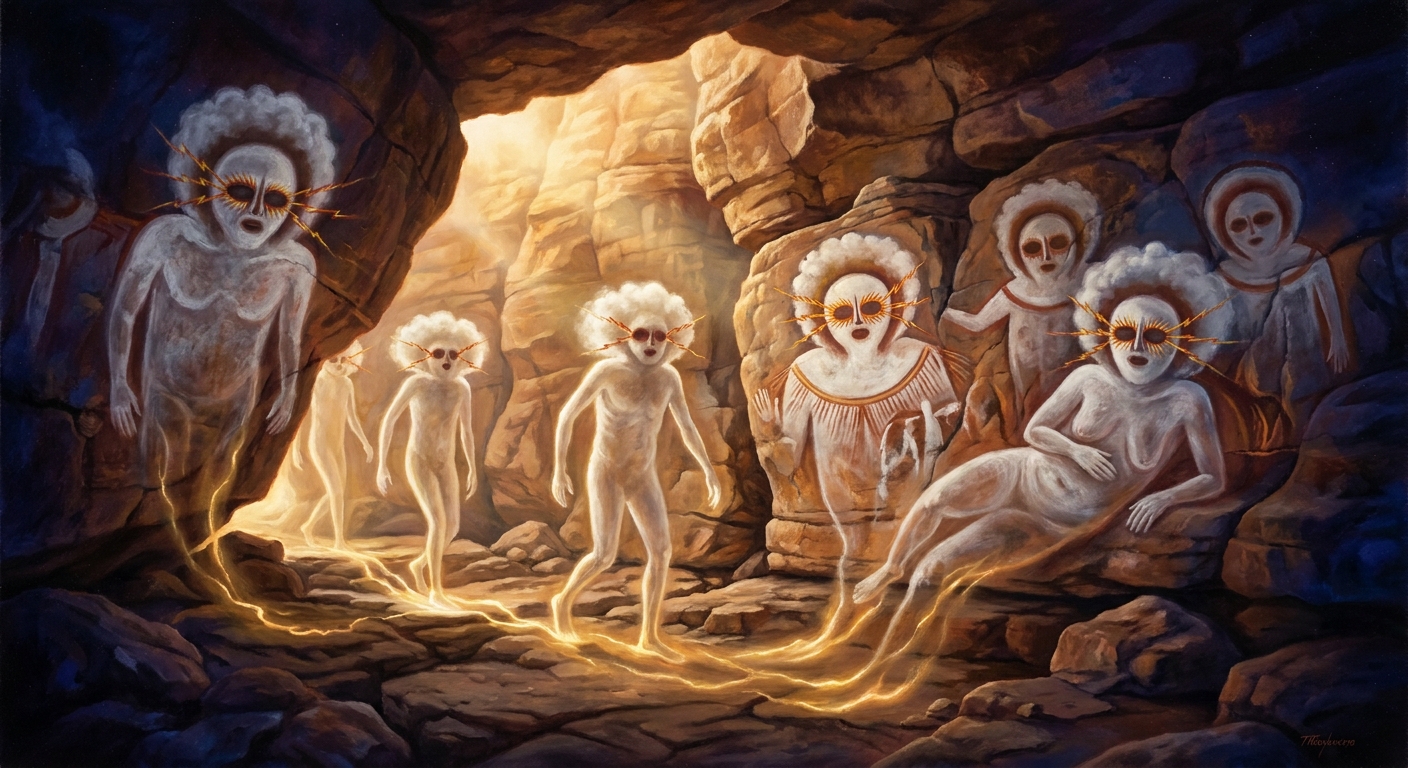
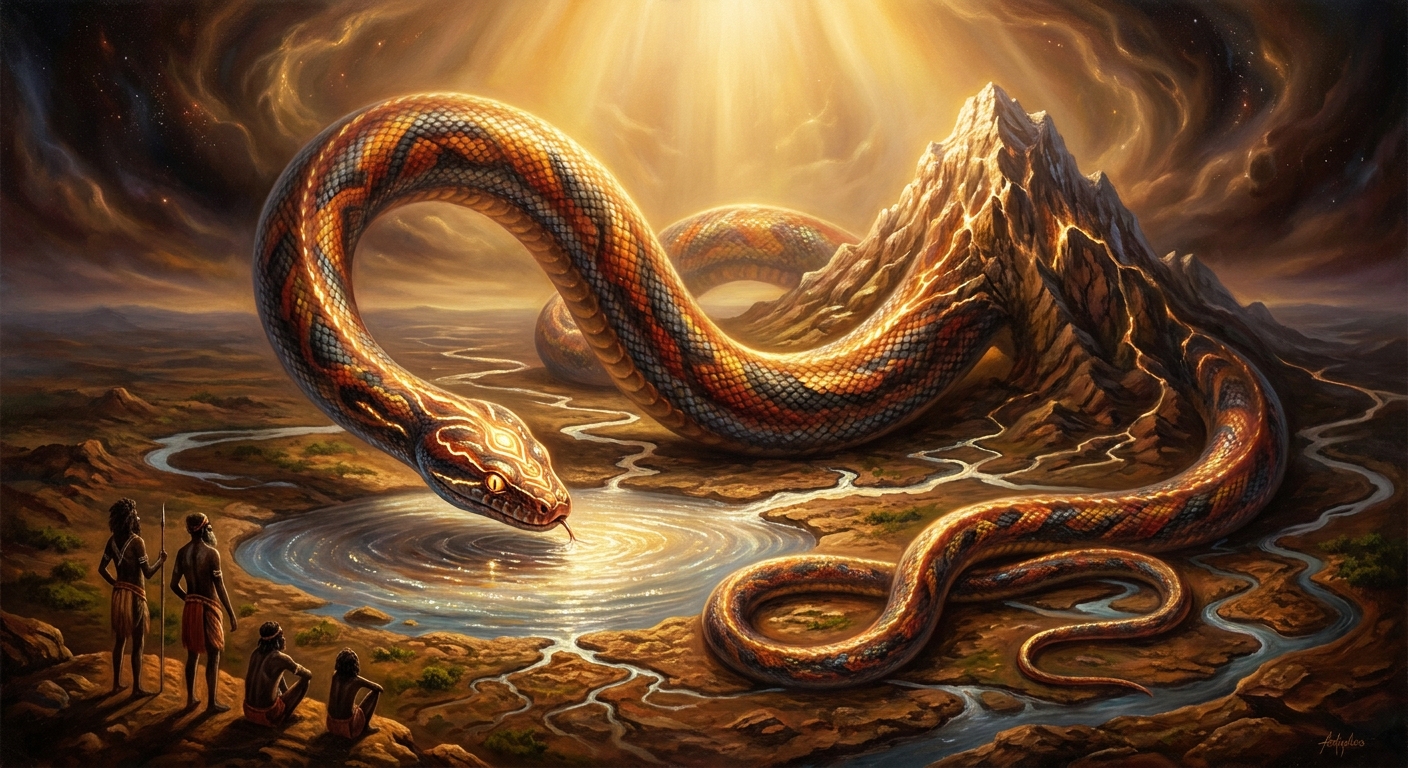
The other Ancestors wake. They come up out of the ground in their hundreds — Wandjina with their great mouthless faces and halos of cloud-hair, walking up out of the rock-shelters of the Kimberley, becoming the rain-bringers; the Rainbow Serpent uncoiling from a waterhole in the desert, sliding across the plain and leaving the long curving line that will be the Murray River; honey-ant Ancestors swarming out of an anthill and following each other in a chain that becomes a road; goanna Ancestors slithering up out of cracks and laying down the patterns that will be the goanna-people’s territory.
Each one sings.
Each song is different. The kangaroo Ancestor sings a kangaroo song — the rhythm of grazing, of leaping, of pausing to listen. The honey-ant Ancestor sings a honey-ant song — the rhythm of small feet, many of them, all going the same way. The Rainbow Serpent sings a serpent song — long, curved, full of the names of waterholes that are not yet there but will be there by the time her singing reaches them.
The songs do not contradict each other. They braid. The plain becomes a country.
The Wandjina come last out of the rock.
They are huge. Their faces have no mouths — because if a Wandjina opened its mouth to speak, the world would be flooded again, and the Wandjina remember the flood that ended the previous age. Their eyes are dark and round and ringed with lashes that are also lightning. Their heads are surrounded by halos of cloud-hair that are the rainclouds — when a Wandjina shakes its head, rain falls.
They walk slowly. They are too heavy to walk fast. They lay down the cliffs of the Kimberley as they walk, the great ochre-and-white walls that will, ten thousand generations later, hold their painted images in shelter after shelter — the rock-art the people will repaint each generation, not to make the Wandjina present but to keep them present, because a Wandjina whose image fades begins to forget the country, and a country whose Wandjina forgets it begins to dry.
When the Wandjina have walked far enough, they lie back down. They lie down inside the rock-walls themselves. They are still there. The painted faces in the shelters are not portraits. They are the Wandjina’s actual faces, looking out from inside the stone where they sleep.
The Rainbow Serpent does not lie down.
She is the longest of the Ancestors and the most restless. She slides across the continent from coast to coast, and the line of her body becomes the river-system of an entire country. Where she pauses to drink, a billabong forms. Where she rears up, a mountain. Where she hunts, a gorge. Where she fights another serpent — and there are other serpents; the world is full of them — the fight leaves a scar of broken stone that the people will read, ten thousand generations later, as the marker of that fight, and they will sing the fight back into being every time they walk past.
She is the principle by which the world stays wet. She is in every waterhole. She is angry when waterholes are disrespected — when people take more than their share, when ceremonies are skipped, when the country’s name is forgotten. Then she rises. Then there is a flood, or a drought, or a child taken by a creek that should have been safe.
The people sing carefully when they walk her line. They sing the right names in the right order, and she lets them pass.
When the Ancestors have finished walking, they lie back down.
Not all of them. The Rainbow Serpent stays awake. The Wandjina stay half-awake, dozing in their rock-walls. But most of the kangaroo and honey-ant and goanna and emu Ancestors return to the earth — they walk back into the ground at the place they will be remembered, and the place becomes a site, a sacred location, the spot where that Ancestor went home. Each site is the property of the people whose songline runs through it. Each people is responsible for keeping their stretch of the song alive.
This is the architecture of the continent.
A songline is not a metaphor. It is a literal route, hundreds or thousands of kilometers long, that crosses the continent following the path an Ancestor walked. It connects waterholes, sacred sites, hunting grounds, ceremonial places. To walk it is to re-sing the verses associated with each landmark, in the right order, in the right language. The verses are the world’s instructions to itself. They are how the country remembers what it is.
A person who walks the songline correctly is not traveling through the world. They are making the world, every step.
This is the deepest claim of the Dreaming, and it is the claim that takes Western minds longest to hear: the creation is not finished. It is not even past. The Ancestors walked the world into being, yes — but the world stays in being only because their descendants keep walking the songs, repainting the Wandjina, telling the children the names of the waterholes in the order the Rainbow Serpent gave them.
The Tjukurpa — the Dreaming — is not a long-ago event. It is a time-shape that is still happening. It is past, present, and future at once. The Ancestor who became the kangaroo is the kangaroo eating grass on the next ridge. The Wandjina painted in the shelter is also the Wandjina sleeping in the rock behind the painting. The Rainbow Serpent in the river is the Rainbow Serpent who made the river.
To break a songline — to bulldoze a sacred site, to flood a Dreaming track with a dam, to forget the verses — is not to lose a piece of culture. It is to let a piece of the world fall back asleep. The Ancestor whose song is forgotten goes back under the earth, and the earth at that point loses its shape, and something that was alive in the country goes still.
W. E. H. Stanner, the Australian anthropologist who spent his life among the Murinbata and Pintupi peoples, gave the Dreaming a phrase that has stuck: “everywhen.” Not eternity, which is timelessness. Not history, which is sequence. Everywhen — a kind of time in which the act of creation is permanently present, available to anyone who knows the song to enter it.
The Dreaming is at least 60,000 years old. It may be 80,000. It is the longest continuous religious tradition on the planet, and it has survived not despite colonization but in stubborn defiance of it — songlines deliberately taught to children even when languages were being suppressed, Wandjina shelters secretly maintained even when the country had been fenced off as cattle station, Rainbow Serpent stories whispered through generations who were forbidden their own ceremonies.
Every other religion in this collection is younger. Every one of them, when it tries to imagine a god speaking the world into being, is reaching for something the Aboriginal peoples of Australia have known for as long as humans have known anything: the world is a song, and it stays in being only as long as somebody is still singing it.
Scenes
The first Ancestor walks up out of the featureless plain
Generating art… The Wandjina walk slowly out of the Kimberley rock-walls — mouthless, halo-haired with cloud, eyes ringed in lightning
 Generating art…
 The Rainbow Serpent slides across the continent from coast to coast
 Generating art…
 Echoes Across Traditions
Entities
- the Ancestral Beings
- the Wandjina
- the Rainbow Serpent
- the Tjukurpa (the Dreaming)
Sources
- W. E. H. Stanner, *White Man Got No Dreaming: Essays 1938–1973* (1979)
- T. G. H. Strehlow, *Songs of Central Australia* (1971)
- Bruce Chatwin, *The Songlines* (1987) — popular but methodologically careful on the songline concept
- Deborah Bird Rose, *Nourishing Terrains: Australian Aboriginal Views of Landscape and Wilderness* (1996)
- Howard Morphy, *Aboriginal Art* (1998) — on Wandjina and Rainbow Serpent iconography