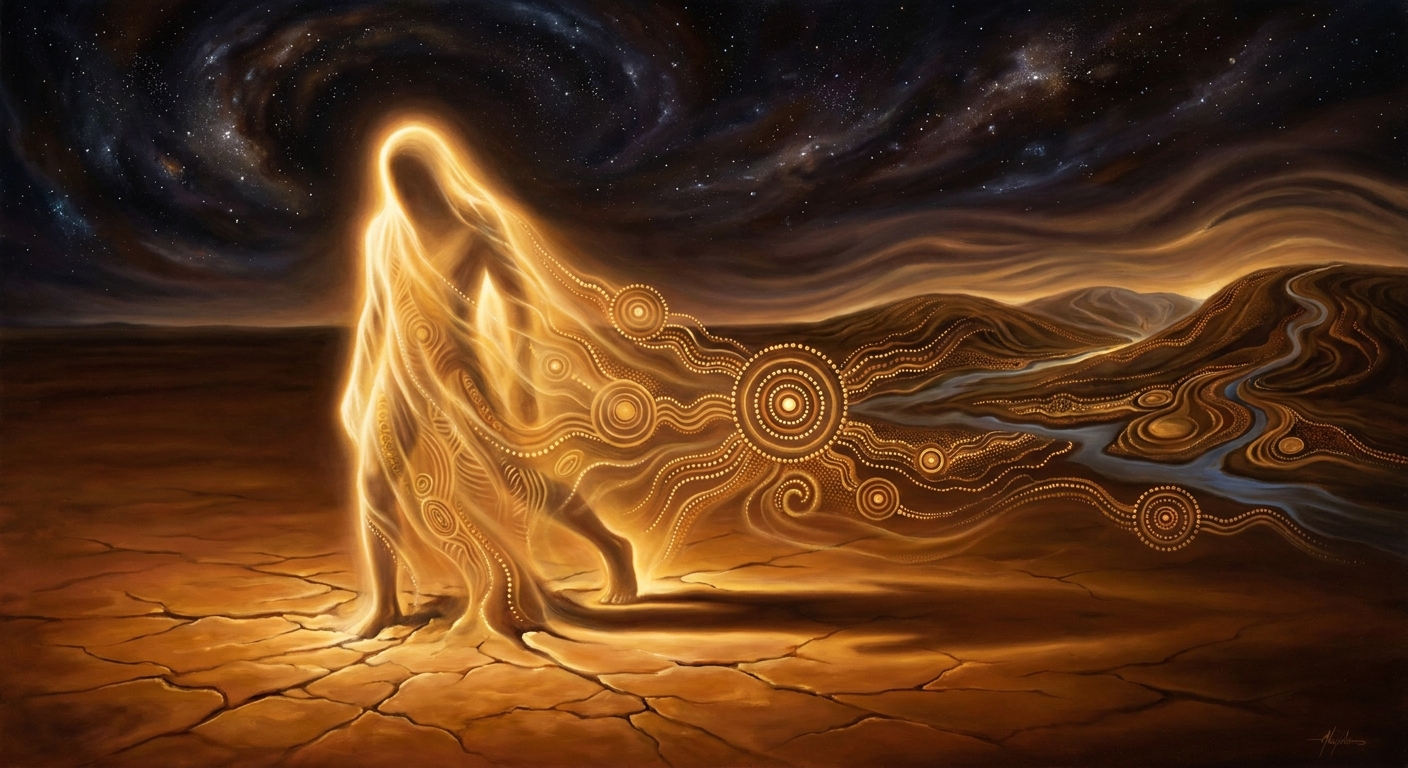
The Rainbow Serpent Makes the Rivers
The Dreaming (eternal / mythic time) · Arnhem Land, Northern Territory, Australia
Contents
The Rainbow Serpent has many names and one body: the creator of every river, lake, and waterhole in Australia. In Arnhem Land, a Kuninjku elder takes a young person to the water's edge and teaches her to read the Serpent's path in the shape of the land — because the child who learns where the Serpent went is keeping the Serpent moving.
- When
- The Dreaming (eternal / mythic time)
- Where
- Arnhem Land, Northern Territory, Australia
The elder sets out before dawn.
She walks the path she has walked ten thousand times, on feet that remember every root and dip without consulting the eyes. The young woman behind her is new to this country — not entirely new; she has the right bloodlines, the right mother’s mother’s country — but she has never walked this section of the creek before, and so she watches the elder’s feet and does her best not to trip.
The air smells like water before you can see water. It smells like the breath of something large that has been very still for a long time.
The billabong opens in front of them like a fact.
It is not a beautiful dawn. The water is flat and the color of iron. A jabiru stands one-legged on the far bank, watching them with the particular attention of a creature who is both bird and more than bird. The elder stops at the water’s edge and does not speak for several minutes. The young woman stops beside her and also does not speak, because she has been taught that the first thing you do when you arrive somewhere is let the country see you.
When the elder speaks, she speaks in language. The young woman’s language is good enough, mostly. She will ask later about the words she misses.
“This is where she drank,” the elder says. She does not say who. It is already understood who.
The young woman looks at the billabong. It is roughly circular, deep-looking even from the bank. The creek feeds it from the east and leaves it from the west, but the billabong itself is much wider than the creek at either end — it is the place where something paused, where a pressure was applied that spread the water out and held it.
“How do you know she stopped here?”
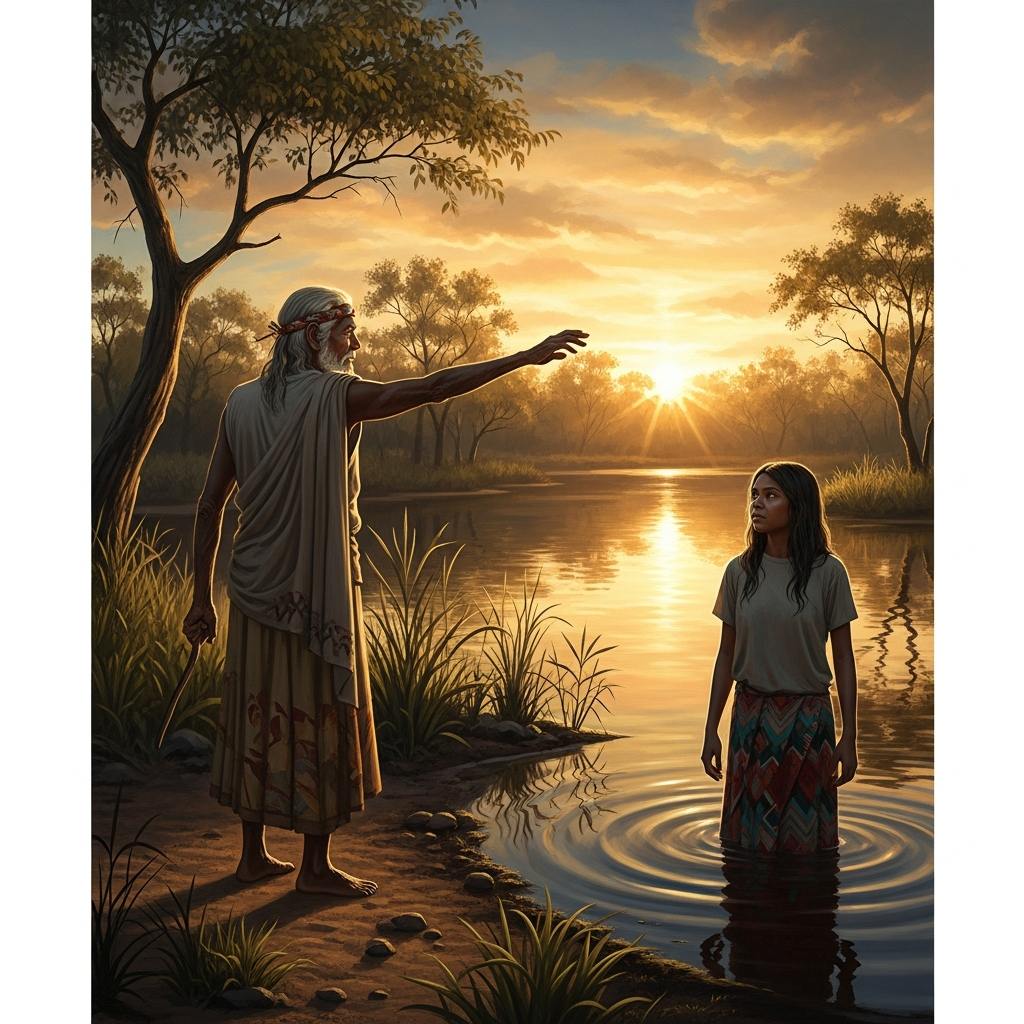
“Look at the shape.” The elder gestures — not at the water but at the land around it. The clay banks rise in a curve on the eastern side that is not the curve of a creek bank. It is a heavier curve. The kind of curve made by a body pressing into soft earth from above.
Ngalyod came here in the Dreaming. She has many names — Yurlunggur to the Yolngu to the east, Wagyl far in the south, other names in other languages, all the same being moving through different countries, carrying different story-segments the way a river carries different sediment through different soils. Here she is Ngalyod, and her coming is not an event that happened and is over. The Dreaming is not the past. The elder has been told this her whole life and she has spent her whole life finding different ways to understand it, and she is still not sure she has a version that would satisfy a person who was not already inside the story.
What she knows is this: the Dreaming happened. The Dreaming is happening. The billabong is the Dreaming’s body held in place in the earth, and every wet season when the rains fill it, Ngalyod is filling it. They are not metaphors for the same event. They are the same event.
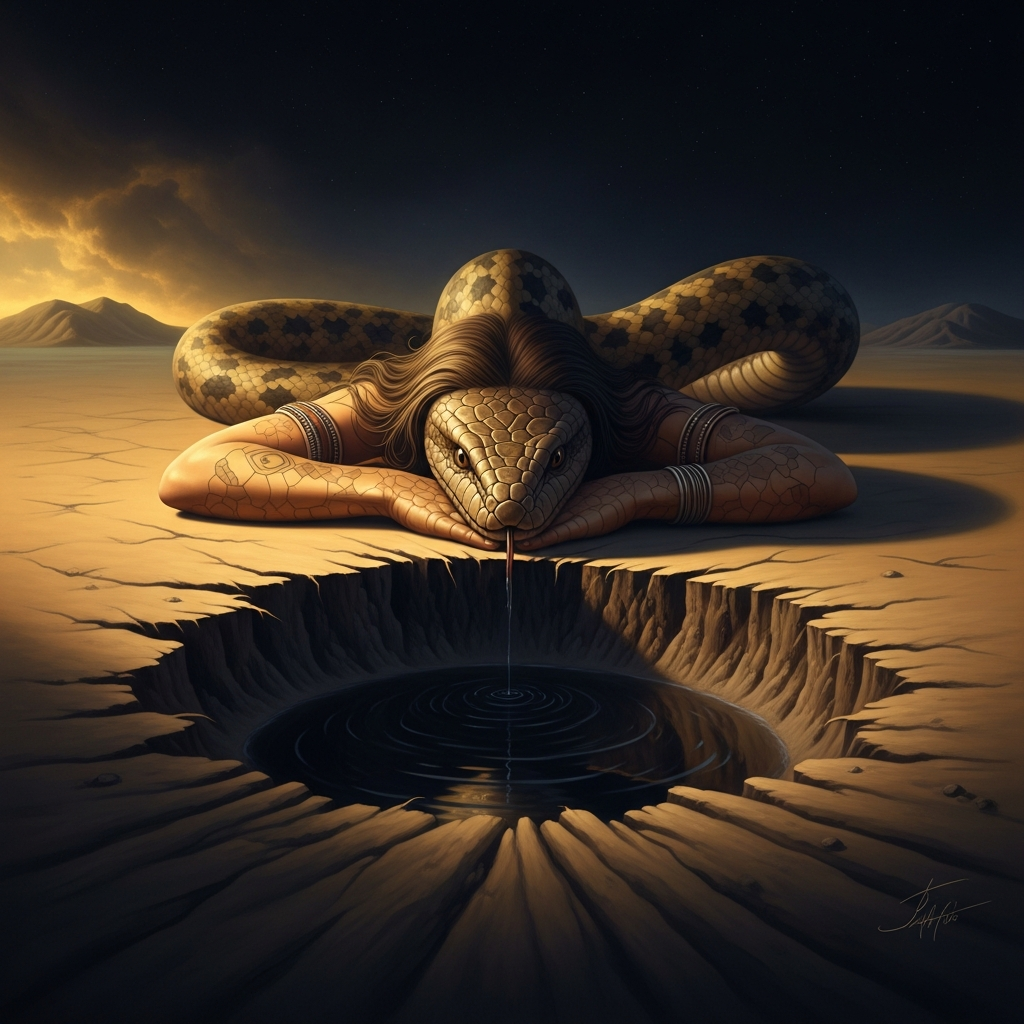
“She came from the east,” the elder says. She turns to face the direction the water comes from, squinting slightly at the growing light. “She came from that big lagoon, the one with the paperbark trees — you haven’t been there yet. She came from there and she moved this way and she was thirsty, and when she drank, she drank a lot.”
The young woman nods. She is forming the image: a body so large that its drinking displaces enough earth to make a permanent waterhole. The scale is not metaphorical.
“Then she turned.”
This is the part the elder has been building toward. She turns from the billabong and walks along the creek’s edge, downstream, and the young woman follows. The creek bends here in a long slow arc to the north. If you have walked creeks your whole life, you know what a water-driven bend looks like — the outer bank eroding, the inner bank depositing, the logic of fluid dynamics. This bend does not look like that. The outer bank is not eroded. It is compressed. The clay on the north face of the bend is packed harder than it should be, as if pressed from inside.
The elder crouches down and puts her palm flat against the hard clay.
“She turned here. Slow. Because she was full.” She stands. “When the Serpent turns slow, the country turns with her. You feel it underfoot — you’ll feel it if you walk this bank — the whole land is bent this way because she bent this way.”
The young woman crouches and puts her own palm against the clay. The clay is cool and hard and absolutely certain of its own shape. She doesn’t know what she expected to feel — a pulse, a warmth, something that would confirm the story kinesthetically. What she feels is the cold certainty of something that has been pressed into position and held there for longer than she can think about.
She is not disappointed. This is what the elder is teaching her. The story is not in the feeling. The story is in the shape.
They walk the bend until it straightens again, and the elder names each feature as they reach it: the place where Ngalyod rested her chin and the ground dipped; the place where her tail dragged and left a long, shallow depression that fills with water first when the rains begin; the place where she reared up — and here the land does something unexpected, rising in a low ridge that has no geological explanation except this one, that a very large body pressed down on the earth here and the earth pushed back up to either side.
Each feature has a name. Each name is a verse in a song. The elder sings the verses as they walk, quietly, the way you say something that is true and does not need to be said loudly. The young woman listens and begins to understand that the walk they are taking and the song they are singing are the same thing.
This is the knowledge she is here to receive: not the facts about the Serpent’s path, but the act of walking it while singing it. The walk is the ceremony. The ceremony is the maintenance. She will do this walk every year for the rest of her life, and every year she does it she will be keeping Ngalyod moving through this country, because a Serpent whose path is walked and sung is still in motion, and a Serpent still in motion is still making the rivers, and the rivers run because the Serpent runs.
By midday they have reached the place where the creek joins a larger waterway, and the elder stops and looks at the confluence for a long time. Two stories meeting. The young woman has been told that the larger river has its own Serpent — a different name, a different lineage, a different set of verses — but that Ngalyod and this other Serpent met here in the Dreaming and the meeting was amicable, and so this is a place where two countries can meet without conflict, and has been used for trade and ceremony for longer than anyone can say.
“You’ll learn that story later,” the elder says. “Someone else’s to teach.”
The young woman understands. The knowledge is not a common property. It lives in specific bodies, specific lineages, specific obligations. She has the right to Ngalyod’s path because of who her grandmothers were. She does not have the right to the other river’s story, not yet, maybe not ever. The landscape is not a text anyone can read. It is a library of restricted knowledge, and you have access only to the shelves that belong to your bloodline.
She looks at the river. She looks at the shape of the bank where the two waters meet, and she can already see it — the compression, the particular hardness of the earth on the southern side, the evidence of a turning. Another body pressed against this earth and left its shape.
The stories told here are from the publicly shared religious knowledge of the Bininj Kunwok peoples of western Arnhem Land — the existence of the Rainbow Serpent, her role as the creator of waterways, and the practice of walking her Dreaming tracks as a form of ceremonial maintenance. The specific sacred names, the restricted ceremonial songs, and the deep content of the Serpent’s story as held by particular clan groups are not included here, because they are not for everyone. This is, the Kuninjku would say, the outside of the story. The inside is kept where it belongs.
After rain in Arnhem Land, the arc of the Serpent sometimes appears in the sky above the floodplains — brilliant, curved, her scales catching the light. The elder sees it and names it without breaking stride. Not a metaphor. Not a reminder. The Serpent, present, visible, still moving through her country.
Scenes
The Serpent presses her body against the flat earth and the land folds around her like cloth
 Generating art…
 An elder stands at the edge of a billabong at dawn, arm extended toward the bend in the creek that proves the Serpent turned here
 Generating art…
 After rain, the arc of the Serpent hangs in the sky above the floodplains — her scales catching the light, her head in the eastern clouds, her body curved as a river
 Generating art…
 Echoes Across Traditions
Entities
- Ngalyod (the Rainbow Serpent)
- the Kuninjku elder
- the waterholes of Arnhem Land
Sources
- Deborah Bird Rose, *Nourishing Terrains: Australian Aboriginal Views of Landscape and Wilderness* (ATSIC, 1996)
- Howard Morphy, *Aboriginal Art* (Phaidon, 1998)
- Luke Taylor, *Seeing the Inside: Bark Painting in Western Arnhem Land* (Clarendon Press, 1996)
- Murray Garde, *Bininj Kunwok: A Cross-referencing Dictionary of the Bininj Kunwok Language Group* (AIATSIS, 2013)
- W. E. H. Stanner, *White Man Got No Dreaming: Essays 1938–1973* (ANU Press, 1979)