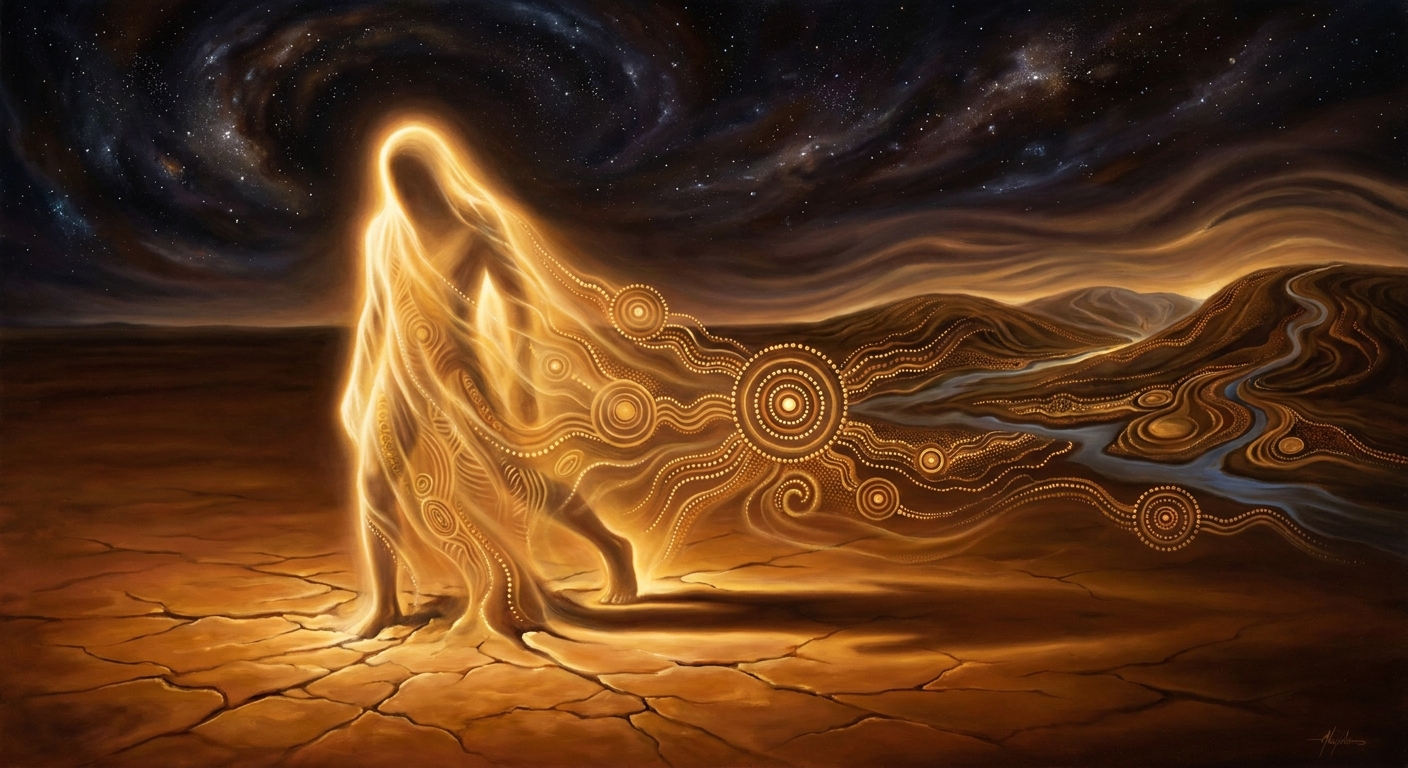
The Djang'kawu Sisters Arrive Singing
The Dreaming (eternal / mythic time) · Northeast Arnhem Land — the Yolngu homelands, from the coast to the interior
Contents
The Djang'kawu sisters arrive by canoe from Baralku — the island of the dead — singing every place they visit into existence. They create the Yolngu people, establish the sacred ceremonies, and name the world. Then the men take their sacred objects. The sisters let them, because the women already carry the sacred in their bodies.
- When
- The Dreaming (eternal / mythic time)
- Where
- Northeast Arnhem Land — the Yolngu homelands, from the coast to the interior
They come from the east, from the sea.
Baralku — the island of the dead — is visible as a cluster of light on the horizon just before dawn. The Yolngu know it is there by the quality of the eastern sky at that hour, a brightness that is not sunrise but is associated with it, a luminescence coming from the right direction. The dead go there. The Ancestor beings come from there. The Djang’kawu sisters and their brother come from there by canoe, arriving at the coast of Arnhem Land at the moment that is neither night nor morning, in the light that belongs to neither.
They are singing as they cross.
The song is not a song about something that exists yet. It is a song about what they are about to make — names called out across open water to a coast that does not yet have names, names arriving before the people arrive, traveling ahead of them the way sound always travels. When the prow of the canoe touches the sand, the first places have already been named, and the names are the places, and the coast is no longer a nameless thing.
Bildjiwuraroju steps out first.
She carries the sacred rangga — the sacred posts and emblems that are also the generative sacred objects of the Yolngu — and she walks up the beach with the gait of someone who knows exactly where she is going even though she has never been here before. She has never been here before because this shore did not exist before her. She made it by naming it. She is walking into the world she named.
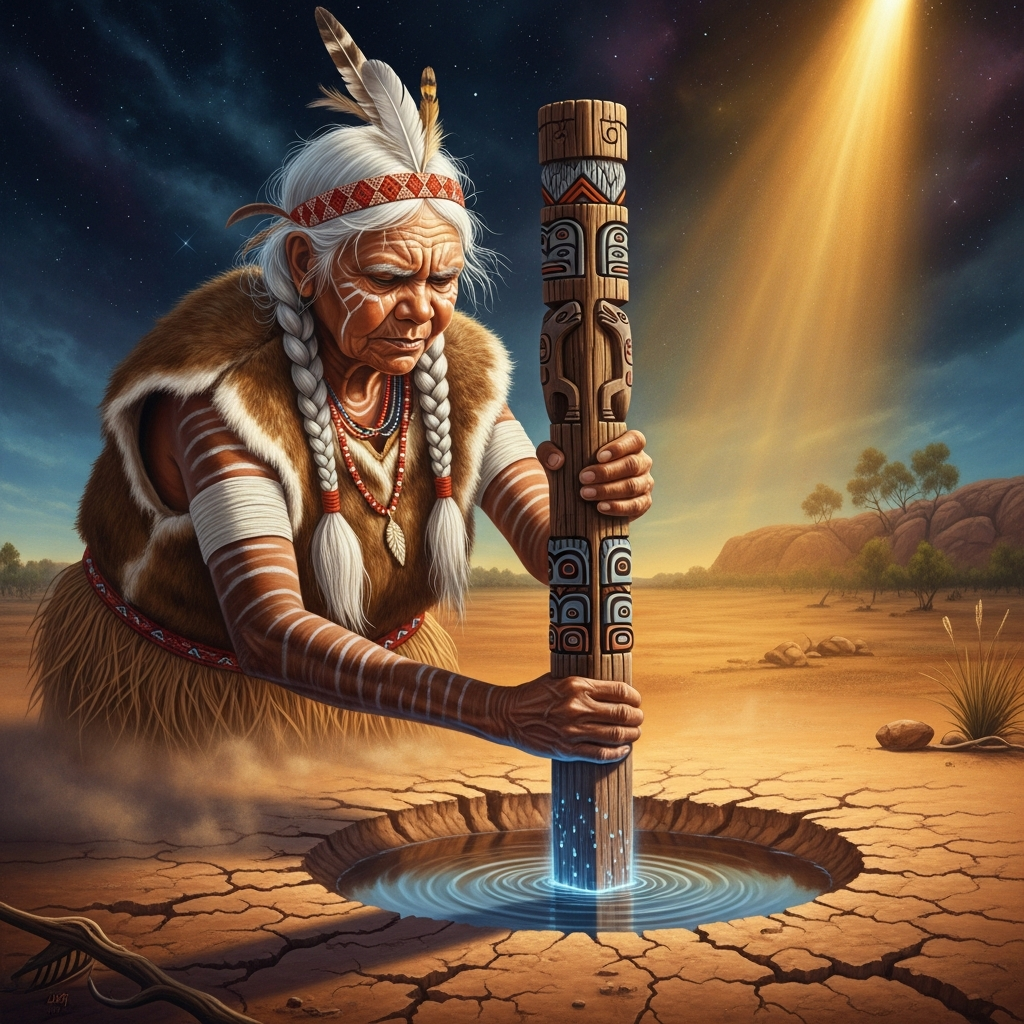
She drives the first rangga into the ground.
The earth receives it. At the place where it enters, something changes — a pressure releases, a hollow forms, water appears. She has created a waterhole. She gives it a name, and the name is not a label placed on top of the thing. The name is what makes the thing this thing and not some other thing. It is the same word for both. Yolngu epistemology does not separate the name from the named; they are one substance, one act, sustained simultaneously.
Behind her, her sister Mirijalku comes up the beach singing a different part of the same song. The brother comes last, carrying what he is responsible for carrying, which is his own smaller set of objects and the obligation to remember what his sisters do so he can perform it in ceremony later.
They move inland.
The journey through Arnhem Land takes what Western thought would call a very long time and what Yolngu thought calls the time it takes to do it correctly. At every significant place — every waterhole site, every outcropping, every place where one kind of country gives way to another — the sisters stop. They plant a rangga. They name the place. They create the clan whose country this will be by naming the clan and the totem and the sacred designs that belong to that clan.
They are not allocating a pre-existing landscape to pre-existing groups. They are making the landscape and the groups simultaneously, out of the same creative act. The clan is the place; the place is the clan; the sacred designs that represent the connection are the evidence — the trace left in art and ceremony of the original creative naming.
Mirijalku is the more talkative of the two sisters. She names things with a quality of delight that is described in the song-cycles that carry this story — a pleasure in the act of naming that is not like the pleasure of labeling but like the pleasure of meeting someone for the first time and understanding immediately that this person is real. The waterhole is real because she makes it real. Making it real is a form of recognition. The recognition is itself the sacred act.
The sisters create people.
This is the most restricted part of the Djang’kawu narrative, and it is not repeated in full here because it belongs to the women’s ceremonial tradition of the Yolngu and its details are not public knowledge. What can be said is this: the sisters carry in their bodies the power of birth, and they use this power in the Dreaming to bring the Yolngu clans into existence. The people do not come from clay, or from the sea, or from divine exhalation. They come from the sisters’ bodies, in the way that all people come from women’s bodies, and the ceremony that re-enacts this birth is a women’s ceremony, and it is old.
The brother watches. He learns the shapes of the ceremonies, the objects involved, the songs. He has good memory. This will matter later.
The sisters are not unaware of what he is learning. They know he is watching. They continue without concealing anything from him, because at this point in the story they are creating a world in which concealment is not yet a feature. Everything is open because there is no reason to close it.
This will change.
It changes at dawn, while the sisters sleep.
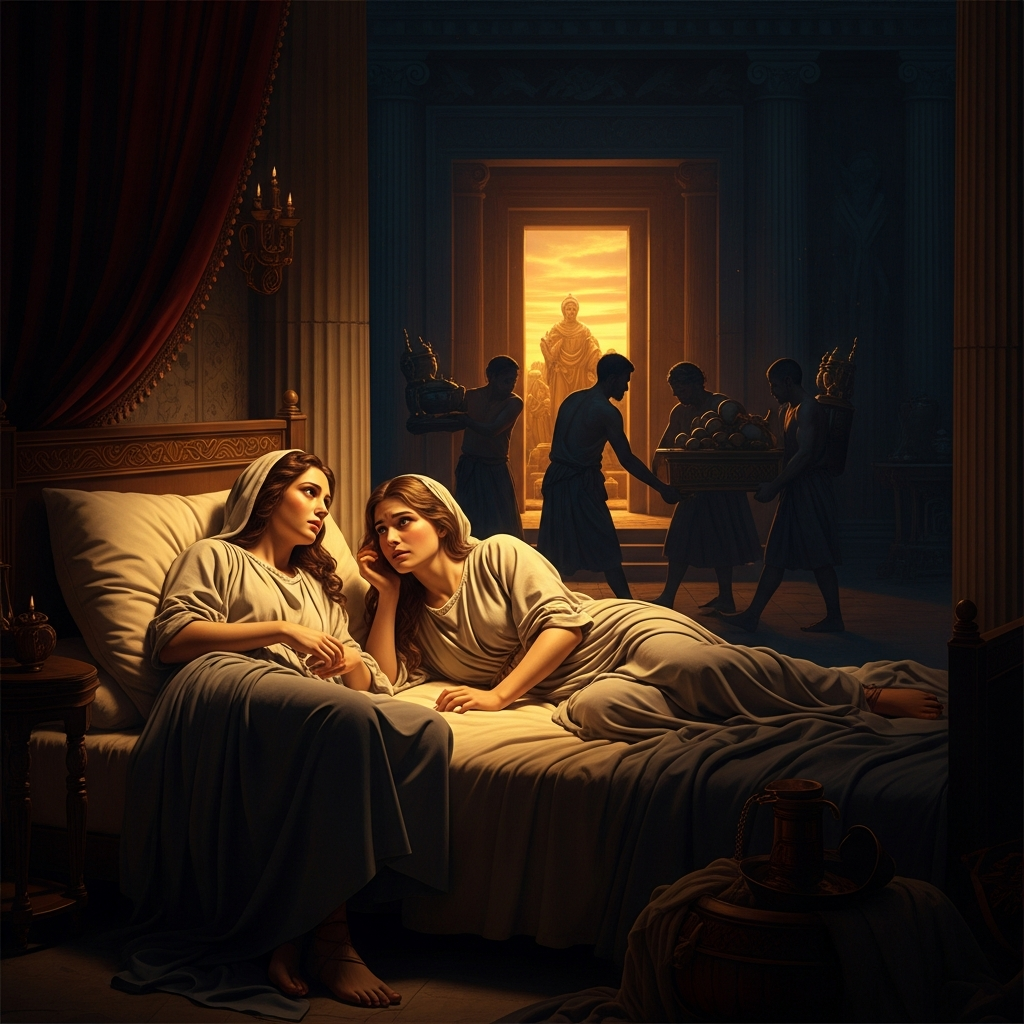
The brother takes the sacred objects. He does this quietly, with care — he does not damage them, he does not use them improperly, he simply carries them away with the men who have gathered around him, men who want what the women have and who have been persuaded that they can take it. They go. The objects go with them.
When the sisters wake and find the objects gone, there is a pause in the story that every version of it preserves. They wake. They see the absence. They look at each other.
What passes between them in that look is the theological heart of the entire narrative.
The sisters are not angry. This is consistently attested across the versions of the story held by different Yolngu clans — the sisters do not pursue the men, do not demand the objects returned, do not punish the theft. They accept it with what can only be described as equanimity, if equanimity can carry the weight of something much more active than resignation.
The reason, as it is understood by the Yolngu women who hold the story’s inner meaning, is this: the men need the ceremonies. They need external objects and external songs and external performance because they do not have what the women have internally. The women’s bodies carry the sacred; the ceremonies the men took are the men’s way of approaching what the women already are. The theft is not an act of power. It is an act of need. The sisters recognized the need and allowed the taking.
This is the story the Yolngu tell about why men hold the public ceremonies.
The public ceremonies — the great mortuary rites, the initiation ceremonies, the ceremonies that cross clan boundaries — are performed by men with sacred objects. The objects were the women’s first. The men took them. The women allowed the taking. The men now hold the public ceremonies with the objects, and the women hold the ceremonies that are private, not public, the ones that happen in the women’s country where men do not come.
Ian Keen and Howard Morphy, the anthropologists who have worked most extensively with Yolngu religious knowledge in the twentieth century, both note that the Djang’kawu story should not be read as a myth of patriarchal takeover followed by female resignation. The structure is more precise than that. The women’s sacredness is intrinsic — it is in their bodies, in the power of birth, in the capacity to bring the Yolngu clans into existence, and none of this is transferable. The men can have the sacred objects. They cannot have what makes the objects sacred, which is the women’s creative power. The ceremonies the men perform with the rangga are ceremonies about that power. The women do not need ceremonies about a power they possess.
The sisters stand on the morning shore of what they have made — the named country, the named people, the waterhole sites, the sacred designs, the ceremonies — and they nod at each other. They have given the men something the men can carry. They have kept what cannot be given.
The Djang’kawu narrative belongs to the Yolngu people of northeast Arnhem Land and is transmitted through specific clan lineages with the authority to hold and perform it. What is described here draws on the published ethnographic and anthropological record — Howard Morphy’s work on ancestral connections, Ian Keen’s documentation of Yolngu religious knowledge, the Berndt and Berndt collection — which represents the portions of this story that have been shared publicly by Yolngu people for the purpose of wider understanding. The restricted ceremonial content, the specific sacred designs, the women’s ceremony details, and the deep inner meaning held by initiated knowledge-holders are not included here. They are transmitted in the proper way, through the proper channels, to the people who have the right to receive them.
The sisters’ canoe is still visible on the right mornings, as a brightness in the eastern sky before dawn. Baralku is still there. The sisters are still, in some sense, arriving — because the Dreaming is not past, and the act of creation they performed, the naming of the world, is an act that the Yolngu maintain through ceremony, and the maintenance of the naming is the continuation of the arrival.
Scenes
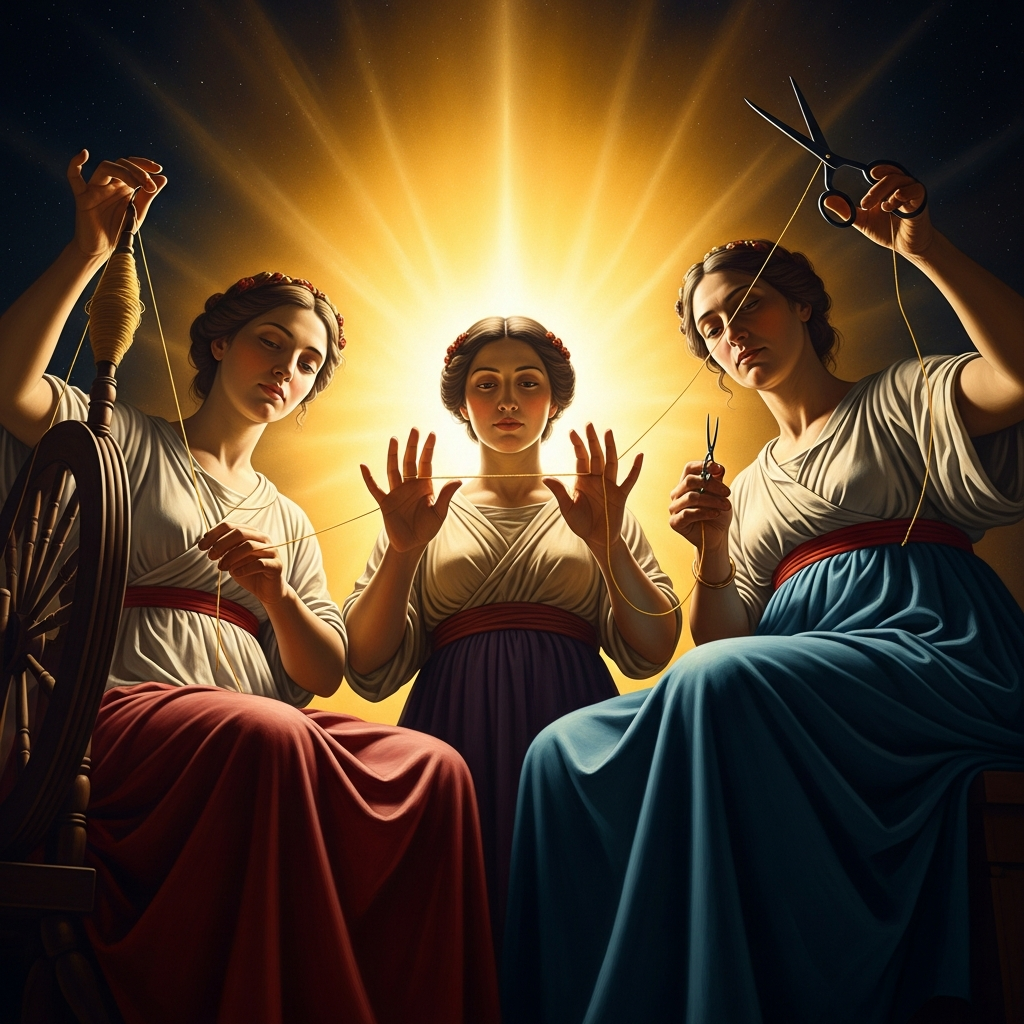
The sisters' canoe emerges from the dawn light over the Arafura Sea
 Generating art…
 Mirijalku drives a sacred rangga post into the ground and the land trembles with recognition
 Generating art…
 The men carry the sacred objects away at dawn while the sisters sleep
 Generating art…
 Echoes Across Traditions
Entities
- Bildjiwuraroju (the first Djang'kawu sister)
- Mirijalku (the second Djang'kawu sister)
- the Djang'kawu brother
- the Yolngu people
- Baralku (the island of the dead)
Sources
- Howard Morphy, *Ancestral Connections: Art and an Aboriginal System of Knowledge* (University of Chicago Press, 1991)
- W. Lloyd Warner, *A Black Civilization: A Social Study of an Australian Tribe* (Harper, 1937)
- Ian Keen, *Knowledge and Secrecy in an Aboriginal Religion: Yolngu of North-east Arnhem Land* (Clarendon Press, 1994)
- Frances Morphy and Howard Morphy, eds., *Morphy on Aboriginal Art* (2006)
- Berndt and Berndt, *The Speaking Land: Myth and Story in Aboriginal Australia* (Penguin, 1988)