The Song That Holds the Land
The Dreaming (eternal / mythic time) — and every ceremony since · Across Australia — the Eagle Hawk Dreaming track runs from the interior to the coast through the country of multiple language groups
Contents
A man who is the custodian of an Eagle Hawk Dreaming track explains what it means to hold a Songline: the song is not something you own, it is something that lives in your country and passes through you as a current passes through water. If you don't sing it, the land becomes quieter. If the last person who knows it dies without teaching it, that section of the world's music goes silent.
- When
- The Dreaming (eternal / mythic time) — and every ceremony since
- Where
- Across Australia — the Eagle Hawk Dreaming track runs from the interior to the coast through the country of multiple language groups
The song does not belong to him.
He is careful about this when he explains it, because the word “custodian” in English implies possession, and possession is not what this is. He is responsible for the song. He carries it. It is in his body the way his blood type is in his body — not something he chose, not something he can put down, not something that would still be him if it were removed. The Eagle Hawk Dreaming track passes through his country, and his country passes through him, and the song that narrates the Eagle Hawk Ancestor’s journey through that country is the point of connection between him and the land he stands on.
“The song lives in the country,” he says. “I’m just the one who knows where to find it.”
This is a distinction he holds precisely. The song existed in this country before he was born. It will exist in this country after he dies, in the bodies of the people he has taught and in the country itself, which does not forget what has happened inside it. His role is not to create the song or to own it. His role is to be the vehicle through which the song remains audible.
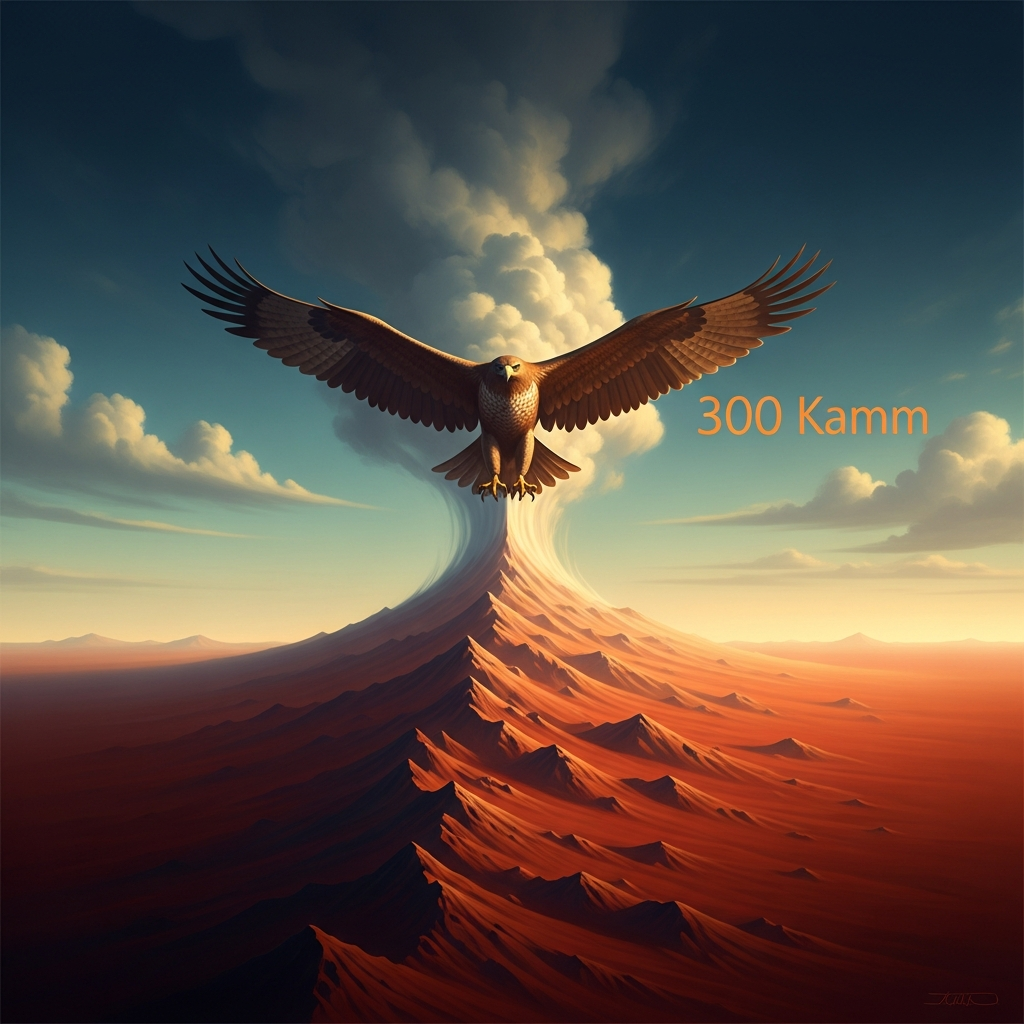
The Eagle Hawk Dreaming track runs northwest for three hundred kilometers.
It begins — or rather, it has its origin point in his country — at a specific place where a ridge of hills rises from the plain in a particular shape. The shape is the record of what happened there in the Dreaming: the Eagle Hawk Ancestor rose from the red earth, and the updraft of its wings pressed the land on either side into a ridge. If you stand at the right position and look northwest, the ridge runs away from you in a line that curves slightly at the horizon, and the curve is where the Eagle Hawk banked in flight, and the country banked with it.
From his country, the track continues northwest into the country of the neighboring language group. They hold the verses for their section — the verses that name the waterholes, the sacred sites, the places the Eagle Hawk stopped and what it did there. At the border of their country, the track passes to the group beyond them, and so on for the full three hundred kilometers until the track reaches a coastal group whose section ends at the sea.
He knows his section of the song in its entirety. He knows the neighboring group’s opening verses, because the ceremony that joins the two sections requires both groups to know the junction. He knows the broad outline of the other sections because he has participated in the ceremonies that cross the full track, where representatives from all the groups walk the track together and each group sings its verses in the right sequence. But he does not know the other groups’ verses in full, because they are not his to know.
This is the discipline of the system. Each group holds what they hold. The song in its entirety is held by the whole network of groups together, distributed across the continent the way a river is distributed across the landscape — no single point holding all of it, but every point connected to every other point through the logic of flow.
He learned the song from his father, who learned it from his father’s uncle.
He was a child when the teaching began and he did not understand most of what he was receiving. This was intentional. The song was put in his body before his mind could resist or interrogate it, laid down in him the way a path is laid down by use — not consciously, not theoretically, but through repetition until the path is there even when you are not thinking about it. By the time he was old enough to understand what he had learned, he had already learned it. The understanding came after the knowledge, not before.
His father taught him to sing the verses for each waterhole on the track in the order the track requires. The order is not arbitrary — it is the order of the Eagle Hawk Ancestor’s actual journey, and singing the verses in the wrong order would be describing a journey that didn’t happen, which is not the Tjukurpa but something else, something weaker and false. The order is the truth of the thing. He can no more rearrange it than he can rearrange the order of the waterholes on the land.
There are fourteen major verses in his section of the track. He can sing all of them. He has sung all of them in the ceremony that crosses the full track, standing at each site on his country with the representatives of the neighboring groups beside him, adding his voice to theirs at the junction so the song moved continuously from verse to verse without a gap. The continuity matters. A gap in the song is a gap in the country.
He worries about the gaps.
He has one student, his sister’s son. The boy is diligent and has a good ear and has the right lineage to hold this section of the track. He is fourteen years old and has learned five of the fourteen verses so far. If something happened to the custodian tomorrow — a death, an incapacity — the boy would have five verses. The other nine would be held by no one in his lineage.
This is not a hypothetical worry. It has happened. He knows of sections of other Dreaming tracks where the custodian died without completing the transmission — took the knowledge under before the student was ready, or the student wasn’t there, or the connection between the right knowledge-holder and the right student was broken by a generation of forced removal of children from country, which happened across Australia in the twentieth century and which he discusses without euphemism when it comes up.
“They took the kids,” he says. “The kids couldn’t be taught. The old people died. You lose a generation, you lose the songs.” He is quiet for a moment. “Some of them got them back. Some of them didn’t.”
What it means to not get a song back: not the loss of a cultural artifact, not the loss of a story. The loss of a verse in the song that holds the country. A waterhole whose verse is gone is a waterhole the country has forgotten. The Ancestor whose journey is not sung at that location is an Ancestor who no longer moves through that part of the track. The land becomes quieter. Something that was alive goes still.
He does not romanticize this. He does not pretend that the land literally dies when a song is lost — the waterhole remains, the ridge remains, the physical features remain. But the feature’s status changes. It is no longer a living text. It is a geological object. The shift from one to the other is the shift from meaningful to merely present, and that shift, in the Yolngu and Anangu and his own tradition’s understanding, is significant in a way that has no adequate Western equivalent.
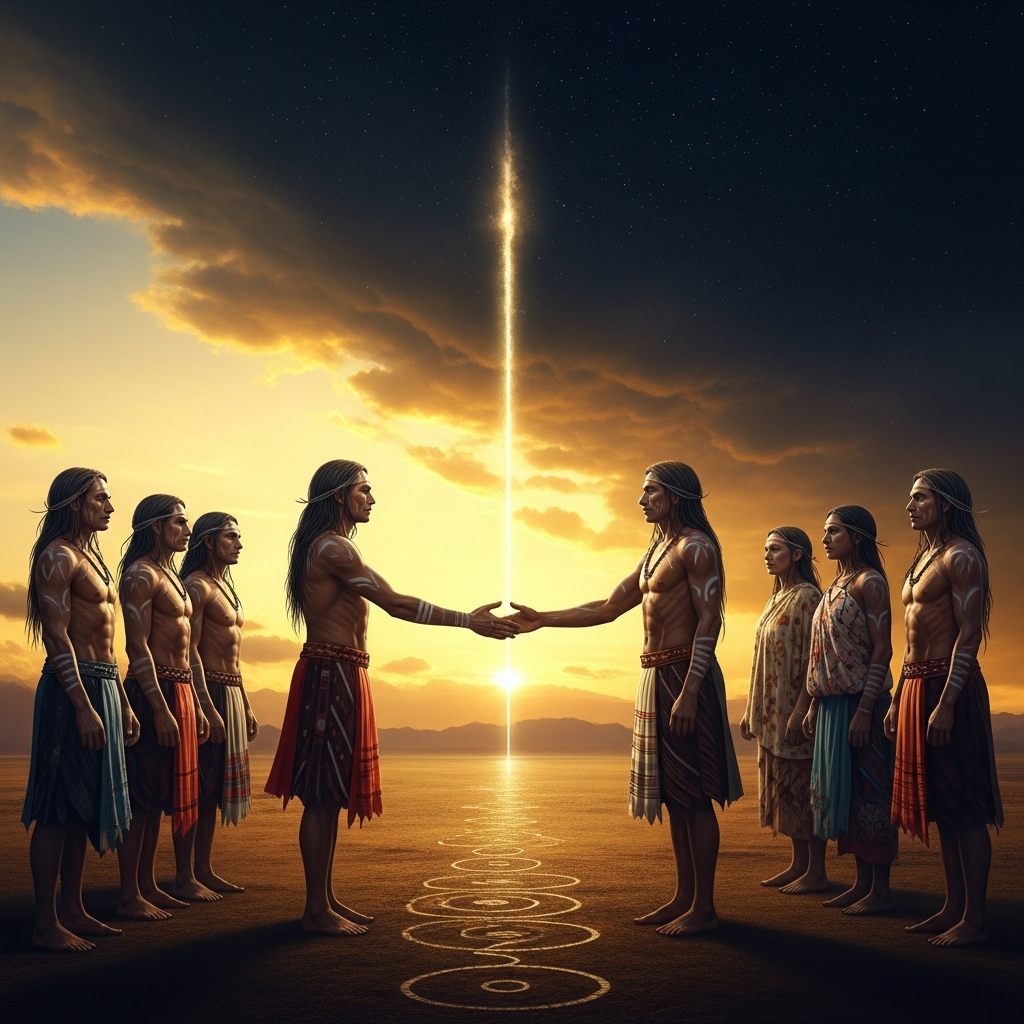
The ceremony that connects his section of the track to the neighboring group’s section happens at a specific site on the border of the two countries. He travels there once a year for the ceremony, and the neighbors come from their side, and they sing the junction together.
The junction ceremony is not a performance. It is a functional act. The connection between his group’s section and the neighboring group’s section must be maintained in ceremony for the Songline to function as a continuous path — for the Eagle Hawk Ancestor to be able to move the full length of its track, which is what the track is for, and without which both sections become isolated fragments instead of a living route.
He describes the ceremony in the way he describes everything: carefully, giving the outside of it, holding the inside. The outside is this: two groups arrive at the border site. Each group sings its final verses, or its opening verses, in the right order, in the right language, at the right time of day. The singing overlaps at the junction — his group’s last verse and the neighboring group’s first verse are sung simultaneously, braided together at the border, so there is a moment when both voices are present and neither has ended yet, and in that moment the seam between the two sections is sealed.
He watches the overlap very carefully every time. The seam must be clean. A clean seam means the track is whole. A track that is whole is a track the Ancestor can still travel.
The question that troubles outsiders, he says, is whether he believes this is true or whether he performs it because it is his tradition.
He looks at this question the way he looks at a bird at a distance — steadily, waiting to see what it does.
“I don’t separate those things,” he says.
He does not mean that he is unable to think critically, or that he is culturally captured, or that the distinction between belief and performance is one he has simply never encountered. He means that the question assumes a gap between what you believe and what you do, and in his understanding of what singing the Songline is, that gap does not exist. The singing is the believing. The believing is the singing. The Ancestor moves through the track because he sings it, and he sings it because the Ancestor is moving through the track, and these are not two things related by causation. They are one thing.
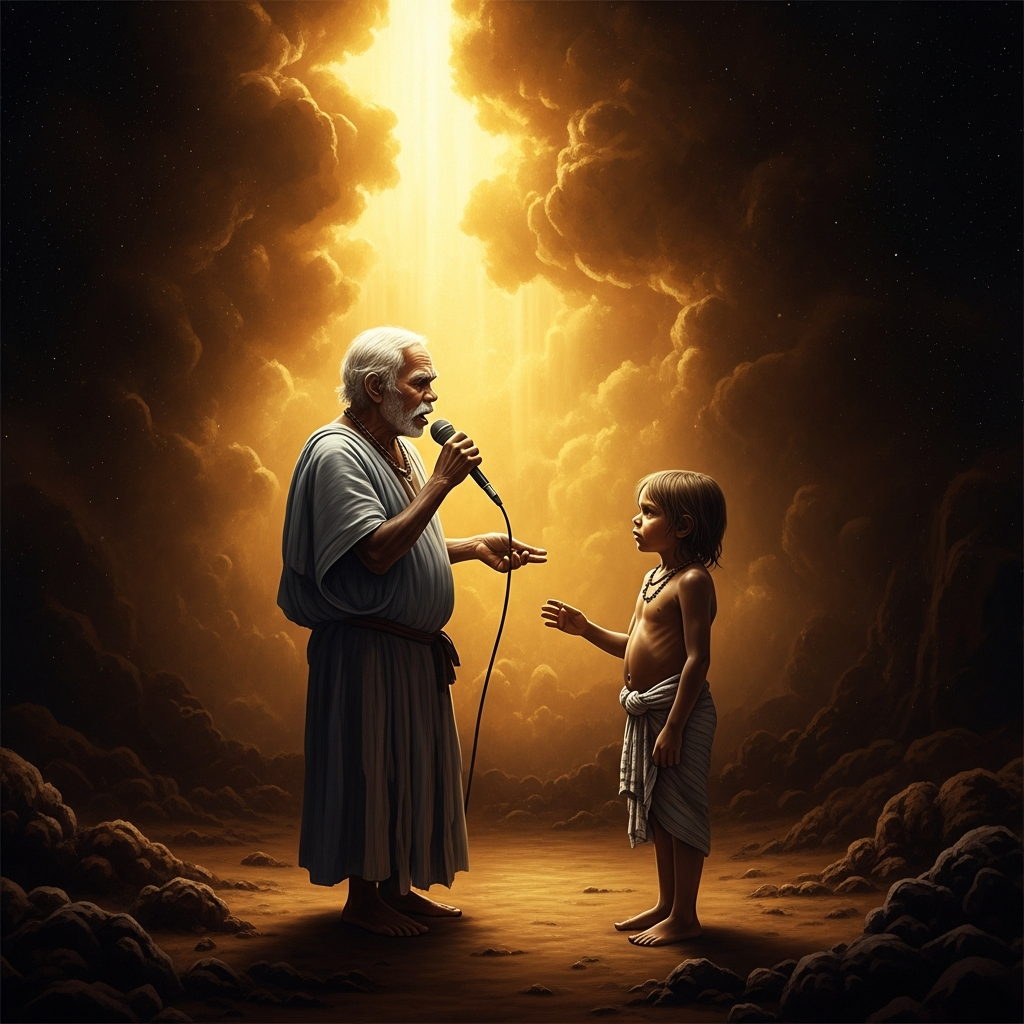
He sings the verse for the first waterhole on his track. The words are Pitjantjatjara, or the language of his country, which is not Pitjantjatjara but is close enough that a Pitjantjatjara speaker would understand most of it. The verse is six lines long. Each line is the name of a feature the Eagle Hawk passed, in the order it was passed, in the rhythm of the Ancestor’s flight. At the end of the verse, the waterhole has been named, and the naming has maintained the waterhole’s status as a site in the track, and the Eagle Hawk Ancestor is still moving.
He finishes the verse. He does not look to see if the listener understood it or felt the right thing. The verse is not for the listener. It is for the country.
The knowledge described in this story is based on the publicly shared framework of the Songline system as documented by anthropologists, ethnographers, and — increasingly — by Aboriginal Australians themselves in works like Margo Neale and Lynne Kelly’s Songlines: The Power and Promise (2020), which was produced in consultation with Traditional Owners across multiple language groups. The specific ceremonial content, the names of restricted sacred sites, and the inner meaning of particular Dreaming tracks held by specific custodians are not included here.
Bruce Chatwin wrote that the Songlines were “a way of not getting lost.” This is true in the practical sense — they function as maps, as navigational tools, as ecological guides to where water can be found in a desert landscape. It is also true in a deeper sense. The Songlines are a way of not getting lost in time, not getting lost in the question of who you are and where you come from and what you are responsible for. The man who holds the Eagle Hawk track knows exactly who he is: the current vehicle through which a 60,000-year-old song remains audible. He finds this neither burdensome nor mystical. It is simply what he is.
The land is listening. Sing.
Scenes
The Eagle Hawk Ancestor rises from the red plain and the updraft of its wings becomes a ridge of hills that runs northwest for three hundred kilometers
 Generating art…
 Two groups meet at the border of their countries for the ceremony that joins their sections of the Songline
 Generating art…
 An elder sings the Songline verse for a waterhole to a child who has the right to learn it
 Generating art…
 Echoes Across Traditions
Entities
- Wedge-tail Eagle Ancestor (the Eagle Hawk Dreaming)
- the Songline custodian
- the country
- the neighboring language groups
Sources
- Bruce Chatwin, *The Songlines* (Jonathan Cape, 1987)
- Deborah Bird Rose, *Nourishing Terrains: Australian Aboriginal Views of Landscape and Wilderness* (ATSIC, 1996)
- Margo Neale and Lynne Kelly, *Songlines: The Power and Promise* (Thames & Hudson, 2020)
- T. G. H. Strehlow, *Songs of Central Australia* (Angus & Robertson, 1971)
- Peter Sutton, *Dreamings: The Art of Aboriginal Australia* (Viking, 1988)