The Seven Sisters Run
The Dreaming (eternal / mythic time) · The Central Desert and southern Australia — and the sky above it
Contents
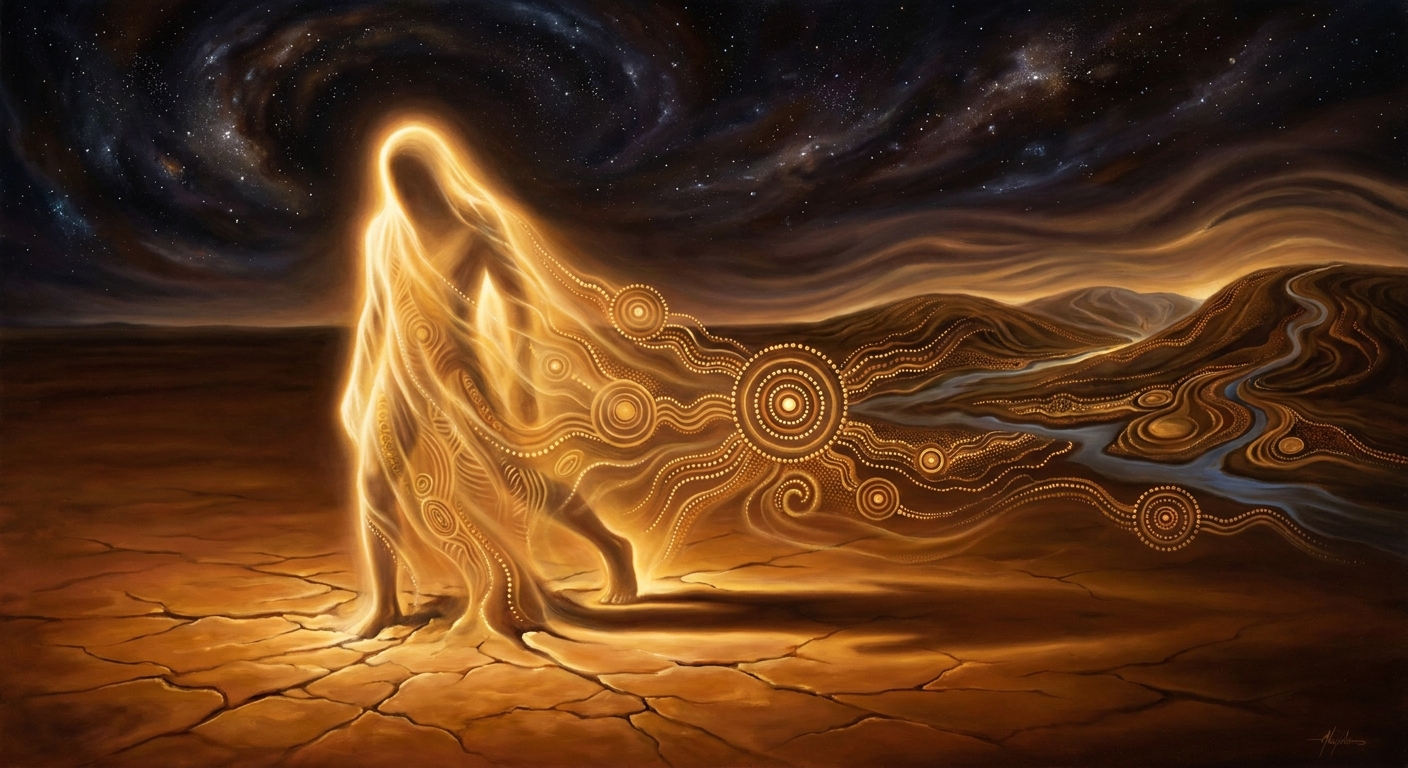
The Seven Sisters are the most widely told story in Aboriginal Australia — tracked across dozens of language groups from the Western Desert to the east coast, their Dreaming trail marked in sacred sites and carved into the sky as the Pleiades. They are still running. The man who pursues them is still just behind.
- When
- The Dreaming (eternal / mythic time)
- Where
- The Central Desert and southern Australia — and the sky above it
They are running.
They have been running since before the first fire, since before anyone was old enough to remember a time when the chase was young. Seven women moving across country — the Western Desert, the salt lakes, the red stone ridges of the ranges — at a pace that is not desperate but is absolutely sustained. They do not tire. They sleep underground and emerge rested at sacred sites they made on an earlier passage, and they continue running.
Behind them, at a fixed distance, is the man who wants one of them.
His name is Nyiru in many of the languages that carry this story. He is not evil in the way that the word evil is used in religions that have devils. He is a man who wants what he should not want, and who will not stop wanting it, and that combination — persistent desire directed at the wrong object — is its own kind of catastrophe. The seventh sister, the youngest, is the one he follows. She runs with her sisters. She is always just ahead of him.
The Central Desert in the story is not the Central Desert as a tourist sees it. It is a landscape under active creation.
Every place the Sisters stop becomes a place. Every waterhole they drink from becomes, from that moment, a site associated with their Dreaming and therefore a site with a name, a custodian, a set of obligations. The sacred sites that mark their trail across South Australia and the Northern Territory are not memorials to a past journey. They are the journey, held in the earth, accessible to anyone who has the right knowledge and the right lineage to approach them.
The Sisters move mostly at night. They know the night sky the way people who have been awake in it for ten thousand years know it — by the quality of the dark between the stars, by the feel of the air at different hours. They navigate by the position of their own future selves: the Pleiades cluster that will be, when this story reaches its end, the trace of their journey permanently installed in the sky.
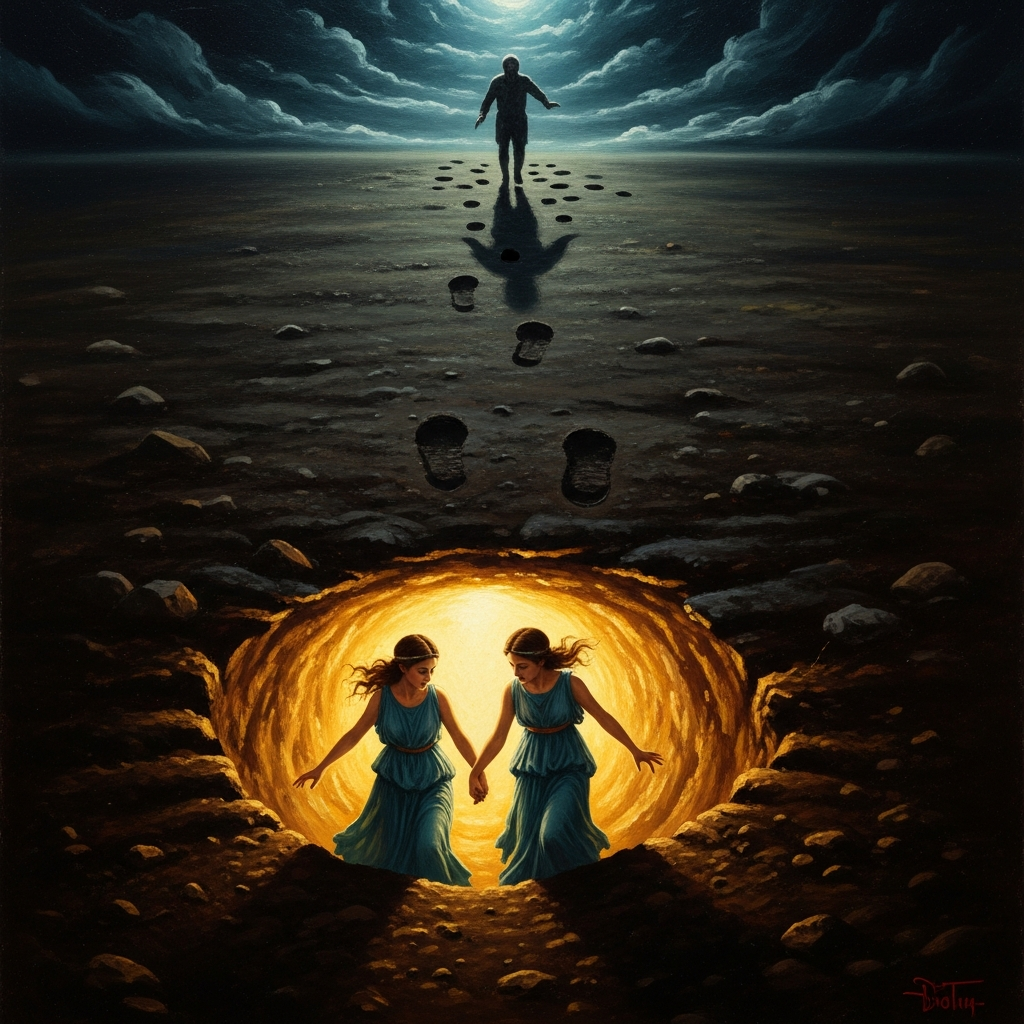
At a waterhole east of the ranges — a site whose name is not repeated here because it belongs to the women’s ceremonies of the Anangu people — the Sisters go underground.
This is one of the story’s characteristic moves. When Nyiru gets too close, when the distance closes to something uncomfortable, the Sisters do not run faster. They disappear. The earth opens for them the way water opens for a hand: they step in, and the ground closes over them, and they rest in the dark below while above them Nyiru circles the site, footprints going round and round the slight hollow in the ground, unable to find the entrance because the entrance is not a physical gap. It is a permission. It requires the right songs, the right bloodline, the knowledge of how to ask the country to open.
He does not have these things. He walks the perimeter of the site until he gives up and continues in the direction he was traveling, and an hour or a day or a season later the Sisters emerge, rested, and continue running in the same direction.
This is repeated across the length of the trail. Sacred sites accumulate along their path like knots in a rope — each one a place where they paused, went underground, rested, emerged. Each site is both the trace of their passage and the location of a ceremony that keeps their passage active. The women who hold these ceremonies, in the language groups whose country the Sisters passed through, are maintaining the Sisters’ ability to run. The ceremonies are not commemorations. They are maintenance.
The theology of the story, as it is understood by the women’s ceremonial groups who hold it, involves several things that require careful attention.
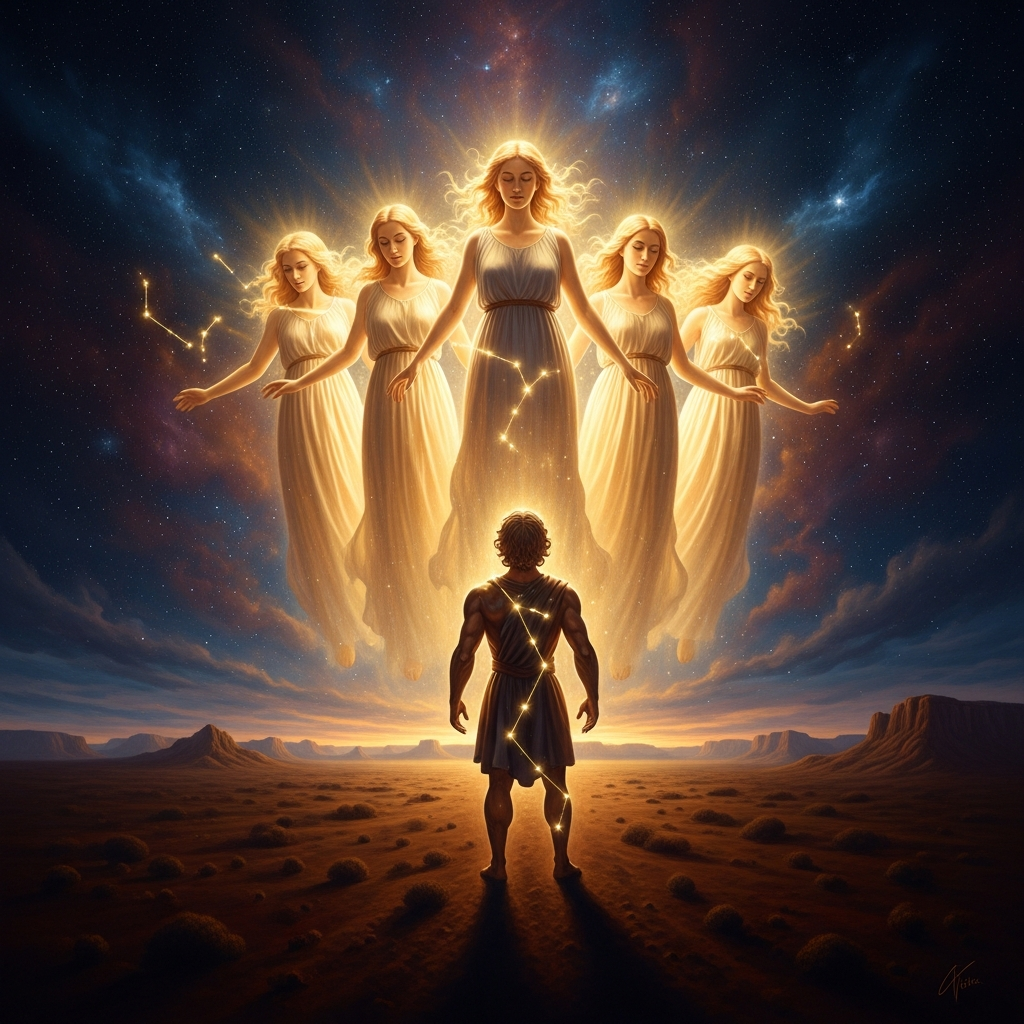
The Sisters are not characters in a story about the Pleiades. The Pleiades are the trace of the Sisters’ actual journey. When the story reached its conclusion — when the Sisters finally outran Nyiru by going permanently into the sky — the sky recorded the event and has been displaying it ever since. Every night when the Pleiades rise, what you are seeing is the moment the Sisters won. Every night when Orion’s constellation follows them across the arc of the sky, you are watching Nyiru still pursuing, still a fixed distance behind, still unable to close the gap.
The chase is not over. It is happening in the sky permanently. The fact that it is also told in story and also marked in the earth at sacred sites does not make three versions of one event. It makes one event simultaneously present in three registers — story, land, and sky — which is how the Dreaming works. The Dreaming is not a story told about the past. It is the past that is also happening now.
There is a version of the story told in the women’s ceremonies of several Central Desert and South Australian language groups — publicly shared in broad outline, privately held in specificity — in which the youngest sister is offered a choice when they reach the sky. She can go up with her sisters, or she can stay. The man who pursues her would stop pursuing her if she stayed, because the pursuit is a sky-pursuit now and he is committed to the trajectory. But her sisters would be six.
She goes up.
The Pleiades, as all astronomers know, appears to contain six stars visible to the naked eye, though the cluster has hundreds of members. Many cultures across the world have stories about the seven stars that should be there and the one that is missing. The Anangu and Pitjantjatjara stories do not typically say that one Sister is missing; they say that she is there, inside the cluster, where Nyiru cannot reach her. She is the sixth visible star. The seventh is hidden in her sisters’ company, which is the safest place.
The Pleiades rising in autumn — as seen from the southern hemisphere — is one of the markers of the ceremonial year in the language groups whose country the Sisters crossed. When the cluster appears over the horizon in the east, it is time for certain ceremonies to begin. The ceremonies are the women’s business and their specific content is not general knowledge. What is general knowledge is that the ceremonies must happen, that the women who hold them understand themselves to be active participants in keeping the Sisters running, and that if the ceremonies stopped, the country whose sacred sites mark the Sisters’ trail would lose something essential — the story would become past, the sites would go quiet, and the world at those locations would be a little more inert.
The man who documented the Sisters story across the most language groups — the linguist and ethnographer who spent decades in the Western Desert in the mid-twentieth century — wrote that he found versions of it in every language group he worked with, stretching across fifteen hundred kilometers, each version distinct in its detail and consistent in its fundamental shape: seven women running, a man behind them, the sky at the end. He wrote that the consistency of the story across groups that had, in many cases, no direct contact with each other was one of the most striking things he had encountered in a career full of striking things.
He did not, in what he published, speculate about whether the story might have originated in a single source and spread, or whether the same stars, seen across the same latitudes, had generated the same story independently. He said he didn’t know and neither did anyone else, and the people who held the story were not interested in the question because the story was not history. It was the Dreaming, and it was true, and the women who held the ceremonies understood what they were for.
The story described here is drawn from publicly available documentation of the Seven Sisters Dreaming across multiple Australian language groups — particularly the Martu, Pitjantjatjara, Anangu Pitjantjatjara Yankunytjatjara, and Arrernte peoples. The restricted ceremonial content belonging to specific women’s groups — the specific songs, the specific site knowledge, the deep ceremonial practice — is not included here. That knowledge belongs to those women and is transmitted through proper ceremonial channels.
Look up on a clear night. The Pleiades are there. Orion follows, just behind. They have been in these positions, from the perspective of a human watcher, for as long as there have been humans to watch. The Sisters are still running. The man is still a fixed distance behind. The gap has not closed in thirty thousand years of telling, and this is not a coincidence.
Scenes
Seven women cross a red saltpan in the last light, their shadows long behind them
 Generating art…
 The Sisters go underground at a sacred site — the earth opens and they slip in
 Generating art…
 The Pleiades rise above the Central Desert horizon
 Generating art…
 Echoes Across Traditions
Entities
- the Seven Sisters (the Pleiades)
- Nyiru (the Pursuer, Orion)
- the Anangu, Pitjantjatjara, and Martu Peoples
Sources
- Duane Hamacher and Ghillar Michael Anderson, 'Identifying Seasonal Stars in Kamilaroi Astronomical Traditions,' *Journal of Astronomical History and Heritage* 13.2 (2010)
- Margo Neale and Lynne Kelly, *Songlines: The Power and Promise* (Thames & Hudson, 2020)
- Philip Clarke, *Aboriginal People and Their Plants* (Rosenberg Publishing, 2007)
- Deborah Bird Rose, *Nourishing Terrains: Australian Aboriginal Views of Landscape and Wilderness* (ATSIC, 1996)
- Josephine Flood, *Rock Art of the Dreamtime* (Angus & Robertson, 1997)