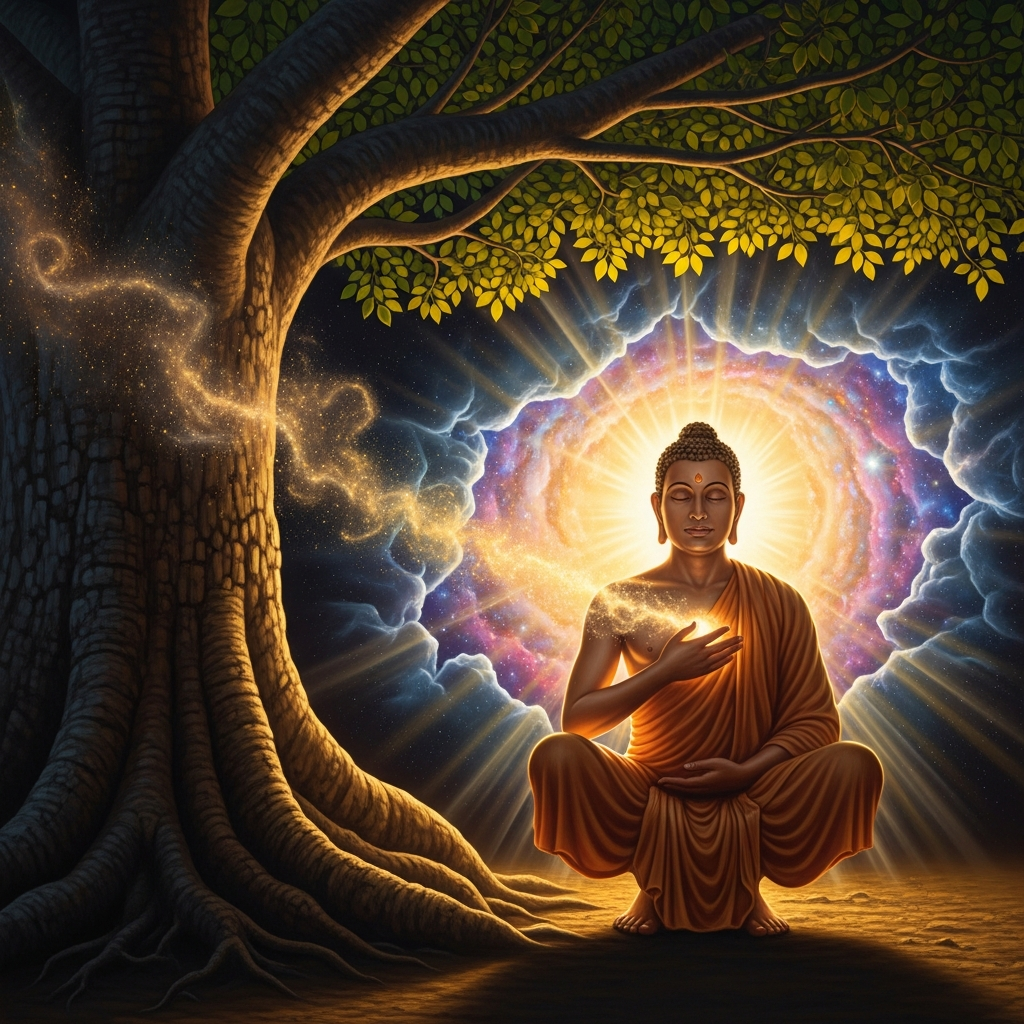
Twelve Years of Burning Off the World
c. 599–527 BCE · Vaishali district and wanderings through Magadha, Anga, Vajji · the sal grove near the Rijupalika river, Jambhiya district — after twelve years of wandering barefoot across the Gangetic plain
Contents
At thirty, the nobleman Vardhamana pulls out his own hair by the roots, walks naked into the forest, and spends twelve years in near-total silence, eating almost nothing, speaking to no one, standing in the heat and the rain and the cold until the last particle of karma burns away. Under a sal tree near the Rijupalika river, in his forty-third year, he becomes Mahavira — the Great Hero — and achieves omniscience.
- When
- c. 599–527 BCE · Vaishali district and wanderings through Magadha, Anga, Vajji
- Where
- the sal grove near the Rijupalika river, Jambhiya district — after twelve years of wandering barefoot across the Gangetic plain
He is thirty years old and owns nothing that he has not already decided to return.
His parents took the vow of sallekhana two years ago — the Jain practice of ritual fasting unto death, chosen freely, the soul’s final assertion of will over body — and starved themselves into liberation while he watched. The kingdom passes to his brother. His wife and daughter sleep in the rooms of a palace that already feels, to Vardhamana, like a coat he is still wearing but has mentally hung up. He takes the rings from his fingers. He takes the gold cord from his throat. He places them on the silk with the careful precision of a man returning borrowed tools. He does not wake anyone. There is no one with the authority to forbid him.
He walks out of Kundagrama under a winter moon.
In the Jnatrikhanda grove outside the city he stops beneath an ashoka tree and sits down in the dirt.
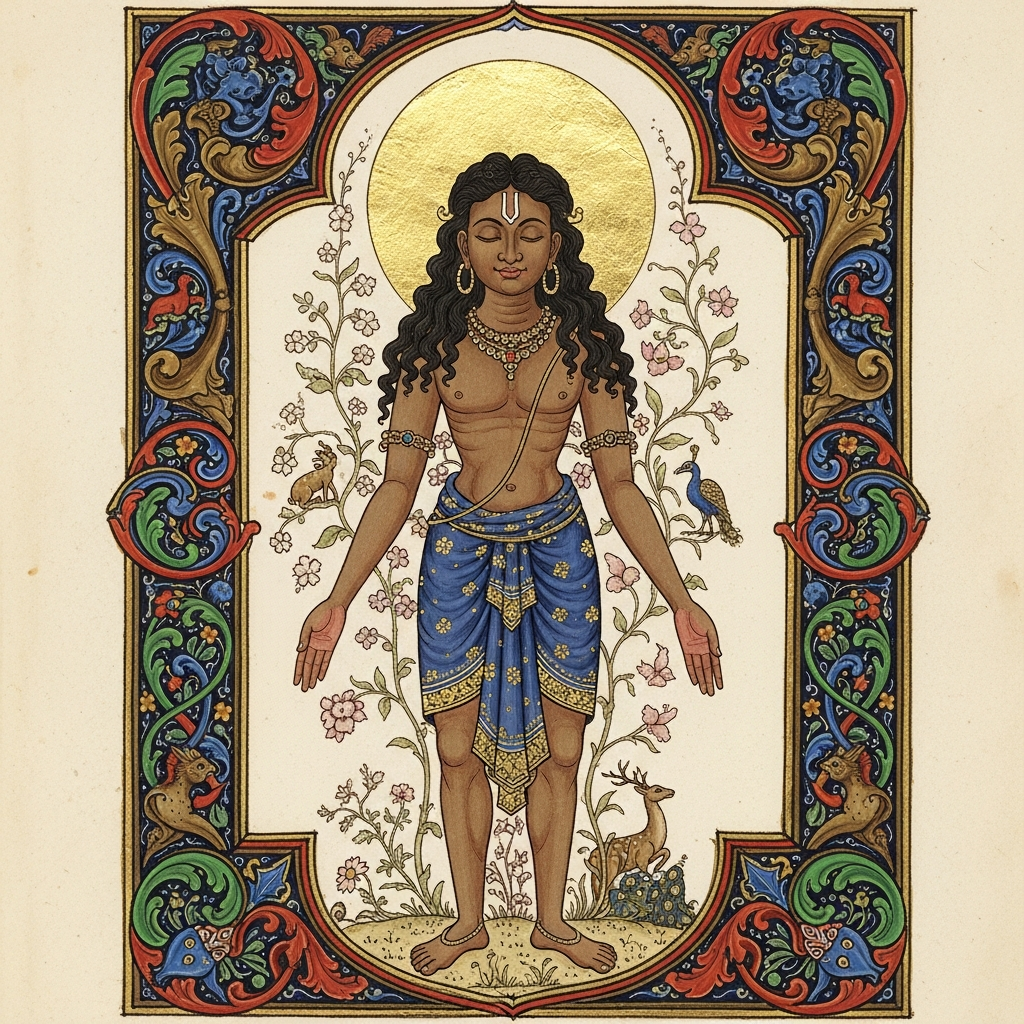
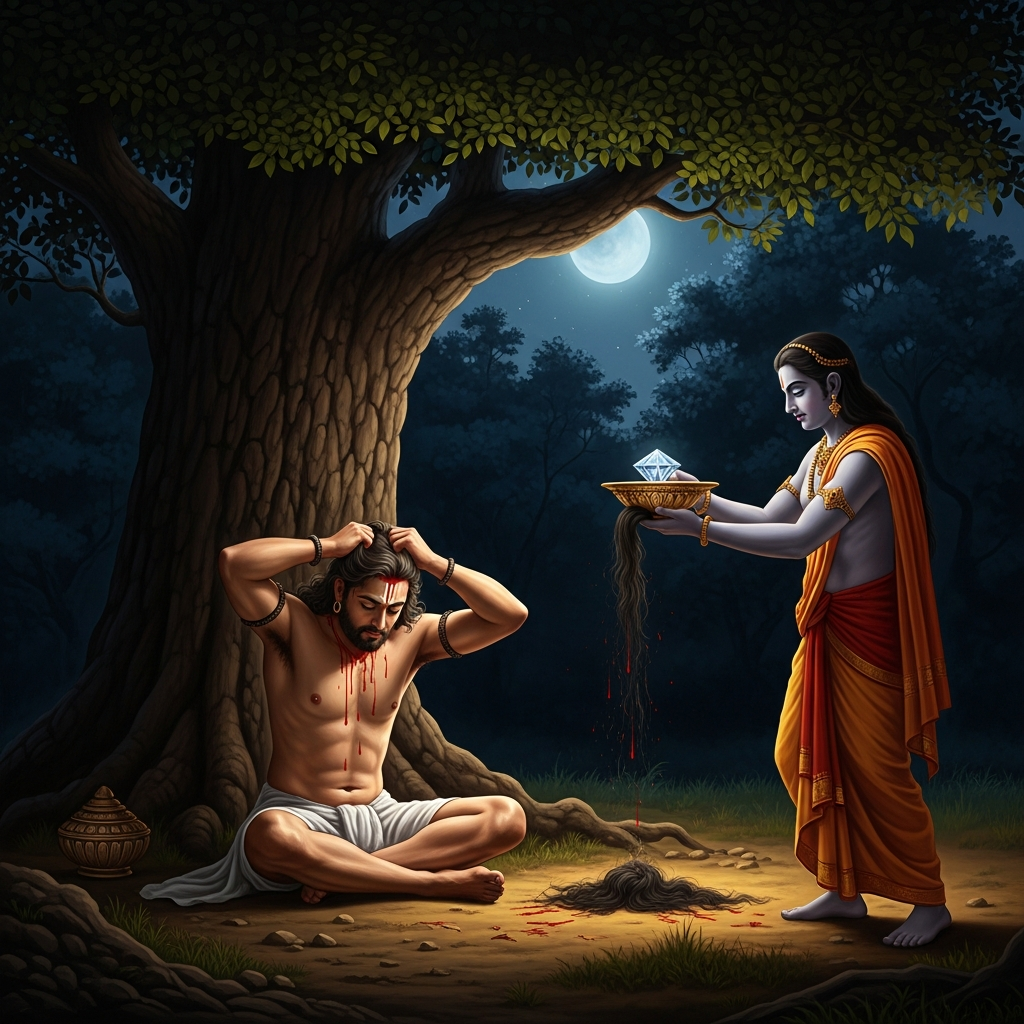
He removes his outer robe and folds it. He removes his inner robe and folds it. He is naked now and the cold is thorough and he sits with his spine straight and his breath slowing and reaches up and takes a fistful of his own hair at the root. He pulls. Once. Twice. Three times. Four. Five fistfuls, torn at the root, the scalp raw and bleeding. The Kalpa Sutra counts the fistfuls; this number matters. Every Jain monk ordained for the next twenty-six centuries repeats this gesture at initiation — panca-mushti loca, the five-fisted plucking. No razor. No assistant. No ceremony softening the act. The point is that it hurts and he does it to himself.
The sky, the text says, opens. Indra descends with a diamond bowl and catches the falling hair before it can touch the ground. He carries it to the Milk Ocean. The cosmos notes the beginning of the ascesis and agrees to stay out of it.
He does not speak for nearly the entire twelve years.
He walks across Magadha, Anga, Vajji, the kingdoms that are now archaeological evidence. He walks barefoot. He walks naked, which means he sleeps where he stands, eats what is placed in his cupped palms by someone who did not kill for him, did not prepare the food specially for him, and did not think an unkind thought while preparing it — conditions that are met, at most, once every few days. He stands in the rain. He stands in the sun. He fasts for six months and breaks the fast on cold rice. In the village of Ladha, children throw stones at him and he counts the stones the way he counts breaths. In other villages, dogs are set on him. In at least one account, antagonists drive iron nails into his ears.
He does not brush the insects away. He does not step around the ant. He registers each blow, each bite, each burning hour of summer, and does not flinch and does not retaliate and does not hurry — because the point is not to reach the end of the walk. The point is to burn.
Karma — the Jains are specific about this — is not metaphor.
It is matter. It is fine particles, real particles, adhering to the soul the way soot adheres to iron, accumulated across uncountable previous lives of desire and aggression and attachment. You cannot pray it off. You cannot have it forgiven by a god, because in the Jain cosmos there is no god in the transactional sense — no being above you who holds your ledger and can choose to write it off. You burn karma with tapas, austerity’s heat, the way a smith burns slag out of iron. The body is the forge. The discomfort is the fuel. The soul is what remains when everything that was clinging to it is gone.
For twelve years, Mahavira is a forge. He feeds it everything.
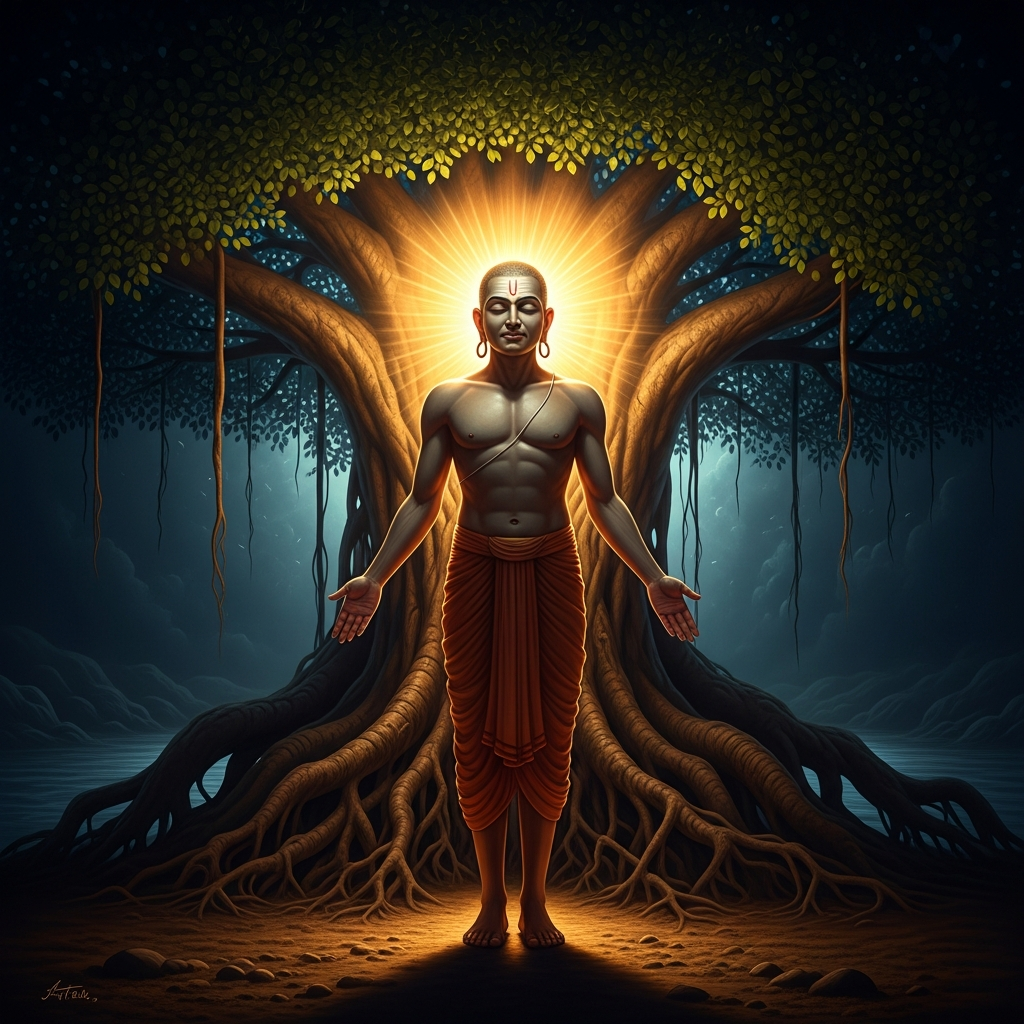
The thirteenth year, in the second month of summer, in a field near the Rijupalika river owned by a man named Samaga, squatting in the godohika posture — heels beneath the buttocks, the back unsupported, the sun on the crown of the head — the last karma-particle burns away.
The texts are exact about the timing because the moment is the hinge of Jain history: kevala-jnana opens. Omniscience. Not insight, not vision, not expanded awareness — total knowledge. Every soul in every realm of the cosmos. Every karma-particle on every soul. Every past life and every future moment of every being, simultaneously, without effort or mediation, the way light fills a room when a window is opened. He sees the whole cosmos at once, in its entirety, and does not flinch, because there is nothing left in him capable of flinching.
He holds it the way the sky holds weather — completely, without opinion.
He walks out of the field and teaches for the next thirty years.
His first disciples are eleven ganadharas, scholars who debate him and lose and stay. The tradition he hands them is precise: the five great vows — ahimsa (no harm), satya (no lies), asteya (no theft), brahmacharya (no sensual indulgence), aparigraha (no possession) — and the twelve disciplines of ascetic conduct, and the doctrine of anekantavada, the many-sidedness of truth, which says that every claim about reality is true from one angle and false from another and the honest thinker marks the angle before making the claim. He teaches in the language of the people, not the priests. He teaches that every living thing has a soul, down to the microorganism in the soil, and every soul can in principle achieve what he achieved — in this life, or the next, or the one after.
He dies at Pavapuri at age seventy-two in the posture of body-abandonment: feet together, arms hanging free, having not eaten in forty-eight hours. His last sermon is thirty-six hours long.
The sal tree near the Rijupalika is gone; the grove at Pavapuri where he died is now a Jain temple complex, the Jal Mandir, surrounded by a rectangular lotus pool. Pilgrims from five continents bathe in the pool and circumambulate the shrine where the omniscient man died in the same posture he stood in on the worst days of the twelve years, arms hanging loose, ready.
Scenes
Midnight, the Jnatrikhanda grove
 Generating art…
 Year seven of the wandering
 Generating art…
 Second month of summer, year thirteen
Generating art… Echoes Across Traditions
Entities


Sources
- *Acaranga Sutra* 1.7-9 (the oldest account of Mahavira's wanderings and enlightenment)
- *Kalpa Sutra* (Bhadrabahu, c. 4th century BCE; Hermann Jacobi trans., *Sacred Books of the East* vol. 22, 1884)
- *Uttaradhyayana Sutra* (contains doctrinal summaries attributed to Mahavira)
- Paul Dundas, *The Jains* (Routledge, 2nd ed. 2002)
- Padmanabh S. Jaini, *The Jaina Path of Purification* (University of California Press, 1979)
- Kristi L. Wiley, *Historical Dictionary of Jainism* (Scarecrow Press, 2004)