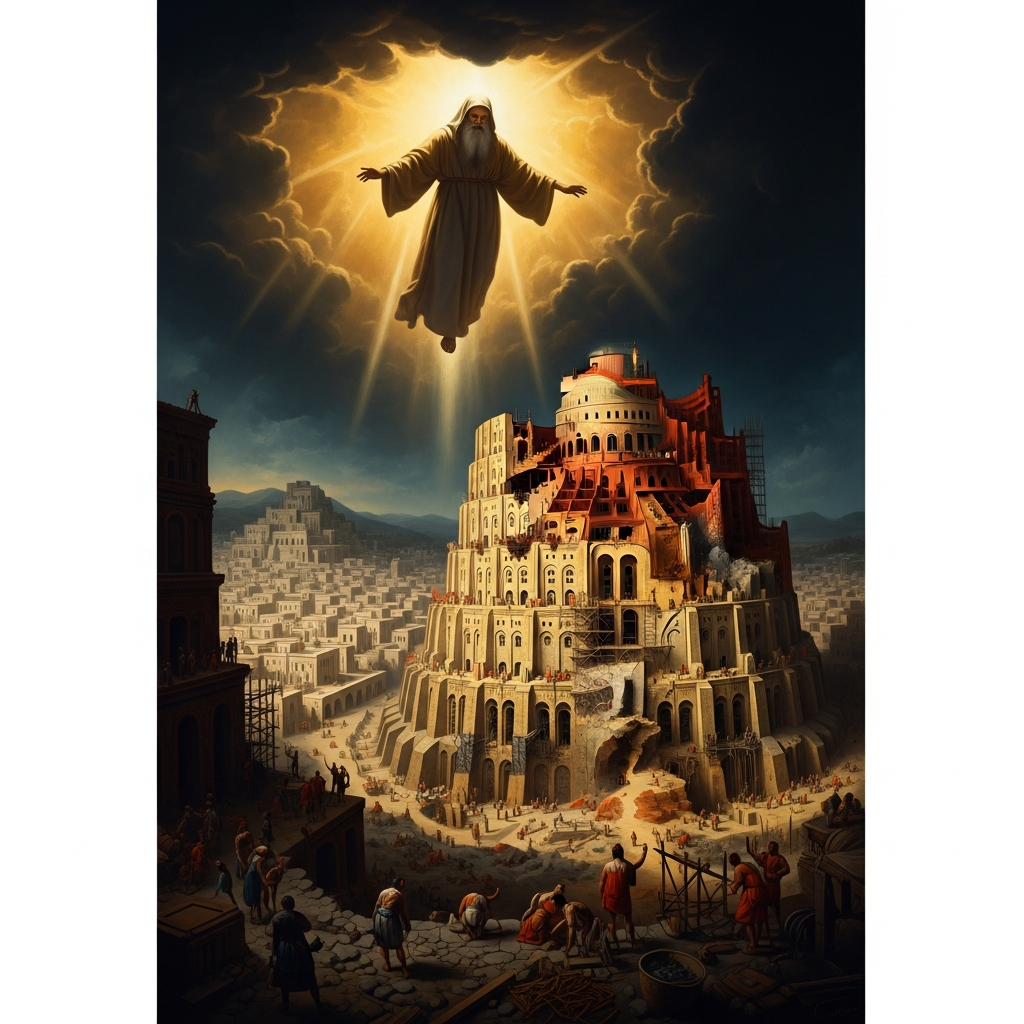
The Tower of Babel and the Scattering
Mythic Time · text from Genesis 11, redacted ~600–500 BCE; Babylonian background ~600 BCE · The plain of Shinar — Babylon
Contents
One people with one language begin building a tower to heaven. God descends to see what they can accomplish together and decides to stop them — not by destroying the tower, but by destroying the unity of speech itself.
- When
- Mythic Time · text from Genesis 11, redacted ~600–500 BCE; Babylonian background ~600 BCE
- Where
- The plain of Shinar — Babylon
The whole earth speaks one language and uses the same words.
Not metaphorically — the same sounds, the same words for brick and water and sky, the same word for the thing a man means when he says I want. They travel east, following the rivers as rivers have always gathered people, and they find a plain in the land of Shinar, flat and vast and without natural boundary, the kind of land that becomes anything you decide to make it. They look at each other and arrive at the same conclusion simultaneously, which is what happens when all minds share all words: we can build here. We can build anything. We can build something permanent that says we were here and that we mattered and that nothing can reach us once we have built it high enough.
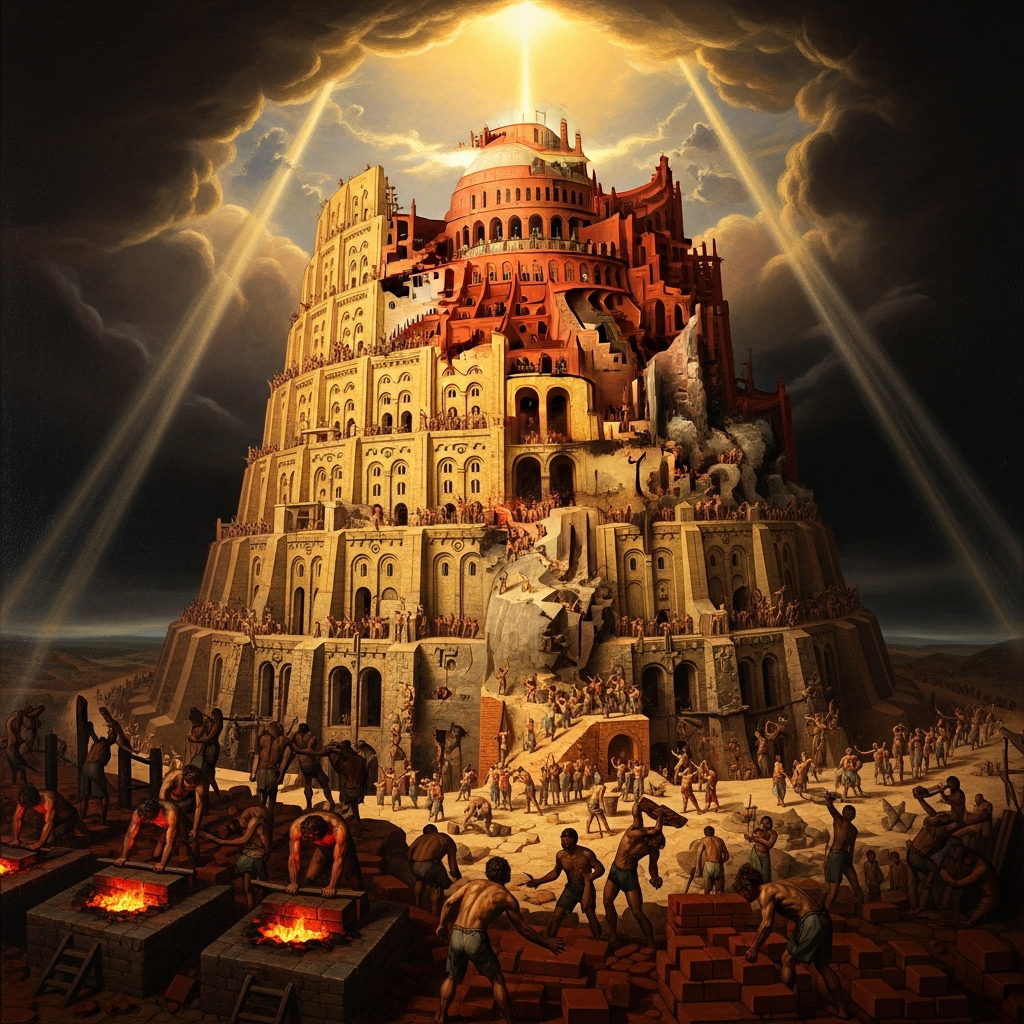
They have fire and they have clay.
They burn the clay into brick, and brick is a technology of permanence — sun-dried mud dissolves in rain, but kiln-fired brick outlasts the people who made it. They have bitumen for mortar, the black tar that seeps from the ground in Shinar, adhesive and weatherproof and ancient. The text names these materials with the precision of a building manual: brick for stone, bitumen for mortar. They are not being metaphorical. They are engineers. They are building a city with a tower whose top reaches the heavens — not a poetic top but an architectural one, a thing that actually rises higher than anything that has been built before, a thing that says: we are not scattered, we are one, we have a name, and the name will not be forgotten.
The whole point is the name. Let us make a name for ourselves, they say, lest we be scattered over the face of the whole earth. They know scattering is possible. They are building against it.
God descends.
The text is precise and devastating in its precision: The Lord came down to see the city and the tower that the children of men had built. God comes down to see. From wherever God is, the tower is too small to be seen without descending — which means the tower that these people have built as an attempt to reach heaven is not, from heaven, actually very tall. It is the work of small creatures building as high as small creatures can build, and it has reached perhaps knee height from where God stands. God kneels, effectively, to look at it.
What God says next is not a judgment of evil. There is no accusation of sin in the passage. God says: Look — they are one people with one language, and this is the first of what they will do. Now nothing they scheme to do will be impossible for them. The threat is not that they are wicked. The threat is that they are competent, and that unified competence in humans is not something the divine order can accommodate.
God does not destroy the tower.
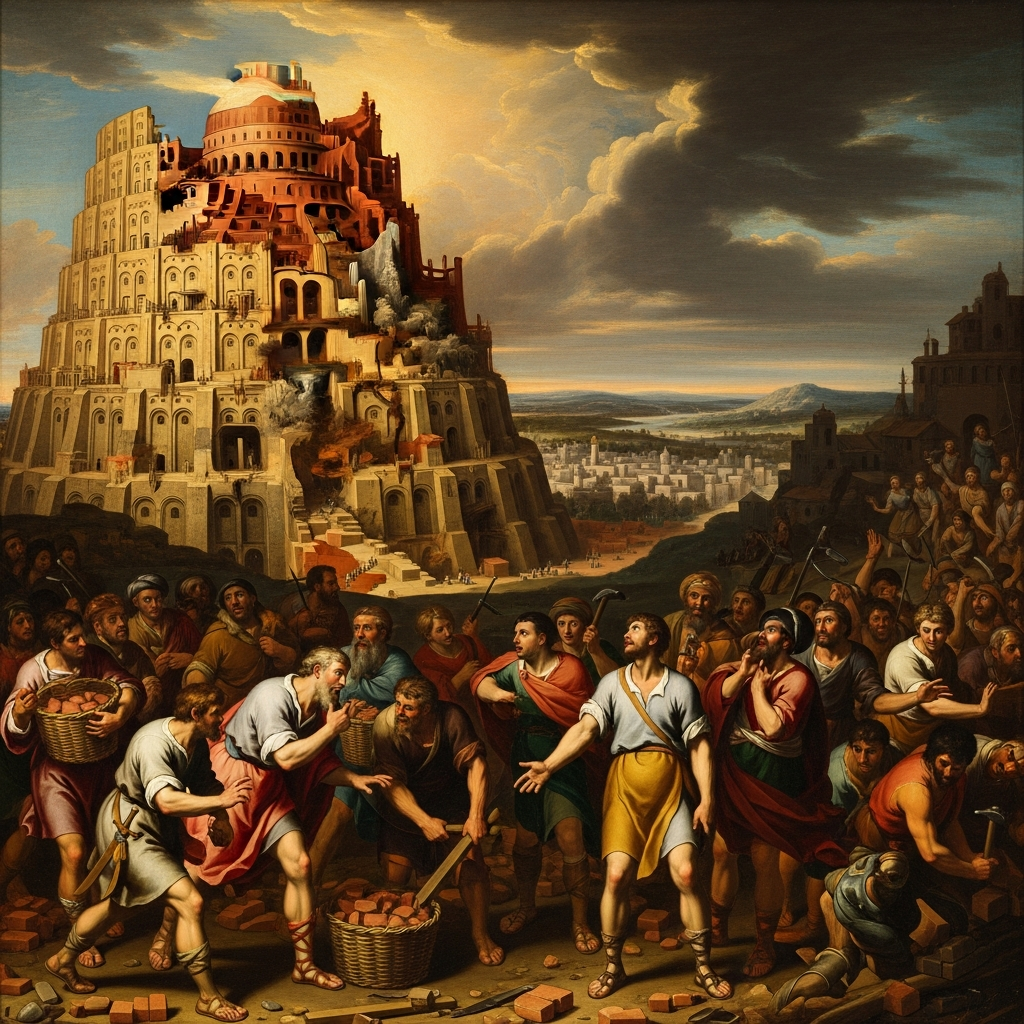
God destroys the conversation. Come, let us go down and confuse their language there, so that a man will not understand what his neighbor says. The tower stands. The brick remains. The bitumen holds. The city is still there. But the builders turn to each other and the mouths of their neighbors are making sounds that do not resolve into meaning, and what was a unified project, a single collective will driving thousands of hands in the same direction, becomes a thousand separate peoples each hearing only noise from every other. Work stops. Not because anyone orders it stopped. Because coordinated work requires shared language and there is no more shared language and so there is no more coordinated work.
They scatter over the face of the whole earth — which is the thing they were building to prevent. The city they name Babel, the gate of god, which in Hebrew sounds like the word for confusion, balal, so that the city’s name becomes its own etymology: the place where God confused the speech of the whole earth.
The tower is never mentioned again.
It stands on the plain of Shinar, half-finished, no one tending it, the scaffold still up, the mortar still wet in the last courses of brick. The workers who laid those last courses are already walking in different directions, each in a group who speaks the same new language, each group gradually forgetting that they were once part of something larger. In a generation the plain is empty. In a century the tower begins to degrade at the edges, the upper courses losing bricks to wind and weather. In a millennium it is a ruin. In the sixth century BCE, when the Hebrew scribes who are captives in Babylon look up at the ziggurat of Marduk — the Etemenanki, House of the Foundation of Heaven and Earth — they see the tower still standing in the plain and they write the story of how it came to be unfinished, because they are exiles in Babylon and they understand, from experience, exactly what it feels like to have your language become useless in a city full of voices that mean nothing.
The god of Genesis does not forbid ambition; he forbids the particular power that comes when human beings understand each other completely — because that power, the text implies, has no ceiling, and the universe apparently requires that we remain, to some irreducible degree, alone in our own skulls.
Scenes
The whole earth speaks one language
 Generating art…
 God comes down to see the city and the tower that the children of men are building, and what he sees changes everything
Generating art… The builders turn to each other and hear only noise
 Generating art…
 Echoes Across Traditions
Entities
- YHWH
- the sons of men
- Nimrod
Sources
- Genesis 11:1–9 (Hebrew Bible)
- Robert Alter (trans.), *The Hebrew Bible: A Translation with Commentary* (W. W. Norton, 2018)
- Samuel Noah Kramer, *History Begins at Sumer* (University of Pennsylvania Press, 1956)
- Andrew George, *The Babylonian Gilgamesh Epic* (Oxford University Press, 2003)