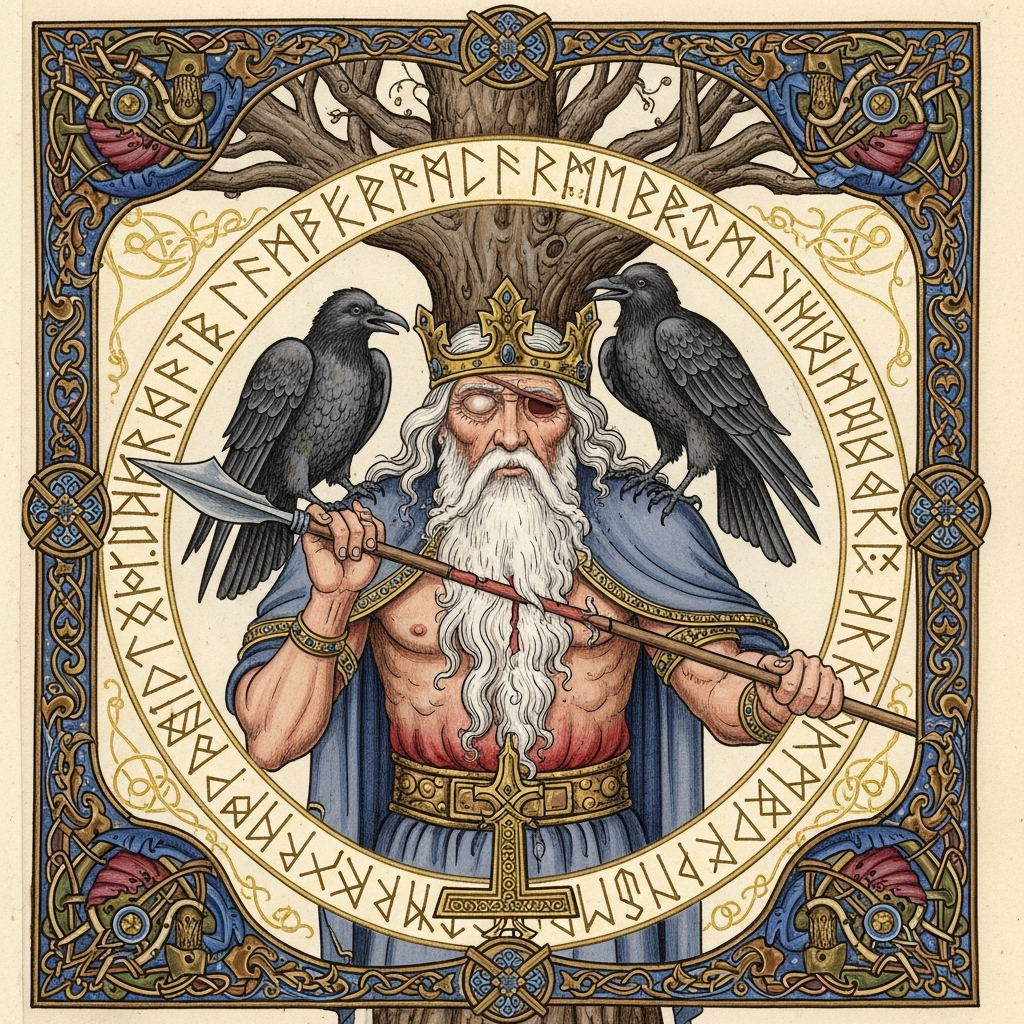
Huginn and Muninn: The Eyes of Odin
Mythic time — daily, since the world began (attested in *Grímnismál* 20, Poetic Edda; also *Prose Edda*, Gylfaginning) · All nine worlds — from Asgard at dawn to Niflheim's edge, and back before dark
Contents
Every morning at dawn, Odin sends his two ravens across the nine worlds to observe everything that lives and moves. Huginn carries Thought. Muninn carries Memory. They return at dinner and whisper in Odin's ears. Odin fears for Huginn when they are gone — but fears more for Muninn. A single day in Huginn's flight, and what it means that the cosmos is witnessed.
- When
- Mythic time — daily, since the world began (attested in *Grímnismál* 20, Poetic Edda; also *Prose Edda*, Gylfaginning)
- Where
- All nine worlds — from Asgard at dawn to Niflheim's edge, and back before dark
Odin’s shoulder is where they begin.
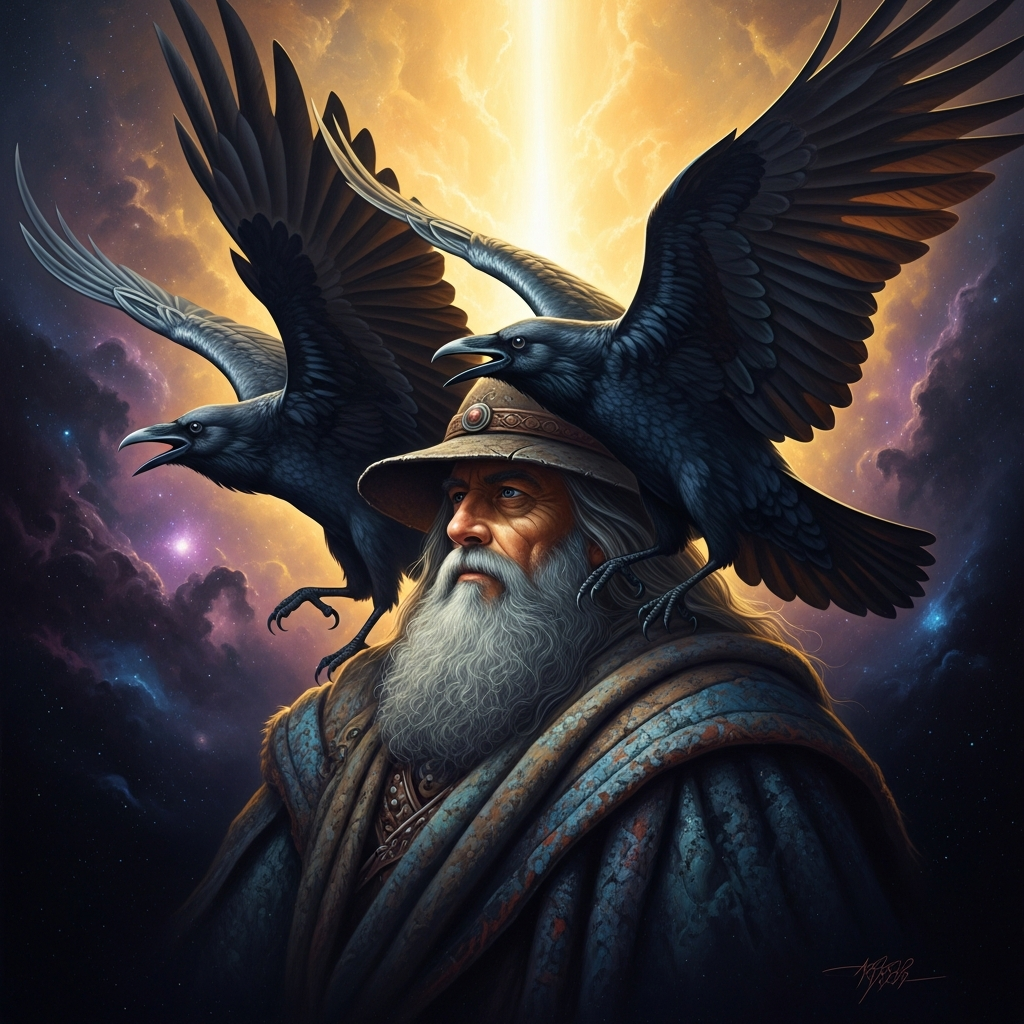
Every morning at the first graying of the sky over Asgard — before the gods have risen, before the einherjar in Valhalla have begun their daily violence — Huginn and Muninn lift from his shoulders in the dark and fly out of the hall’s high windows. He watches them go. He watches until they are gone. He has done this since the world had ravens in it and will do it until the world no longer does, and he has never watched them leave without the specific dread of a man releasing something he cannot replace.
He fears more for Muninn.
The Grímnismál is clear about this: I fear for Huginn, that he comes not back, / yet more for Muninn do I care. Thought might wander. Thought might get distracted by the sheer volume of what is happening across nine worlds and fail to make it home by dinner. But if Memory does not return — if Muninn is lost over Jotunheim or falls into the sea that surrounds the world or is taken by something that knows what Odin’s ravens carry — then the universe continues to exist but becomes unwitnessed. And an unwitnessed universe is, in the Norse account, a worse disaster than a destroyed one.
Huginn leaves Asgard first.
He is the faster of the two — not by much, but enough that he reaches Midgard while Muninn is still crossing Vanaheim. He circles down toward the coast of Norway, where the world is narrow and the fjords cut deep and the smell of pine and salt and smoke is the smell of humans making their ordinary desperate choices. There is a hall below him where a family is eating and arguing about land; he does not stop. There is a ship crossing the Hardangerfjord in weather that will worsen; he circles it once and carries away the picture. There is a battlefield — there is almost always a battlefield — where men are dying in the particular graceless way that men die in battle, nothing like the sagas, nothing clean.
He watches the battle with the attention of a creature for whom attention is not a faculty but a nature. He does not choose what to observe. He observes everything. The man who dies on his own spear because he tripped on a corpse. The boy who turns and runs and lives. The jarl’s son who is braver than anyone expected and dies because of it. Huginn carries all of it away.
Below him, the actual crows are landing on the actual dead. They are always slightly ahead of him, the crows; they seem to know something is going to happen before it does, which is a thing Huginn has never entirely understood about crows.
He crosses into Jotunheim in midmorning, where the scale changes.
The mountains here are mountains the way the mountains in Midgard are not — they are the mountains of the world’s imagination, peaks whose tops are in clouds that are in clouds. The giants who live in them are not always visible; sometimes a mountain is a giant and you only realize it when it moves. Huginn is small enough that he is not interesting to most of them, which is the advantage of being a raven in a world of things that are large. He banks above a valley where a giant woman is grinding grain in a quernstone the size of a house, and he carries away the sound of the grinding, and he carries away the smell of the grain, and he carries away the look of her face, which is not the face of something malicious but the face of something that is simply enormous and has always been enormous and finds the size of gods and humans faintly amusing.
There is one giant who is always awake in Jotunheim, watching the sky. He sees Huginn pass and makes a gesture that might be a greeting. Huginn does not respond. He is not here for diplomacy.
He comes to Yggdrasil from the east.
The World Tree is not a tree you approach without it affecting you, even if you are a raven who has made this approach ten thousand times. It is too large for the eye to process as a single object; you see the roots first, then the trunk, then you realize the clouds above you are the canopy, and then you realize the canopy extends to the edge of what you can see in every direction, and then you realize you have been inside Yggdrasil this whole time without knowing it because the nine worlds are inside the tree.
He descends to the roots.
At the lowest root that is accessible without going into the mist — the one that reaches toward Niflheim, the one that Niðhöggr gnaws at from below — the squirrel Ratatoskr is running up the trunk with one of the insults he carries between the dragon below and the eagle above. Ratatoskr is always in a hurry. He sees Huginn and slows slightly and they exchange the look of two creatures who have been doing the same work in the same place for a very long time and have no interest in each other.
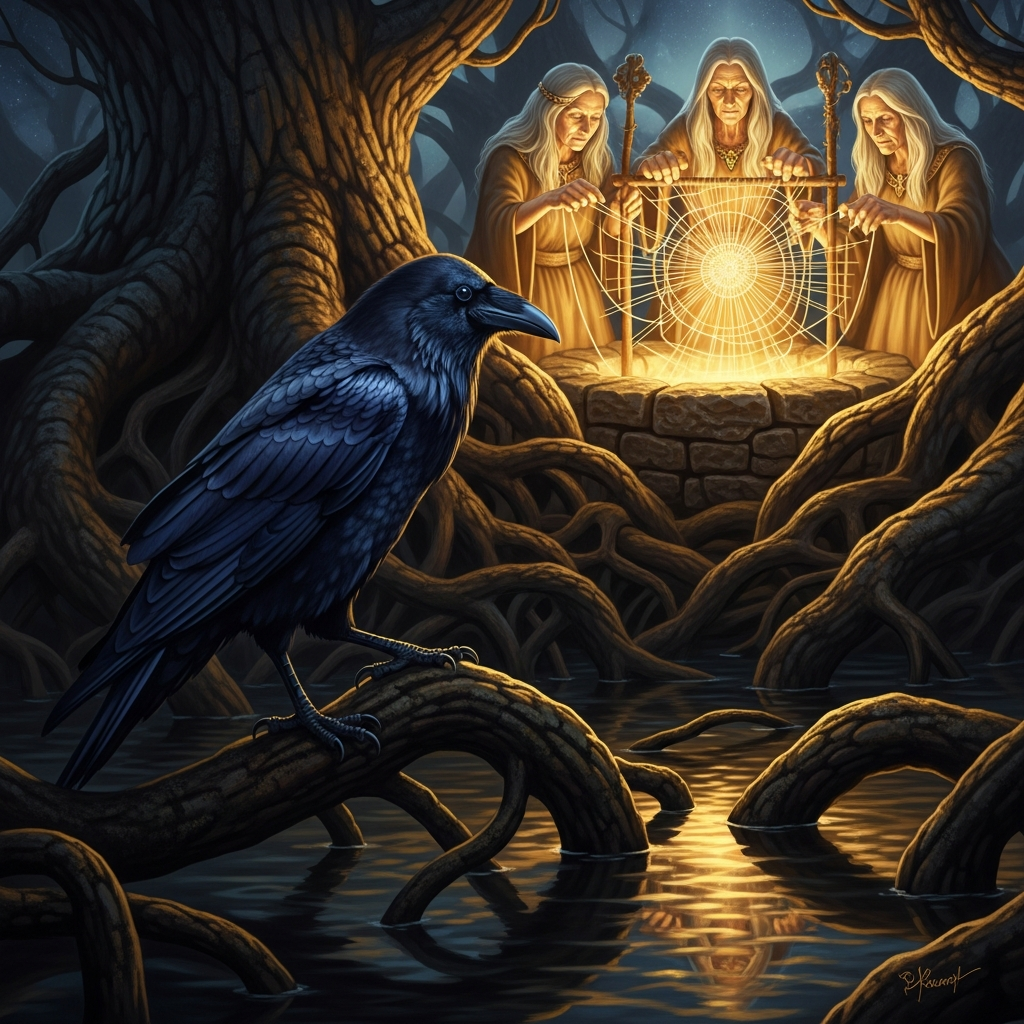
The Well of Urð is here. The Norns are here: Urð who is the Past, Verðandi who is the Present, Skuld who is the Future. They are weaving. They are always weaving; they have been weaving since before the gods were named. They do not look up. Huginn circles them once, low, and what he takes away is what he always takes away from this place: the sound of the weaving, which is the sound of everything that has ever happened and everything that is happening and everything that will, all of it running through the same loom at the same time.
He does not go into Niflheim.
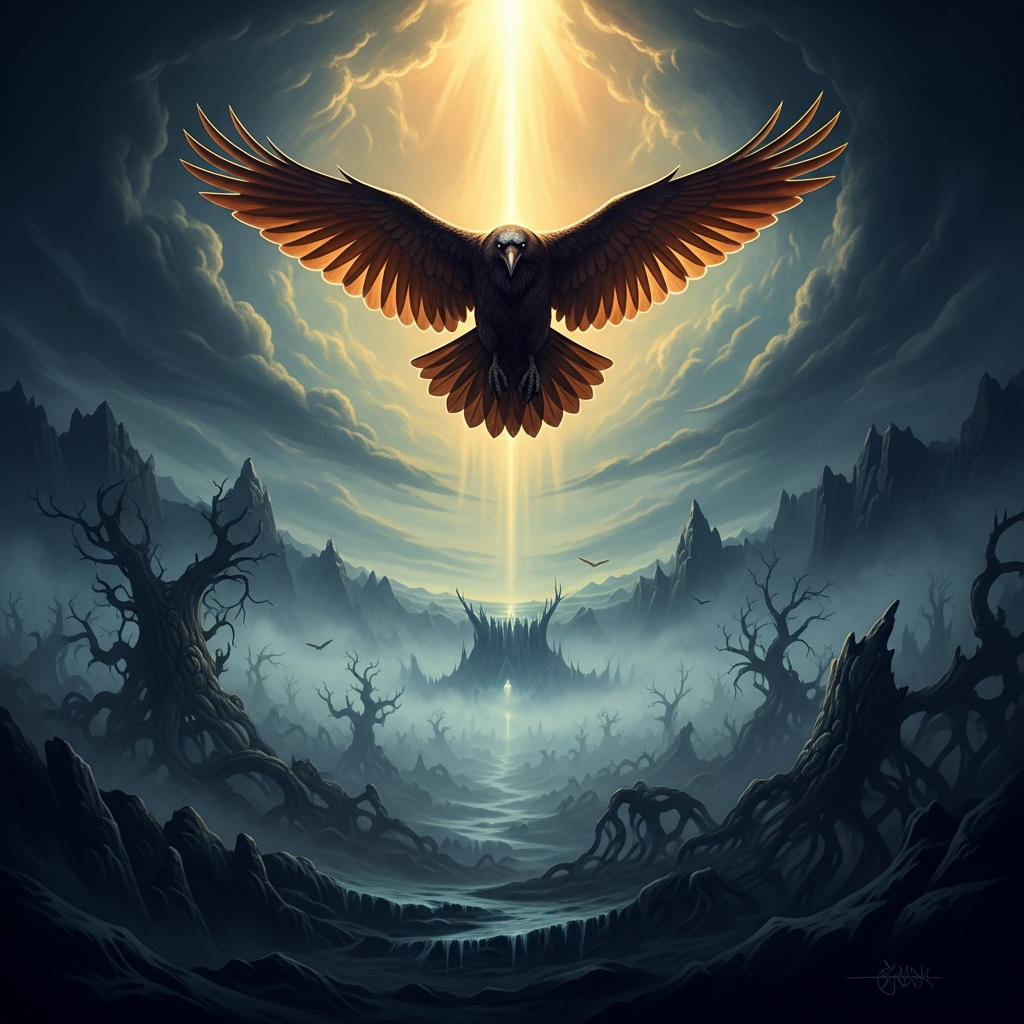
There is a rule about this — not a rule anyone stated, but the kind of rule that enforces itself. Niflheim begins at the line where the mist becomes so thick that what is inside it cannot be seen from outside, and below the mist is Hel, and below Hel is Náströnd where the worst of the dead wash up, and below Náströnd is Niðhöggr chewing at the root that holds everything together. Huginn circles the edge of the mist and looks down into it and sees nothing but white, and the white is all that prevents him from seeing what is below the white.
He carries away the white.
He turns north, toward home.
Muninn has been to different places.
While Huginn watched the present — the battle, the grinding, the Norns — Muninn was further back. He went to the places where things have already happened and left their marks: the scorched stone at Hnitbjorg where Odin was, the shore where Ragnarök will happen that already looks like a shore where something happened, the root of Yggdrasil that Niðhöggr has been chewing since before the gods and shows it. Muninn is interested in traces. He circles the marks that events leave on the world the way a geologist circles strata. He carries away not what is happening now but what everything that has happened means to what is happening now.
They meet over the sea west of Asgard in late afternoon and fly the last distance together, not speaking. They have not spoken to each other since the world began. They have never needed to.
The hall is full when they arrive. The einherjar are eating — the gods are at the long table, the mead is moving, someone is telling a story about something that happened at Utgard that may or may not be true. The din of Valhalla at dinner is the din of a place that has always been full and expects to be full forever.
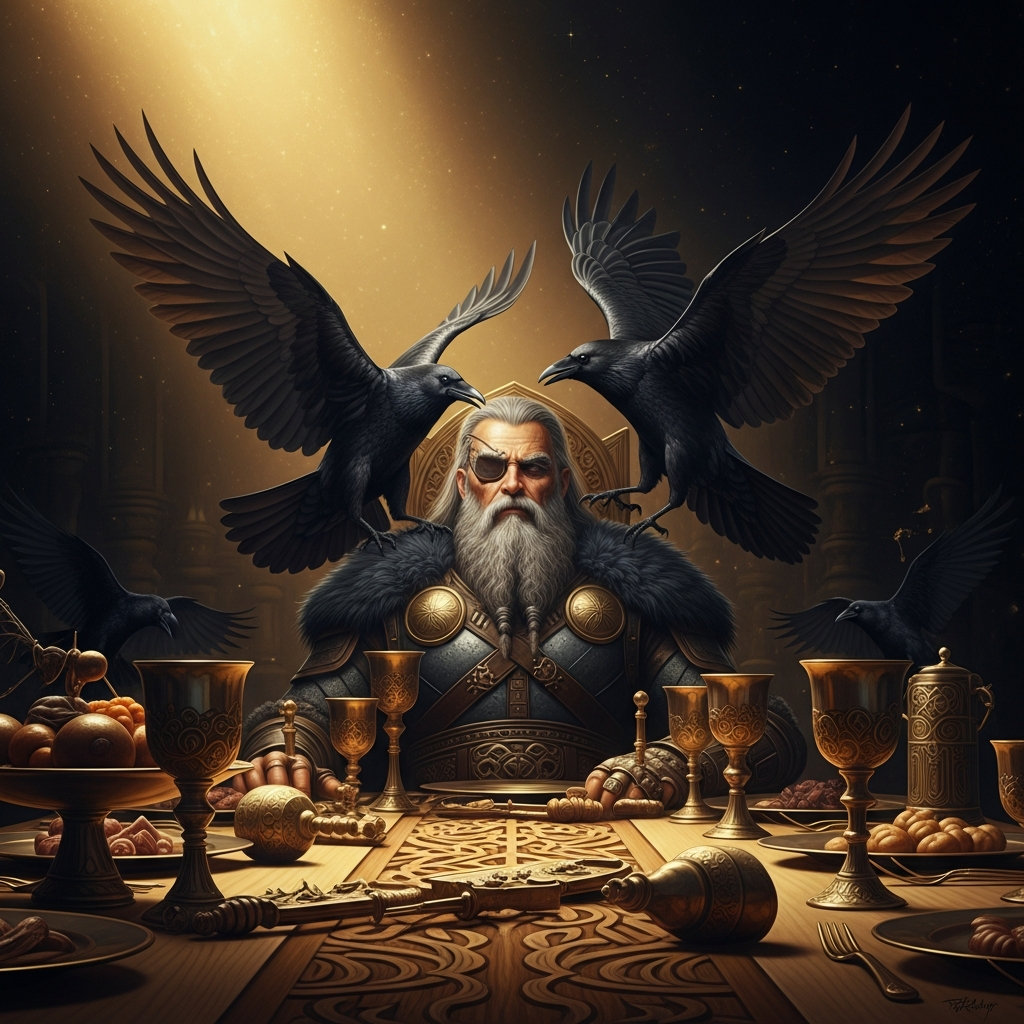
Huginn lands on the left shoulder. Muninn lands on the right.
Odin goes still.
He tilts his head left and Huginn puts his beak at the ear and speaks in the way ravens speak to the one who made them what they are — not in words, exactly, but in images, in sounds, in the smell of pine smoke and the sound of grinding and the white of Niflheim’s edge and the texture of the battle and the names of the men who died and the names of the men who ran. Odin receives all of it without expression. Then he tilts his head right and Muninn speaks.
What Muninn says takes longer. Memory always does.
No one at the table notices. No one at Valhalla’s long table has ever noticed, in all the nights since the table was built, because to notice you would have to already know what the ravens carry, and only Odin knows, which is why he sends them.
He fears more for Muninn. The line from the Grímnismál has been interpreted for centuries as a clue to something about Odin’s psychology — the god of war prefers memory to thought, or the god of wisdom knows that thought without memory is chaos. Both readings are true and neither is complete.
The complete reading is cosmological: the universe is real whether or not it is observed, but it is coherent only when it is remembered. Thought can be reconstructed from scratch. Memory cannot. If Huginn does not return, Odin thinks differently tomorrow. If Muninn does not return, the world loses its witness, and a world without a witness is a world that is becoming, increment by increment, as if it never was.
The ravens leave every morning. They return every evening. Between those two facts is the whole of creation, observed.
Scenes
Huginn and Muninn lifting from Odin's shoulders at first light in Asgard
 Generating art…
 Huginn banking over a field in Midgard where men are dying
 Generating art…
 Muninn at the roots of Yggdrasil, at the Well of Urð
 Generating art…
 Huginn above Niflheim's mist
 Generating art…
 Huginn and Muninn landing at dinner on Odin's shoulders
 Generating art…
 Echoes Across Traditions
Entities
- Huginn
- Muninn
- Odin
- Yggdrasil
- the Norns
- Niðhöggr

Sources
- *Grímnismál* 20, Poetic Edda (Codex Regius, c. 1270 CE)
- Snorri Sturluson, *Prose Edda*, Gylfaginning 38
- Rudolf Simek, *Dictionary of Northern Mythology* (1993)
- Hilda Roderick Ellis Davidson, *Gods and Myths of Northern Europe* (Penguin, 1964)
- John Lindow, *Norse Mythology: A Guide to Gods, Heroes, Rituals, and Beliefs* (Oxford, 2001)