Anansi Steals Fire from the Sky
Mythic time · Akan oral tradition, recorded ~19th–20th century CE · The sky kingdom of Nyame and the cold earth below — Akan territory, present-day Ghana
Contents
The earth is cold. Nyame keeps fire in a gourd in his sky palace, guarded by hornets. Anansi, the spider trickster of the Akan, wants it — not because he is strong enough to take it, but because he is clever enough to make Nyame give it freely.
- When
- Mythic time · Akan oral tradition, recorded ~19th–20th century CE
- Where
- The sky kingdom of Nyame and the cold earth below — Akan territory, present-day Ghana
In the beginning, the earth is cold.
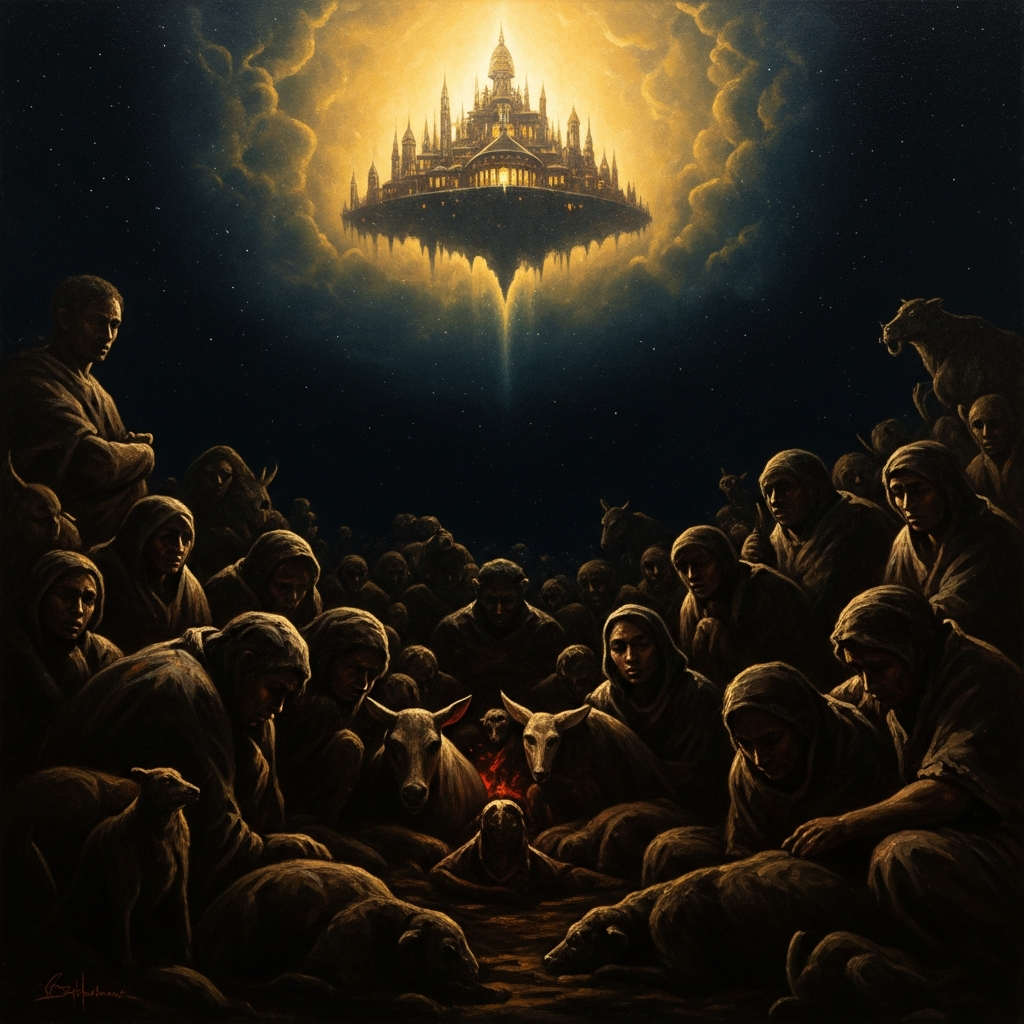
There is no fire on the earth. There is warmth in the sun, which is Nyame’s light and not a thing any creature can hold. At night the temperature drops to the temperature of absence, and the animals and the first human beings press against one another in the dark, sharing what heat their bodies can make, and it is not enough. The cold is not simply uncomfortable. It is existential. Without fire there is no cooked food, no light for ceremonies, no warmth for the children who are dying in the cold months. There is no smelting, no pottery, no forge. The animals do not have words for what they lack, but they feel the shape of the lack every night — a hollow in the center of the world where something should be and is not.
Nyame has fire. Everyone knows this. His palace in the sky glows with it, warm and golden from below, and when the sun sets and his palace lights come on, the animals on the cold earth look up and can see it. He has had fire since before the earth was finished. He is not in any hurry to share it. He is asked. Delegations go up — the eagle, who can fly; the cloud-spirit, who belongs to both sky and earth. They ask. They petition. They argue necessity, fairness, the suffering of the weak creatures below. Nyame says no each time, not cruelly, not even unkindly. He says no the way the powerful say no when they have not thought deeply enough about the question to have a real reason. He says: this is how it is.
The hornets guard the gourd. The gourd of fire sits on a high shelf in his innermost chamber, and the hornets ring it in a cloud — thousands of them, each sting capable of killing a small creature, and Anansi is a very small creature. Every delegation has looked at the hornets and turned back. Strength is the wrong approach here. Strength is always the wrong approach when the hornets outnumber you ten thousand to one. Strength is what has kept the fire in the sky.
Anansi watches all of this from his web in the silk-cotton tree and thinks: strength is not the right tool for this job.
He goes to his wife, Aso, and explains what he is going to do. Aso is smarter than Anansi in most practical matters and she knows it. She listens to the plan. She asks three questions, which he answers, and she makes two adjustments, which he accepts. The second adjustment is crucial and Anansi is honest enough to admit it. Then he spins his thread and climbs to the sky.
Nyame’s palace is magnificent. The sky court is everything the cold earth is not: warm, bright, full of the smell of roasting things and good oil. Anansi walks in on his eight legs and the court attendants look at him the way courts always look at small, uninvited things — not with malice, but with the administrative indifference of people who are very busy and have not realized that the small uninvited thing has already begun to work. Anansi does not go to the throne first. He goes to the kitchens. He asks, with tremendous charm, whether there is any question of a small meal for a traveler. He is given a banana.
He sits in the corner of the kitchen and eats the banana very slowly and watches how the palace works. He watches who talks to whom. He watches where the hornets sleep. He watches the guard rotation, the serving schedule, the rhythm of the day in Nyame’s court. He is so unimportant and so pleasant that by evening the kitchen staff have stopped noticing him and have started talking around him. He learns that Nyame’s senior wife has a sister in the human world whom she has not seen in many years. He learns that the head hornet guard is deeply proud of his ability to distinguish between real dangers and false ones. He learns that fire, in the gourd, does not burn through clay — it only burns when it escapes through the mouth of the vessel.
He stores all of this information in the cabinet behind his eyes and goes to bed on the kitchen floor.
The next morning he asks for an audience with Nyame and is granted one, because Nyame is a god with infinite patience and infinite confidence and therefore has no reason to refuse a spider.
Anansi presents himself. He says: Nyame, I have come on behalf of a family matter. He says: I have heard that the great Nyame’s wife has a sister who lives in the world below, and that this sister has children who are suffering in the cold. I have been sent by this sister, who is too humble to approach the sky herself, to ask whether the great Nyame might consider a small gift of fire for her family. This is a lie. Anansi has never met Nyame’s wife’s sister. He does not know whether she exists. But the phrasing is careful: he has not said she sent him, exactly. He has said he has been sent by her. He is technically within the truth.
Nyame is unmoved. He says: no. The fire remains here. He is not angry. He is not even particularly interested.
Anansi says: of course, of course, I completely understand. I will tell her. But may I ask one question? Purely for my own understanding, not to argue. Nyame, who is a god and therefore enjoys explaining himself, says yes. Anansi says: is the reason that fire in the wrong hands causes destruction?
Nyame says: yes, that is the reason.
Anansi says: and if someone could prove that they would use it properly — that the fire would feed families and warm children and not be misused — would that change anything?
Nyame looks at him. He says: theoretically, perhaps.
Anansi says: thank you. I understand completely. I will leave at once. And he goes.
He goes directly to the innermost chamber, where the hornets ring the gourd.
The head hornet sees him coming and moves to intercept. The head hornet is excellent at his job. He is proud of his ability to identify real threats, as Anansi has learned. Anansi approaches with all eight arms visible, empty, moving slowly, telegraphing nothing. He stops well outside sting range. He says: I’m not here for the fire. The head hornet says: then why are you here? Anansi says: I’ve just come from Nyame. He said something interesting — that he might allow fire to go to someone who proved they would use it safely. I thought you should know, in case there is some administrative thing you need to prepare for. The head hornet says nothing, but his cloud tightens slightly around the gourd — an automatic reflex. I have an idea, Anansi says, for how to demonstrate safety — but it requires the gourd to be opened briefly in a controlled setting. Nyame mentioned you would need to supervise. He did not, but Anansi says Nyame mentioned with the calm authority of someone who has just come from a meeting, and the head hornet does not want to look like he missed a briefing.
They go through it together. The head hornet — proud, professional, feeling very much in charge — decides that the controlled test should take place with the cloud of hornets surrounding the gourd in a protective formation inside the gourd itself, which will allow them to detect and neutralize any misuse from within.
Anansi thanks him for his excellent thinking and helps him count his guards into the gourd. He stoppers it the moment the last hornet clears the mouth. He does not run. He walks out of the palace with the gourd under his arm, stopping to say a polite farewell to the kitchen staff, and climbs back down his thread to the earth.
On the earth, the animals and the first human beings are gathered at the base of the silk-cotton tree, watching the light descend.
Anansi sets the gourd down. He opens the mouth of it toward the open air so the hornets can leave — they pour out in a furious cloud and vanish into the sky. He reaches into the gourd with one careful silk-wrapped leg and brings out the fire. He sets it in the center of the gathering. It catches on the dry grass. The animals press close. The human beings press close. The cold — the structural, existential cold, the hollow in the world where something should be — fills.
Nyame looks down from his palace. He sees the fire on the earth. He sees it spread from hearth to hearth across the human settlements, sees the ceremonies it enables, sees the food it cooks, the metal it eventually smelts, the children it keeps alive through winter. He is not angry. He is — and this is the thing that Anansi understood before any of the delegations — he is relieved. He was going to have to give this eventually. He did not know how. Anansi has solved the problem of how without requiring Nyame to climb down from his position.
Nyame sends no punishment. He sends no hornets back. The fire stays on the earth and is not taken back because taking it back would require acknowledging that it was stolen, and Nyame is not sure it was stolen exactly — the head hornet went into the gourd of his own professional initiative, technically — and the fire is being used exactly as Anansi demonstrated it would be used. The terms were met. The conditions were satisfied. The logic held.
Anansi, for his part, does not come back to the palace and brag. He goes home to Aso, who says: the second adjustment worked. He says: yes it did. She says: you’re welcome. He says: I never said I didn’t need help. She thinks about this for a moment and decides it is close enough to a thank-you.
The difference between Anansi and the heroes who failed before him is not cleverness alone — it is the understanding that Nyame was not an enemy to be defeated but a person to be given a reason. The fire was already his to give. The spider’s only job was to make giving it feel like his own idea.
Scenes
Animals and humans huddle in the dark around a night with no center — no fire, no warmth, no light
 Generating art…
 Anansi stands in Nyame's sky palace, small and eight-legged against the vast luminous chamber
 Generating art…
 Anansi descends on his thread from sky to earth with the gourd of fire under one arm, the hornets still buzzing faintly inside their sealed vessel
 Generating art…
 Echoes Across Traditions
Entities
- Anansi (Kwaku Anansi)
- Nyame (the Sky God)
- The Hornets
Sources
- R.S. Rattray, *Akan-Ashanti Folk Tales* (1930)
- Peggy Appiah, *Ananse the Spider: Tales from an Ashanti Village* (1966)
- Harold Courlander, *A Treasury of African Folklore* (1975)
- Kwame Gyekye, *An Essay on African Philosophical Thought: The Akan Conceptual Scheme* (1987)
- Kofi Asare Opoku, *West African Traditional Religion* (1978)