Anansi Buys All the Stories
In the beginning · Akan oral tradition, recorded ~19th–20th century CE · The sky kingdom of Nyame · the earth below — Akan territory, present-day Ghana
Contents
The sky god owns every story ever told and will not release them. The spider pays the price — four impossible captures using nothing but wit.
- When
- In the beginning · Akan oral tradition, recorded ~19th–20th century CE
- Where
- The sky kingdom of Nyame · the earth below — Akan territory, present-day Ghana
In the beginning, all the stories belong to Nyame.
Every story that has ever been told — the cautionary ones, the funny ones, the ones that explain why the sky is far and the earth is close, the ones whispered between mothers and children in the dark — all of them live in the sky with Nyame, the sky god, locked in his great store-chest. On earth, there are no stories. When something happens, it just happens. There is no way to pass it forward. Anansi the spider watches this from his web in the silk-cotton tree and thinks the situation is unreasonable.
He climbs to the sky.
Nyame receives him with the patience of a god who is not worried.
“I want to buy the stories,” Anansi says.
Nyame looks at him. Nyame looks at him for a long time — at the eight legs, the small body, the two bright eyes — and then names his price. Four captures: Onini the python, who is so long no man has measured him. Osebo the leopard, who has never been caught. The Mmoboro hornets, whose sting kills in clusters. And Mmoatia, the fairy no one has ever seen, because she is invisible. Every chief and warrior and king who has heard the price has laughed and walked away. They all go home and tell the story of the spider who tried to buy the stories, and they do not notice the irony that they are already trading in stories that are not theirs.
Anansi says: “I will bring them all by morning.”
He captures Onini first.
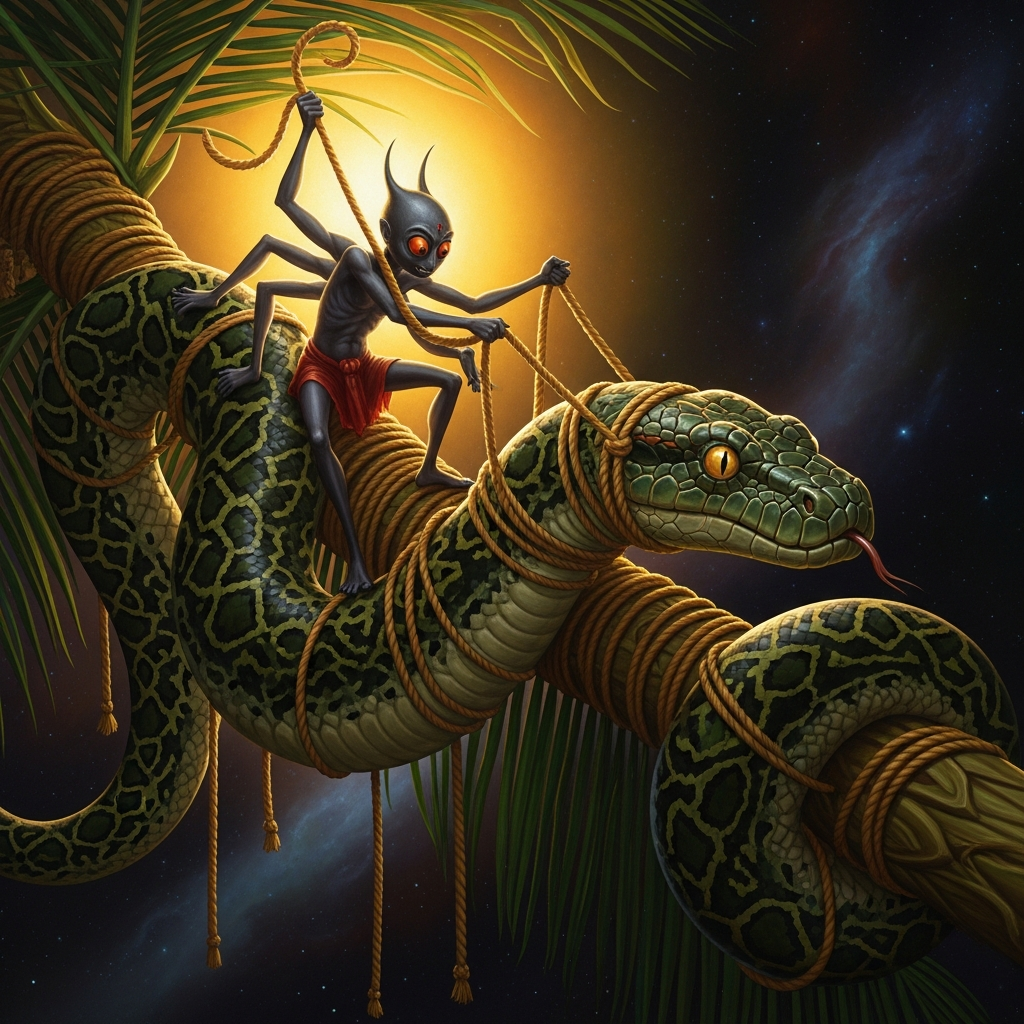
He goes to Onini’s river and begins arguing loudly with himself about whether the python is really as long as the great palm tree growing at the bank, or shorter, or longer. He argues specifically and technically, the way someone argues who has already done the math. Onini glides out of the water because there is a principle at stake. He is exactly as long as that tree, Onini says, and I can prove it. Anansi says: well, the only honest proof is to lie beside the tree and let me mark the ends. Onini considers this. He considers it for exactly as long as it takes a vain animal to decide that accurate measurement of its own greatness is a reasonable request. He stretches out along the palm branch Anansi has cut. Anansi begins to measure — and he uses the measuring to lash the snake to the branch, vine over vine, starting at the tail, moving up to the neck, explaining each loop as a unit of measurement, until Onini is perfectly tied and perfectly unable to do anything about it. He is very long. Anansi carries him to Nyame.
Osebo goes into a pit.
The leopard’s tracks are easy to follow because Osebo sees no reason to hide them. Anansi digs a deep pit in the path and covers it with sticks and leaves and goes home. In the morning, Osebo is at the bottom. Anansi appears at the rim. He says: you’ve caught yourself, which is embarrassing — let me help you out. He bends a green sapling, lowers it into the pit, and when Osebo grabs it and is swung up, Anansi ties him by all four legs before the arc is finished. It takes perhaps three seconds from the moment the leopard’s paws clear the rim. Osebo does not understand how this has happened. Anansi carries him to Nyame.
The Mmoboro hornets require a leaf and a gourd and Anansi’s best performance.
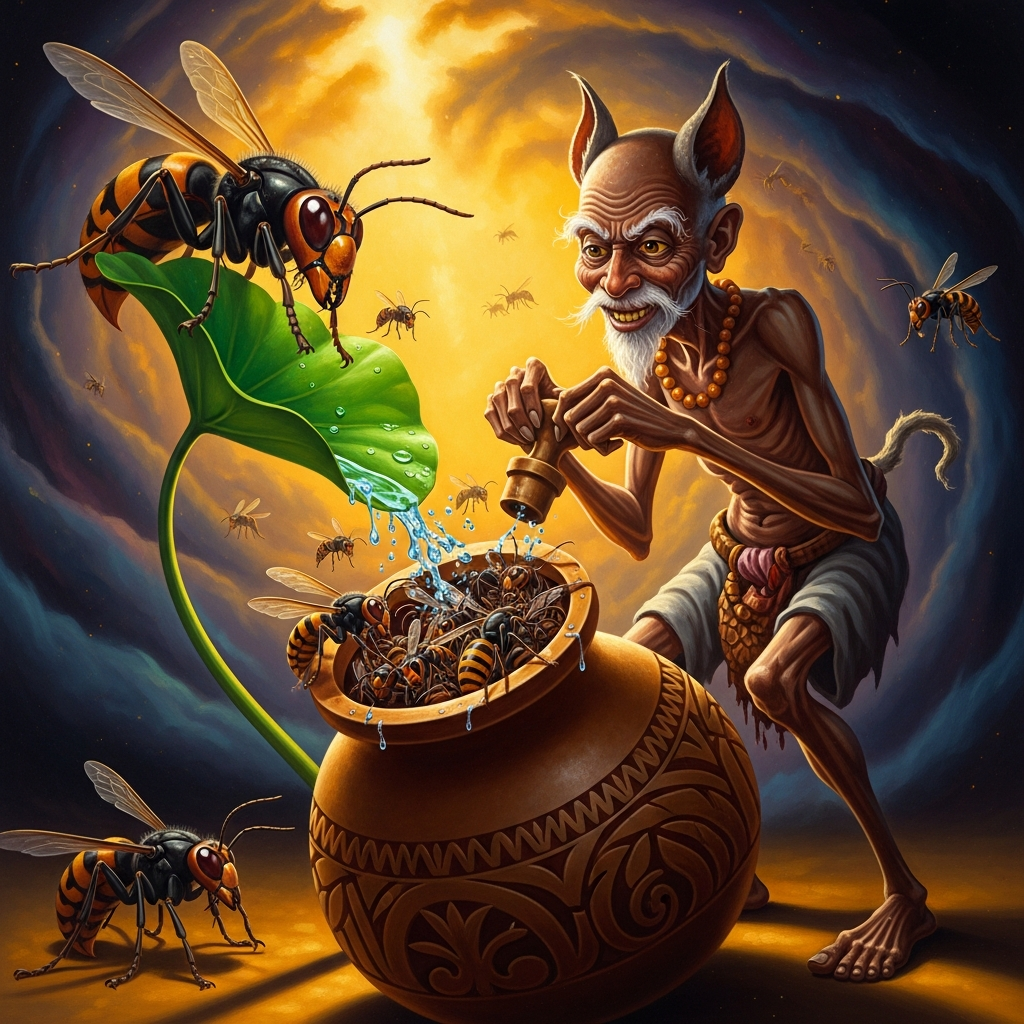
He approaches their nest with a banana leaf held over his head and the gourd in his other hand. He pours water on the leaf. He shouts to the hornets that the rain has started and they should take shelter. He holds the gourd open and says: in here, in here, fast. The Mmoboro swarm inside, because hornets move in mass consensus and the consensus is that water is bad and shelter is good and the gourd is shelter. Anansi stoppers it before the last one clears the entrance. He can hear them inside, angry, recalculating. He carries the gourd to Nyame.
Mmoatia is the hardest because she cannot be seen.
Anansi carves a doll from the black gum tree and covers it in sticky latex and props it at the base of the odum tree, where the invisible fairy likes to dance. He puts a bowl of mashed yams in the doll’s lap, because Mmoatia loves mashed yams and everyone knows it. He ties a string to the doll’s head and hides in the bush. Mmoatia arrives — he cannot see her, but the yams begin to vanish. She thanks the doll for the food and the doll does not answer, because it is a doll. She thanks it again. Silence. She slaps it. Her hand sticks to the latex. She hits it with the other hand. That hand sticks too. She kicks it. Her foot sticks. By the time Anansi walks out of the bush, the invisible fairy is completely adhered to a statue of her own outrage and he wraps her in cloth before releasing her — she becomes visible in captivity, because being held is its own kind of seeing.
He carries her to Nyame.
Nyame opens the chest.
He opens it slowly, because gods understand ceremony, and he takes out all the stories — every last one, the whole vast inventory of what has ever happened and been made meaningful — and he gives them to Anansi. He says: from this day, when men speak of stories, they will call them spider stories. And they do. To this day, across the Akan-speaking world and far beyond it, a tale is called Anansesem — a spider thing, a word that means the story belongs to the creature who was small enough to know that the only way to own something the powerful will not give you freely is to pay a price they were certain you could not afford.
Anansi climbs back down his thread to the earth and opens his hands.
The stories scatter like seeds.
The sky god had every reason to believe the price was impossible. He was right about the difficulty and wrong about who was standing in front of him — and that, Anansi would tell you, is exactly the kind of mistake that costs you everything.
Scenes
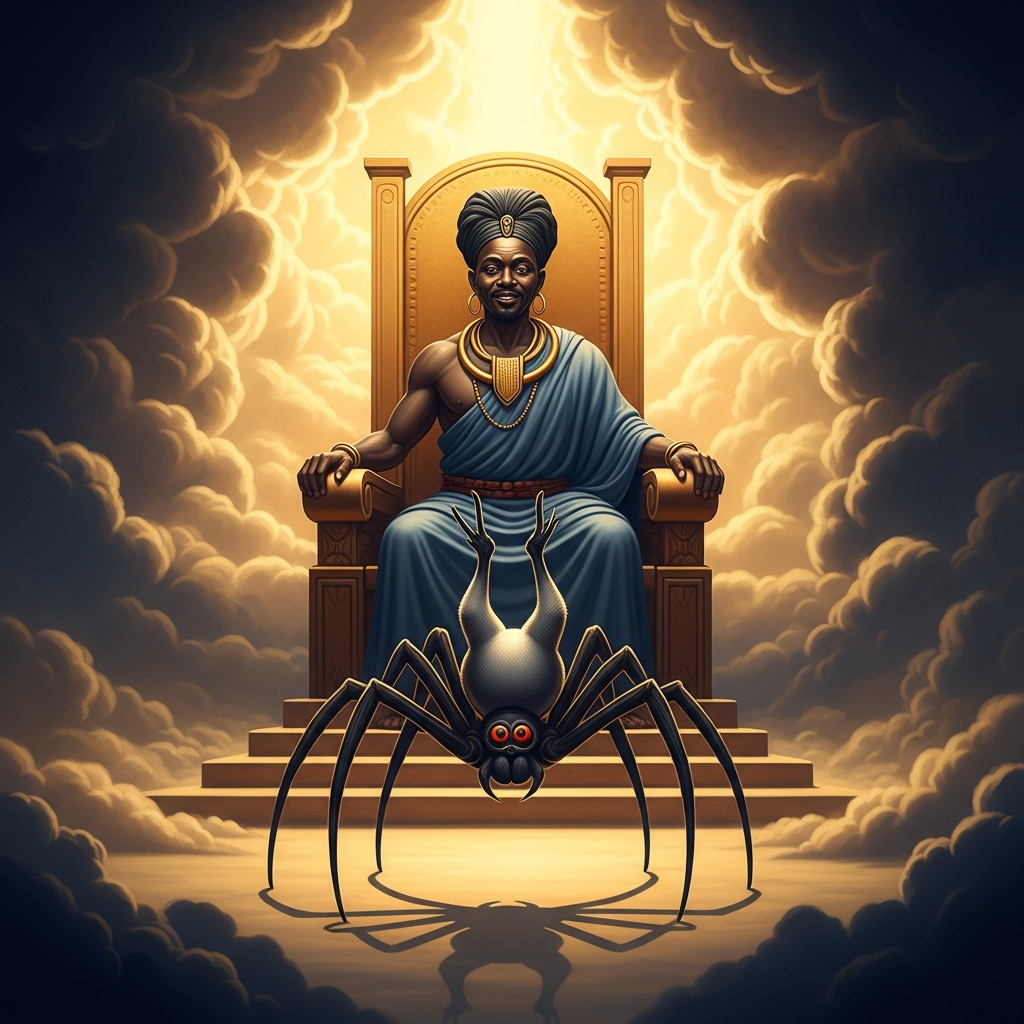
Anansi the spider stands before Nyame's sky-throne, eight legs planted on the cloud-floor, asking the price of all the stories in the world
Generating art… Anansi ties Onini the great python to a palm branch, the snake stretched full length in honest measurement of a debate that was never about length
 Generating art…
 The Mmoboro hornets swarm into the gourd, convinced by Anansi's tilted water-leaf that the rain has already started
 Generating art…
 Echoes Across Traditions
Entities


Sources
- R.S. Rattray, *Akan-Ashanti Folk Tales* (1930)
- Harold Courlander, *A Treasury of African Folklore* (1975)
- Peggy Appiah, *Ananse the Spider: Tales from an Ashanti Village* (1966)
- Kwame Gyekye, *An Essay on African Philosophical Thought: The Akan Conceptual Scheme* (1987)