Sundiata Keita Rises
~1235 CE · Battle of Kirina · Mali Empire · The Mande heartland — savanna and woodland west of the Niger Bend, West Africa
Contents
The prophesied lion of Mali cannot walk. The court laughs. Then his hands find an iron rod — and the rod bends.
- When
- ~1235 CE · Battle of Kirina · Mali Empire
- Where
- The Mande heartland — savanna and woodland west of the Niger Bend, West Africa
The boy does not walk.
He is the son of the Mande king Naré Maghann Konaté and a woman called Sogolon Condé — the buffalo woman, the ugly one, the one the king married because a hunter brought her in chains and a djinn spoke in the night and said this woman carries Mali. Sundiata is born, and the diviner-kings of the region travel days to see him, and they say the same thing in different words: this is the lion. Then the years pass and the lion does not stand. He crawls on his hands and knees. He drags himself across the packed-earth compound floor while the other boys his age run and jump and wrestle. The court watches. The court laughs.
His mother Sogolon bears the laughter on her back like a load of firewood.
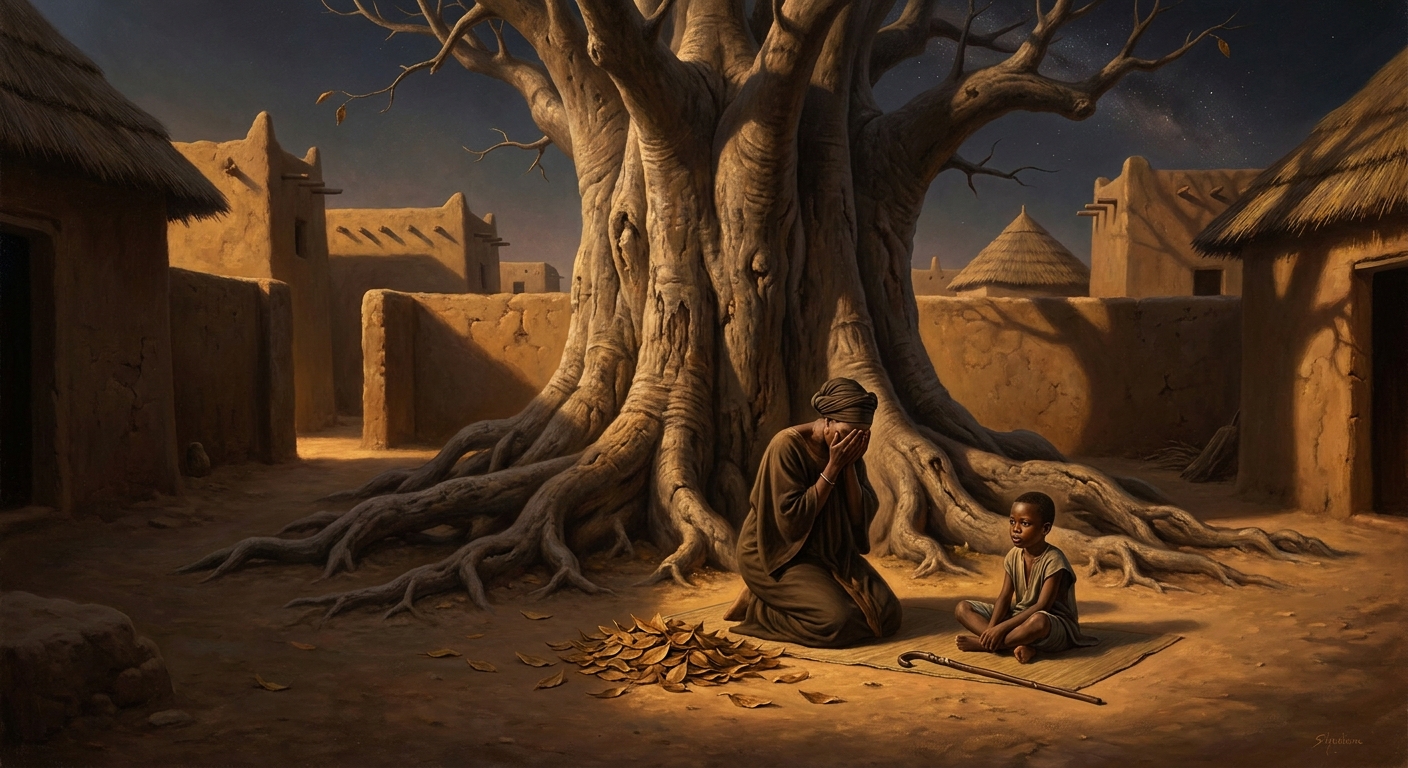
She is already the court’s joke — the ugly wife, the hunchbacked one — and now her son confirms it. Other wives send their children past the compound door to laugh where Sogolon can hear it. The first wife of the king pulls her own son forward, the legitimate heir, the straight-limbed boy who will never be what any diviner has promised, and she says to Sogolon: your lion cannot even stand up to roar. Sogolon does not answer. She walks to the great baobab at the edge of the compound and kneels in the dirt and weeps, because she believes what she cannot stop believing — that the djinn did not lie, that the hunter did not lie, that the boy on the floor is holding something inside him that the floor cannot hold forever.
One morning Sundiata asks for an iron rod.
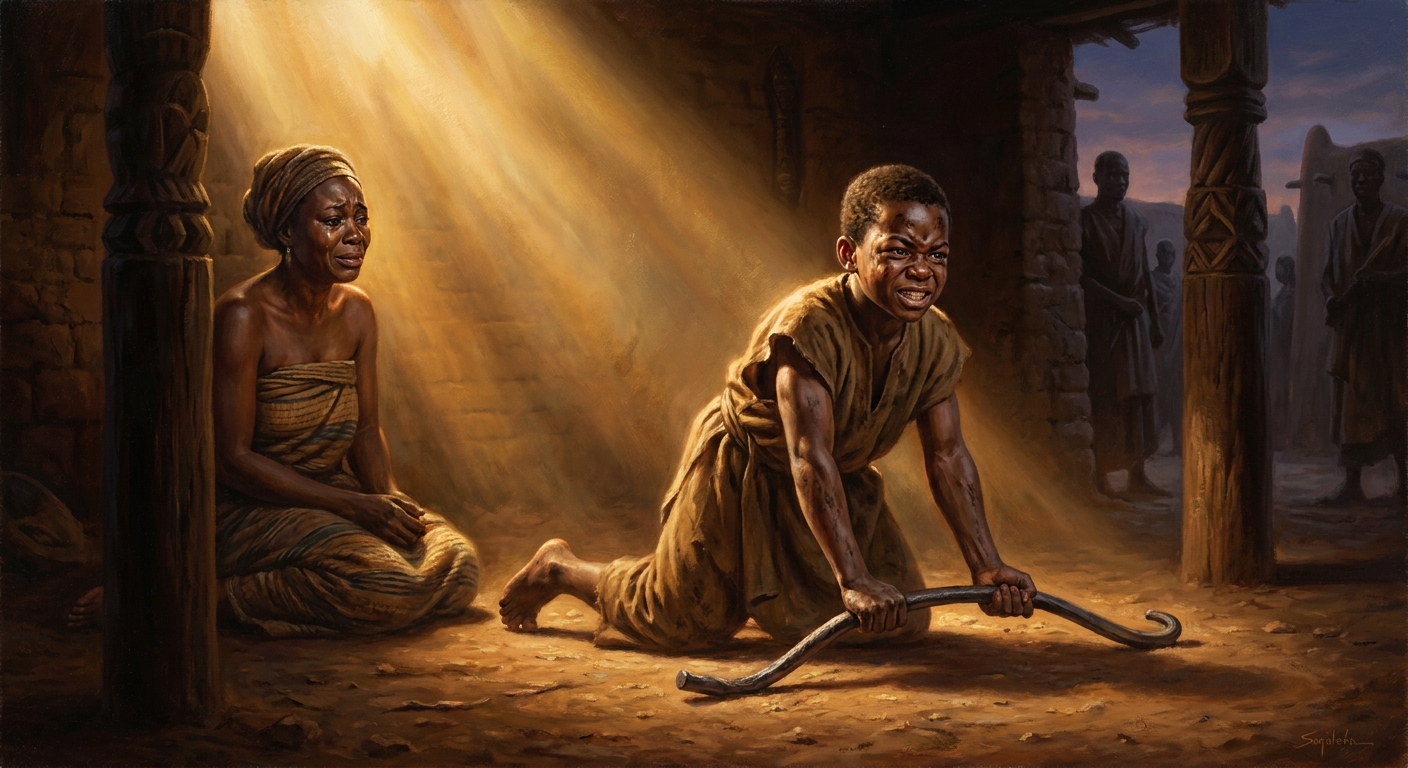
Not a cane. Not a crutch. An iron rod driven into the courtyard earth, the kind used to tether cattle. The blacksmith brings it and hammers it in and looks at the boy on the ground and does not say anything, because blacksmiths in the Mande tradition know about iron and patience and the things that are harder than they look. Sundiata wraps both hands around the rod. He pulls. His arms tremble. The tendons in his neck stand out like tree roots. The compound goes quiet — the wives, the servants, the children who came to watch the failure, all of them suddenly motionless. The rod groans. Then it bends. It bends outward like a green sapling bowing to wind, and Sundiata Keita, the lion of Mali, stands upright for the first time in his life. The earth does not shake. It does not need to.
He walks that day.
He walks out of the compound and across the village and into the bush beyond it, and when he comes back he is carrying a tree — a small one, freshly uprooted, roots still trailing dirt — and he plants it in the courtyard in front of his mother and says nothing. She says nothing. The court watches in silence. That evening the first wife of the king moves her household to a different compound and does not speak of the iron rod again. Sundiata’s griot, Balla Fasséké, picks up his kora and begins to sing, and the song he sings is the song that will still be sung eight centuries later — the praise-name, the lineage, the promise that was always the truth even when it looked like a lie.
But Mali is not yet his.
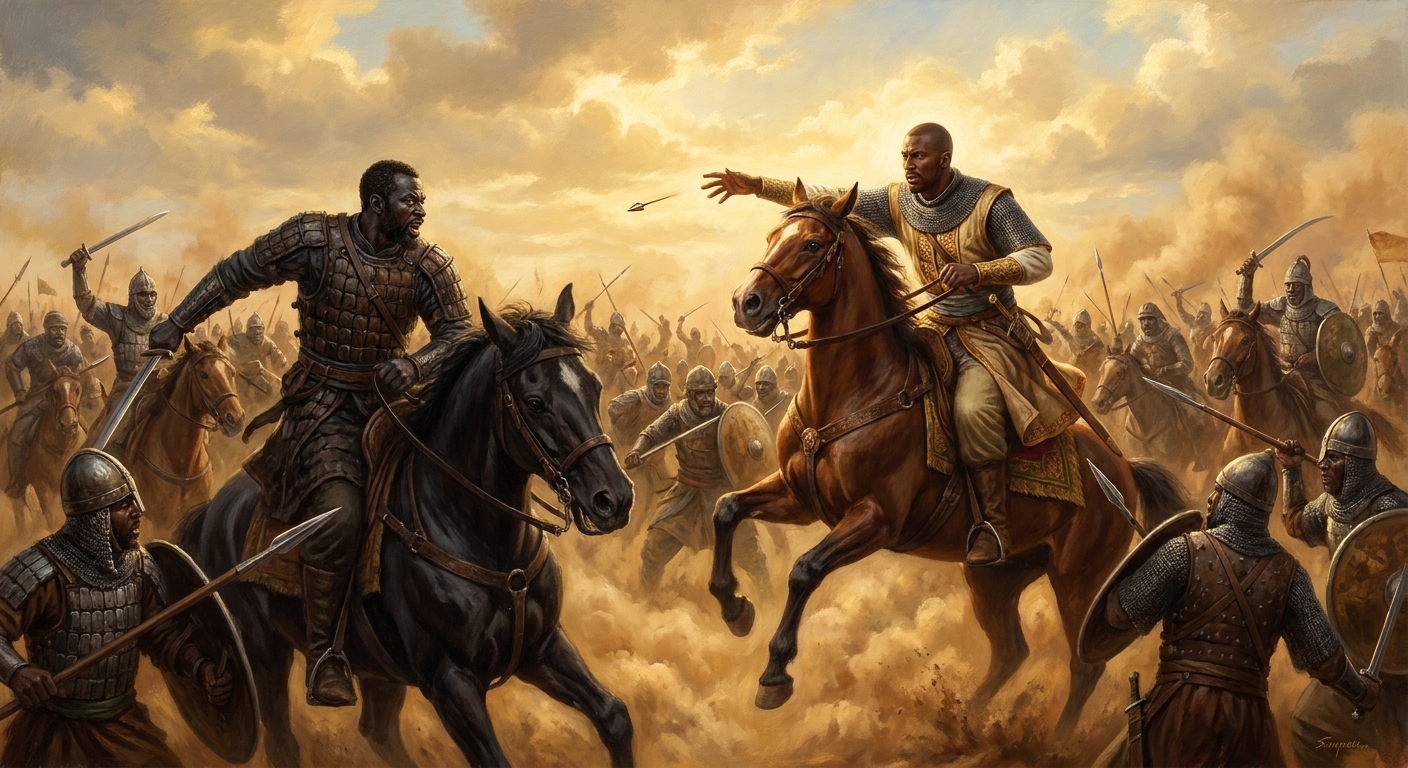
Soumaoro Kanté, the sorcerer-king of the Sosso, rules the Mande heartland with a war shirt sewn from human skin — the skin of nine kings he has personally killed. He is not merely a military enemy; he is a metaphysical one. His power has a tana, a totem-taboo, a hidden weakness that only his own griot knows, and Sundiata’s griots work for years to find it. The answer, when it comes, is a spur from the foot of a white cockerel — attached to an arrow and shot at the sorcerer-king, it does not need to wound him. It need only touch him. Tana works by contact, by the collision of the forbidden with the power it defines. At the Battle of Kirina, Sundiata’s forces meet Soumaoro’s across a wide plain and the war drums of both armies are so loud that birds fall from the sky. Sundiata draws. He shoots. The cockerel-spur grazes Soumaoro’s shoulder. The war shirt loses its power in the same instant a man loses feeling after a stroke — completely, without warning, mid-motion. Soumaoro flees into the Koulikoro mountain. He is never seen again.
The Mali Empire begins on a battlefield that smells of blood and iron and the particular ozone of a power that has just been annulled.
Sundiata Keita does not celebrate the way conquerors celebrate. He walks the field. He looks at what the day has cost. Then he organizes: the Gbara, the great assembly, where the clans and kingdoms and lineages that joined him receive their rights and responsibilities. The hunters get their charter. The blacksmiths get their place. The griots get their office — keepers of memory, proof against forgetting. He is not building a kingdom. He is building a constitution, Mande-style, oral and binding, every term memorized by the men whose job is to remember. The boy who could not walk founds a state that will govern most of West Africa for two centuries and whose legal traditions the Mandinka carry still. The iron rod is gone. But every blacksmith in the Mande tradition knows its name.
Sundiata did not rise by becoming something other than what he was. He rose by waiting for the earth to need exactly the weight he already had.
Scenes
Sundiata grips the iron rod driven into the courtyard earth
Generating art… The plain of Kirina at dawn
 Generating art…
 Sogolon Condé kneels beneath the great baobab tree, weeping over her crippled son while the court's laughter carries across the compound
 Generating art…
 Echoes Across Traditions
Entities
- Sundiata Keita
- Soumaoro Kanté
- Sogolon Condé
- Balla Fasséké
Sources
- D.T. Niane, *Sundiata: An Epic of Old Mali*, trans. G.D. Pickett (1965)
- Issiaka-Prosper Laléyê, 'The Oral Tradition in West Africa,' *UNESCO General History of Africa*, Vol. IV (1984)
- Nehemia Levtzion, *Ancient Ghana and Mali* (1973)
- John William Johnson, *The Epic of Son-Jara: A West African Tradition* (1986)