Ibn Arabi and the Ring of Solomon
Ayyubid Damascus - 1229 CE (627 AH) · Damascus, at the foot of Mount Qasiyun — exile city, final home, place of composition and death
Contents
Damascus, 1229. Ibn Arabi receives the Fusus al-Hikam in a vision from the Prophet — a book about rings. Each prophet is a bezel, a carved face of the divine ring, manifesting one name of God more completely than any other. A student in Damascus tries to understand why the ring has twenty-seven facets rather than one perfect face, and Ibn Arabi explains: the One needs many mirrors.
- When
- Ayyubid Damascus - 1229 CE (627 AH)
- Where
- Damascus, at the foot of Mount Qasiyun — exile city, final home, place of composition and death
The dream arrives in Damascus, in 1229, in the last decade of his life.
Ibn Arabi is sixty-four years old. He has already written more than three hundred books. The Futuhat al-Makkiyya — the Meccan Revelations — is still growing; it will not be finished for another decade, and it will fill fourteen thick volumes when it is done. He has traveled from Murcia to Mecca to Konya to Baghdad. He has been the student of masters long dead, whom he met in vision. He has been the teacher of the Seljuk princes. He has been accused of heresy in Cairo and celebrated as a saint in Konya and ignored in his own Andalusia.
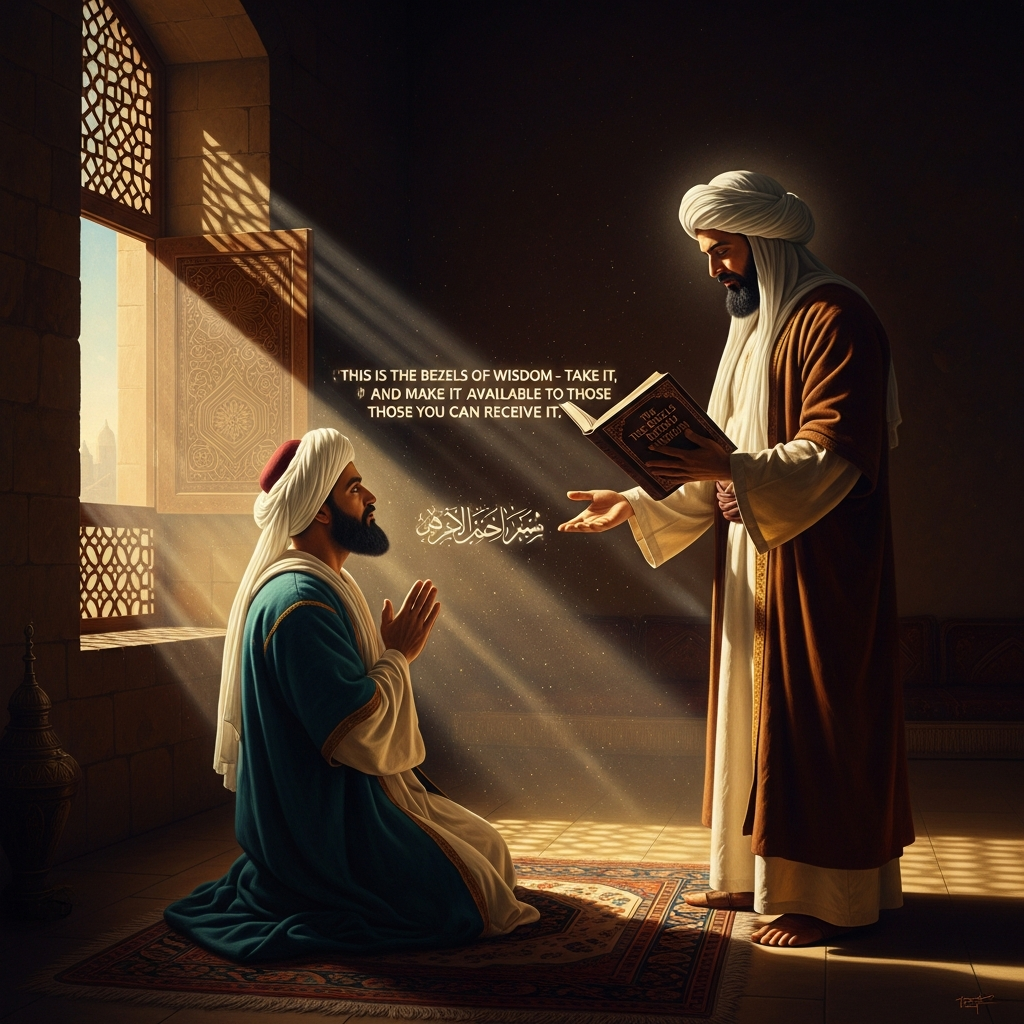
In the dream, the Prophet is standing in his room holding a book.
This, the Prophet says, is the Bezels of Wisdom. Take it, and make it available to those who can receive it. Do not withhold it from those who are fit for it.
He wakes up and begins to write.
The book is about a ring.
Specifically, the ring of Solomon — Sulayman — the prophet-king who wore the divine names on his seal and commanded the jinn and the winds by it. But Solomon is only the occasion. The ring is a figure for the relationship between the One and the many, between divine unity and the multiplicity of prophets and creation. Ibn Arabi is constructing, in seventy-two chapters corresponding to twenty-seven prophets, an argument about why the unity of God requires the multiplicity of revelation.
A bezel is the carved face of a ring — the stone, the setting, the face that the ring presents to the world. Each prophet is a bezel: Adam is the bezel of divine knowledge. Noah is the bezel of transcendence. Abraham is the bezel of love. Moses is the bezel of exaltation. Jesus is the bezel of the divine breath. Muhammad is the bezel of uniqueness, the final face, the one that most completely gathers what all the others showed separately.
The question the book is answering is one that a student in Ibn Arabi’s Damascus circle has been pressing for weeks:
If God is one, why are there twenty-seven prophets?
He takes the student to a goldsmith’s shop in the Damascus bazaar.
This is how the hagiographers tell it, and whether it happened or whether Ibn Arabi simply used the image in a lesson does not matter much — the image is the argument. In the shop there are rings of different cuts. Round cabochons. Square seals. Faceted stones. Rings with carved inscriptions. Rings with portrait faces.
He picks up a signet ring — a flat oval face, smooth, blank.
If you need to seal a letter, he says, you press this face into the wax and the impression carries the face outward. The wax is not the face. The impression is not the face. But the face is known only through the impression. If there were no impression, the face would be known only to itself.
The student understands this much.
Now, Ibn Arabi says. The divine Being is like the face. The cosmos is like the wax. Each thing in the cosmos is an impression of one name of God — one face, one angle, one quality of the infinite pressed into the particular. But no single impression can exhaust the face. No single creature, no single prophet, no single tradition can carry the entire self-disclosure of the One.
He sets down the ring and picks up another — faceted, many angles.
This is the ring of Solomon. Each face of the cut stone shows the same stone, but from a different angle, catching the light differently. Adam shows you the divine omniscience from one angle. Abraham shows it from another. The Face is one. The facets are many. The many are why the Face can be seen at all.
This is the doctrine they call wahdat al-wujud — the unity of Being.
Ibn Arabi himself does not use the phrase. His students use it to summarize the Futuhat and the Fusus together. The doctrine says: there is one Being. The cosmos is its self-disclosure, its act of self-knowledge, the mirror in which the One contemplates itself. Each thing — each stone, each creature, each prophet, each name of God — is a face that the Being has turned toward itself in order to know one dimension of what it is.
This is radically different from the orthodox Islamic cosmology, in which God creates the world from outside it and remains utterly distinct from creation. In Ibn Arabi’s metaphysics, the world is not separate from God but is the form God’s self-knowledge takes. The multiplicity of creation is not a diminishment of divine unity but the necessary condition of divine self-knowledge: the One cannot know itself except through the Many, because the Many are the angles from which the One’s inexhaustible reality becomes visible.
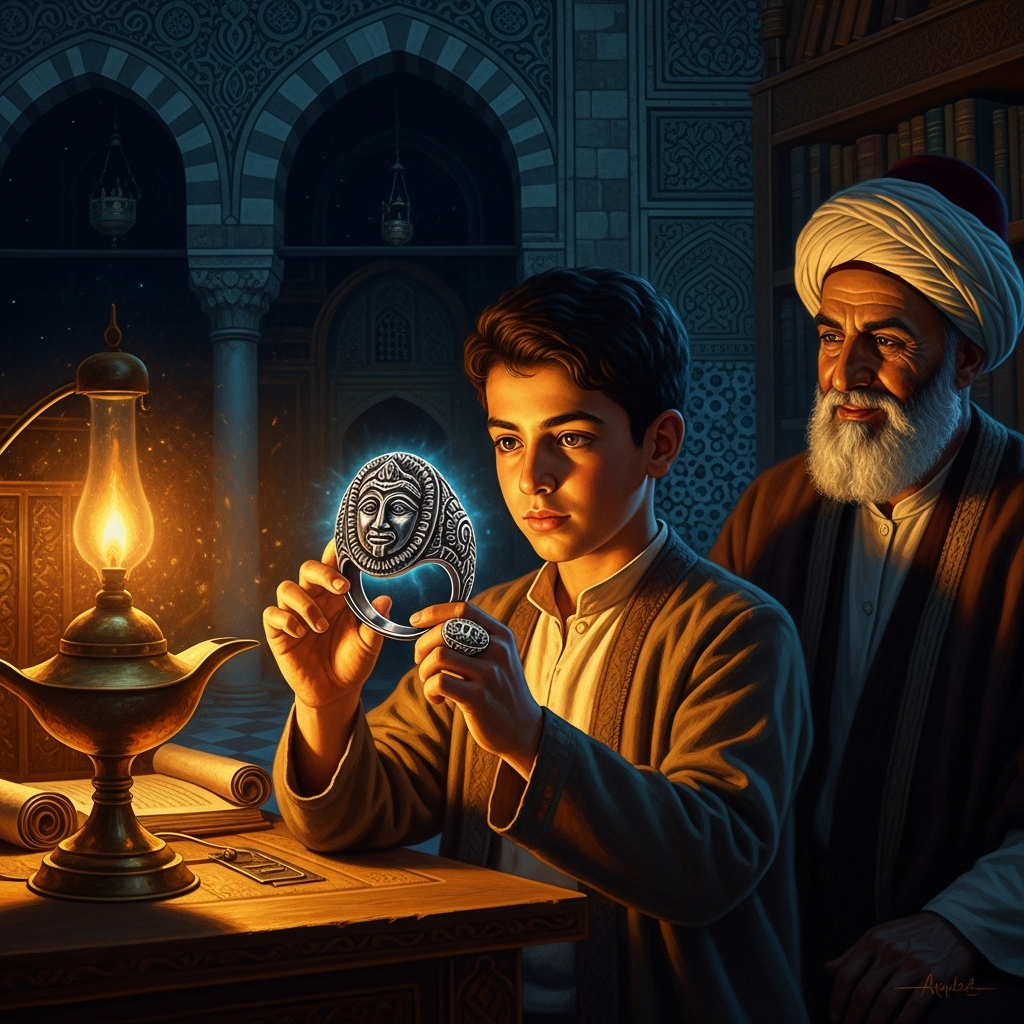
The student in Damascus holds the faceted ring up to the lamp.
So every prophet, he says slowly, is a face of the ring. And we need all of them because no single face shows everything.
And if you had only one face, Ibn Arabi says, you would have only one angle. And the stone has infinite angles. The infinite cannot be exhausted by the finite. But the finite is the only way the infinite becomes visible.
The student asks the harder question.
If all religions are facets of the same ring — if the bezel of Moses and the bezel of Jesus and the bezel of Muhammad are all faces of the same divine reality — does it matter which tradition you follow?
Ibn Arabi is quiet for a long moment.
The ring is one, he says finally. But you are not the ring. You are the wax. And the wax receives one impression at a time. You cannot be pressed by every face simultaneously — you would receive no impression at all. The multiplicity of traditions is necessary for the ring to show itself in the world. Your particularity — this tradition, this practice, this name of God on your lips — is how you become an impression of one face rather than a smear of all of them.
He pauses. Then:
But the man who has seen the ring knows that the other impressions are also real. He does not mistake his impression for the only one. He recognizes, in the seal of a different tradition, the same stone cutting from a different angle.
This is the passage the orthodox cannot forgive. The Fusus is burned in several cities. Ibn Arabi is accused of making all prophetic traditions equivalent, of dissolving the distinction between Islam and what Islam defines as error. He is accused of making the ring the object of worship rather than the God the ring seals.
He answers: I worship the God the ring seals. But I have seen the ring, and I cannot pretend that Solomon only had one face.
He dies in Damascus in 1240, and is buried at the foot of Mount Qasiyun in an unmarked grave that the Ottoman sultan Selim I will build a mosque over three centuries later, after a vision in which Ibn Arabi tells him where to dig.
The Fusus al-Hikam is copied and argued over for eight hundred years. It is condemned by Ibn Taymiyya. It is defended by Jami. It is read in secret by Naqshbandi shaykhs who agree with it and dare not say so publicly. It is studied in the Mughal court and in Javanese pesantren and in Turkish tekkes and in Persian madrasas.
The student in Damascus who first asked about the twenty-seven prophets went on to become a teacher himself. His students asked him the same question. He took them to the goldsmith’s shop.
The ring that was the beginning of the answer is still there, somewhere, turning under the lamp, each face catching the light for a moment before the hand moves and the next face appears.
The hardest part of wahdat al-wujud is not the metaphysics. The metaphysics is elegant and has good precedents in Neoplatonism and in the Quranic doctrine of the divine names.
The hard part is the implication: that the multiplicity of religions is not a scandal to be resolved by the final victory of one over the others, but a feature of the divine self-disclosure. That the God who names himself al-Ahad — the One — also named himself al-Wadud, the Loving, and al-Khaliq, the Creator, and ninety-six other names, and that no single name exhausts the Being, and no single tradition exhausts the self-disclosure.
Ibn Arabi is not a pluralist in the modern sense. He believes Muhammad is the seal of the prophets and Islam is the final and most complete expression of the divine intention. But he also believes that the Adam-bezel and the Moses-bezel and the Jesus-bezel are real faces of the real stone, and that the man who smashes them in the name of the Muhammad-bezel has misunderstood what a ring is for.
The ring does not exist to be hoarded. It exists to seal. And what it seals, when it presses into the wax, is the face of the One — seen from one angle, in this moment, in this tradition, for this student standing in a Damascus goldsmith’s shop turning the cut stone toward the lamp.
Scenes
In his Damascus room at dawn, Ibn Arabi sees the Prophet holding a book and saying: this is the Bezels of Wisdom — take it, and make it available to those who can receive it
 Generating art…
 In the Damascus madrasa, a student holds a ring up to the lamplight and turns it slowly, watching the carved face catch the light from different angles, while Ibn Arabi watches him understand
 Generating art…
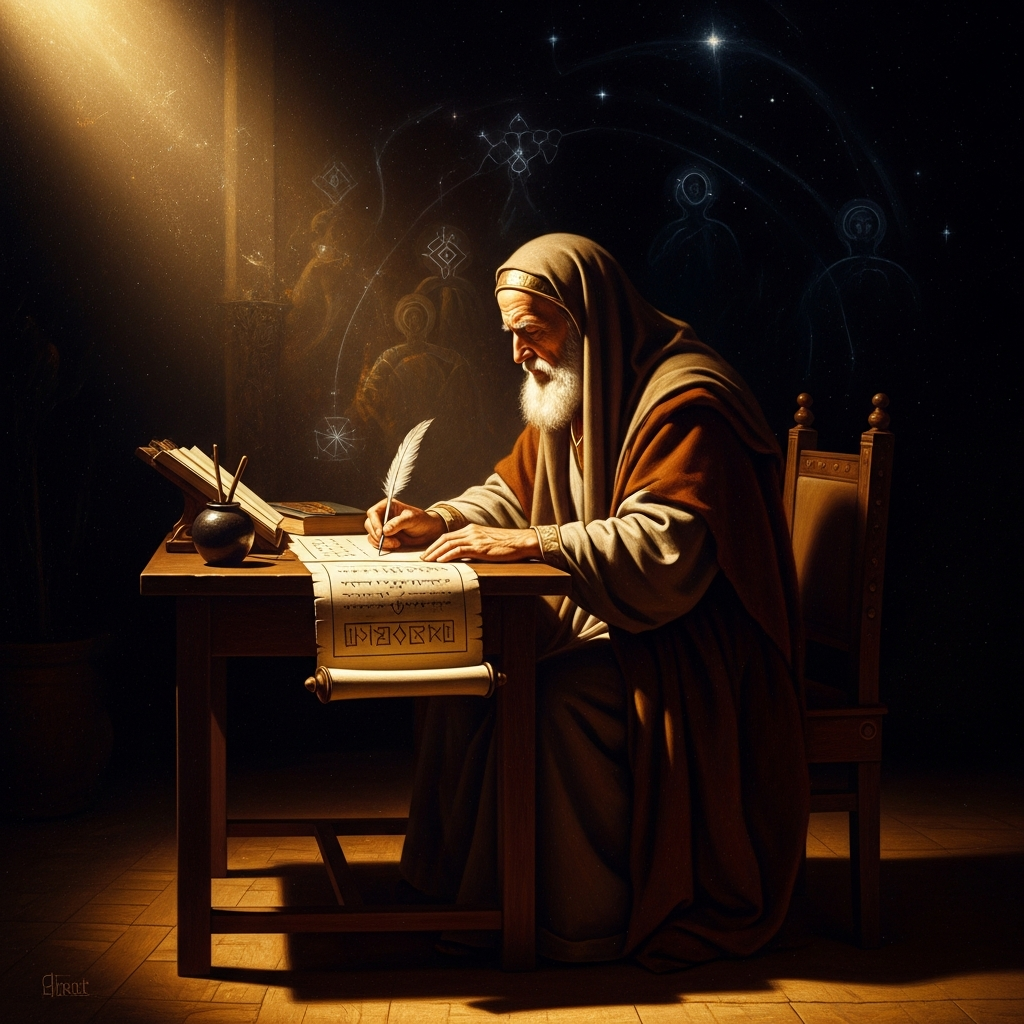
 A scribe in Ibn Arabi's circle writes out the doctrine of wahdat al-wujud in gold on dark paper — the unity of Being, the cosmos as the self-disclosure of the One who has no face except all faces
 Generating art…
 Echoes Across Traditions
Entities
- Ibn Arabi (Muhyi al-Din)
- the Prophet Muhammad
- Solomon
- the twenty-seven prophets
- wahdat al-wujud
Sources
- Ibn Arabi, Fusus al-Hikam, trans. R.W.J. Austin as The Bezels of Wisdom (Paulist Press, 1980)
- William Chittick, The Sufi Path of Knowledge: Ibn al-Arabi's Metaphysics of Imagination (SUNY Press, 1989)
- Toshihiko Izutsu, Sufism and Taoism: A Comparative Study of Key Philosophical Concepts (University of California Press, 1984)
- Henry Corbin, Creative Imagination in the Sufism of Ibn Arabi (Princeton University Press, 1969)
- Annemarie Schimmel, Mystical Dimensions of Islam (University of North Carolina Press, 1975), ch. 9