Rumi Loses Shams of Tabriz
Seljuk Sultanate of Rum, Konya - c. 1247 CE · Konya in central Anatolia, and Damascus — the geography of loss and recognition
Contents
One night in 1247, Shams-i-Tabrizi is called from Rumi's house in Konya and never returns. What follows is the strangest transformation in Persian literature: the wound becomes the work, and the most devastating loss in a mystic's life becomes the condition for the greatest poetry written in any language.
- When
- Seljuk Sultanate of Rum, Konya - c. 1247 CE
- Where
- Konya in central Anatolia, and Damascus — the geography of loss and recognition
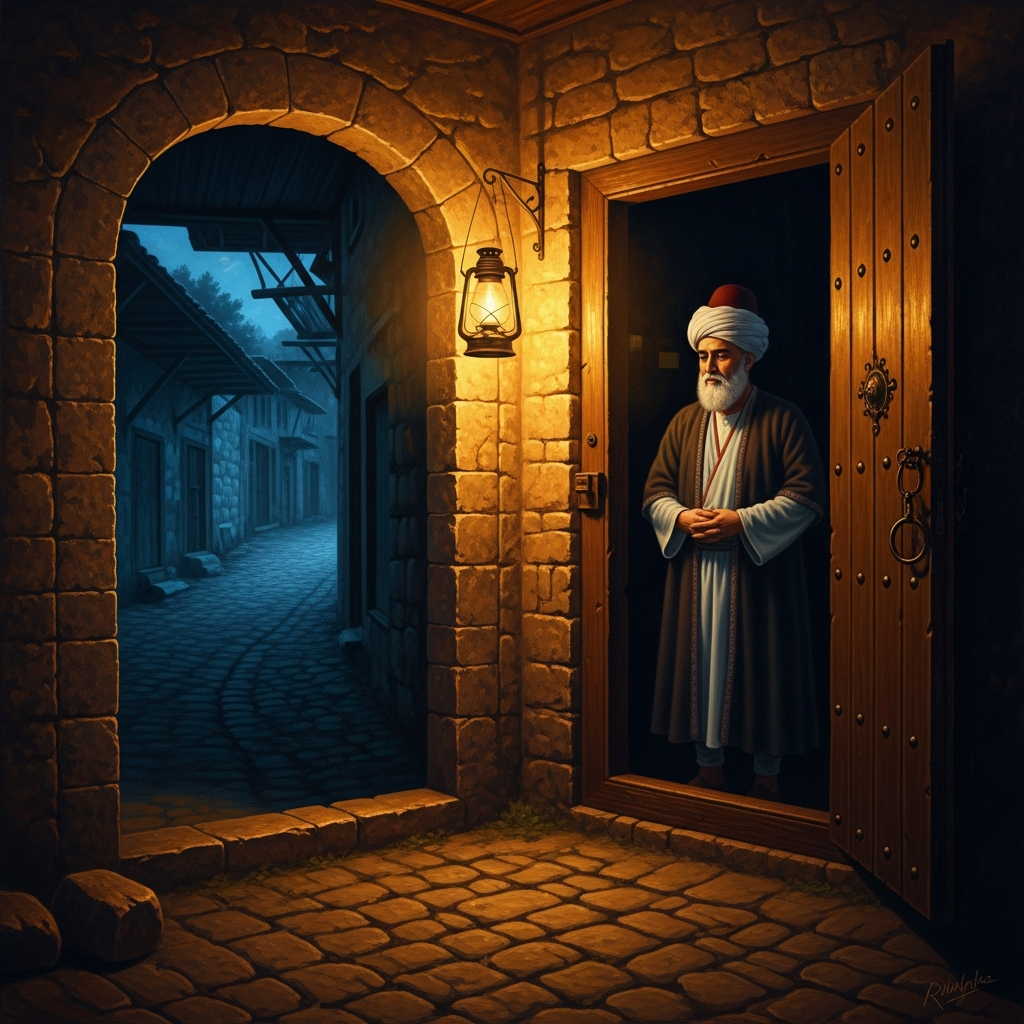
He is called from the house in the evening.
Someone knocks. Shams answers — he often answers the door, a habit the disciples resented from the beginning, as if the wandering dervish had become the master of the threshold in a house that was not his. He steps out. The door closes behind him. The chroniclers will not say who called. Aflaki, writing a century later, implies it is Rumi’s disciples, or Rumi’s son Alauddin, or a group of men who had grown tired of watching their teacher neglect his lectures for an unwashed stranger. There is a body, perhaps, found later in a well behind the madrasa. There is, perhaps, a knife.
There is no body found.
There is only the door standing open, and Rumi inside, and the empty street.
This is what the thirty-nine years of before had been.
A madrasa jurist of Konya, son of a theologian, grandson of a theologian, inheritor of a chair, owner of four hundred students, rider of a white mule through the bazaar in a green turban that signals Prophetic lineage to everyone who can read turbans. Respected. Learned. Producing, in the last three years, an astonishing quantity of Persian verse — ghazals, love-lyrics, cries of mystical longing — that his disciples copied without fully understanding what had happened to the man they thought they knew.
What had happened to him was Shams.
Shams of Tabriz arrived in Konya in the autumn of 1244, grabbed the reins of the white mule in the bazaar, and asked a question. It was not the question itself that broke Rumi open — it was the quality of the person asking, the accumulated intensity of a man who had spent decades searching for a soul equal to his own. They closed a door and the door did not open for forty days, and when it opened Rumi was not the same man.
For three years they talked. The disciples watched their teacher stop teaching. They watched the queue of students shrink. They watched Shams say, in front of witnesses, that God had given Rumi to him as a spiritual companion, and watched Rumi agree. The jealousy is understandable. What is less understandable is the murder, if it was a murder. Possibly it was only a departure. Shams had left once before, to Damascus, and Rumi had searched and found him and brought him back. This time Shams does not come back, and the distinction between departure and murder is, in the chronicles, never settled.
Rumi goes to Damascus looking for him.
This is the strange period — months, perhaps a year — in which the most productive mystical poet in Persian literary history is wandering the Sufi quarters of Damascus asking if anyone has seen a filthy wandering dervish, sixty years old, black cloak, eyes that people describe as unbearable. Nobody has seen him. Or rather, many people have seen someone like that and none of them is the right one.
He composes ghazals in the alleys. He composes them while walking, which is new — the earlier ghazals came from the closed room in Konya, from the lamplight and the voice of Shams beside him. These ones come from movement and absence. He signs them not with his own name but with Shams-i-Tabrizi, as if the friend is the poet and Rumi only the instrument.
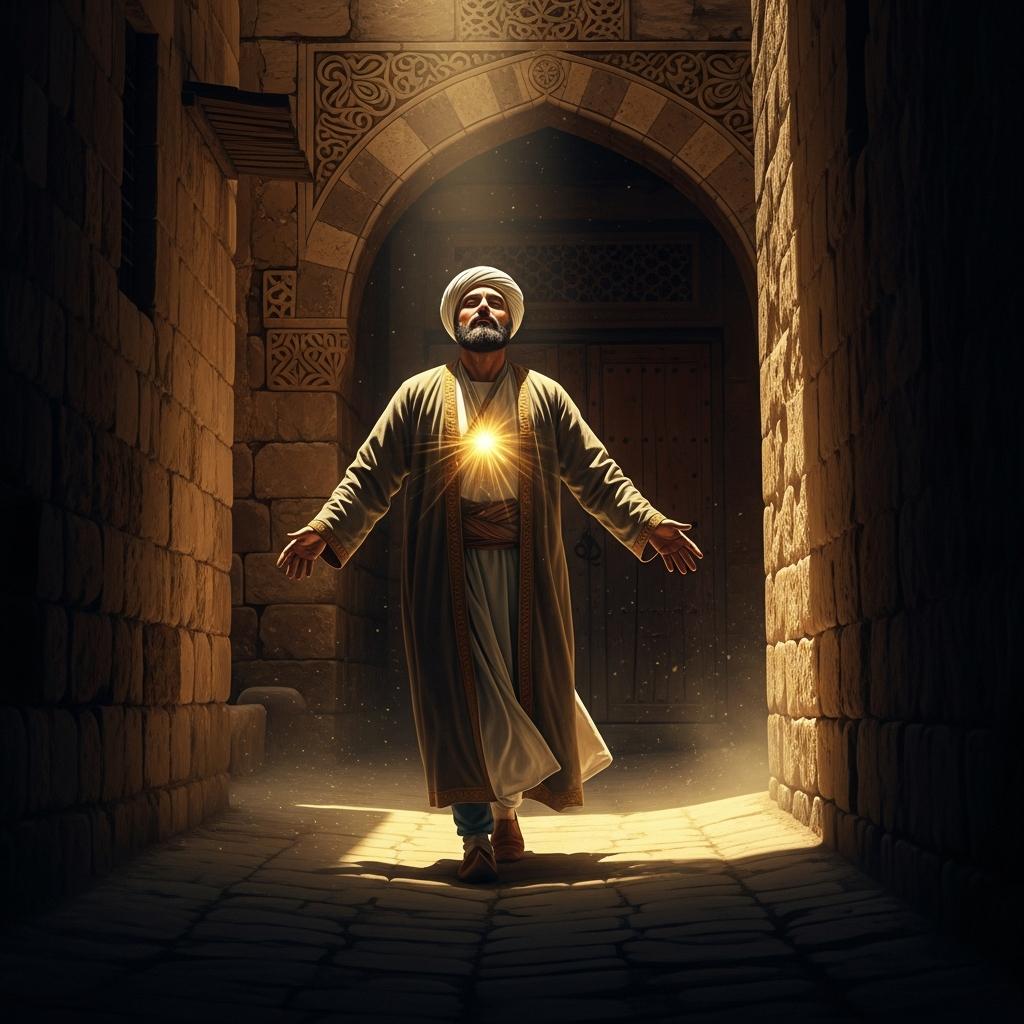
And then, in an alley in Damascus — the chronicles disagree on whether this is a vision, a dream, or simply the recognition that arrives without ceremony after long grief — Rumi goes still.
Why are we searching outside? he writes that night. His voice comes from inside me. I myself am he.
The search ends. The work begins.
He returns to Konya. He never searches for Shams again in any external place. Instead he writes to Shams, as if Shams were the audience, and as Shams, as if Shams were the author. The Diwan-i Shams-i Tabrizi grows to fifty thousand verses over the following decades. It is the largest collection of Persian lyric poetry assembled by one hand, and it is signed with another man’s name.
Then comes the Masnavi.
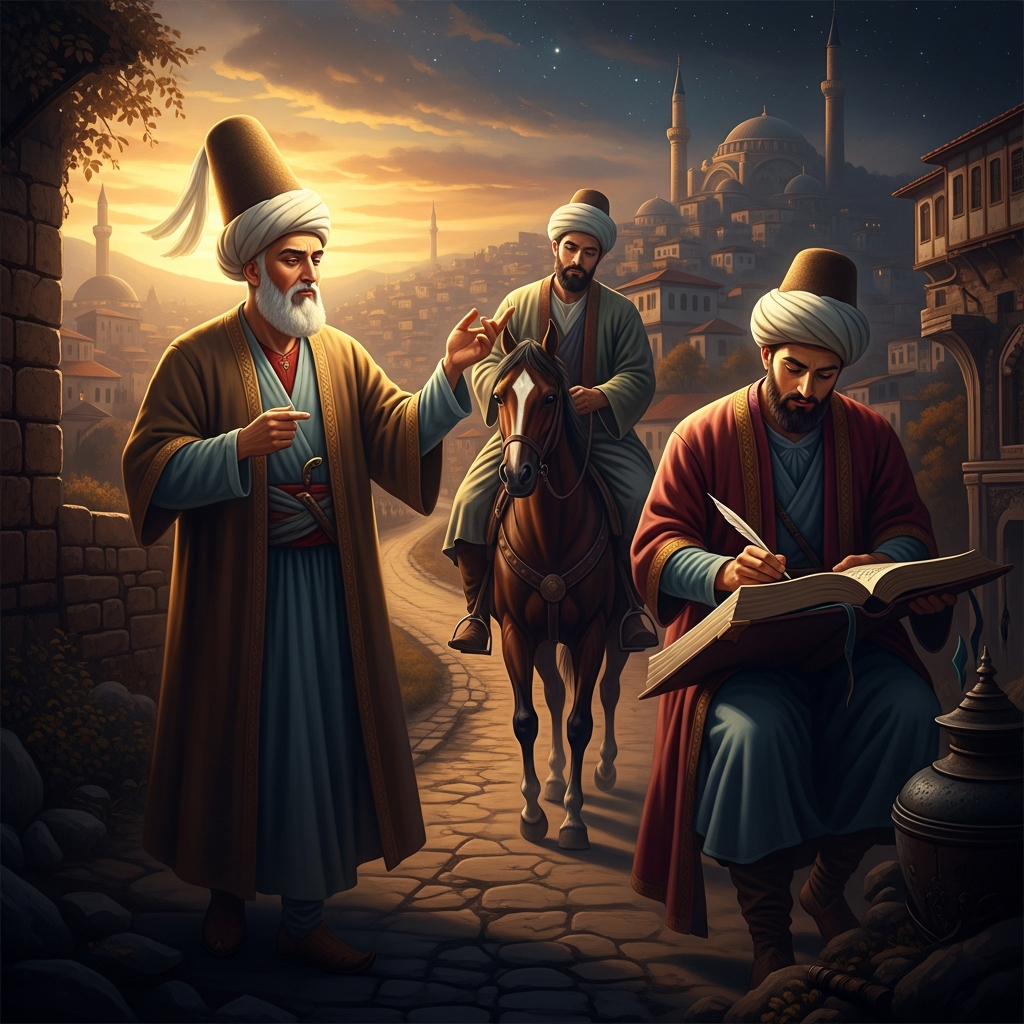
For twelve years he walks the streets of Konya, lies on rooftops at night, dictates in the bath-house, on the road, in the garden, the verse coming faster than Husam al-Din can write. Sixty thousand couplets. The reed crying at the beginning — Listen to the reed, how it complains, telling the tale of separations — is the reed cut from the reed bed, which is Shams cut from Rumi, which is the soul cut from God, which is all the same separation and all the same longing.
The Masnavi is not a poem about Shams. It is a poem about everything — stories of prophets and fools, of Moses and a shepherd, of parrots and merchants and the man who calls to God so long that God finally says: your crying is my answer, your yearning is my nearness. But the engine underneath every story is the theology that the wound and the work are the same, that the loss of the beloved is also the migration of the beloved inward, and that the poem written in the aftermath of loss is the love letter that loss makes possible.
The Sufi doctrine of absence is not consolation. It does not say that loss is not real, or that grief is a misunderstanding. It says that the divine beloved, in withdrawing the physical presence, creates the conditions for a deeper form of union than presence allowed. The friend who is in the room with you can be seen. The friend who has migrated into the breath cannot be separated from the seeing.
Rumi does not argue this. He lives it. Every couplet is evidence.
When he dies in 1273, the funeral procession includes Christians and Jews and Greeks and Armenians alongside the Muslims of every school. They ask the Christians why they are weeping for a Muslim saint. Because he was our Jesus, they say. They ask the Jews. Because he was our Moses. The Muslims do not answer because there is nothing to add.
His son Sultan Walad founds the Mevlevi order. The dervishes learn to whirl — one hand turned up to receive heaven, one hand turned down to give it to the earth — on an axis that Shams planted in a Konya bazaar in November 1244 and Rumi has been spinning on ever since.
The order names itself not after Rumi but after the title his father carried: Mevlana, Our Master. The poems are signed with the name of the man who disappeared. The order is named for the father who never wrote a line of verse before the stranger arrived. Every level of this inheritance is a form of the same gesture: the self displaced by what it loved, the name given away, the work attributed to the absence.
The theology of viraha — the Sanskrit word the Hindu Bhakti traditions use for the pain of divine separation — was being developed in Rajasthan at almost the same moment Rumi was dictating the Masnavi in Konya. The gopis wept for the absent Krishna. Mirabai sang to the husband who would not come. The reed cried for the reed bed.
The traditions did not know about each other. They arrived at the same conclusion from different directions: that the longing for the divine beloved, sustained long enough, becomes indistinguishable from the presence of the divine beloved. That the poem written in the absence is the form the presence takes.
Shams disappeared. The Masnavi appeared. The Sufis, reading carefully, say these are not two events.
The wound is the work. The absence is the most complete form of presence. The love that has lost its object has nowhere to go except everywhere.
Scenes
The door of the Konya house stands open in the lamplight
 Generating art…
 In a Damascus alley, Rumi stops mid-step and goes still — the moment of recognition when the searching ends and the understanding begins: the beloved has migrated inward
 Generating art…
 Walking the roads of Konya at dawn, Rumi dictates the Masnavi to Husam al-Din who rides beside him catching each couplet — sixty thousand lines composed for a man already gone
 Generating art…
 Echoes Across Traditions
Entities
- Jalal al-Din Rumi
- Shams-i-Tabrizi
- Sultan Walad
- Husam al-Din Chalabi
- the Masnavi
Sources
- Annemarie Schimmel, I Am Wind, You Are Fire: The Life and Work of Rumi (Shambhala, 1992)
- Franklin Lewis, Rumi: Past and Present, East and West (Oneworld, 2000)
- Reynold A. Nicholson (trans.), The Mathnawi of Jalalu'ddin Rumi (Gibb Memorial Trust, 1925-1940)
- William Chittick, The Sufi Path of Love: The Spiritual Teachings of Rumi (SUNY Press, 1983)
- Aflaki, Manaqib al-Arifin (Feats of the Knowers of God), c. 1353, trans. John O'Kane (Brill, 2002)