Rumi Meets Shams
Seljuk Sultanate of Rum · 15 November 1244 CE (26 Jumada al-Akhira 642 AH) · Konya, the central Anatolian capital — caravan crossroads, refugee city for scholars fleeing the Mongol storm
Contents
A respectable jurist of Konya stops his mule in the street to answer a wandering dervish's impossible question — and never goes back to the man he was the moment before.
- When
- Seljuk Sultanate of Rum · 15 November 1244 CE (26 Jumada al-Akhira 642 AH)
- Where
- Konya, the central Anatolian capital — caravan crossroads, refugee city for scholars fleeing the Mongol storm
He is forty-seven and has been respectable his entire life.
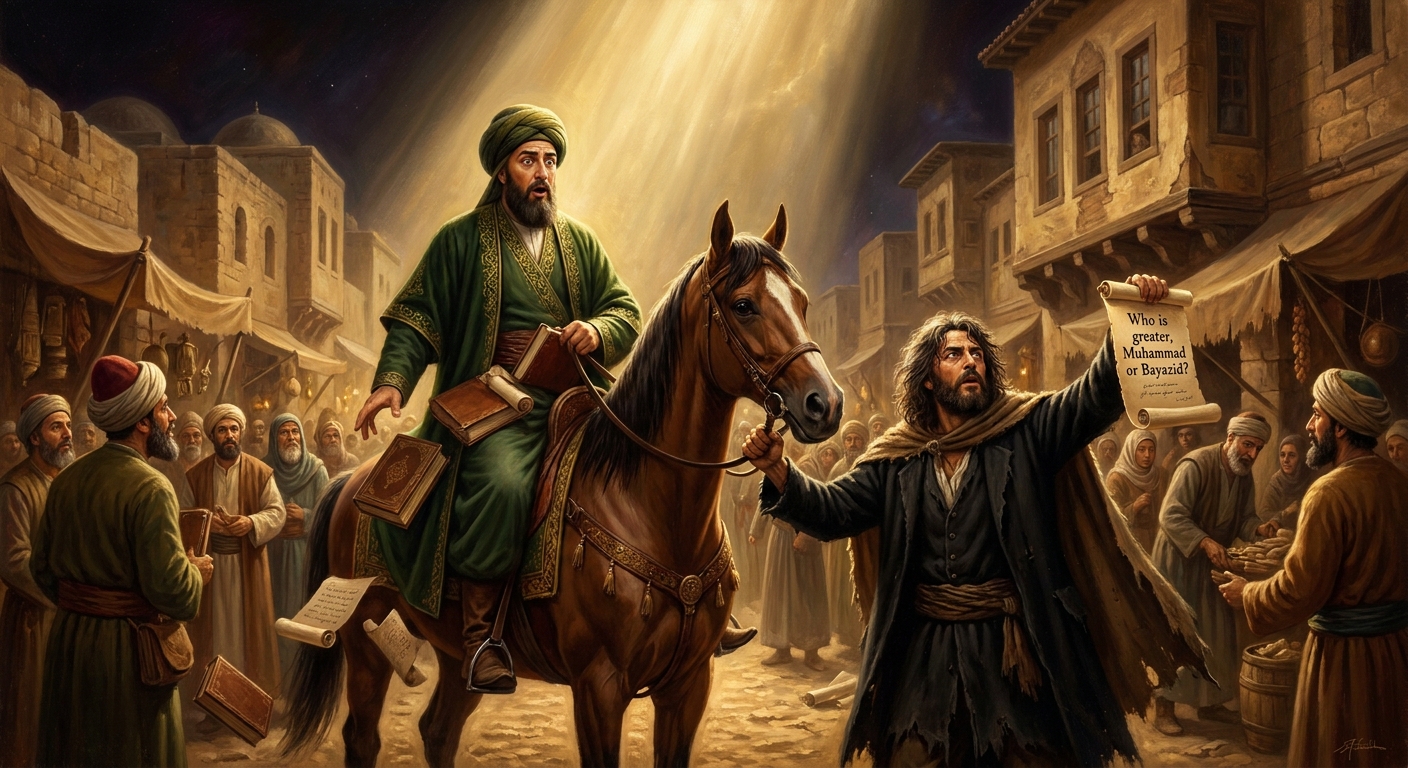
His father was a respected jurist. His teachers were respected jurists. He himself rides a white mule through the bazaar of Konya in a wide green turban that signals, to anyone who can read turbans, that he descends from the Prophet and lectures at the central madrasa. Four hundred students follow him on foot. The bazaar parts for him. The vegetable-sellers nod. The Sultan asks his opinion on points of law.
He has written nothing yet. Not a line of the Masnavi. Not one of the ghazals. He is a man whose biographers, had he died this morning, would have written a paragraph and moved on.
Then a stranger steps out in front of the mule.
The stranger is filthy. Black wool cloak, no turban, the face of someone who has been sleeping outdoors. Sixty years old, maybe more. Eyes that the chroniclers, struggling for a word, will call unbearable.
He grabs the mule’s reins.
He says: Tell me, master of the law — was Muhammad greater, or Bayazid Bistami?
The students draw breath. It is the kind of question that gets a man stoned in the street. Bayazid was a Sufi who, in ecstasy, cried Glory be to me, how great is my majesty! Muhammad is the Prophet. The answer is obvious. The answer is required.
Rumi says: Muhammad, of course. Muhammad is the seal of the prophets. Bayazid is a saint who walked in his shadow.
Shams says: Then why did Muhammad say I have not known Thee as Thou shouldst be known, and Bayazid say Glory be to me?
He steps off the mule.
The chroniclers are not sure exactly when. Some say at the question. Some say after a long silence. One says he fell, and Shams caught him.
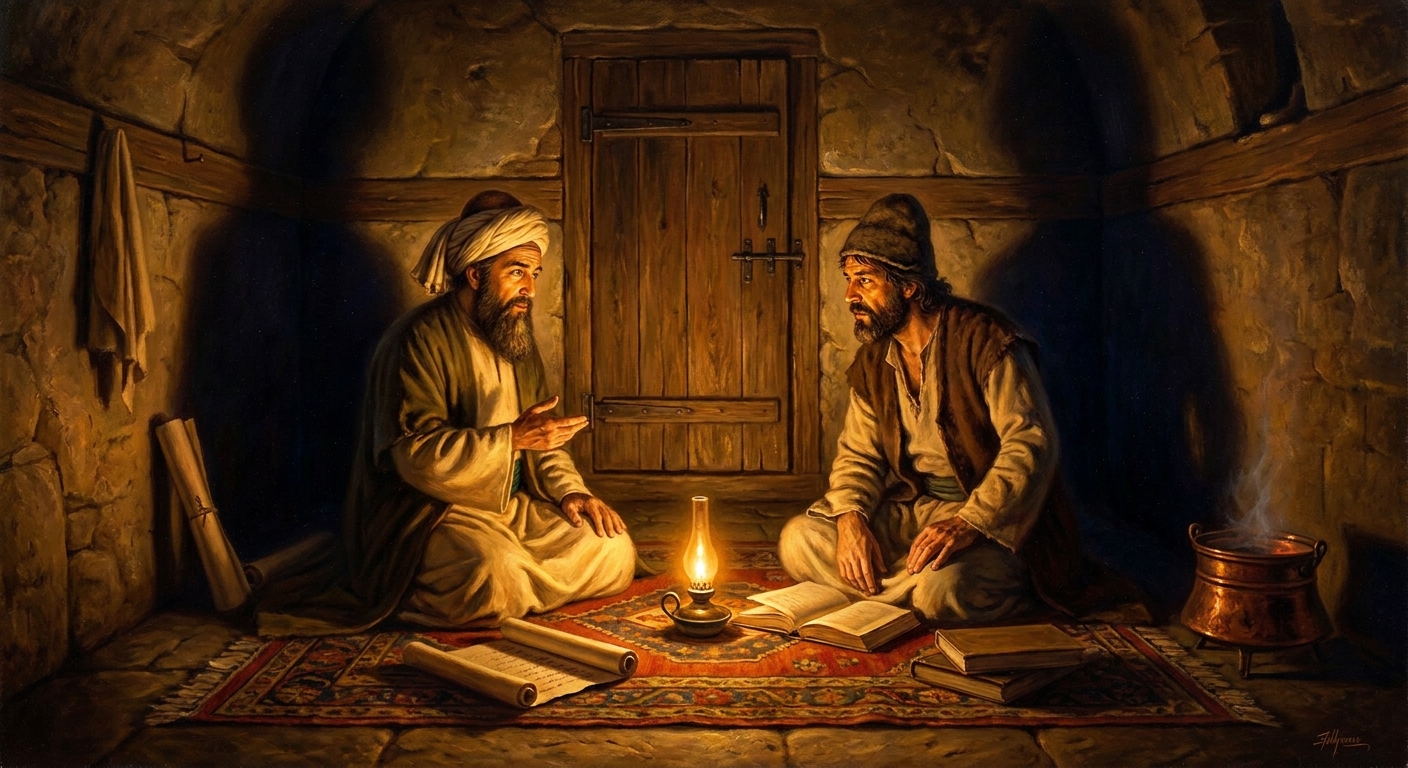
What they all agree on is this: by sundown, the foremost jurist of Konya has taken a wandering dervish into his house, and they have closed the door, and the door does not open for forty days.
The students wait outside. Food is brought in. Plates come out untouched. The two men, inside, are doing what the Persians later call suhbat — companionship, the verb-noun for the kind of conversation that rebuilds a soul. No one knows what is being said. The chronicler Aflaki guesses, generations later. He is guessing.
When the door opens, Rumi has stopped lecturing. He has stopped writing legal opinions. He has begun, in a voice no one has heard from him before, to compose Persian verse.
The students are furious.
Their teacher — their teacher, the inheritor of his father’s chair, the most learned man in Anatolia — is sitting in a back room with an unwashed stranger reciting poetry. They drop in on private lessons. They watch the green turban gather dust. They watch the four hundred shrink to a hundred, then to fifty, then to the men who can stand the new arithmetic.
Rumi’s son, Sultan Walad, who will one day write the most reliable account, is the one who keeps order. He has found something, the boy tells the angry disciples. He has not lost something. There is a difference.
The angry disciples plot.
One night in 1247 — the date is uncertain, the chroniclers will not commit — Shams is called from the house on a pretext. He never returns. There is a body, perhaps, dropped in a well behind the madrasa. There is a knife, perhaps. There is no body found. There is only the absence.
Rumi looks for him for years.
He travels to Damascus. He searches the Sufi quarters. He sends letters. He composes ghazals addressed to Shams of Tabriz — hundreds of them, then thousands, signing them with his friend’s name instead of his own, as if the friend were the poet and Rumi only the pen.
One day, in a Damascus alley, he stops. He has understood something.
Why are we searching? he writes that night. His voice comes from inside me. I myself am he. The friend has not died. The friend has migrated. Love has done the alchemy that grief was performing the slow way.
He returns to Konya. He never composes a line again that is not, in some sense, addressed to or spoken by Shams. The Diwan-i Shams-i Tabrizi is fifty thousand verses long. It is signed with another man’s name, and it is the largest love-poem in any language.
Then comes the Masnavi.
For the next twelve years, walking through the streets of Konya, lying on the rooftops at night, dictating in the bath-house, in the garden, on the road — Rumi composes sixty thousand couplets of Persian verse. His scribe Husam al-Din rides beside him to catch the lines. There are stories of merchants and parrots, of fools and viziers, of moths and flames, of Moses and a shepherd. There are openings that the world will quote for eight centuries: Listen to the reed, how it complains, telling the tale of separations.
Every story is, eventually, a story about Shams. Every separation is the door at the Inn of the Sugar-Sellers closing.
When Rumi dies in 1273, the funeral procession includes Christians, Jews, Greeks, Armenians, Muslims of every school. They ask the Christians why they are weeping. Because he was our Jesus, they say. They ask the Jews. Because he was our Moses. They ask the Muslims. The Muslims do not answer.
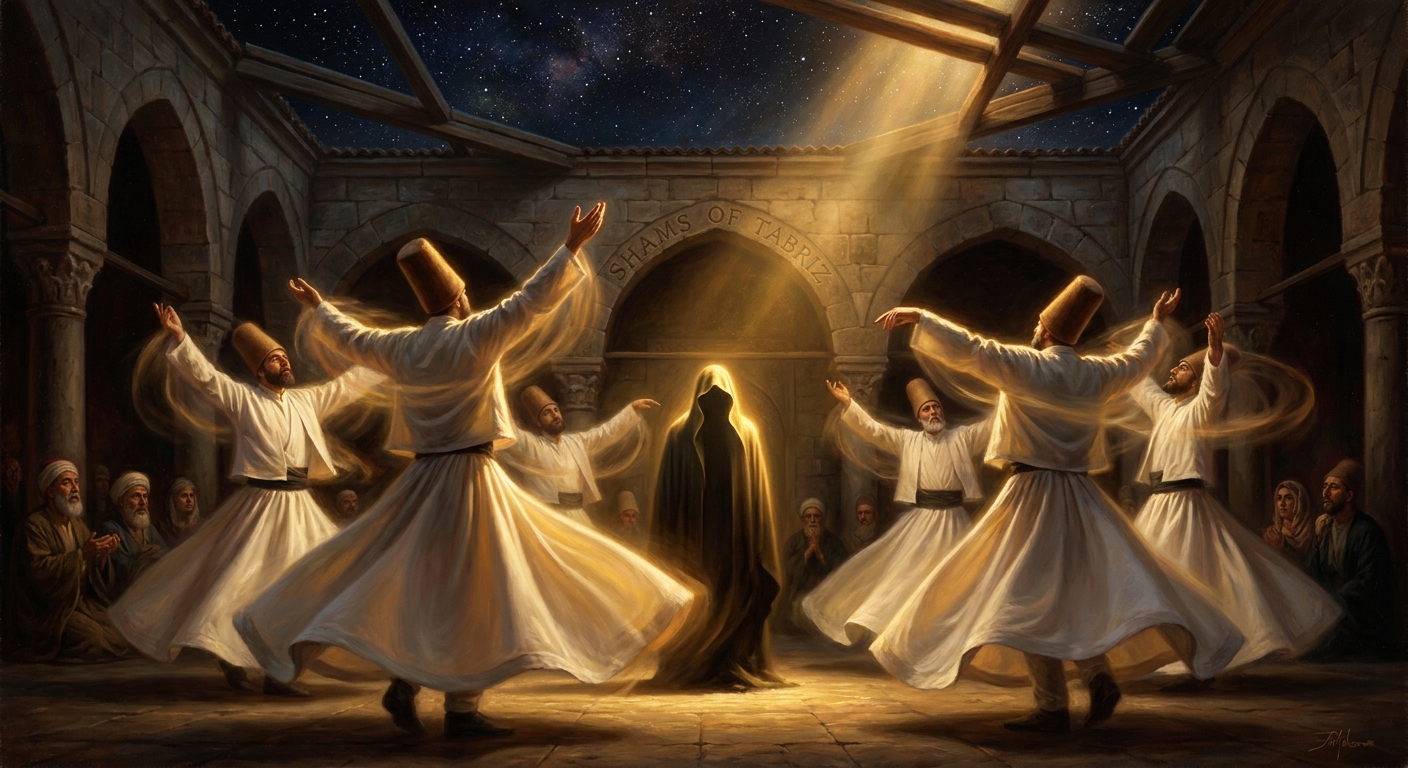
His son founds the Mevlevi order. The dervishes whirl. One hand turned up to receive heaven, one hand turned down to give it to the earth, the body itself the axis between Shams and Rumi.
Friendship, in Sufism, is a technical term. Suhbat is what passes between teacher and student in a sealed room over forty days. Mahabba is the love that survives separation. Ishq is the love that creates the separation in order to write the poem about it.
Rumi did not become a poet because he was talented. He became a poet because a stranger asked him a question on a Tuesday afternoon and the question went all the way down. The mule walked home alone. The turban gathered dust. The man who got off the mule was someone else by sundown.
Every wisdom tradition has the moment when the teacher arrives. The Sufi version is that the teacher arrives in the bazaar, dressed as a beggar, and asks you something you cannot answer without becoming someone new.
Scenes
In the Konya bazaar a wandering dervish seizes the white mule's reins and asks the green-turbaned jurist a question that will not let him remain who he is
Generating art… Behind the closed door of the madrasa cell, Rumi and Shams sit knee-to-knee in the lamplight of the fortieth night, the *suhbat* still unfinished
 Generating art…
 Robes spinning into white halos in the courtyard, the first Mevlevi dervishes turn for the murdered friend, founding an order on the axis of his absence
 Generating art…
 Echoes Across Traditions
Entities
- Jalal al-Din Rumi
- Shams of Tabriz
- Sultan Walad
- Salah al-Din Zarkub
- the disciples of Konya
Sources
- Annemarie Schimmel, *I Am Wind, You Are Fire: The Life and Work of Rumi* (Shambhala, 1992)
- Franklin Lewis, *Rumi: Past and Present, East and West* (Oneworld, 2000) — the definitive scholarly biography
- Reynold A. Nicholson (trans.), *The Mathnawi of Jalalu'ddin Rumi* (Gibb Memorial, 1925-1940)
- Shams of Tabriz, *Maqalat* (the *Discourses*) — recorded by Rumi's circle, c. 1247
- Aflaki, *Manaqib al-'Arifin* (~1353) — the earliest Mevlevi hagiography