The Pyre at Montségur
March 16, 1244 · the fall of Montségur · Montségur, a citadel on a 1,200-meter limestone pog in the Ariège foothills of the Pyrenees, southern France
Contents
After a nine-month siege, two hundred Cathar perfecti walk hand in hand down the mountain into a great fire at the foot of Montségur — refusing, to the last, to recant a heresy that called this world the work of an evil god.
- When
- March 16, 1244 · the fall of Montségur
- Where
- Montségur, a citadel on a 1,200-meter limestone pog in the Ariège foothills of the Pyrenees, southern France
The pog rises out of the foothills like a cracked tooth.
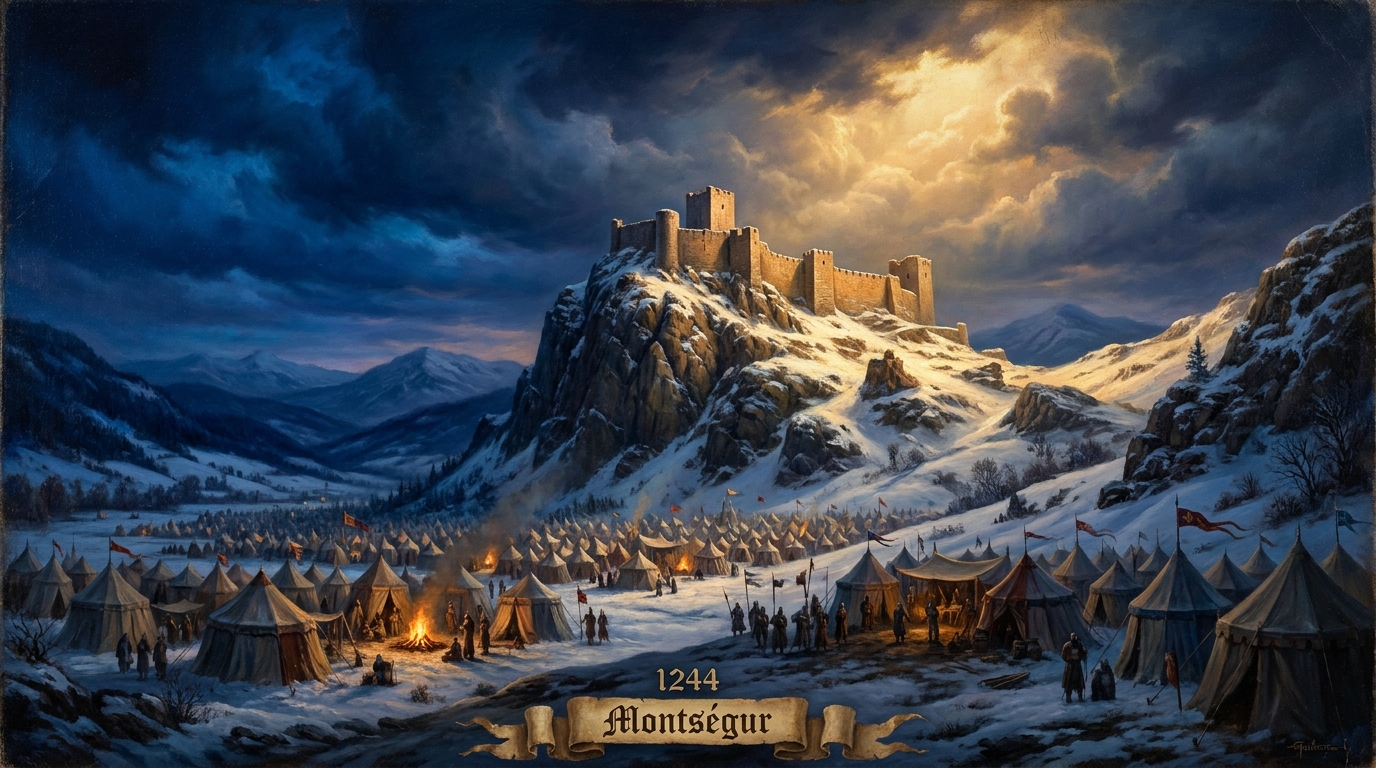
Twelve hundred meters of bare limestone, sheer on three sides, a single thread of switchback path on the fourth. At the top, a small castle: ten knights, perhaps a hundred soldiers, two hundred Cathar perfecti — bons hommes and bonnes femmes, the Good Men and Good Women — and the women, children, and servants of the garrison. Six hundred souls in total, on a rock the wind never stops scraping.
Below, in a ring around the mountain, sit ten thousand men of King Louis IX of France and the Inquisition. They have been there since May. It is now March. Snow has come and gone twice. The Cathars on the mountain have eaten the last of the salted pork, the last of the lentils, and now what is left of the dogs.
This is the last fortress.
For a hundred and fifty years, the heresy of the bons hommes has run through Languedoc the way wine runs through a cellar — quietly, evenly, in every village. Now it has been driven, town by town and burning by burning, up onto this single rock. When this rock falls, the heresy falls.
It is March 1, 1244. The garrison commander, Pierre-Roger de Mirepoix, sends a man down the path with a white cloth.
The terms are merciless and merciful in the same sentence.
Hugh d’Arcis, seneschal of Carcassonne and the king’s commander, agrees: the soldiers and knights of the garrison may walk free with their lives and their weapons, provided they confess to the Inquisition and accept light penance. The perfecti — the consoled ones, the inner church — must recant. If they recant, they live. If they refuse, they burn.
Two weeks. The truce will hold for two weeks. On March 16, at dawn, the perfecti must come down off the mountain and either renounce their faith or walk into the fire at the foot of the path.
Pierre-Roger carries the terms back up to the citadel.
The perfecti gather in the small chapel at the top — Bertrand Marty, the last Cathar bishop of Toulouse, presides. They have spent their adult lives refusing to eat meat, refusing to take oaths, refusing to lie, refusing to touch a woman if they are men or a man if they are women, refusing every contract with the world the Rex Mundi, the king of this world, the evil demiurge, has built as a prison for fallen souls. They have, by their own theology, almost finished their long return out of this corrupted matter and back to the true God.
Recanting now would be apostasy on the threshold of the door home.
They vote. The vote is unanimous.
Then something stranger happens.
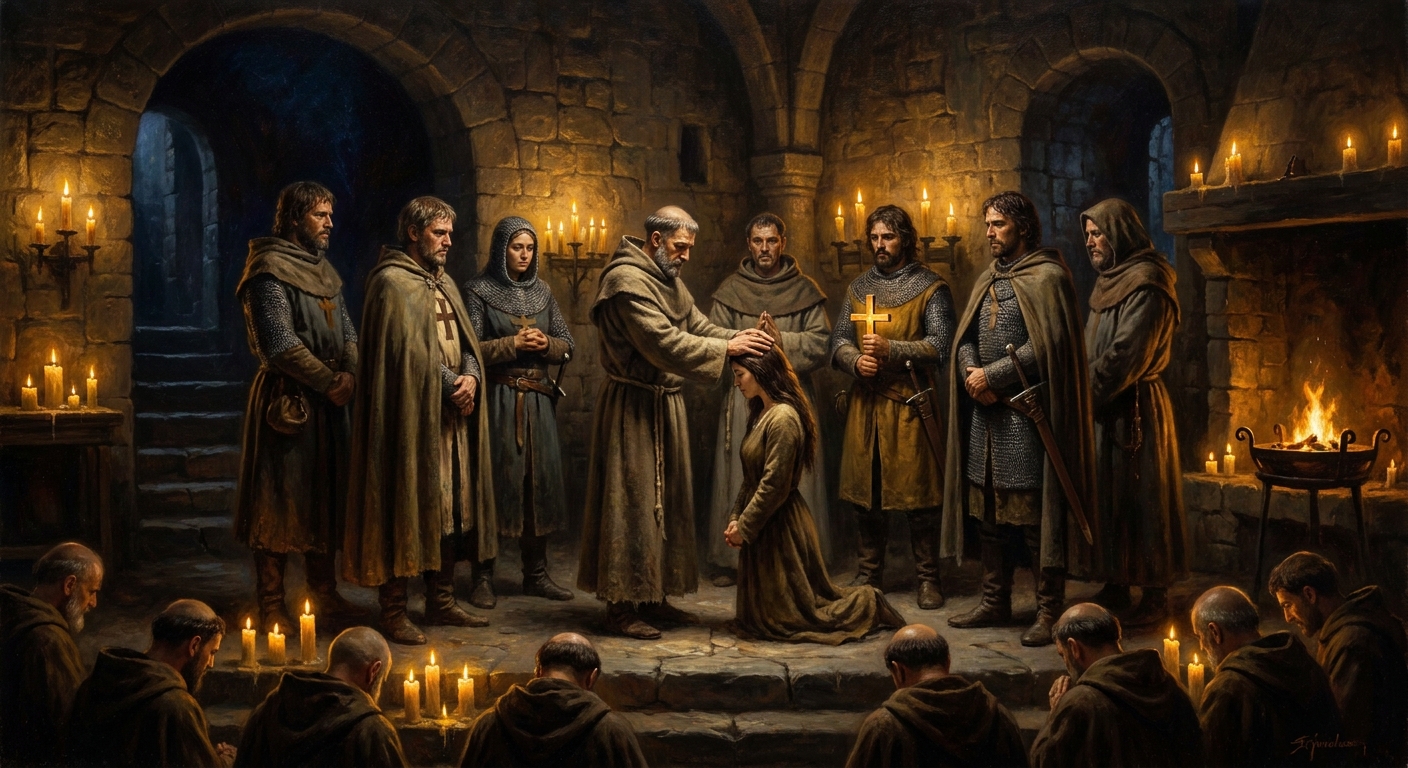
In the two weeks of the truce, more people ask for the consolamentum — the Cathar baptism, the laying-on of hands that transforms an ordinary believer into a perfectus, irrevocably, with full vows. They ask knowing the price. They ask because they have seen, in the bishop’s calm, what they want for themselves.
Twenty-one of them. Six women, fifteen men. Knights of the garrison who have fought beside the perfecti for months and now choose to die with them. The wife of Pierre-Roger himself, Philippa, takes the consolamentum on the night of March 13, in candlelight, in the small chapel, while the wind hammers the shutters and the besiegers’ fires burn in a thousand points across the valley below.
Bertrand Marty lays his hands on her head. He recites the formula. He gives her the kiss of peace.
She is now a perfecta. She will burn three days from now.
She thanks him.
On the night of March 15, four men leave the mountain.
They are lowered on ropes down the sheer western face of the pog, the side the besiegers have not bothered to picket because no one — no one sane — descends that face. They carry something. The chronicles do not say what. The depositions taken later by the Inquisition speak of pecuniam infinitam, an infinite sum, and of certain sacred objects of the Cathar church that must not fall into the hands of Rome.
The legend that grows in the centuries afterward will call it the Cathar treasure. By the nineteenth century the legend will involve the Holy Grail. By the twentieth, the Nazis will send an SS officer named Otto Rahn to dig in the caves around Montségur looking for it. He will find nothing. He will write a book. He will die mysteriously in 1939.
What the four men carried down the cliff that night, on ropes, in the dark, while their bishop and their friends prepared to burn — we do not know. We know only that they made it. We know only that they vanished into the Pyrenees and into legend, and that the besiegers, the next morning, never found what they had taken.
The treasure may have been gold. It may have been books. It may have been the four perfecti themselves, sent down to seed the church somewhere it might still survive.
The Cathar church did not survive. Whatever the four carried, it was not enough.
Dawn, March 16, 1244.
The perfecti come down off the mountain.
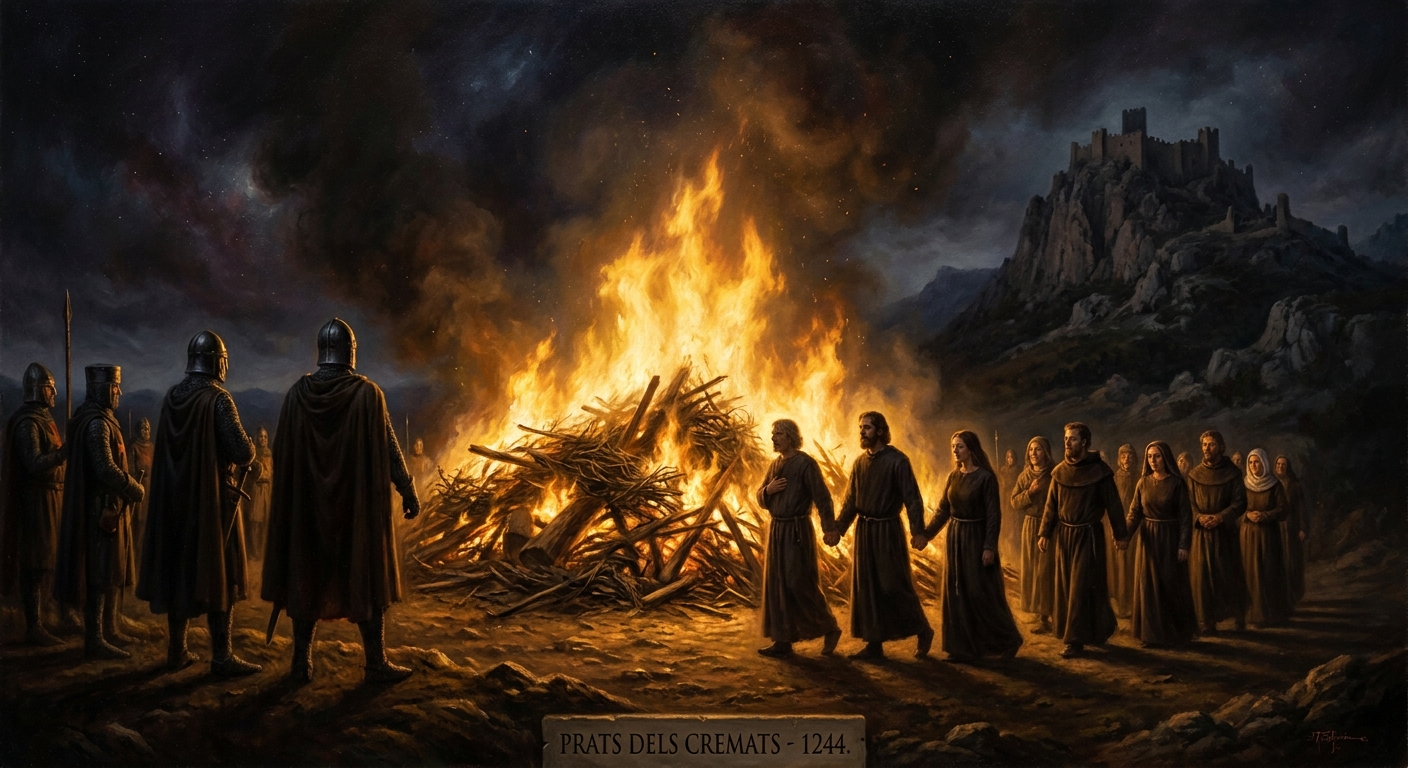
There is no path wide enough for two abreast — it is a steep, switchbacking goat-track — but at the bottom, on the small terrace at the foot of the cliff that locals will call, ever after, the Prats dels Cremats, the Field of the Burned, the soldiers have built a great pyre. Logs piled chest-high, packed with kindling, rimmed with stakes. They have not built two hundred individual stakes. They have built one fire, the way a man builds a fire to clear a field of brush.
The Cathars do not need to be tied.
They walk into it.
Bertrand Marty leads. The twenty-one new perfecti follow. Then the rest — old men, old women, the cook, the laundress, the teenage girl who was consoled three days ago. They walk hand in hand. They are singing, the chronicler William of Puylaurens writes, the Pater Noster in their tongue, the Our Father in Occitan, the only prayer Cathars said. They do not stop singing as the fire takes them.
The whole thing lasts perhaps an hour.
The smoke rises straight up in the cold mountain air, past the citadel they have just left, past the white peaks of the Pyrenees, into a sky the perfecti believed was not the true heaven but only the lid of a beautiful, terrible prison.
When the last of them stops singing, the sergeant in charge orders his men to rake the ashes into the river.
The river runs clear in two days.
The Inquisition lists the dead in its registers — combusti apud Montem Securum, burned at Montségur — but there are not two hundred named lines. Most of the perfecti went into the fire without surnames the inquisitors thought worth recording. They were marked perfectus, perfecta, and the column of names ends.
Pierre-Roger de Mirepoix, the garrison commander, who was permitted to leave with his weapons, rides off into the mountains. He never gives up his sword. He dies, decades later, in obscurity. His wife is in the river.
The castle on top of the pog is dismantled, then rebuilt as a royal fortress in the next century — the ruin tourists climb today is mostly the king’s castle, not the Cathars’. The terrace at the foot of the mountain is given a Latin name, Pratum Combustorum, in the Inquisition’s records and an Occitan name, Prats dels Cremats, by the people who live in the valley and who, four hundred years later, will still be quietly remembering.
The Cathar church is dismantled with the methodical patience the Inquisition was invented to provide. Bishops are hunted, perfecti are hunted, believers are hunted; entire villages are entered in inquisitorial registers; the last known Cathar perfectus, Guillaume Bélibaste, is burned in 1321, seventy-seven years after Montségur, in the small castle of Villerouge-Termenès. With him the line ends.
There are no Cathars after 1321. The dualist heresy that ran from second-century Egypt through Bulgaria and Bosnia and into the wine-villages of Languedoc dies on a stake in a small Pyrenean fortress while the inquisitor reads from a parchment.
A heresy is a doctrine the side with the books decides to call a heresy.
The Cathars believed this world was the work of an evil god. They believed Christ had come to free trapped souls, not to save flesh, which was the trap. They refused meat because it was the body of the trap. They refused oaths because oaths bound the soul to the prison. They refused war, refused property, refused the sacraments of a church they thought was the demiurge’s most successful counterfeit.
They were medieval Europe’s last Gnostics. They were also the most disciplined, the most generous, the most quietly admired men and women in their region — the bons hommes, the good men, the name was not ironic — and the Catholic Church and the French crown jointly decided, over forty years and three crusades and a permanent Inquisition, that they had to be erased.
They were erased.
And yet — every time, in the centuries since, that anyone has looked at the world and concluded that the suffering is not a bug but the architecture; every time anyone has reached, half-knowingly, for a Christianity that does not bless the empire and does not sanctify the marketplace; every time anyone has imagined a true God beyond the god the powerful proclaim — they have, without naming them, walked back to that pyre, hand in hand with the perfecti, into the fire that did not, in the end, burn the idea.
The four men with the treasure went down the western cliff in the dark. We never learned what they carried. Maybe it was gold. Maybe it was books.
Maybe it was the part that does not burn.
Scenes
Montségur in the snow — a stone citadel on a 1,200-meter pog, besieged for nine months by ten thousand crusaders below
 Generating art…
 The night before the surrender: the *consolamentum* given to twenty-one knights and women who choose to walk into the fire alongside the perfecti
 Generating art…
 March 16, 1244 — the *Prats dels Cremats*, the Field of the Burned
Generating art… Echoes Across Traditions
Entities
- the Cathar perfecti
- Bertrand Marty (last Cathar bishop)
- Pierre-Roger de Mirepoix
- the Inquisition
- Rex Mundi (the evil demiurge)
Sources
- Malcolm Lambert, *The Cathars* (1998)
- Stephen O'Shea, *The Perfect Heresy: The Revolutionary Life and Spectacular Death of the Medieval Cathars* (2000)
- Anne Brenon, *Le Vrai Visage du Catharisme* (1988)
- Michel Roquebert, *L'Épopée Cathare* (1970-1989, five volumes)
- *Doat Collection* (Bibliothèque Nationale de France) — depositions of Inquisitor Jacques Fournier, including testimony from survivors of Montségur