No Name, No Temple, No Destination
1239-1289 CE · Iyo Province, Shikoku → the roads of Japan → Koyano, Hyōgo Province
Contents
Ippen gives away his name, his disciples' names, his temple, and every sutra he owns, and walks Japan for twenty years distributing paper amulets inscribed with the nembutsu. Ten thousand people follow him to a riverbank in Hyōgo. He burns his books. He dies the next morning.
- When
- 1239-1289 CE
- Where
- Iyo Province, Shikoku → the roads of Japan → Koyano, Hyōgo Province
He gives things away all his life.
He is born in 1239 in Iyo Province, on the island of Shikoku, to the Kono clan — a local warrior family with enough standing to educate their sons properly. He is educated in Pure Land Buddhism in the tradition of Hōnen’s school. He is bright and serious and troubled in the specific way of people who believe a thing completely and cannot find a way to live it completely. He becomes a monk. He studies. He trains under masters in the Jōdo tradition. He does what monks do.
At thirty, when his father dies, he returns to secular life briefly — an inheritance to settle, a clan position to manage, the ordinary texture of grief and obligation. He has a wife, perhaps children; the records are unclear. He manages the affairs. Then he gives them away. He gives away the clan position, the inheritances, the domestic life, and returns to the monastery. He spends the next ten years in the Jōdo tradition, doing what monks do, and finding it insufficient.
What he finds insufficient is not the doctrine but the range. The nembutsu — Namu Amida Butsu, the invocation of Amida Buddha — is available to everyone who says it with sincere mind. But the people who know this are, roughly, the people who live near temples or have received formal instruction. The people in the mountain villages, the fishing hamlets, the road towns that the monastic network has never reached — these people do not know it. Ippen decides his work is with them. He leaves the monastery and goes onto the roads.
He has a crisis of qualification.
He is walking the roads of western Japan, distributing paper fuda — amulets inscribed with the six characters of the nembutsu, Namu Amida Butsu — to everyone he meets. He presses them into hands, slips them under doors, leaves them at crossroads. He is offering salvation: the amulet bears the name, and the name is the vehicle of Amida’s vow.
But what about the people who receive a fuda without faith? What about someone who takes the paper because a monk handed it to them and they were too polite to refuse, and who will drop it in a ditch the next mile? Has he helped them? Has he done anything for them? His teacher’s tradition — the Jōdo interpretation he was raised in — says that the nembutsu requires sincere mind. The insincere, the doubtful, the compelled, do not qualify.
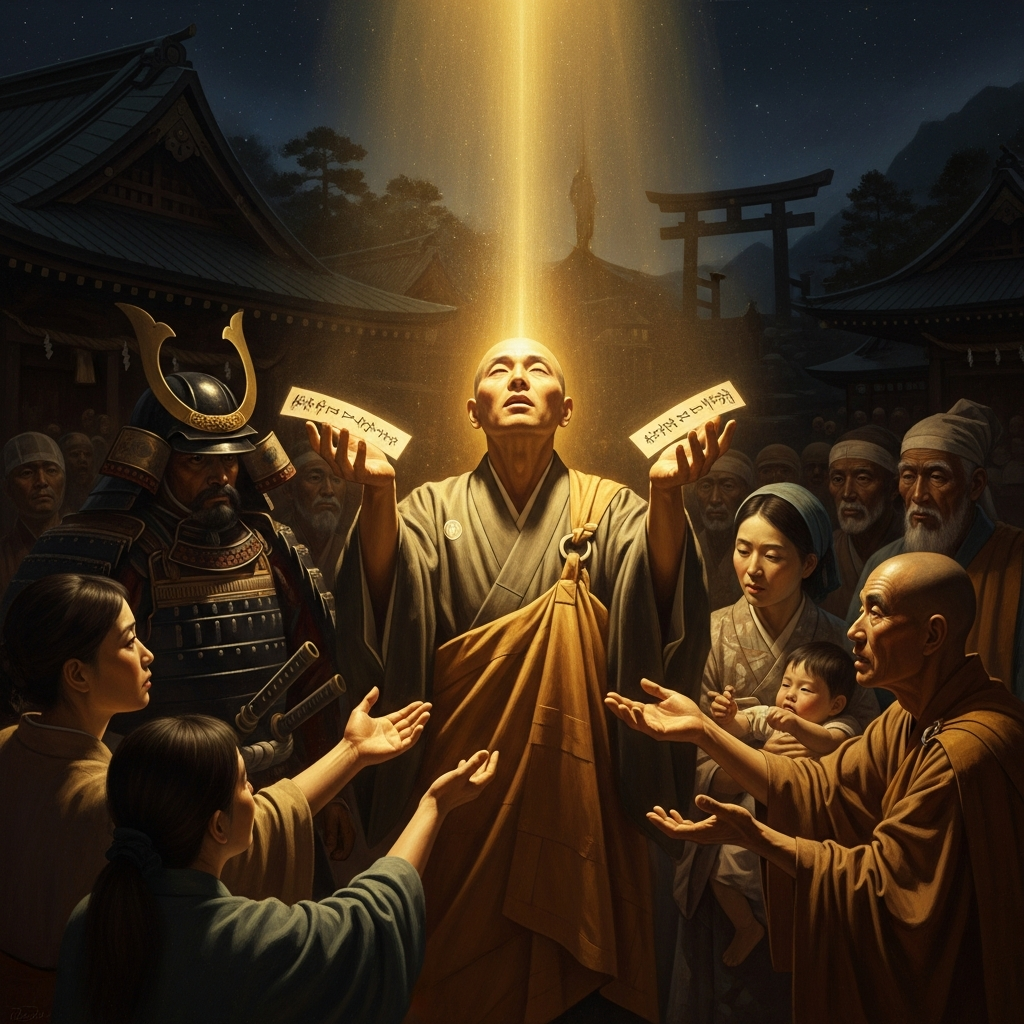
He brings this question to the Kumano Grand Shrine in 1274.
Kumano is not a Buddhist temple. It is a Shinto site — three grand shrines in the mountains of the Kii Peninsula, one of the holiest landscapes in Japan, a place where Buddhist and Shinto traditions had been intermixed for centuries under the practice of shinbutsu shūgō. Ippen sleeps before the altar. He practices nembutsu samadhi — hours of continuous invocation. He waits.
The deity speaks to him through a vision: whether people have faith or not, whether their minds are pure or impure, do not hesitate — distribute the fuda. In the moment of receiving it, all beings attain birth in the Pure Land. It is not your assessment of their sincerity that determines the outcome. It is Amida’s prior vow, which precedes your assessment and anyone’s sincerity.
He walks out of Kumano a different person. He no longer requires qualification.
The distribution becomes total.
He presses fuda into every hand he passes. He does not ask about faith. He does not ask about purity. He distributes to gamblers at dice games, to sex workers in the port towns, to lepers at the gates of every city he enters. He distributes to samurai and merchants and beggars. He distributes to people who laugh at him. He distributes to people who take the paper and immediately use it to light their pipes, which, as far as Ippen is concerned, is fine. The moment of contact is the moment of Amida’s vow operating.
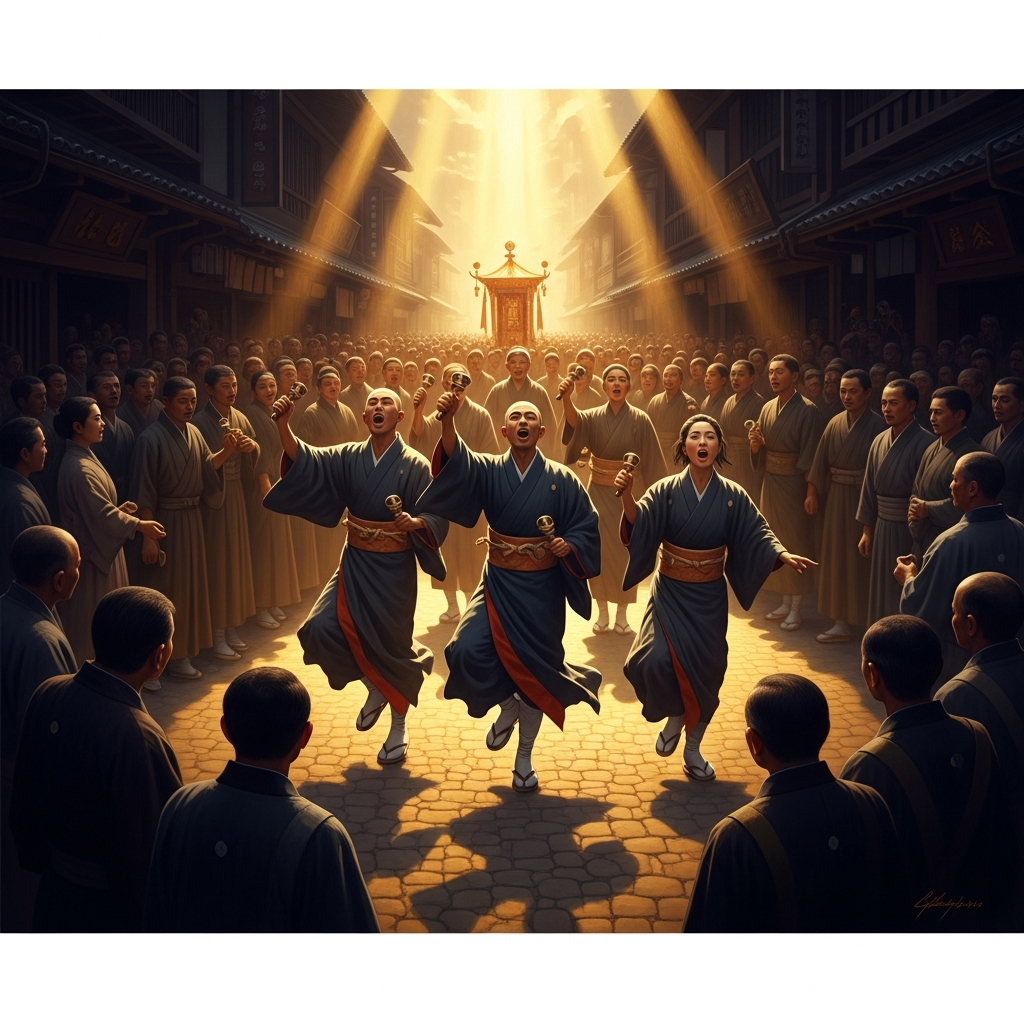
The odori nembutsu — the dancing nembutsu — emerges somewhere in the late 1270s, in the provincial capitals he passes through. It begins as continuous recitation with hand-bells. The recitation finds a rhythm. The rhythm finds a movement. The movement spreads from Ippen’s immediate followers to the crowd watching them, because the human body in the presence of sustained rhythm does not observe; it participates. The dancing crowds move through the streets of towns that have never seen anything like this — monks and lay people and tradespeople and people from the brothels and the gambling halls, all dancing the name of the buddha in the public street. Several provincial governors attempt to stop it. The crowds are too large.
He decides to have no name.
In the early 1280s he gives away the last formal identity he is holding. He tells his followers — the growing mob that has attached itself to him and is traveling with him — that they should not call themselves Ippen’s disciples. They are not disciples of a monk; they are people in whom Amida’s vow is operating. He gives away his own name. He calls himself Yugyo Shōnin — the Wandering Saint, the title that will stick — and after 1281 he stops using the name Ippen almost entirely. He does not stop distributing fuda. He distributes approximately 2.5 million of them in his lifetime, by estimates that are conservative.
He has no temple. He has no fixed location. He cannot be fixed, because fixing him would imply that the nembutsu has a location — that it belongs to a building or an institution or a tradition rather than to the air between any two people, to the road between any two towns. He is always in transit. When a follower asks where he is going, the answer is: wherever the nembutsu has not yet arrived.
He gives away the texts. One by one, across the late 1280s, he distributes the sutras and commentaries he has carried. He has no more use for them. They served as maps when he did not know the territory. He knows the territory now — he is walking in it. The map is less useful than the walking.
In the summer of 1289 he arrives at Koyano, near Hyōgo, on the coast of the Inland Sea.
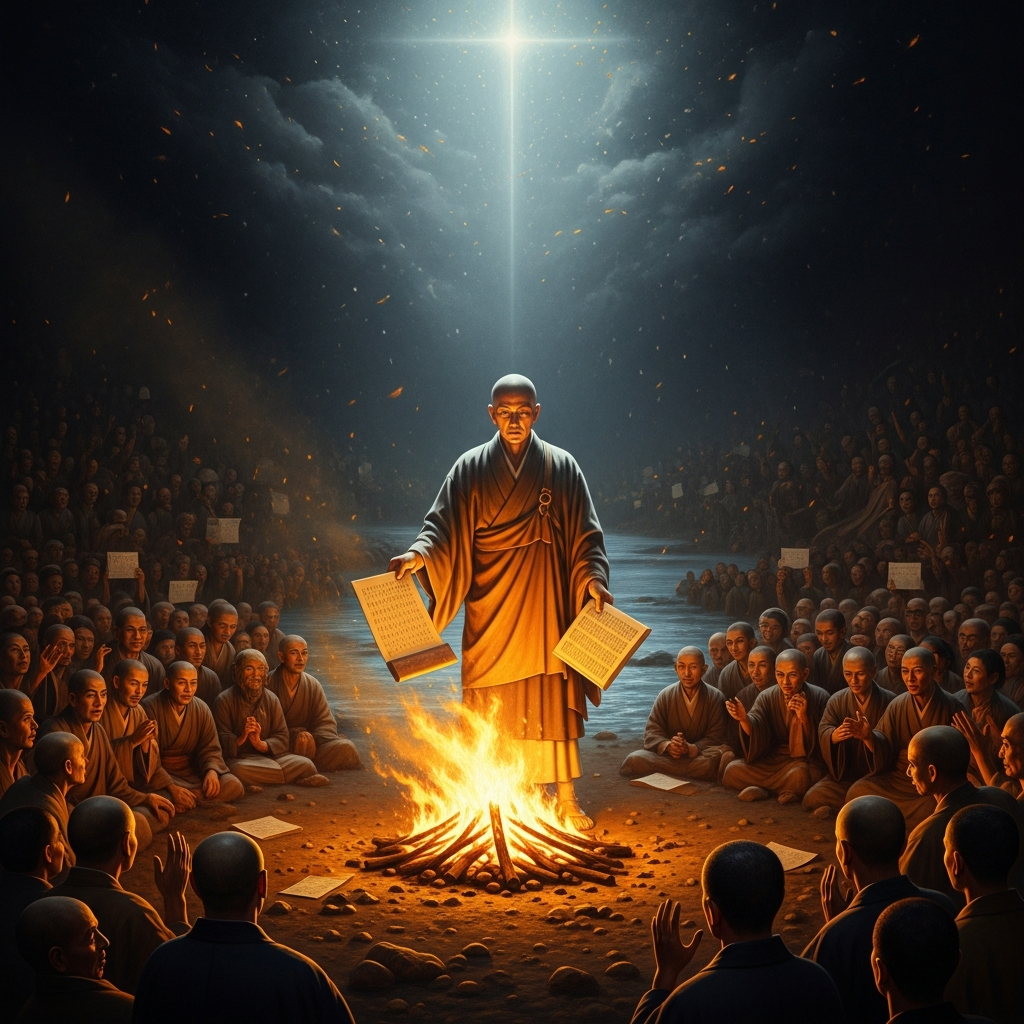
He is fifty years old and dying. He has been dying for some time — the body giving out the way it does when it has been treated as an instrument rather than a dwelling. He stops at a riverbank. The crowds that have been following him settle into a camp. Somewhere between eight thousand and ten thousand people are there, by the account that the Ippen Hijiri-e picture scroll will paint ten years after his death — a landscape of tents and cookfires and constant, low continuous nembutsu, like an ocean sound.
He calls his close followers together. He asks for the remaining texts — the last few scrolls he has kept. He puts them in the fire himself, watching the paper take the flame, watching the characters of the sutras become ash. He is not angry. He is not performing. He is completing. The sutras told him everything he needed to know, and now they have told him everything, and the burning is gratitude expressed in the only form that does not leave anything behind.
I have no teachings, he tells the people sitting with him. I have only the nembutsu. The nembutsu has no master. When I am gone, say the nembutsu and do not look for a successor.
In the morning he is dead.
The crowd at Koyano disperses over the following days, going in all directions at once, which is exactly the direction he would have chosen. No successor is officially appointed. His community — the Ji-shū, the Time School, named for the importance Ippen placed on nembutsu at each moment — continues without a center, which is the only way he designed it to work.
What Ippen built cannot be drawn on a map because it was never located anywhere. He refused every form that would have made it locatable — the fixed temple, the continuous community, the named tradition, the master’s identity that could be transmitted. He gave all of it away.
The fuda still exist in Japanese collections, the little paper rectangles with six characters on them. They were made in their millions by a man who believed that the moment of their transfer — hand to hand, stranger to stranger on the road — was the moment Amida’s vow arrived in a new life. He did not care whether the person believed it. The vow is not conditional on belief. The vow is older than belief. It is what belief is trying to catch up to.
He reached the riverbank. He burned the books. He taught the one thing he knew: say the name. Then he stopped.
Scenes
Kumano Shrine, 1274
 Generating art…
 The odori nembutsu
 Generating art…
 Koyano, Hyōgo Province, 1289
 Generating art…
 Echoes Across Traditions
Entities
- Ippen
- Amida Buddha
- Kūya
Sources
- Ippen, *Ippen Hijiri-e* (picture scroll biography, c. 1299)
- Dennis Hirota (trans.), *No Abode: The Record of Ippen* (1986)
- James Foard, 'Ippen and Pure Land Geography in Medieval Japan,' *Journal of Asian Studies* (1990)
- Lori Meeks, *Hokkeji and the Reemergence of Female Monastic Orders in Premodern Japan* (2010)
- Allan Andrews, *The Teachings Essential for Rebirth* (1973)