Al-Hallaj on the Gibbet
Abbasid Caliphate · 26 March 922 CE (24 Dhu al-Qa'da 309 AH) · Bab al-Taq, the western bank of the Tigris, Baghdad — the gallows ground in sight of the caliph's palace
Contents
The wool-carder who said *I am the Truth* is brought to a Baghdad gibbet at dawn — and prays, with his hands cut off, for the men about to kill him.
- When
- Abbasid Caliphate · 26 March 922 CE (24 Dhu al-Qa'da 309 AH)
- Where
- Bab al-Taq, the western bank of the Tigris, Baghdad — the gallows ground in sight of the caliph's palace
He has been in prison for nine years.
The cell is below the river-mark. In flood season the water rises to his ankles. He has converted three of his guards. He has written, on smuggled paper, the Kitab al-Tawasin — short luminous chapters in which Iblis becomes a tragic monotheist who refused to bow to Adam because he refused to bow to anyone but God. The theologians who read it understand at once why he must die.
The case has been argued in the caliph’s court for years. Junayd of Baghdad — the great teacher, the most cautious Sufi alive — was asked his opinion when al-Hallaj first began to shout in the streets. He must be killed, Junayd said, but according to the outer law.
That is the formula they use. Not heresy as such. Misuse of the formula. Confusion of the masses. Threat to public order.
The vizier Hamid signs the warrant. The caliph al-Muqtadir, eighteen years old, signs without reading.
They bring him out at dawn.
He is wearing a loincloth and an izar. His hair has gone white in prison. He is around sixty-four. A crowd has gathered along the western bank — thousands, by some accounts; the Tigris boats stop in the current to watch.
He sees the gibbet and laughs.
This, he says, is the moment of the lover.
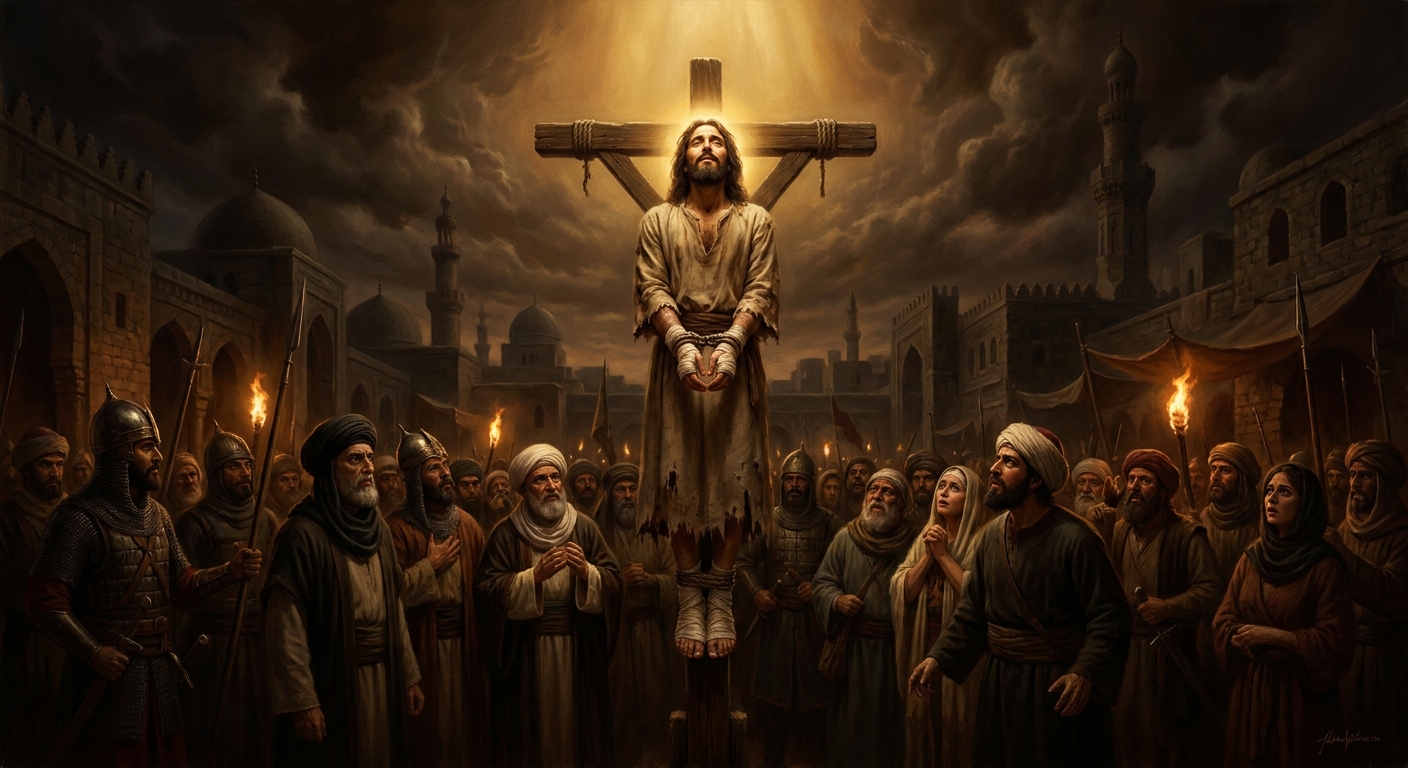
The executioner takes his hands first. The right, then the left. Each cut is a single stroke. He does not cry out. When the blood comes, he dips the stumps into it and smears it across his face — ablution, he says, loud enough for the front row to hear, the lover prays in the blood of the Beloved.
A scribe in the crowd writes this down. It is how we have it.
They take his feet.
He looks up at the sky and says — and this is the prayer, the one Massignon will spend forty years translating —
O Lord, these Thy servants are gathered to slay me, in zeal for Thy religion, seeking nearness to Thee. Forgive them. For if Thou hadst revealed to them what Thou hast revealed to me, they would not have done this. And if Thou hadst hidden from me what Thou hast hidden from them, I would not be suffering this trial. Praise be to Thee in whatsoever Thou doest. Praise be to Thee in whatsoever Thou willest.
His friend Ibn ‘Ata is in the crowd, and at this sentence Ibn ‘Ata begins to weep so hard that the men beside him have to hold him up. Within a year Ibn ‘Ata himself will be summoned, beaten, and killed for refusing to disavow his teacher. The price of love compounds.
They put out his eyes.
A boy in the crowd — not a Sufi, not a theologian, just a boy who came because his father said come and see what happens to a man who calls himself God — vomits into the dust and runs.
A woman hands the boy water on the side street. She is crying. He didn’t say he was God, she tells him. He said God was speaking through his tongue. There is a difference. The boy does not know whether to believe her. He will think about it for the rest of his life.
This is how al-Hallaj is remembered: not by the verdict of the court, but by the people in the side streets who could not unsee what they had seen.
They cut off his tongue at sundown.
Before they do, he is asked — by Hamid, by the chief judge, by anyone who can still extract a recantation — whether he wishes to take back the sentence. Ana al-Haqq. Just say it was a slip. Just say a jinn spoke through you. Just say anything.
He says, instead: To affirm Oneness is to make Him One in oneself.
Then he says: It is enough for the lover that he should make the One single.
Then his tongue is gone.
He smiles. He cannot speak now, but he has spoken enough. The smile is the last argument. The chronicler Ibn al-Nadim, who hated him, records the smile.
They behead him at dusk.
They burn the body. They scatter the ashes into the Tigris from the top of a minaret, so that no shrine can ever be built on the relics.
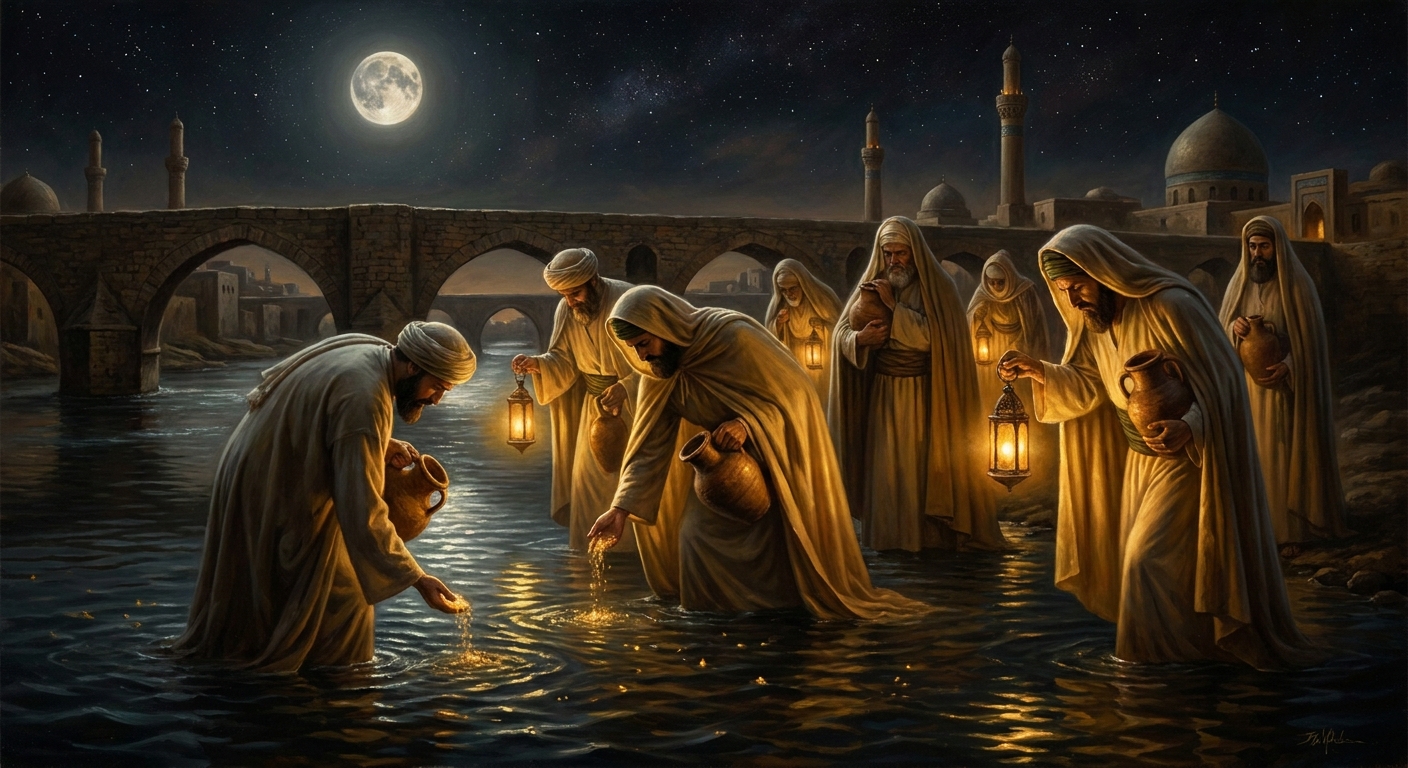
The ashes drift downriver. Some of them, the chronicles say, formed letters on the surface of the water — Allah, Allah, Allah — though every chronicler doubts this and every chronicler reports it.
Within a century his sayings are being copied in Khorasan, in Cairo, in Cordoba. Within two centuries Rumi will write that al-Hallaj only said what every saint says — but he said it loud, and on a Wednesday, in Baghdad. Within four centuries every major Sufi order has found a way to teach his doctrine without using his words. The sentence Ana al-Haqq becomes the secret behind a thousand poems that do not quote it.
The river carries the ashes to the sea.
Massignon — a French Catholic Arabist — spent his entire scholarly life on these few hours in 922. He read every Arabic chronicle, every Sufi hagiography, every Shi’a refutation, every Sunni defense. He died in 1962 still revising the manuscript. He believed al-Hallaj had taught him how to be a Christian.
That is the strange afterlife of the wool-carder. He is the Sufi the orthodox killed, and his death is the moment Sufism becomes a literature of disguise — the wine-poems of Hafiz, the gazelle-poems of Ibn al-Farid, the masnavi of Rumi, all of them descended from a man who said the unsayable thing in plain Arabic and was therefore taken apart at dawn.
The lesson the orders learned was not silence. It was metaphor. The metaphor he refused.
Scenes
Hands severed and feet broken on the Baghdad gibbet, he lifts his face to the dawn sky and prays for the men sharpening the next blade
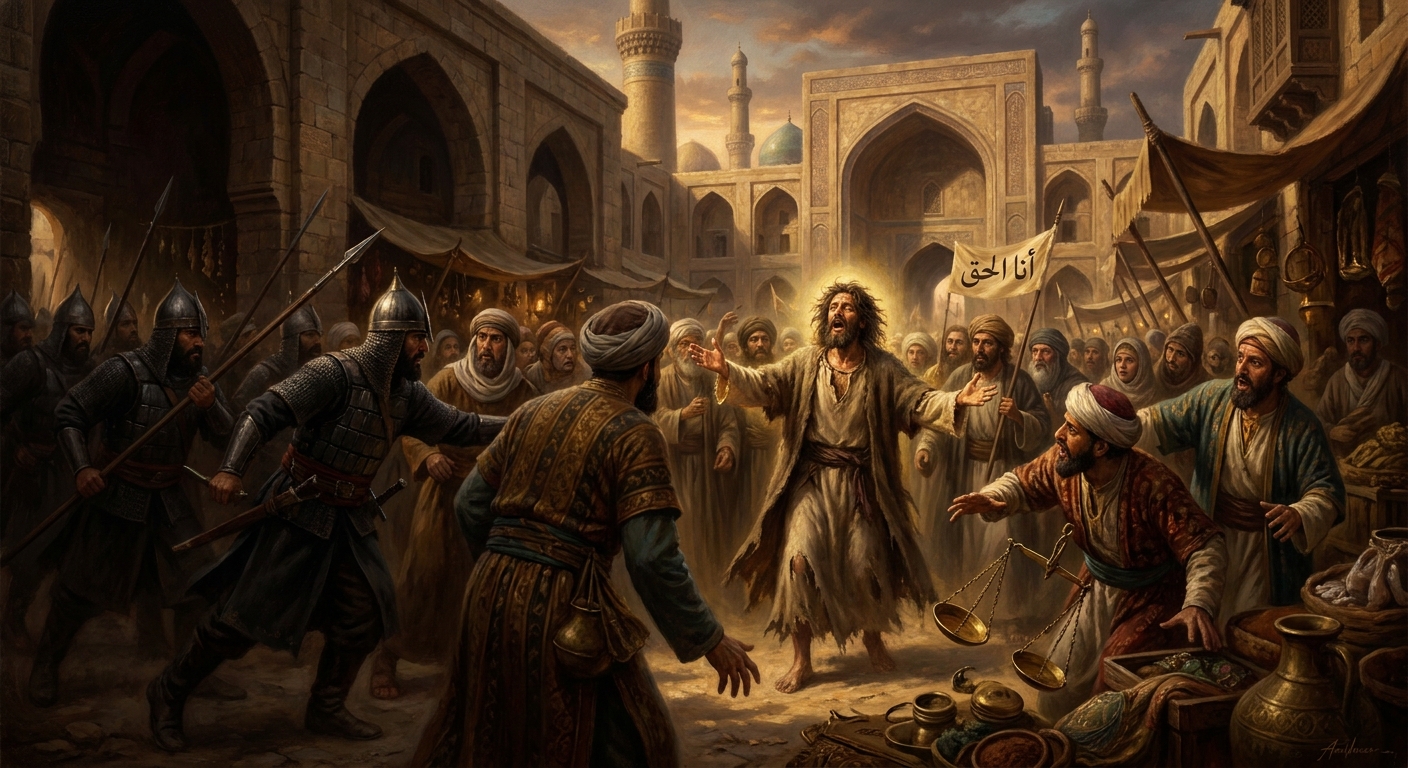
Generating art… In the Baghdad marketplace he cries out *Ana al-Haqq* — *I am the Truth* — and the merchants drop their scales as the soldiers begin to push toward him
 Generating art…
 By moonlight the dervishes wade into the Tigris and gather his floating ashes into clay jars, smuggling the saint home a handful at a time
 Generating art…
 Echoes Across Traditions
Entities
- Mansur al-Hallaj
- Caliph al-Muqtadir
- Vizier Hamid ibn al-'Abbas
- Junayd of Baghdad
- Ibn 'Ata
Sources
- Louis Massignon, *La Passion de Husayn ibn Mansur Hallaj* (1922; English: *The Passion of al-Hallaj*, trans. Herbert Mason, Princeton, 1982) — the foundational 4-volume study
- *Akhbar al-Hallaj* — the earliest collection of his sayings and the trial accounts
- Annemarie Schimmel, *Mystical Dimensions of Islam* (UNC, 1975), ch. 2
- Carl Ernst, *Words of Ecstasy in Sufism* (SUNY, 1985)
- Farid al-Din 'Attar, *Tadhkirat al-Awliya* (~1220) — the *Manaqib al-Hallaj* chapter