Loki Bound in the Cave
Mythic Time · after Baldur's death, before Ragnarök · A cave deep beneath the mountains of Midgard
Contents
After Baldur's death, the gods drag Loki to a cave under the mountains. They bind him to three sharp stones with the entrails of his own son, hardened to iron. A serpent drips venom onto his face. His wife Sigyn catches the drops in a bowl. When she empties it, the venom strikes him, and Midgard quakes. He waits there until Ragnarök.
- When
- Mythic Time · after Baldur's death, before Ragnarök
- Where
- A cave deep beneath the mountains of Midgard
They catch him at the waterfall.
He has turned himself into a salmon. He has spent the day shaping the net that will catch him — designing it, by his own logic, perfectly, because he has always taken pride in his own cleverness — and now Thor wades into the water and grasps him by the tail. The scales cut Thor’s hand. The salmon thrashes. Thor’s grip does not slip. This is why salmon, since that day, are narrow at the tail.
They drag him out. He resumes his shape, dripping, naked, glaring. Baldur is dead because of him. Hod was tricked into throwing the mistletoe; Frigg’s tears could not buy Baldur back from Hel because Loki, disguised as the giantess Thökk, refused to weep for him. Every god in Asgard knows what he did. The trial is already over. Only the sentence is left.
They bring his sons.
Narfi and Váli are his two boys by Sigyn.
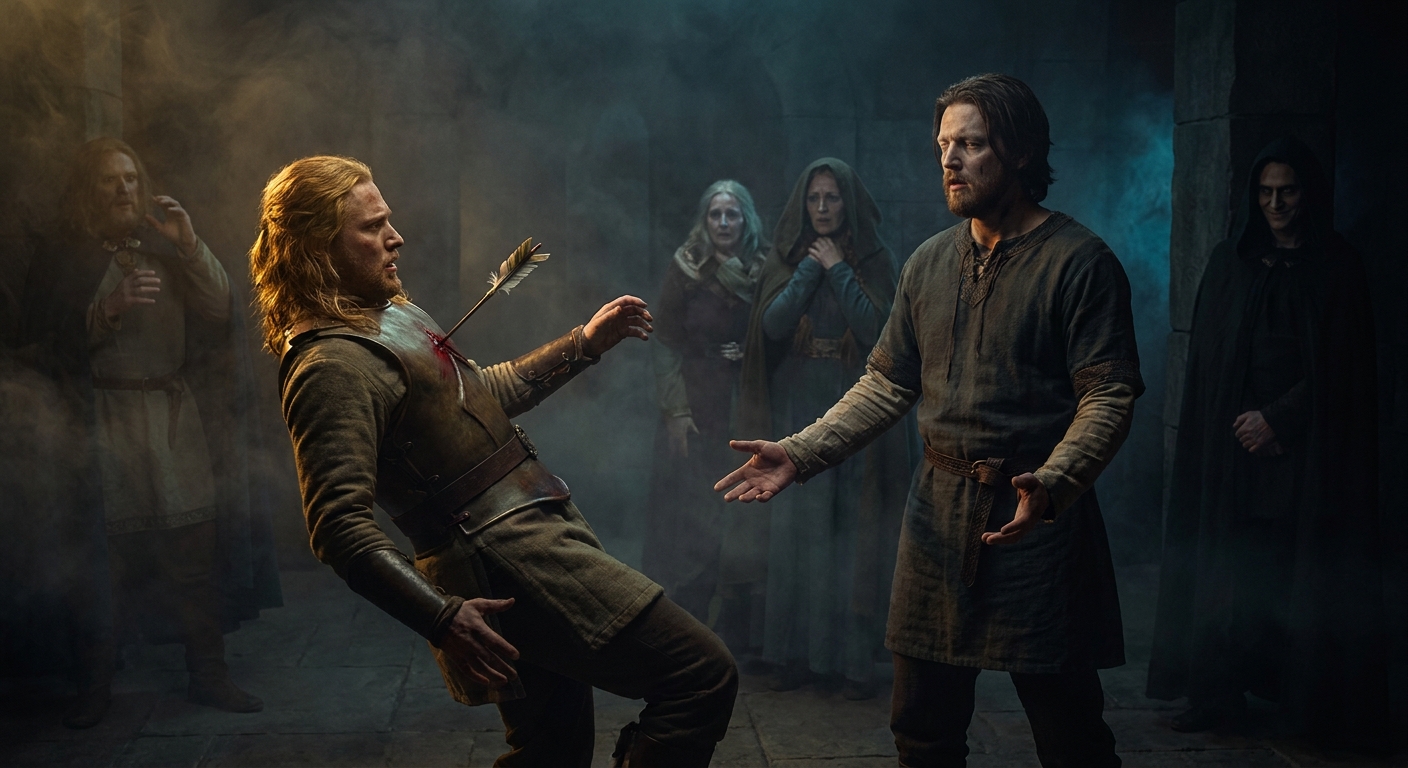
Váli they transform into a wolf. The change is fast — a god’s spell, no mercy in it — and the wolf does what wolves do when they are confused and frightened and shoved at a member of their own pack. He attacks Narfi. He tears out his brother’s entrails. The body of Narfi falls in pieces in the snow, and Váli runs into the woods, and is never named in any saga again.
The gods take Narfi’s entrails.
They harden them. Norse magic does this — it changes one thing into another, milk into stone, breath into rope, a brother’s intestines into iron bands. They drag Loki into a cave deep under the mountains, in a place where no light has ever fallen, and they lay him across three sharp stones. One stone under his shoulders. One under his hips. One under the backs of his knees. They bind him to the stones with his son’s iron-hardened guts.
The bindings hold. They were never going to do anything else.
Skadi brings the serpent.
The giantess whose father Loki helped to murder, who married into the Æsir for vengeance she never quite got — she carries a venomous serpent in a basket, and she fastens it above his face. The snake is alive. It does not want to be there. It hangs by its tail from a stalactite, head down, mouth hinged open, and from its fangs the venom drips.
The first drop falls on Loki’s forehead.
He screams.
The sound does not stay in the cave. It travels up through the rock, through the roots of the mountains, into Midgard above. Somewhere in a fjord, a fisherman drops his net. Somewhere in a meadow, a horse rears for no reason its rider can explain. The sound is the sound of a god feeling pain that was designed for a god.
Skadi leaves. The Æsir leave. There is no guard. There does not need to be one.
Sigyn stays.
She has not spoken in any of the major sagas.
She is barely a name in the genealogies — Loki’s wife, mother of Narfi and Váli, mentioned once in passing and never given a speech. She has watched the gods drag her husband into the cave. She has watched one son turn into a wolf and the other son ripped open. She has watched her dead boy’s intestines knotted around the man she married. She has been given no comfort, no oath, no word.
She picks up a wooden bowl.
She holds it over Loki’s face. The next drop of venom falls. The bowl catches it. Then another. Then another. She holds the bowl steady. Her arms ache. Her shoulders ache. The venom is heavy — heavier than water, the way grief is heavier than ordinary sadness — and she holds the bowl above his face for as long as her body allows.
When the bowl is full, she has to empty it.
She turns aside, only for the seconds it takes, and tips the venom onto the cave floor where it hisses and burns a hole. In those seconds the next drop strikes Loki’s skin.
He convulses.
The cave shakes when he convulses.
The mountains shake. The mountains shake the earth. Across Midgard, in places that have never heard of Loki and have never been told about Sigyn, the ground moves. Walls crack. Children fall out of beds. Old men say a word they were taught by their grandfathers, who learned it from theirs: Loki is writhing in his bonds.
That is what an earthquake is, in the Norse account.
It is not tectonics. It is not the breath of a sleeping giant. It is a wife emptying a bowl, and a husband feeling, in the gap between drops, what the gods arranged for him to feel.
She returns. She lifts the bowl. The drops resume their journey, and she catches them, and the earth stops shaking, and somewhere a mother picks her child up out of the broken cradle and does not understand why she was almost killed by a piece of furniture.
Sigyn does not leave the cave.
Time becomes a strange thing in there.
She does not eat. The sagas do not say what she lives on. Perhaps she lives on the same thing the einherjar live on in Valhalla — the food the dead are given to make them ready for the last battle — except she is not dead, and the food is not for her. She holds the bowl. She empties the bowl. She holds the bowl again. The serpent does not tire. The venom does not run out.
Loki, between convulsions, has nothing to say.
He is the most articulate god in the eddas — the trickster whose tongue talked his way into and out of every hall in the Nine Realms — and in the cave he is silent. Whether the silence is shame, or strategy, or the simple fact that there is no audience worth speaking to, the sagas do not say. He grins sometimes. The grin is his. The grin is the only thing the gods could not tie down.
He waits.
He waits for Ragnarök.
The seeress, in the Vǫluspá, sees him still in the cave when the cock Fjalar crows in Jotunheim. The bonds are still around him. Sigyn is still holding the bowl. Then the world’s calendar gives out, and the chains of the wolf give out, and Loki’s bonds give out with them — every fastening that fate has held breaks at the same hour — and he rises.
He sails to the field of Vigrid in a ship made of dead men’s fingernails.
He meets Heimdall there. They have hated each other since the morning of the world. They kill each other.
That is what the bowl was holding off.
It was not mercy. It was not rehabilitation. It was the schedule. Sigyn caught the venom for as long as the prophecy required her to catch it, and the moment the prophecy was complete, she set the bowl down, and her husband walked out of the cave to die.
Then she vanishes from the eddas.
She is not at Idavoll on the green new shore. She is not among the surviving gods. The texts do not say where she went. She held a bowl above her husband’s face for an age of the world, and when the age ended, she went somewhere the texts do not follow.
Snorri tells this story in the Gylfaginning to explain earthquakes. That is the surface of it. The depth of it is what the Norse believed about justice: that the gods were not above arranging an eternity of pain, that the punishment of one being could be made to require the suffering of his wife and the murder of his sons, and that this arrangement could be called righteous because the alternative — letting the killer of Baldur walk free — was unbearable.
Loki bound is Prometheus chained, and is Satan in the pit, and is Azazel beneath the rocks, and is every adversary fixed in place by the cosmos until the last act. What is unique to the Norse version is Sigyn. Prometheus has no wife in the Caucasus. Satan has no companion in the abyss. Loki has Sigyn, and she stays, and her staying is the strangest thing in the myth.
The eddas do not tell us why she stays. They simply tell us that she does. Whatever the gods built into the punishment, they did not build that. That, Sigyn brought herself.
Echoes Across Traditions
Entities
- Loki
- Sigyn
- Narfi
- Váli
- the Serpent

Sources
- Snorri Sturluson, *Prose Edda*, Gylfaginning 50 (c. 1220)
- *Lokasenna*, prose epilogue, Codex Regius
- *Vǫluspá* 35
- Anthony Faulkes (trans.), *Edda* (1987)
- Carolyne Larrington (trans.), *The Poetic Edda* (1996)
- John Lindow, *Norse Mythology: A Guide* (2001)