Mazu Enters the Storm
960–987 CE · Song Dynasty · cult spreading to 960 CE present · Meizhou Island, Putian County, Fujian Province · then the entire South China Sea
Contents
Lin Mo, born on Meizhou Island in 960 CE, is sixteen when she enters a trance during a storm and guides her father's fishing boat home with her mind while her body sits unconscious in the courtyard. She dies at twenty-seven, a virgin who refused all suitors because she had already given herself to the sea. Within a generation, sailors across the South China Sea call her Mazu — the Mother Ancestor — and build her temples on every coast from Fujian to Vietnam to Japan.
- When
- 960–987 CE · Song Dynasty · cult spreading to 960 CE present
- Where
- Meizhou Island, Putian County, Fujian Province · then the entire South China Sea
She sits in the courtyard and does not move.
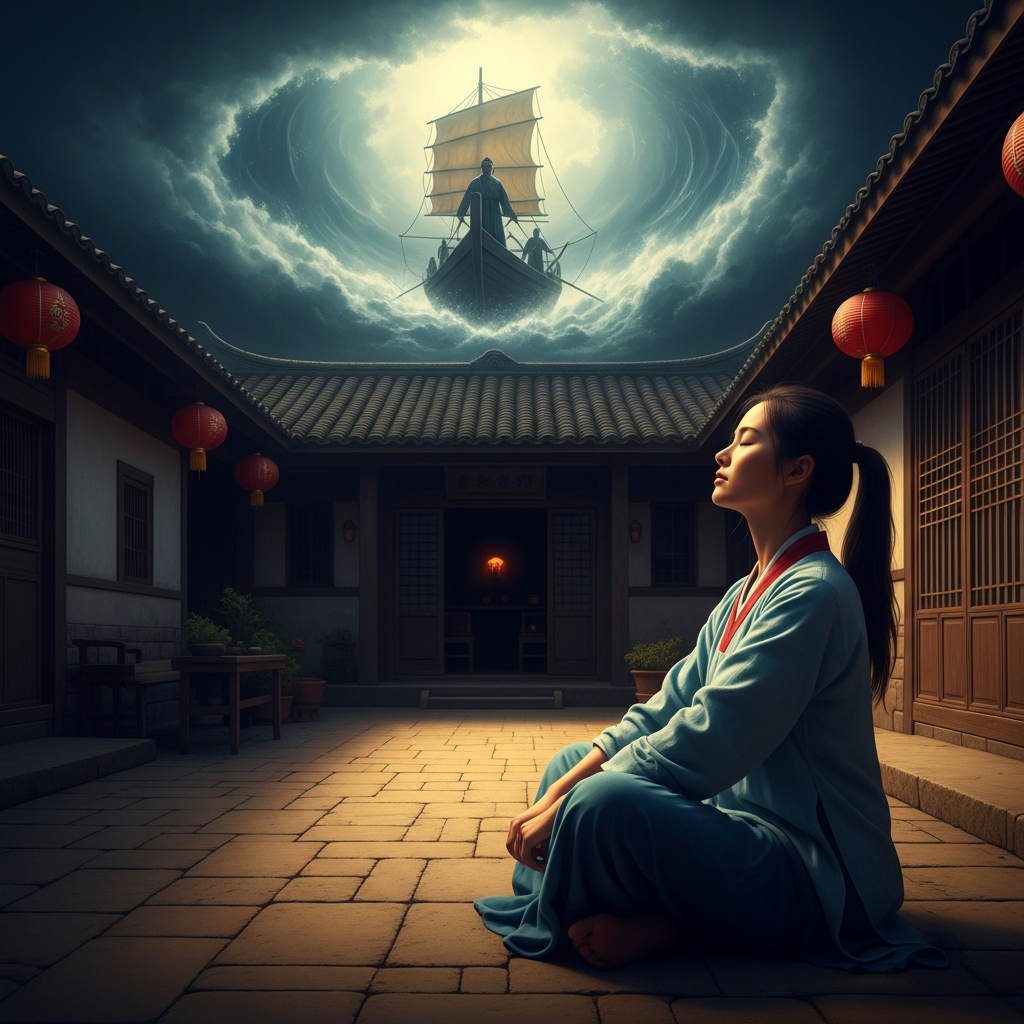
This is what her mother finds when she comes back from the well: her daughter, sixteen years old, seated on a low stool with her hands open in her lap and her eyes closed and her breathing so slow and even that for one terrible moment the mother thinks she is dead. The incense burns in the kitchen. A dog crosses the yard. The clouds above Meizhou Island are the color of hammered pewter and moving fast from the east, and somewhere out in the Taiwan Strait, where the South China Sea begins its long argument with the Pacific, her husband’s fishing boat is in the storm.
The mother shakes her daughter’s shoulder.
Nothing.
She shakes harder. The girl’s body moves with the shaking like a doll, limp in all its joints, but her face does not change and her eyes do not open.
The mother puts her hands on her daughter’s face. She calls her name: Mo. Lin Mo. The personal name, the use name, the secret name. The girl does not come back.
Her mother sits down in the dirt of the courtyard and puts her head in her hands and waits for whatever this is to be over, and the clouds pile up over the Strait like a fist closing.
Inside the trance, Lin Mo stands at the prow of her father’s boat.
She cannot explain this to anyone afterward because she will never find language adequate to what the trance is: not a dream, not a vision in the prophetic sense, but a presence. She is genuinely in two places — on the stool in the courtyard and at the prow of the boat — without this seeming strange to the part of her that is in the trance. The water is green-black in the storm light. The sail is half-torn. Her brothers — her father has taken two of them this trip — are at the oars and the ropes and they cannot hear her, but she puts her hands on the boat’s planks and she feels where the rocks are, feels where the current turns, feels the way through.
She steers with her mind. She puts her weight into the boat’s decision-making, which is not how any fisherman would describe what a boat does but is, nonetheless, what happens. The boat corrects toward safety. Her father at the rudder feels something assist him — not wind, not current, but something with intention, a hand on the tiller that is not there. He follows the suggestion. The boat finds the channel.
In the courtyard, Lin Mo’s mother is still sitting in the dirt when she hears her daughter make a noise — a small exhaled sound, not quite a word — and then Lin Mo’s eyes open and she looks at her hands and then at her mother and her face has the expression of someone who has just returned from a long journey and needs a moment before the familiar world comes back into focus.
“The boat,” Lin Mo says. “It’s safe. They’re coming back.”
Her mother demands explanation. Her daughter cannot give one that satisfies. The mother will later describe the day as the strangest of her life, and she is a woman who has survived three typhoons and a plague and the death of two children in infancy.
Her father’s boat arrives at the dock the following morning. Her father describes, haltingly, the help he felt in the storm. Her brothers say nothing but look at their sister in the way that people look at something they have decided not to argue with.
She does it again. And again.
Every storm season, when the boats go out and the Strait becomes dangerous, Lin Mo sits in the courtyard and goes somewhere else and guides them back. The fishing families of Meizhou Island know this. They do not advertise it because the Song dynasty administration is interested in practical results and uninterested in the theology, but they know. They also know that she has refused every marriage proposal — several have been made, because she is the daughter of a man with a boat and she can read and she is known to have some power over weather — and that her refusals are not coy but final. She does not want a husband. She does not explain why in terms anyone can quote. But the people who watch her in the courtyard during storms and watch her eyes when she comes back have a working theory that her heart is already somewhere that is not available to a husband.
She gives it to the sea at sixteen, in the trance. She has never taken it back.
At twenty-seven, she climbs Meizhou Mountain alone on the ninth day of the ninth lunar month, the festival of ascending heights. Her family watches her go up the path. She reaches the summit and stands there for a moment visible against the sky, and then the clouds come down around the mountain in a column of colored light — rose and gold, by the accounts of those who saw it from below — and when the clouds lift, the summit is empty.
No body is ever found. No trace. She has not descended by any path anyone has checked.
She has, in the language her tradition will eventually develop to describe this, ascended.
The first miracle attributed to her posthumously happens six months later.
A merchant ship from Quanzhou is caught in a storm in the Strait. The captain sees a woman in red standing on the wave crests beside his boat, pointing north toward the safe channel, and he follows her, and the boat does not sink. He arrives at port and asks the dockworkers who the woman in red was, and a fisherman from Meizhou tells him about Lin Mo, and the captain builds a small shrine at the Quanzhou dock, and the sailors begin stopping there.
This is how every Mazu temple begins: someone is saved and they build something to remember it.
By the time the Song dynasty officially recognizes her in 1123 CE — after she helps the imperial inspector Lujun survive a storm en route to Korea, by appearing on the mast of his ship and guiding him through — there are already dozens of shrines from the Fujian coast to Guangdong. The official recognition gives her the title Linghui Fei, the Numinous and Efficacious Lady, and within two centuries she will accumulate titles the way storms accumulate water: each dynasty adds to her rank, each emperor who survives a sea crossing adds another character to her name, until by the Qing dynasty she is Tianhou, the Empress of Heaven, officially co-equal in title with the wife of the Jade Emperor himself.
She began on a stool in a courtyard on an island eleven miles long.
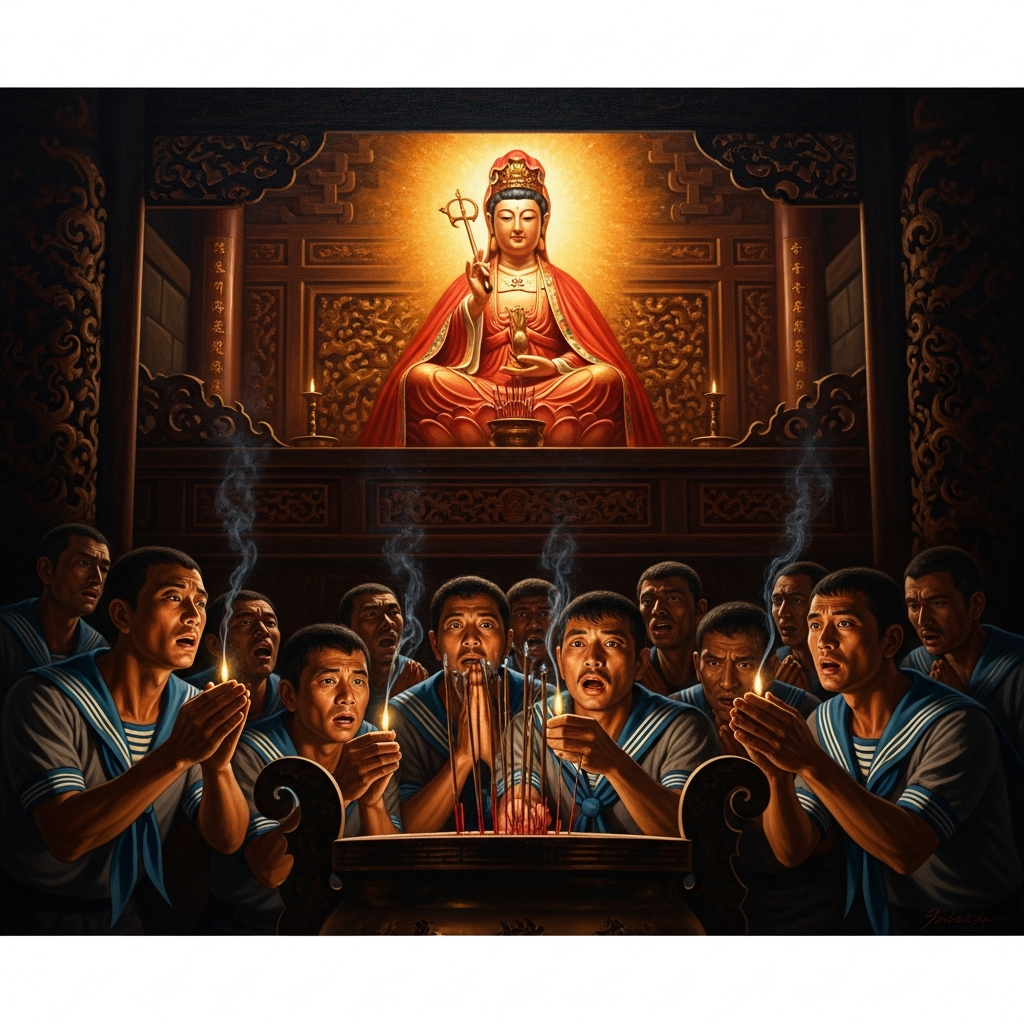
In the temples that house her today — five thousand of them, spread from the coast of China to Malaysia, Vietnam, Singapore, Japan, and every Chinatown in the world that has enough sailors to need a patron — she sits enthroned in red and gold. Her face is painted the pale ivory of idealized beauty, her expression the absolute calm of someone who cannot be alarmed by weather because weather is what she is. On either side of her stand her generals: Thousand-Mile Eye and Wind-Following Ear, who see across the ocean’s horizon and hear the prayers of the drowning, and bring her news to which she responds by appearing on the masts of sinking ships.
The offerings people bring her are practical: incense, oranges, cups of tea, red cloth, sometimes a paper boat. The prayers are practical too: we are going out tomorrow in rough weather, keep us from the rocks, bring us back with the fish, let the boat hold.
She does not require theology. She requires the sea, and she has that.
Every year on the twenty-third day of the third lunar month — the date of her birth, not her death, because the tradition commemorates the beginning of the story rather than its earthly end — the faithful carry her effigy from her temple and parade it through the streets to the shore. They light firecrackers to clear the path. They burn incense to tell her where they are. They lower the effigy toward the water, and the sea receives the gesture.
She is sixteen, in the courtyard, in the storm. She is always sixteen in the courtyard in the storm. The trance never fully ended. She is still in two places: on the mountain where she ascended, and at the prow of every boat in the South China Sea that is afraid and finding its way home.
What Mazu offers her worshippers is not the distant intercession of a deity who was once human but has long since forgotten what a storm feels like. She offers the specific, embodied knowledge of someone who sat in the wind and felt the water’s thinking, who chose the sea over the life that was offered to her and died still choosing it.
The virgin who refuses marriage in Chinese tradition is always suspect — an unfilial daughter, a failed woman, a problem. What Lin Mo’s tradition does is take the refusal and reinterpret it not as rejection of life but as marriage to something larger than the life she was offered. She did not refuse the sea. She accepted it so completely that it took her back.
The fishermen of Meizhou Island know why she never came down the mountain. She had already arrived.
Scenes
Lin Mo sits in the courtyard of her family's house on Meizhou Island, eyes closed, body rigid in the trance — while in her vision she stands at the prow of her father's boat in the heart of the storm
 Generating art…
 At twenty-seven, Lin Mo climbs Meizhou Mountain alone and ascends into the clouds in a column of colored light while her family below can only watch the place where she was
 Generating art…
 Sailors in the Taiwan Strait light incense at a Mazu temple on a stormy night, her red-robed figure on the altar calm above their fear
 Generating art…
 Echoes Across Traditions
Entities
- Mazu
- Lin Mo
- Jade Emperor
Sources
- James L. Watson, Standardizing the Gods: The Promotion of T'ien Hou Along the South China Coast, in *Popular Culture in Late Imperial China* (University of California Press, 1985)
- Brigitte Baptandier, *The Lady of Linshui: A Chinese Female Cult* (Stanford University Press, 2008)
- P. Steven Sangren, *History and Magical Power in a Chinese Community* (Stanford University Press, 1987)
- Kang Xiaofei, *The Cult of the Fox: Power, Gender, and Popular Religion in Late Imperial and Modern China* (Columbia University Press, 2006)