The Choosers of the Slain
c. 960 CE — the Battle of Fitjar, Stord island, Norway (mythologized in *Hákonarmál* by Eyvindr skáldaspillir) · The island of Stord off the Norwegian coast — and the air above it
Contents
A Valkyrie named Göndul rides above a battlefield in Viking-Age Norway and marks a young warrior named Hákon for death. She does not kill him. She identifies the death that Odin has already ordained. The story follows her perspective: the battle below, the moment of Hákon's choosing, and the ride to Valhalla that follows.
- When
- c. 960 CE — the Battle of Fitjar, Stord island, Norway (mythologized in *Hákonarmál* by Eyvindr skáldaspillir)
- Where
- The island of Stord off the Norwegian coast — and the air above it
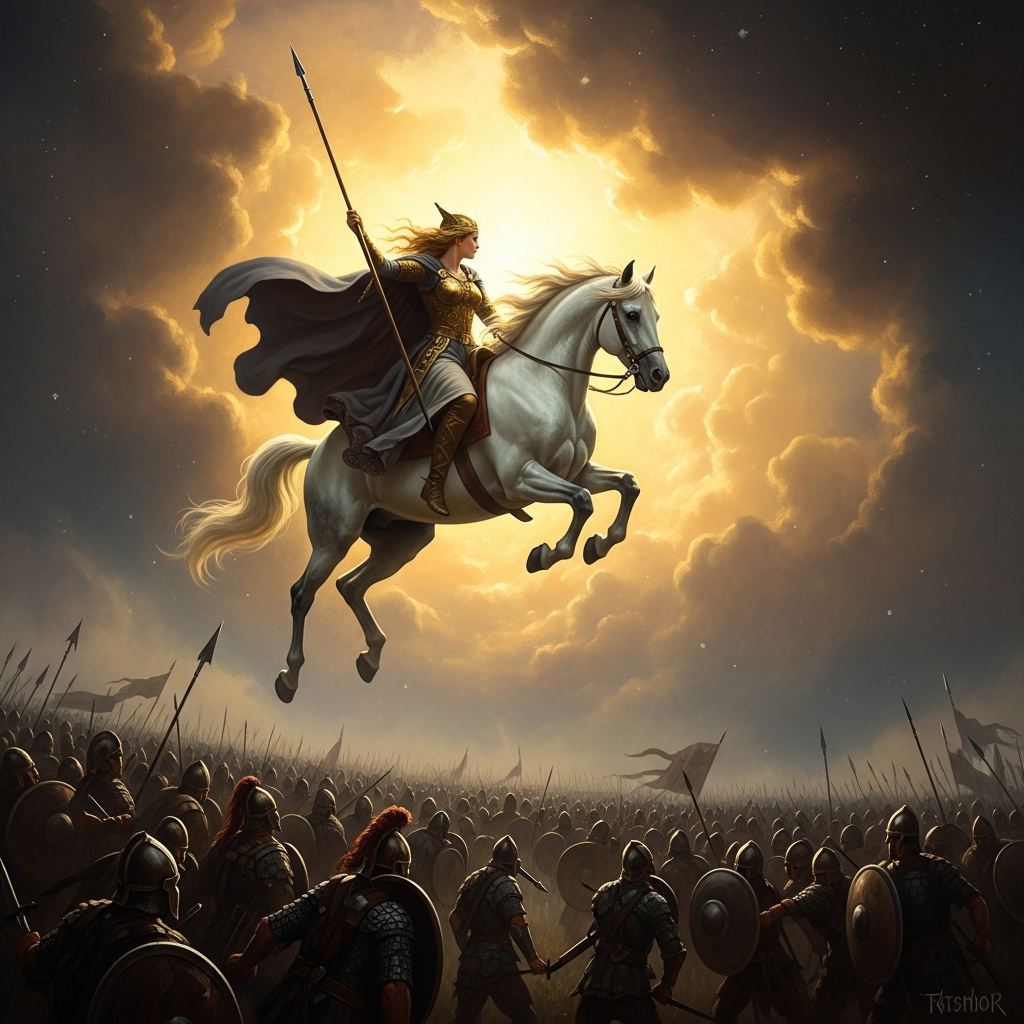
She rides above the water before the battle begins.
The island of Stord is visible below her — a shelf of rock and thin pasture in the Hardangerfjord, the kind of place where men beach their ships and fight because there is nowhere else to go. Two fleets have arrived on opposite shores. She can see the campfires of both sides. She can see the men checking their equipment in the dark, the way men always do before a battle: the same gestures in every century, the tightening of straps, the testing of edges, the specific stillness that descends on warriors who have run out of things to prepare.
Her name is Göndul. She has eleven sisters riding with her tonight, but she is the one Odin sent first, the one who was already flying east when the message came, already watching Hákon’s ships cross the Hardangerfjord with a feeling she recognizes — the particular attention that means she is watching someone who has very little time left.
Hákon is a good king.
This is unusual enough to be worth recording: the sagas call him Hákon góði, Hákon the Good, and the epithet is not ironic. He was raised at the Christian court of Athelstan of England and brought back something softer than the men around him expected. He tried to reintroduce Christianity to Norway and found that Norway was not interested. He accepted this and kept the old observances. His warriors love him. He fights alongside them rather than behind them, which is also unusual, and which is why the arrow will find him tonight.
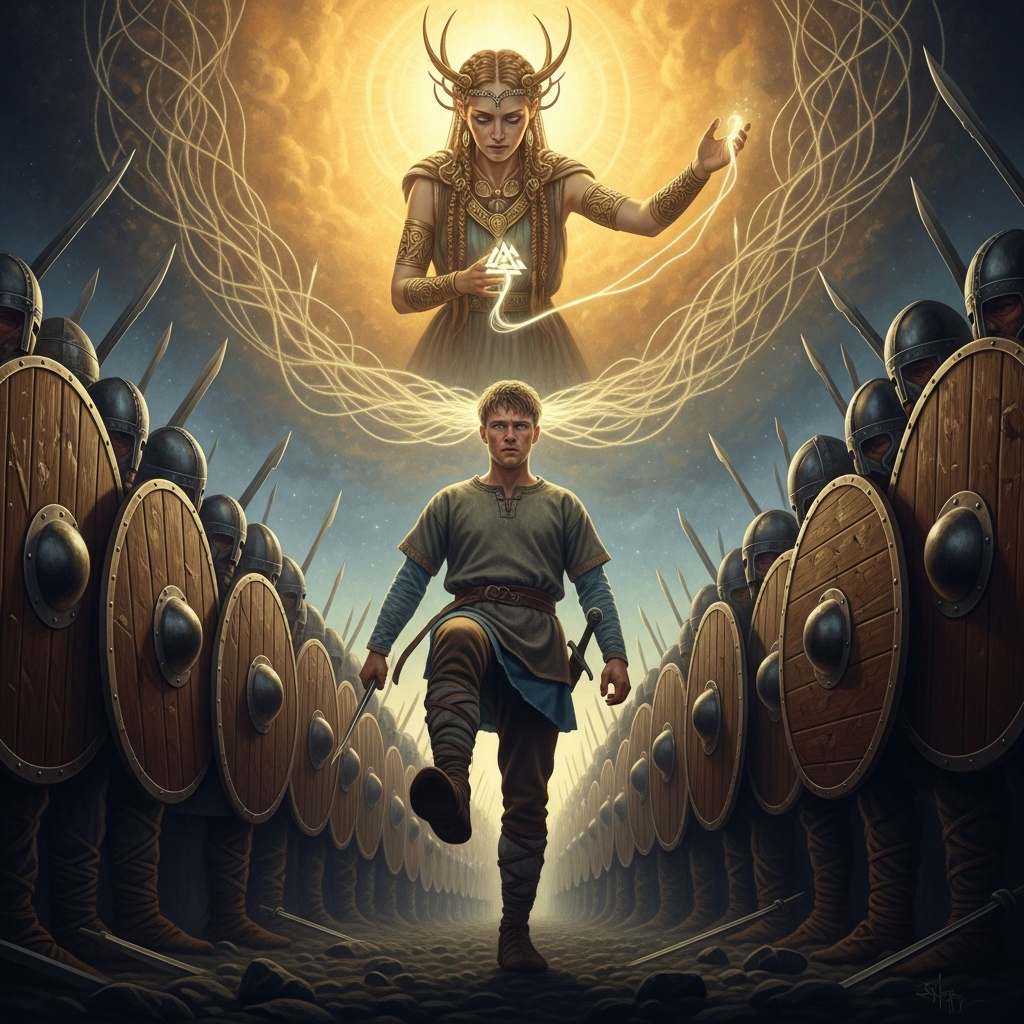
He is outnumbered on Stord. He knows it. Göndul watches him assess the field with the eyes of a man who is calculating, not praying. He has sent his chainmail to the ship for safekeeping — a practical decision, poorly timed; he moves faster without it, and he needs to move fast tonight.
She sees the moment he decides to advance.
It looks like nothing from the ground. From above it looks like a thread changing color.
He is holding the shield-wall at the center of the line, and the line is holding, and then he sees a gap in the enemy formation — a gap that has appeared because his flanks have pushed forward faster than the center, and there is a moment, a window of perhaps ten seconds, in which he could step through it and break the enemy line entirely. He steps through it.
The gap closes behind him.
He is in the middle of the enemy formation, alone, moving at a speed that has kept him alive for thirty years of fighting. He kills two men, then three. The men around him step back. For a moment — for a long, bright, impossible moment — it looks like he might do it. It looks like the gap might reopen behind him and his men might follow and the line might hold and the battle might end here, with Hákon victorious on Stord and alive to see winter.
Göndul is watching.
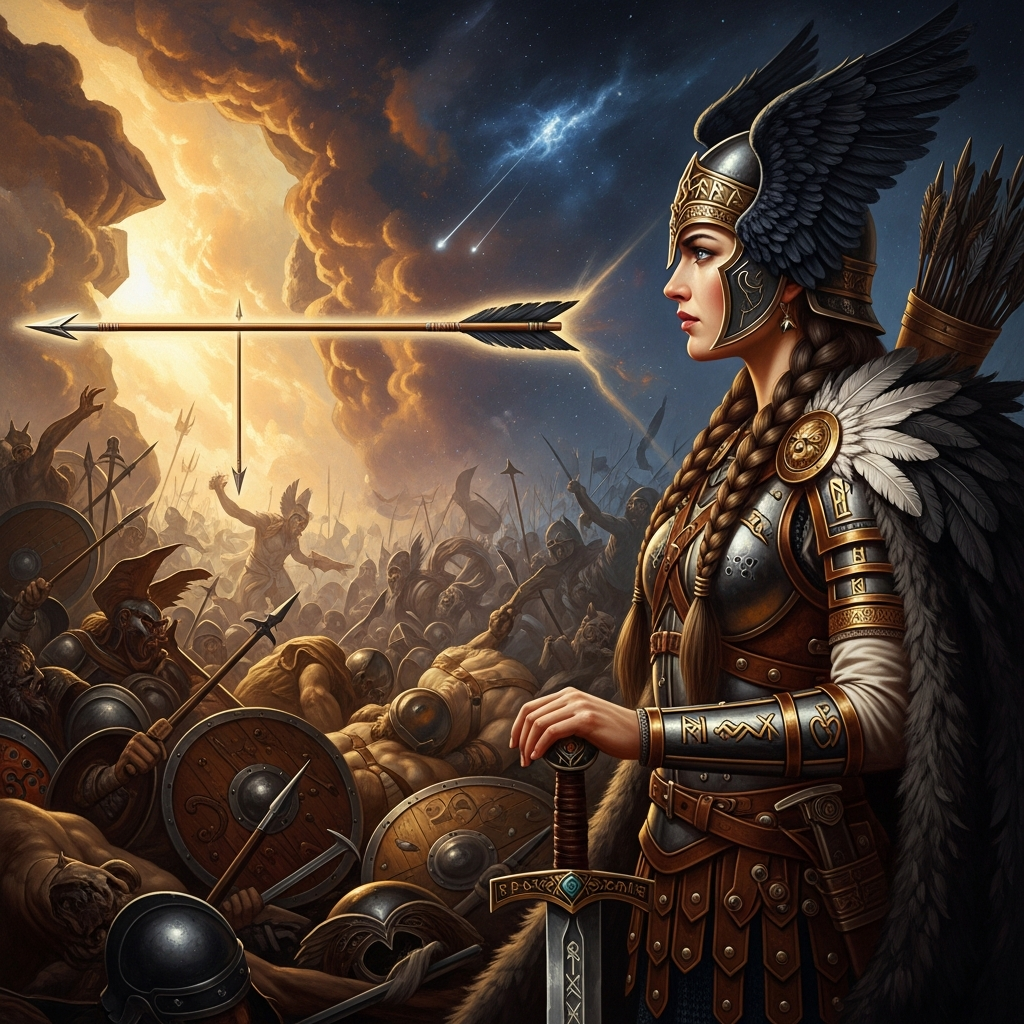
She knows what the thread looks like. She has seen it above a thousand battlefields: the moment when a warrior’s bravery and his death become the same gesture. He steps forward with everything he has, and the stepping forward is why the arrow finds the gap in his armor that the stepping forward has created.
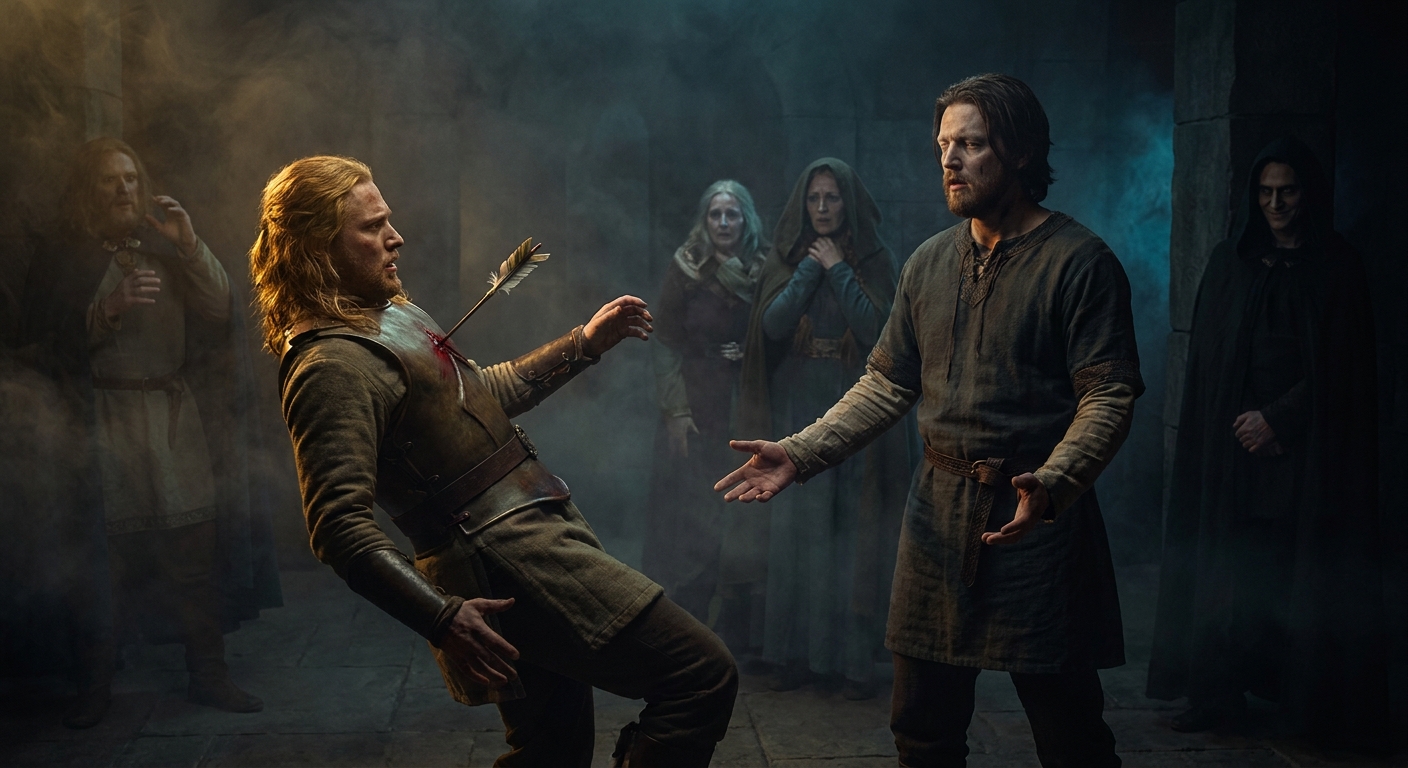
The arrow crosses the field and enters him below the arm.
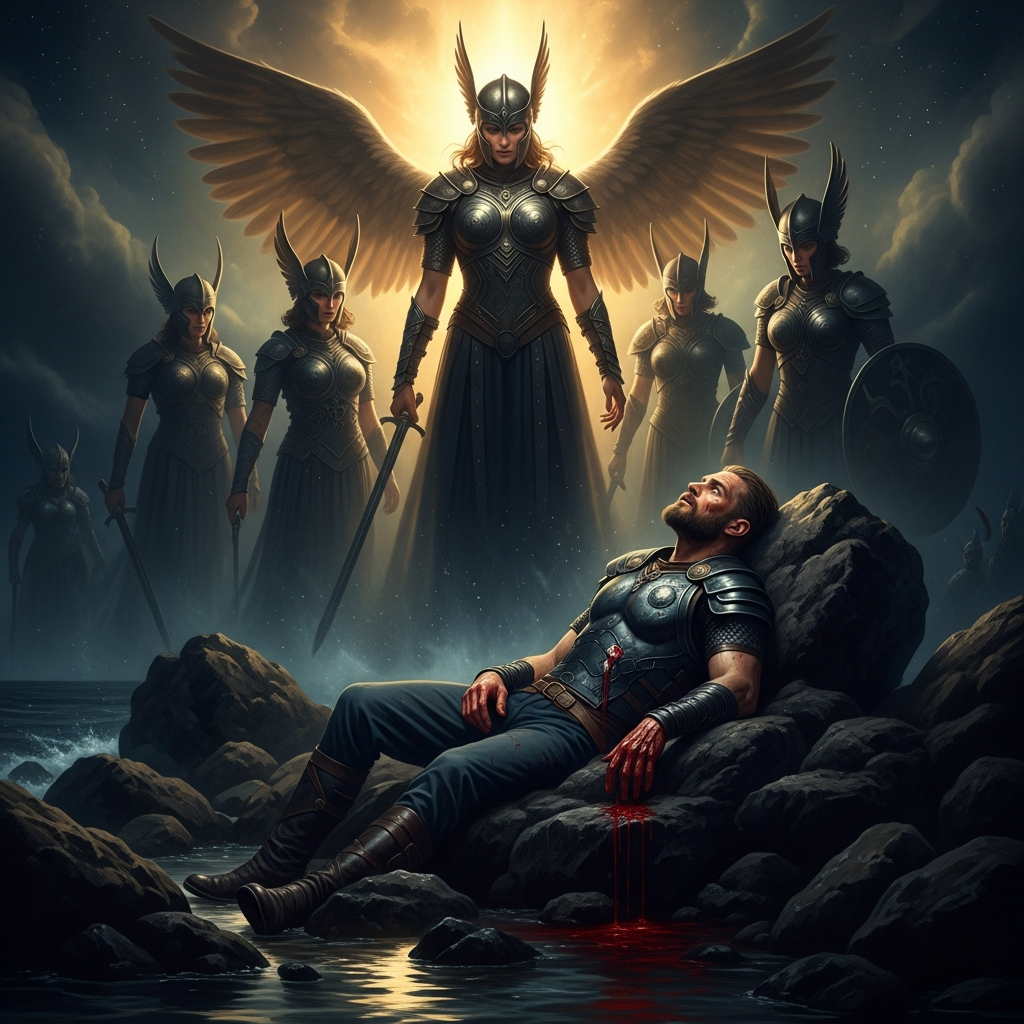
He does not fall immediately. This is what the sagas record and what Göndul watches: Hákon kills two more men after the arrow hits. He kills them with an arrow in his side, with blood running down his ribs, with the particular focus of a warrior who has decided that the dying can wait until the fighting is done. He pushes back to his own lines. He leans against the rocks at the shore. His men gather around him. The battle is over. He has won it, technically — the enemy withdraws, the field is his.
He is dying on the field he won.
Göndul descends. She and Skögul materialize in the air above him — the sagas say he can see them, which means he is already more than half in the next world, already in that borderland where the living can see what was invisible an hour ago. He looks up at them with the expression of a man who has understood everything too late and is now trying to understand it correctly.
He asks: why did you decide this? He has been faithful. He has kept the feasts, honored the sacrifices, fought for his people. Why does a faithful king die on the field he just won?
Skögul speaks. She speaks the way fate always speaks — not cruelly, not kindly, but with the precision of something that does not have an opinion about the outcome. She says: we chose you for Odin. We arranged your victory and your death simultaneously, because Odin needs you in Valhalla more than Norway needs you on its throne. The distinction between dying and being selected is one she seems to think is important.
Hákon looks at his hands. He does not appear comforted.
He says: I still have my armor. I still have my sword. He means: I was supposed to keep fighting. He means: there was more I intended to do.
She says: your weapons go with you. Your hall is prepared. The All-Father is waiting.
This is the theology of the Valkyrie compressed into a single exchange: the warrior who cannot tell the difference between death and promotion, and the emissary who has never had to explain it this way before and is not sure the explanation is working.
The company rides.
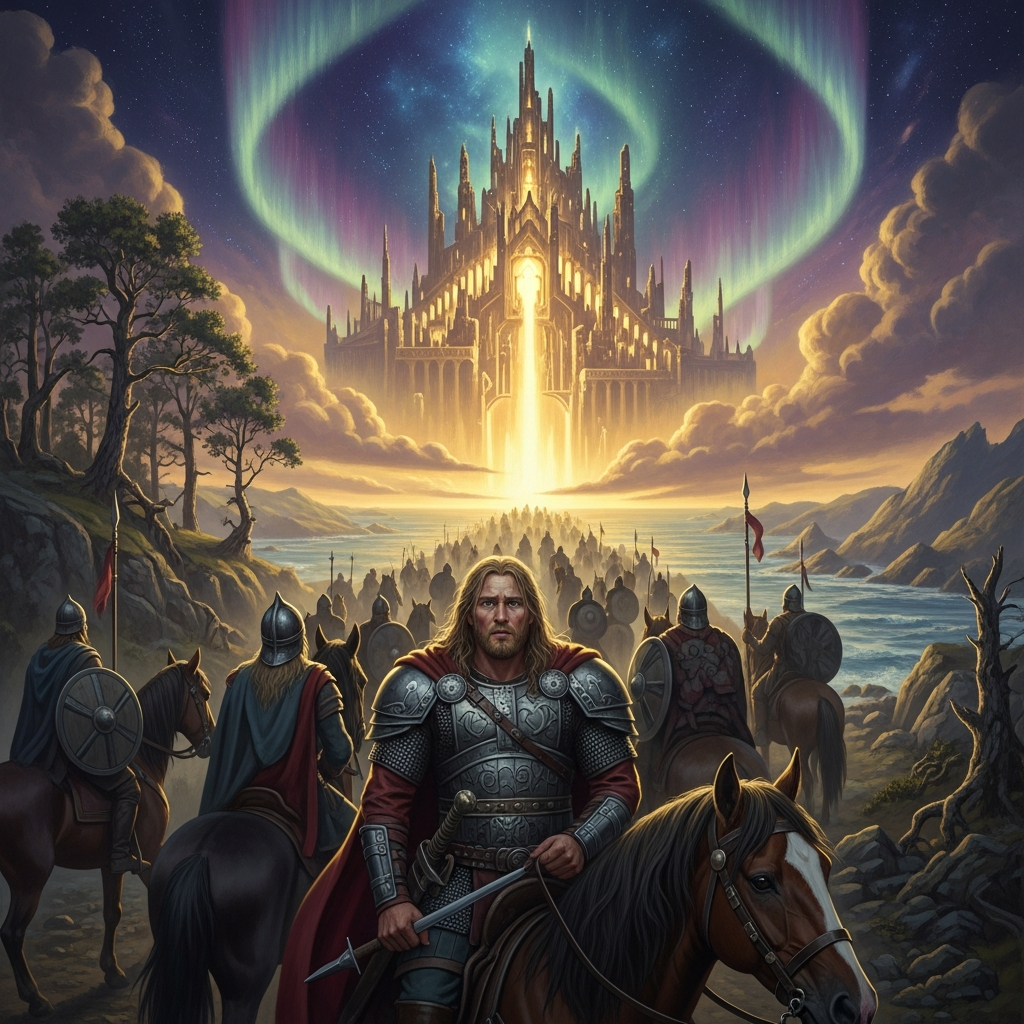
Göndul rides beside Hákon on the long road north and east, away from the coast, away from his men who are building his burial mound on Stord in the traditional way — the ship-burial, the grave-goods, the care for a king’s body that the Norse give to their best. She rides beside him in silence for a long time.
He adjusts. The sagas note this with admiration: he adjusts the way a warrior adjusts after a bad day’s fighting, with a reassessment of the situation and a willingness to go forward. He is still carrying his sword. The sword is still the sword he carried through the fire-gap at Fitjar, still damp from the fight, still good.
Valhalla appears on the horizon. Its five hundred and forty doors are open. The light from inside is the light of a hall where the fire has been burning since the beginning of the world and will burn until the last night of it. From the outside you can hear voices — the einherjar, every warrior who has arrived since the hall was built, playing out the eternal war game that Odin requires them to prepare for.
The skald Eyvindr wrote the Hákonarmál within a few years of Hákon’s death at Fitjar in 960 CE. It is one of the few surviving skaldic poems with an identifiable historical event at its center. The battle is real. The king is real. The Valkyries riding above him are the mythological explanation for why a good man died young on a field he had just won.
The poem ends with the chorus: it is not known since Odin first walked the earth when a king of such worth will come to his inheritance. This is the final Norse word on the subject: you are chosen because you are worthy, and because you are worthy you die at the moment of your greatest courage, and the dying is the choosing, and the choosing is the point.
The theology of the Valkyrie says: fate does not choose the unworthy. It says the best die early because the best are needed somewhere that matters more than Norway.
Whether this is consolation or cruelty is not a distinction the old Norse made.
Scenes
Göndul above the field at Fitjar, spear in hand, watching the lines below
 Generating art…
 Hákon without his chainmail, advancing into the shield-wall
 Generating art…
 The arrow crosses twenty yards of chaos and finds the one gap left unguarded
 Generating art…
 Hákon dying against the rocks, blood on his hands
 Generating art…
 The company riding north and east, away from the coast
 Generating art…
 Echoes Across Traditions
Entities
- Göndul
- Skögul
- Hákon the Good
- Odin
- the Norns

Sources
- Eyvindr skáldaspillir, *Hákonarmál* (c. 960–970 CE)
- *Grímnismál* 36 (Valkyrie name-lists, Poetic Edda)
- *Vǫluspá* 28–31 (the Valkyries riding over the field)
- H.R. Ellis Davidson, *Myths and Symbols in Pagan Europe* (1988)
- Carolyne Larrington (trans.), *The Poetic Edda* (Oxford, 1996)
- Snorri Sturluson, *Prose Edda*, Gylfaginning 36