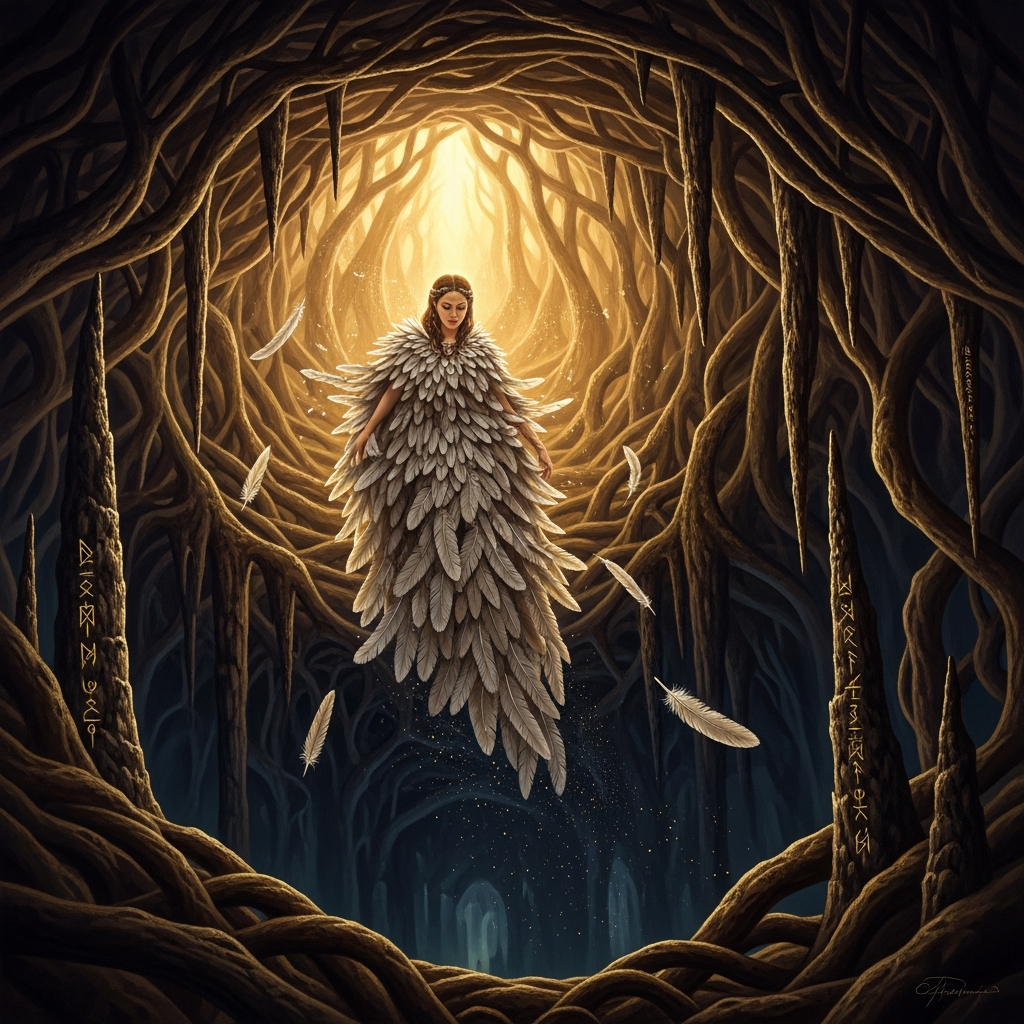
Freya and the Four Dwarves of Svartalfheim
Mythic time (sources: *Sörla þáttr*, c. 14th-century; also referenced in *Húsdrápa*, c. 983 CE) · Svartalfheim — the realm of the dwarves beneath the earth — and Ásgarðr
Contents
Deep in the caves beneath the world, four dwarves are forging the most beautiful object in the nine realms — Brísingamen, a necklace of amber and fire. Freya descends into Svartalfheim to claim it. The dwarves name a price. Freya pays. Odin learns what she has done and demands his own price in return: a war that does not end. Both prices are paid in full.
- When
- Mythic time (sources: *Sörla þáttr*, c. 14th-century; also referenced in *Húsdrápa*, c. 983 CE)
- Where
- Svartalfheim — the realm of the dwarves beneath the earth — and Ásgarðr
The thing the dwarves are making, deep under the world, is not yet a necklace.
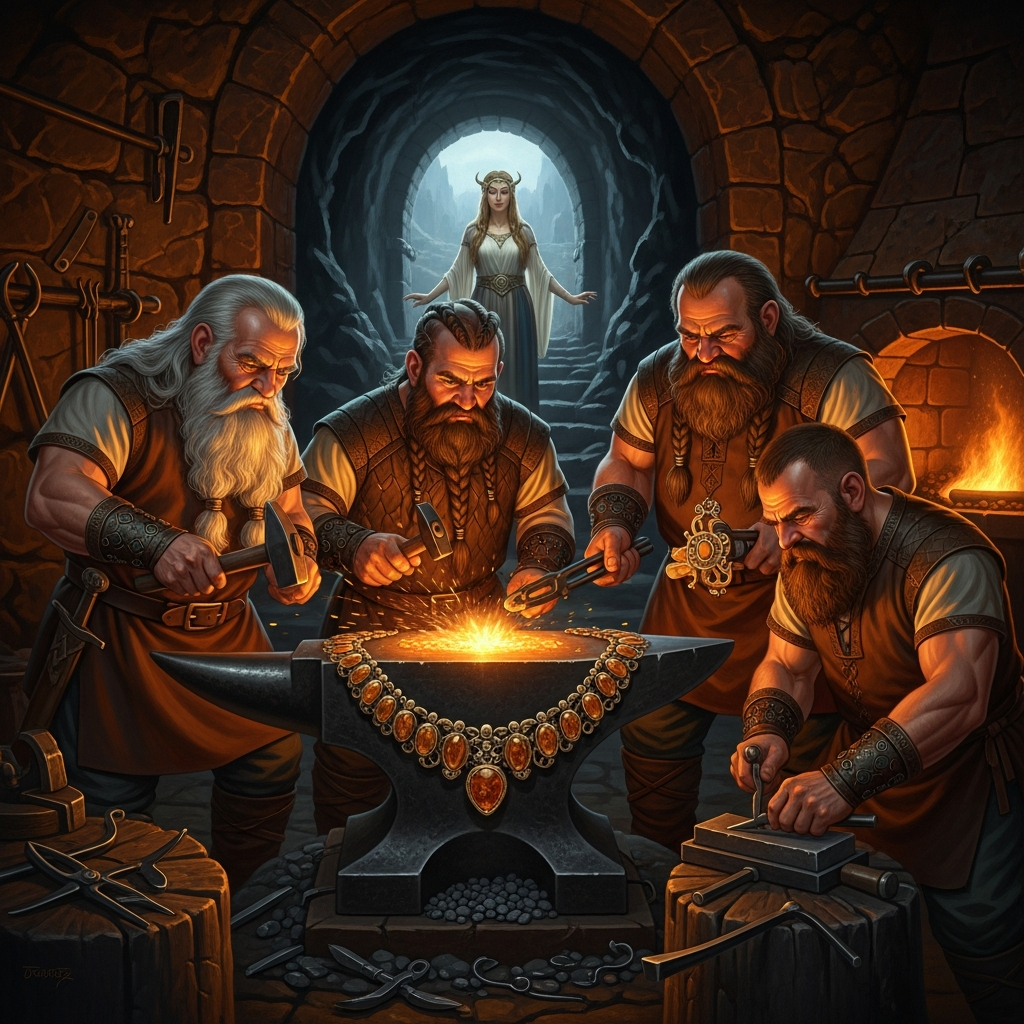
It is still molten. It is still poured. It is light caught in metal, fire suspended in amber, and on the long stone table of the forge it lies in a half-finished arc of incandescence, and the four smiths who are making it have not slept in eleven days. Their names are Alfrigg, Dvalinn, Berlingr, Grerr. They are brothers. They have made other things, smaller things, in the long centuries of their craft — things the gods have bought and the gods have boasted of — but they have never made anything like this. They are making it because they wanted to know if it could be made. They are making it because the four of them together can do, at the limit of their craft, what no other dwarves in the nine worlds can. They are making it because beauty at this concentration is, for them, the only argument they have left to make against the dark.
They do not expect a buyer.
Freya hears about the necklace because Freya hears about everything. She is the goddess of seiðr, of the cunning sight that sees across the realms, and rumors come to her on the wind and in the cries of falcons and in the dreams of mortal women who do not know they are dreaming her dreams. She hears about a thing being made under the earth that will, when it is finished, be the most beautiful thing in the nine worlds. She does not hesitate. She puts on her cloak of falcon feathers. She goes down.
Svartalfheim is not what travellers say it is.
It is not, principally, dark. The forges burn day and night and the cave-cathedrals of the dwarves are lit with a light that does not exist on the surface — a light that has been worked, smelted, raised out of stone and iron and patience. There are halls below the world more luminous than any palace in Ásgarðr, and they smell of hot iron and old amber and the sweat of beings who have been at the anvil since the world was new. Freya walks through them. She has been here before, but never to this forge. The forge of the four brothers is at the far end of a corridor she has not previously been allowed to enter. She enters it now.
The brothers see her in the doorway and they all stop, all four of them, at the same instant. The hammer of Berlingr stops mid-stroke. The bellows of Grerr exhale and do not refill. The arc of fire on the table dims and steadies. Freya stands in the doorway in her falcon-cloak and she looks at the necklace and she does not pretend to look at anything else.
I want it, she says.
Alfrigg, who is the eldest and the spokesman, sets down his hammer. The brothers look at one another.
It is not finished, says Alfrigg.
It will be, says Freya. And when it is finished it will be mine. Name your price.
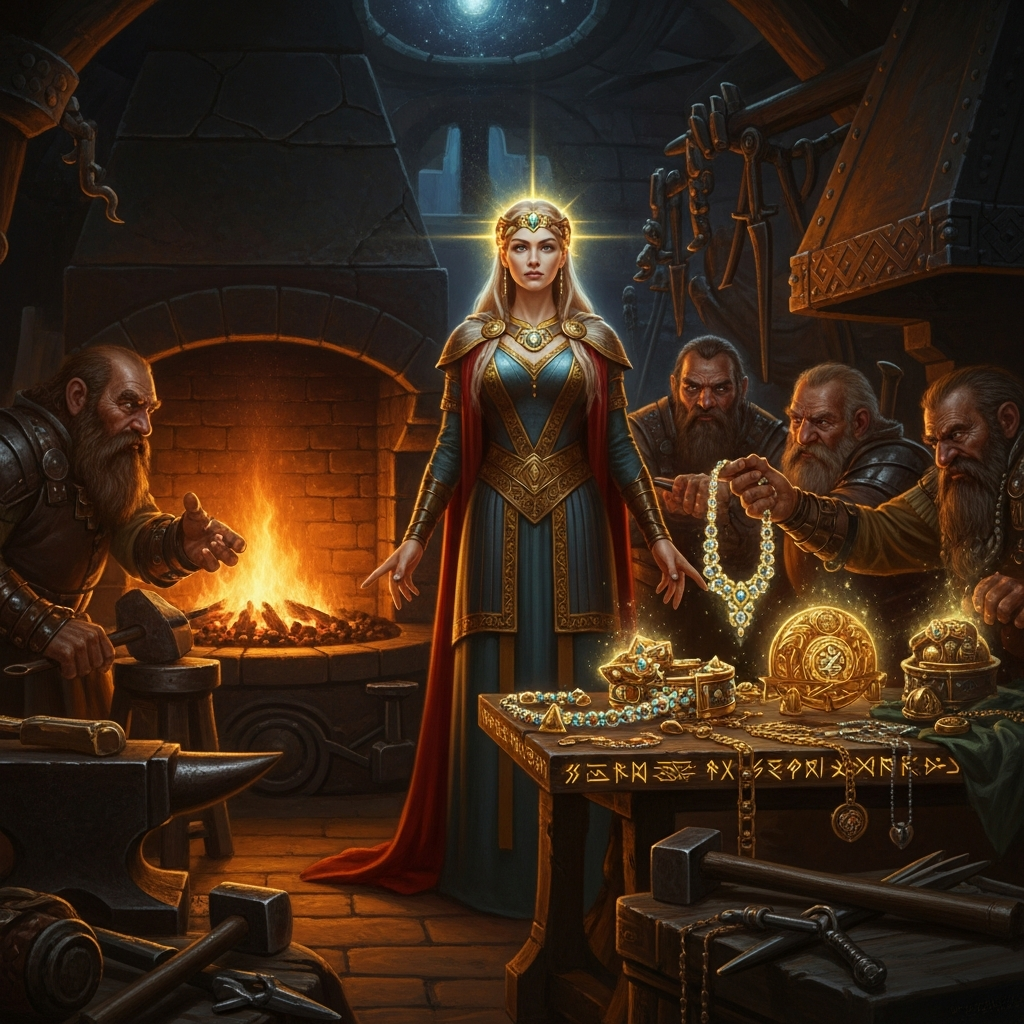
The brothers confer in the dwarvish that does not translate. They argue in low voices for a long time. They are not, despite the rumors mortals tell, greedy. They have all the gold they need; they have made gold; they could make more gold if they wanted gold. They are not interested in payment in coin. What they are interested in — what no dwarf has ever had, what no dwarf has ever even hoped for — is what stands now in the doorway of their forge.
Alfrigg names the price.
It is not a price Freya was expecting. It is also not a price she refuses. She does not pretend to weigh it; she does not bargain it down; she does not feign reluctance. She is the goddess of desire, and she understands the geometry of desire — that desire is not free, that beauty at this concentration always requires payment, that to refuse the price is to refuse the necklace, and she has not come this far to refuse the necklace. She nods once. She crosses the threshold of the forge. She closes the door behind her.
What happens inside the forge is between Freya and the four brothers and is not the part of the story that Snorri Sturluson chose to preserve.
What is preserved is what comes after.
Loki is watching.
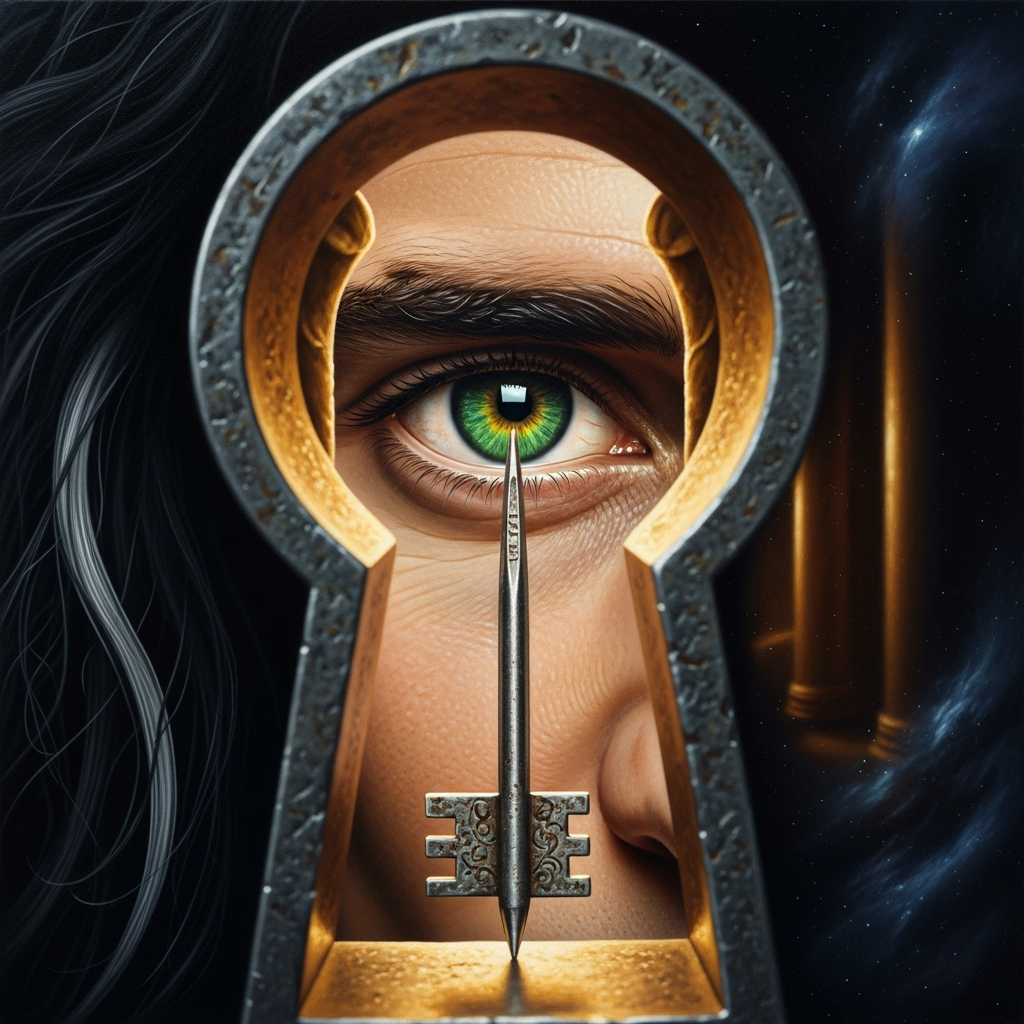
Odin has sent him. Odin has been suspicious of Freya for a long time — she is Vanir, not Aesir, she came to Ásgarðr as a hostage in the old peace treaty between the two divine houses, and Odin has never fully decided whether she is his ally or merely his guest. When word reaches Ásgarðr that Freya has descended into Svartalfheim alone, Odin sends his most reliable instrument of indignity to find out why. Loki goes. Loki is small enough to be a fly. Loki finds the forge. Loki watches through a chink in the stone wall no larger than a needle’s eye, and he sees what he sees, and he flies back to Ásgarðr to report to the All-Father.
Odin listens. Odin says nothing for a long time. Then Odin says: Bring me the necklace.
This is the part of the myth that the patriarchs of later centuries will use to make Freya seem grasping or shameful. Read it carefully and it is not a myth about Freya at all. It is a myth about Odin. Loki sneaks into Freya’s chamber at night while she sleeps. Loki cannot work the clasp. He turns himself into a flea and bites her cheek and she rolls in her sleep and the clasp opens and the Brísingamen falls into his hand. He brings it to Odin. Odin holds it for a long time. Odin does not put it on, because the necklace is not for him; it has never been for him; it could never be for him. He gives it back to Freya in the morning. He gives it back, but he keeps a portion of its meaning.
This is your price, he says.
He tells her what he has decided. There are two mortal kings, Heðinn and Högni, who rule neighboring realms in the world below. Freya is to set them at war. She is to ensure that they fight, and that their warriors fight, and that the dead rise each night to fight again, and that this war goes on without end until the last day of the world. She is the goddess of love; she is also (and Odin is the one who has decided this) the goddess of slain warriors, and her hall Sessrúmnir takes half of those who fall in battle. Odin is doubling her domain. He is turning her beauty into a quartermaster’s account.
Freya looks at him for a long time.
She is wearing the Brísingamen as he speaks. The amber on her throat catches the dawn coming through the high window of his hall. He cannot, even now, look away from it. He hates that he cannot look away from it. He is punishing her, and in the same breath he is admitting that he cannot punish her enough — that the necklace will outlast the punishment, that she will wear it through the war he is imposing and through every war after, and that when Ragnarok finally comes the Brísingamen will still be on her throat and the last thing the dying world will see, before the wolf eats the sun, is its amber light.
She nods once. She accepts the price.
She always accepts the price. That is what makes her Freya.
The war begins that night.
Heðinn and Högni — who were friends, in a country where friendship between kings was rare — fall out over a misunderstanding that no chronicler can quite reconstruct. They quarrel. They draw weapons. They go to the field. Their armies meet at a place called Háey, and the slaughter is enormous, and at sundown both kings are dead and most of their warriors are dead, and the goddess Freya walks among the corpses with her cloak of falcon-feathers and her amber on her throat. She raises the dead. They rise stiffly and look about them. They pick up the weapons that lie where they fell. They begin again.
This is the Hjaðningavíg — the Battle of the Hjaðnings — and the chroniclers who recorded it say that it will continue, the same battle, every night until the end of the world. Each evening the dead rise. Each dawn they fall again. Freya watches. The Brísingamen catches the firelight of the burning camps. The dead do not blame her; the dead understand that the price was Odin’s, not hers, and that she paid hers in the forge and is paying his now in the fields, and that the goddess of desire is also the goddess of consequence, and that no one in the nine worlds knows this better than she does.
At the end of the world, in the chaos of Ragnarok, Loki and Heimdall will fight one another to the death over the Brísingamen. Snorri does not say why. The skalds say it is because the necklace, by then, will have become the symbol of everything the gods have failed to keep — beauty bought and beauty kept and beauty paid for in the blood of mortals who were never asked.
Heimdall will die with his hand on it.
Loki will die with his hand on it.
It will fall into the burning sea.
But that is the end of the story, and we are not yet there. Now, in the long mythic present, Freya stands on her balcony in Ásgarðr and the dawn breaks pale and gold and the amber on her throat catches the first light of the sun, and she does not flinch from any of it.
She has paid every price. She has refused none. She is wearing what she went down to get.
Scenes
Freya descends through the root-channels of Yggdrasil into Svartalfheim
Generating art… Alfrigg, Dvalinn, Berlingr, and Grerr at the anvil
 Generating art…
 The dwarves name their price
 Generating art…
 Loki, sent by Odin, watches through a keyhole no larger than a needle's eye
 Generating art…
 Freya returns to Ásgarðr wearing Brísingamen
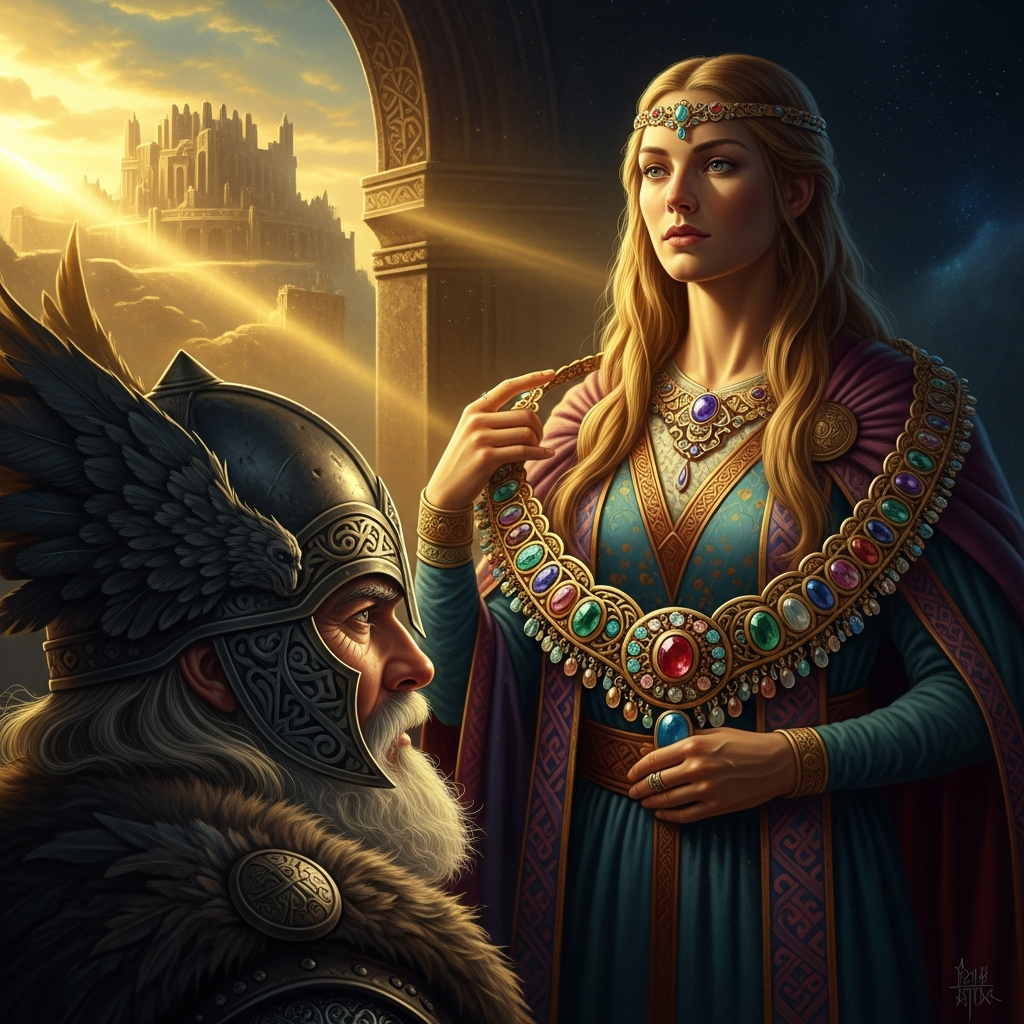 Generating art…
 Echoes Across Traditions
Entities


Sources
- *Sörla þáttr* (preserved in the *Flateyjarbók*, late 14th century)
- *Húsdrápa* by Úlfr Uggason, c. 983 CE (skaldic verse on the carved hall of Hjarðarholt)
- Britt-Mari Näsström, *Freyja: The Great Goddess of the North* (Lund, 1995)
- Hilda Roderick Ellis Davidson, *Gods and Myths of Northern Europe* (Penguin, 1964)
- Snorri Sturluson, *Prose Edda* (Skáldskaparmál), c. 1220 CE