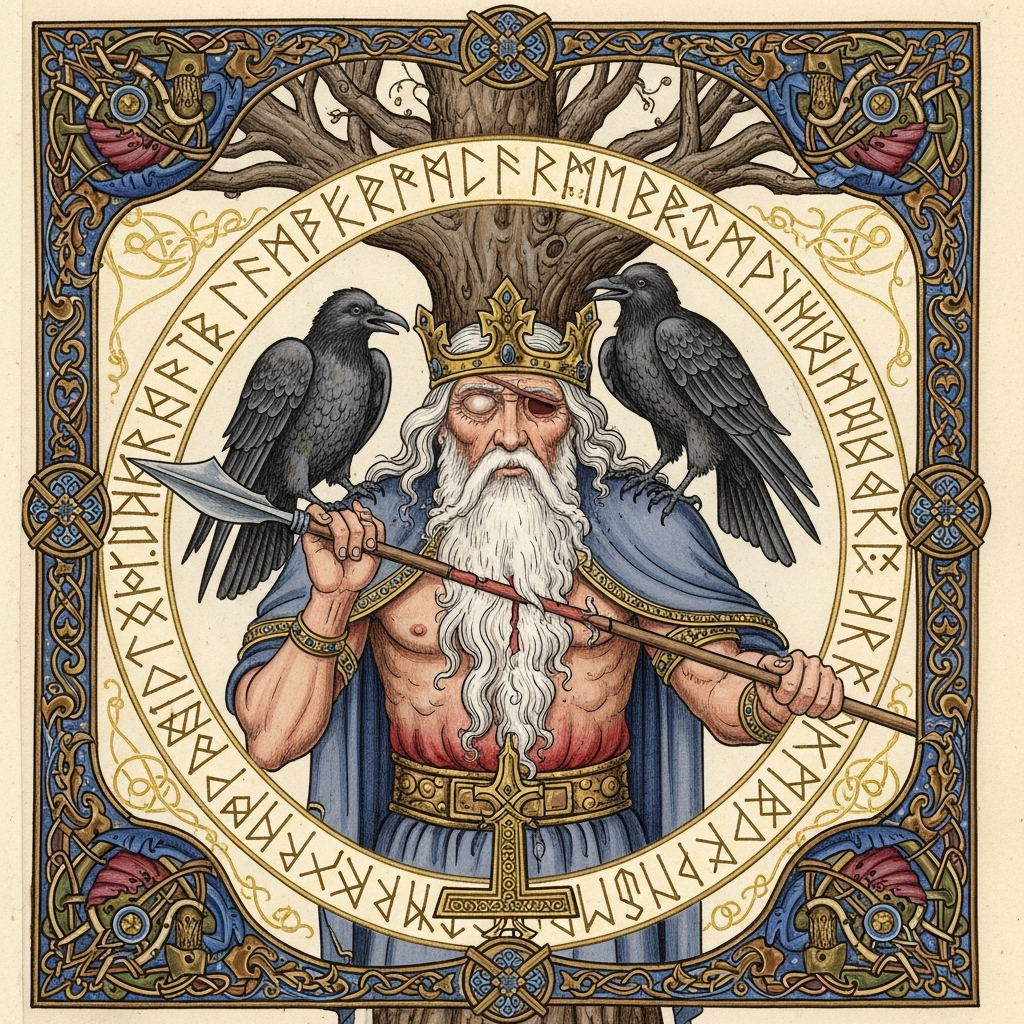
Brynhildr's Cursed Sleep
Mythic time (recorded in *Völsunga saga* c. 1200–1270 CE; *Sigurðarkviða hin skamma*, *Helreið Brynhildar*, Poetic Edda) · The mountain Hindarfjall — and all the courts of the Gjukungs thereafter
Contents
A Valkyrie defies Odin and is put to sleep with a thorn of enchantment on a mountain ringed by fire. The greatest warrior in the world wakes her. They fall in love. Then fate, a potion, and another woman's pride ensure that the only way this ends is fire.
- When
- Mythic time (recorded in *Völsunga saga* c. 1200–1270 CE; *Sigurðarkviða hin skamma*, *Helreið Brynhildar*, Poetic Edda)
- Where
- The mountain Hindarfjall — and all the courts of the Gjukungs thereafter
She chose the wrong man for death.
Every Valkyrie knows what the choosing looks like: you are above the battle, and you can see what the warriors cannot, the threads of each life laid out beneath the chaos, and Odin has already decided which ones end today. Your work is to confirm it, to find the man Odin has chosen and shepherd him from the spear’s exit to Valhalla’s entrance. You do not choose. You execute the choice that has already been made.
Brynhildr chose anyway.
Two kings were fighting — Hjalmgunnar, old and famous, Odin’s own favorite; and Agnar, who had no divine patron and no right to win. She looked at the battle. She looked at the threads. She let Agnar live and Hjalmgunnar die, and when she climbed back through the air after, she already knew what was coming.
Odin meets her on the mountain of Hindarfjall.
He does not shout. He does not curse. He speaks to her the way the master of fate speaks to someone who has reached behind him and moved the pieces: with a cold precision that is more final than anger. He tells her she will not ride into battle again. She will become a wife. She will marry. She will live, from this point forward, the life of a mortal woman.
She answers: she will only marry a man who does not know fear.
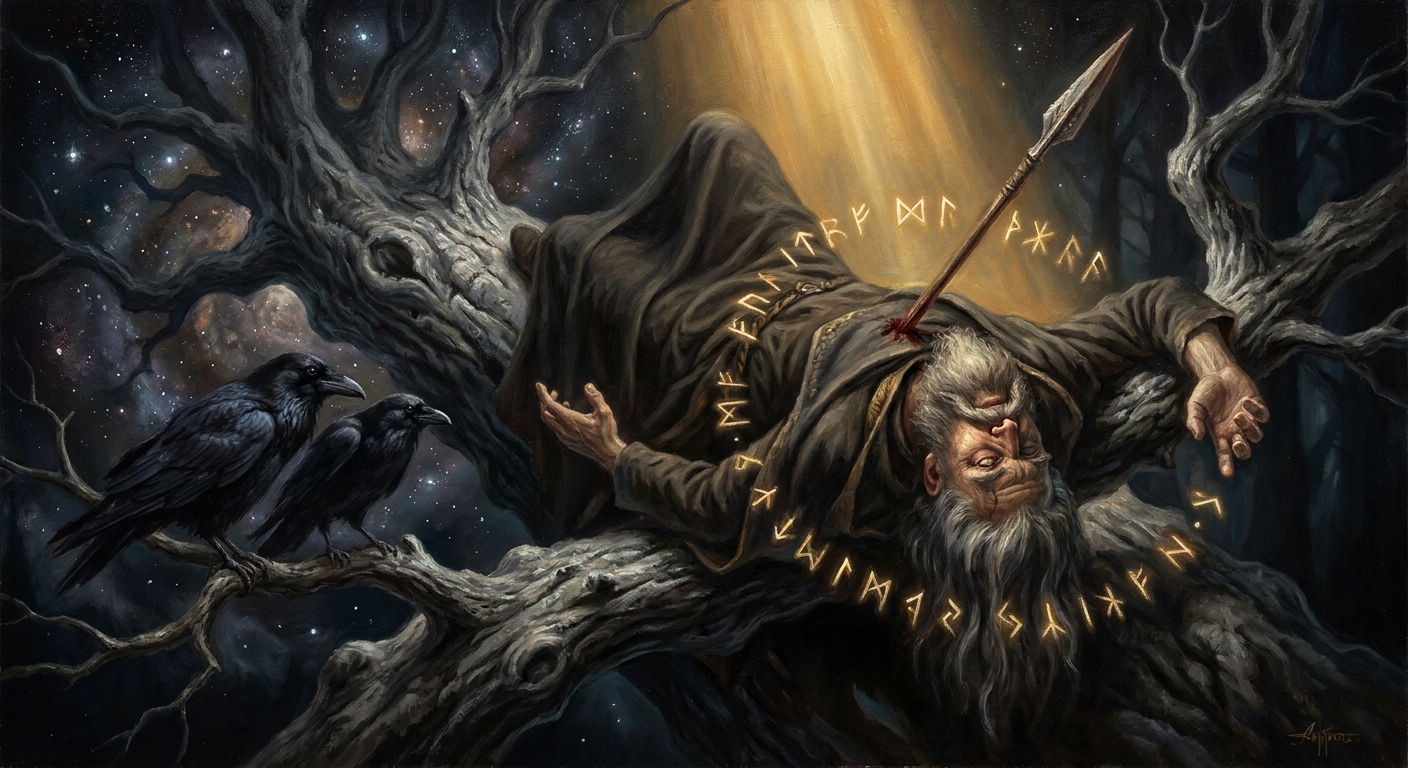
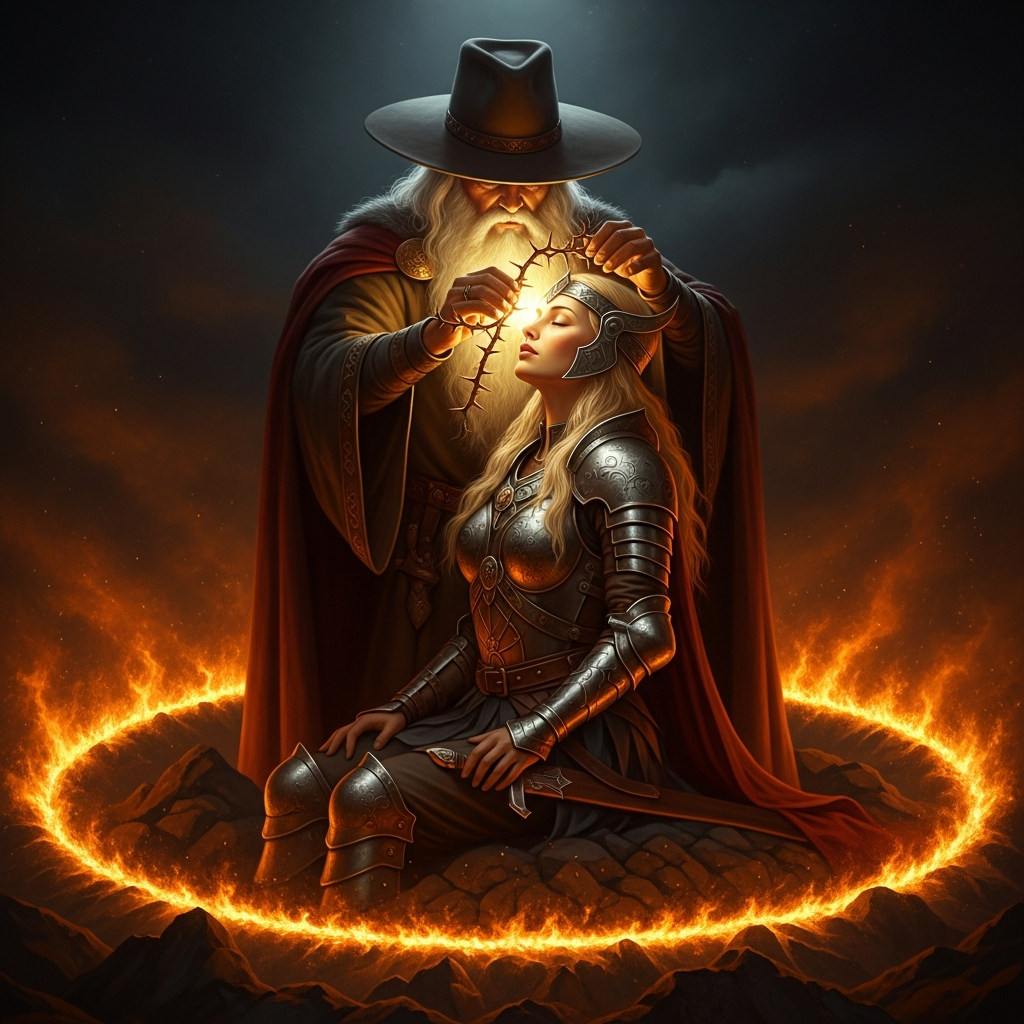
He considers this for a moment — perhaps he is impressed, perhaps he is simply calculating — and then he takes the sleep-thorn from his belt and presses it against her skin. The last thing she sees before her eyes close is the fire rising around the mountain. A wall of flame, a ring of it, stretching from the base to the summit. She has asked for the fearless; he has given her a test. She falls asleep as the fire settles in.
She sleeps in her armor.
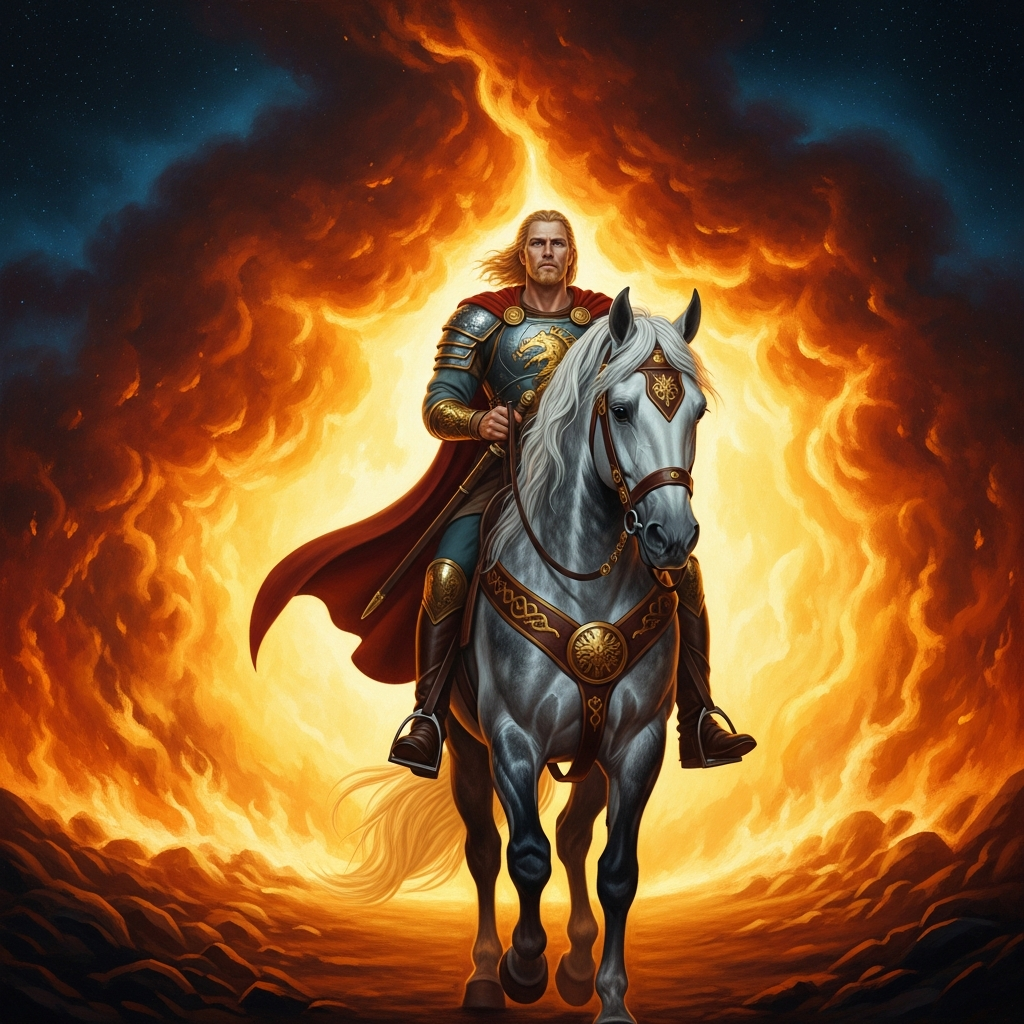
Sigurd rides through the flames as if they are not there.
He is the greatest warrior alive — son of Sigmund, reforged of the sword Gram, killer of the dragon Fáfnir, speaker with birds. His horse Grani does not slow at the wall of fire. The horse is Sleipnir’s get: he has Odin’s blood and will not flinch at what Odin arranged. They come through the fire onto the summit and there is a figure lying on the rock, completely still, in armor.
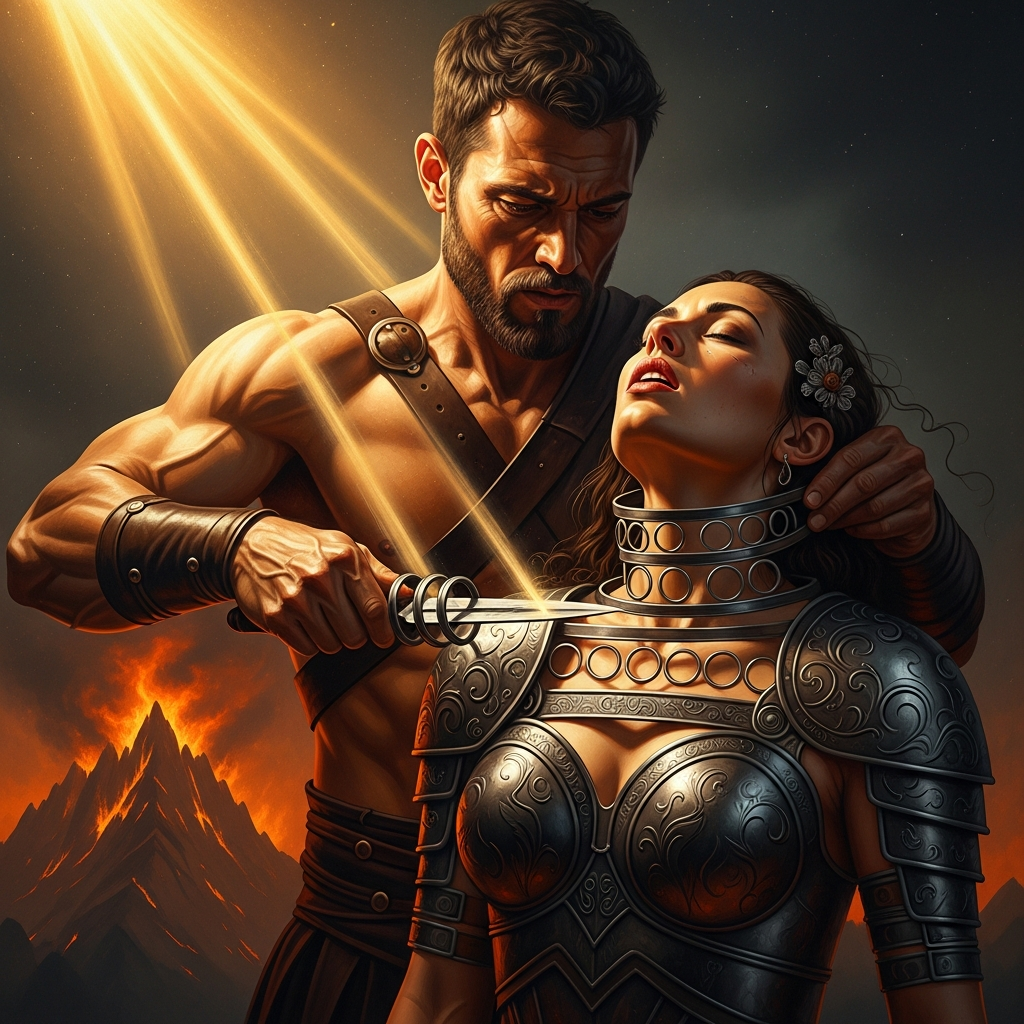
He thinks it is a man. He removes the helmet and sees the hair. He looks at the armor and cannot find the clasps. He tries to lift the rings free and they resist. The armor has been on her so long it has grown inward; the mail is part of her skin now, and the skin has grown around it. He takes Gram and he cuts the armor off, ring by ring, careful as a man disassembling something he does not want to break. The cuts go down each side of her body and she breathes as if for the first time in years and her eyes open.
She looks up at him. She already knows who he is — she is a Valkyrie; she has watched him from above on every battlefield he has ever crossed. She knows his thread. She knows what it looks like. She knows, with the precision of a creature who was once the messenger of fate, that the thread is not long.
She says nothing about this. She tells him her name. He tells her his. They talk until the sky changes color.
They are together on that mountain for a time the saga leaves deliberately vague — days, a season, enough. He swears to marry her. He swears it on Gram, on his life, on every oath a Norse hero can swear. She believes him. She has read his fate in the way she read every warrior’s fate above a battlefield, and she believes the thread she sees.
Then he rides off the mountain and into the world of men.
In the halls of the Gjukungs he is given a drink — not poisoned, not malicious in its intent, but laced with the specific forgetting that this particular story requires. He forgets Brynhildr. He sees Gudrun, the king’s daughter, and marries her with the straightforward appetite of a man who has never been in love before. They are happy. He is very happy. He has no memory of the mountain.
Gunnar, his brother-in-law, wants Brynhildr for a wife.
There is a fire-wall around her, which is how Gunnar knows she is the one worth wanting. He cannot ride through it. His horse will not enter. He borrows Grani and Grani will not move for him either — the horse knows. He tells Sigurd. Sigurd, who has forgotten everything except the skill, agrees to cross the fire in Gunnar’s shape. He uses the magic that exists in his family’s blood to wear Gunnar’s face and body. He rides through the fire on Grani, who goes through it easily enough because it is still Sigurd inside.
He wakes Brynhildr again — the same summit, the same eyes opening — and this time he does not know her. He woos her as Gunnar. She looks at the face of Gunnar and hears a voice that is almost right, almost the voice she remembers, slightly wrong. She agrees to marry the man in front of her because the fire accepted him, which was the test, and she cannot explain why something in her chest says the answer is false.
She marries Gunnar. Sigurd, in Gunnar’s shape, spends three nights on the mountain with Brynhildr and places his sword between them when they sleep.
He rides home and becomes Sigurd again and says nothing.
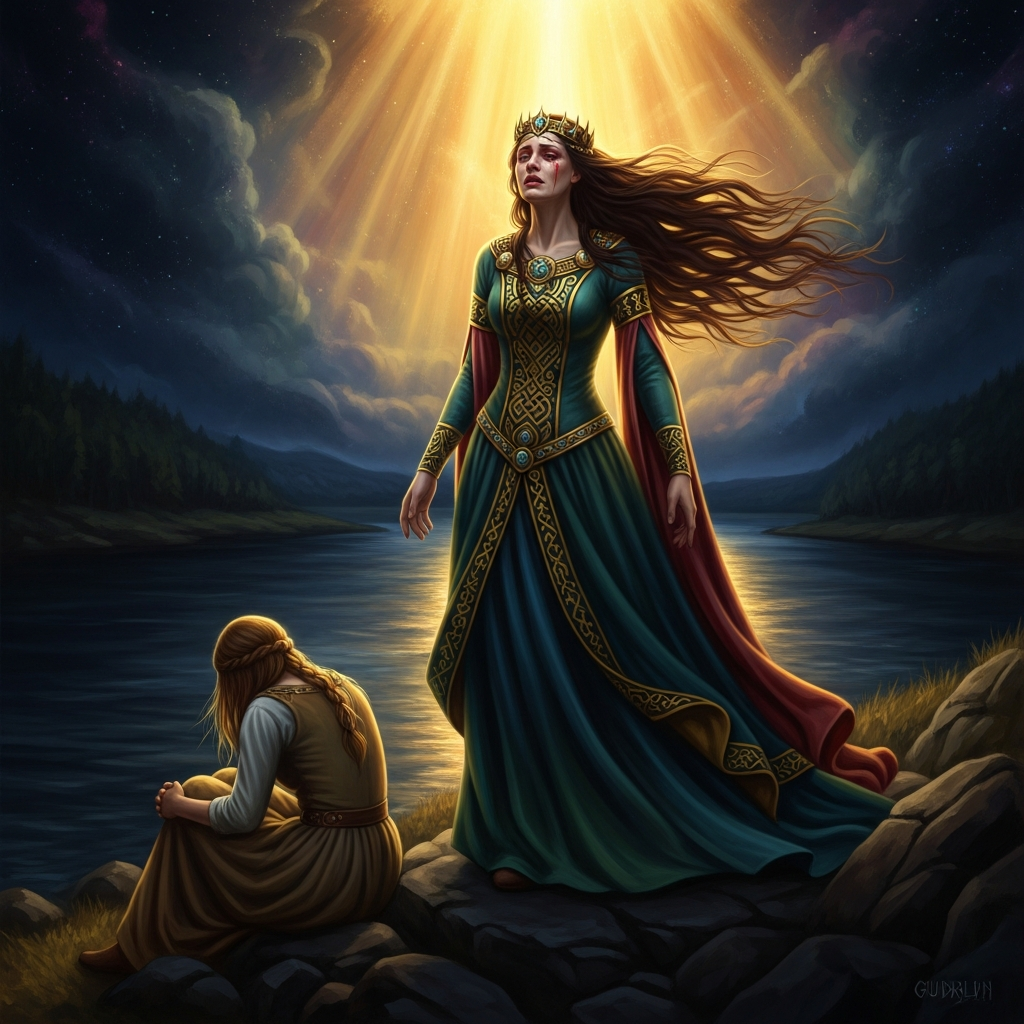
The quarrel happens at the river.
Brynhildr and Gudrun are washing their hair in the river and they argue about whose husband is greater. Brynhildr says Gunnar rode through the fire that surrounds her mountain. Gudrun says Sigurd killed Fáfnir. The disagreement escalates the way these things do — through pity and pride and the specific violence of women who know each other’s husbands too well — until Gudrun says the thing she should not say.
She says: it was not Gunnar who rode through the fire. It was Sigurd, wearing Gunnar’s face. And she holds up the ring Ándvari’s gold, which Sigurd took from Brynhildr’s hand when he woke her in Gunnar’s shape and kept without knowing why.
Brynhildr looks at the ring. She looks at Gudrun’s face. She understands everything in a single moment — not just the deception, but its shape: the potion, the forgetting, the man she loved who came to her as another man and did not know her, who took her ring without knowing it was hers. He did not betray her. He was betrayed into betraying her. The structure of the trap is so complete that there is no one to blame except the fate that arranged it.
She goes home. She does not speak for a night and a day.
She arranges for Sigurd’s death.
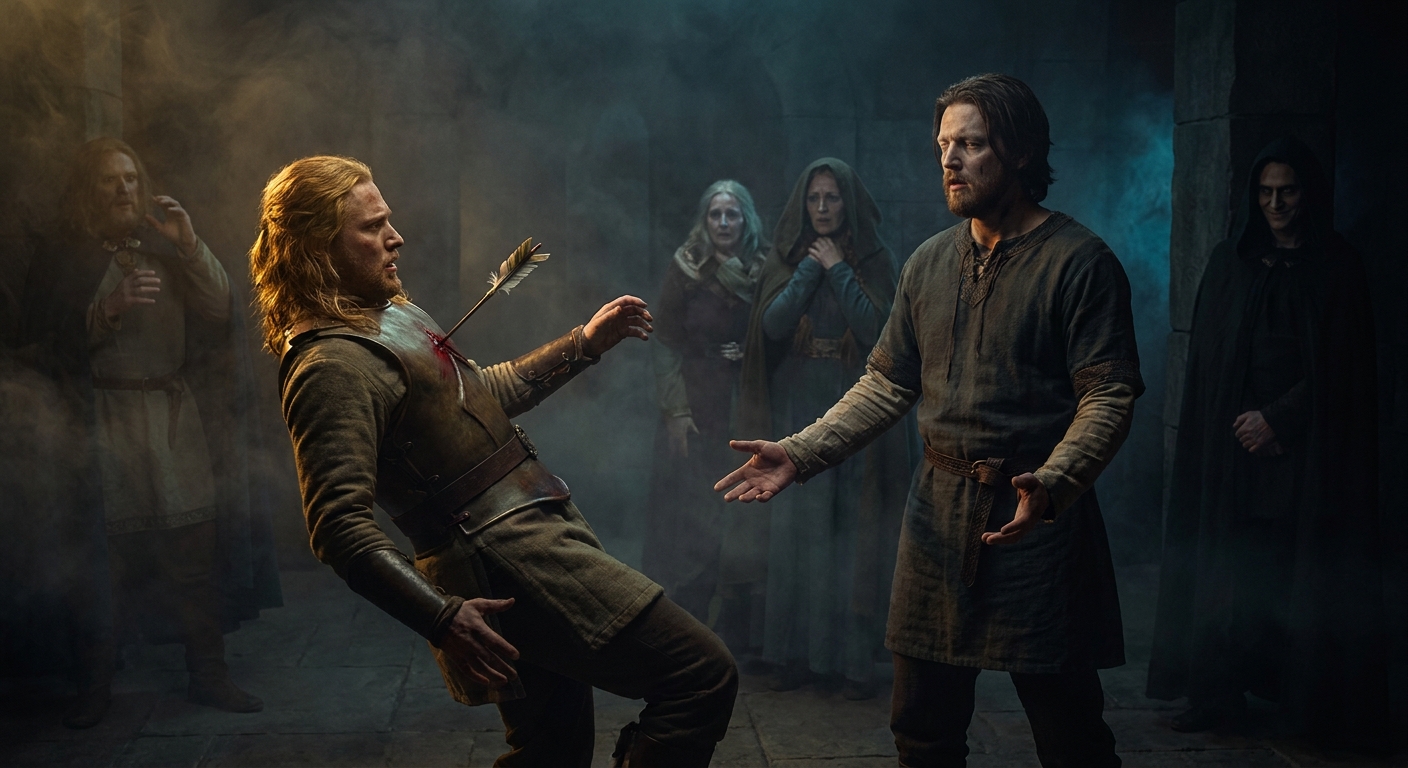
She has Guttorm, the one Gjukungar brother not bound by oath to Sigurd, run a spear through him in his bed. Sigurd, dying, throws Gram across the room with his last strength. The blade cuts Guttorm in half in the doorway.
The hall fills with wailing. Gudrun weeps. Brynhildr hears the weeping and laughs — laughs so hard that Gunnar comes to her and shakes her and demands to know what is wrong with her. She tells him to not ask. She tells him Gudrun will not weep for long. Then she stops laughing and picks up her gold and her weapons.
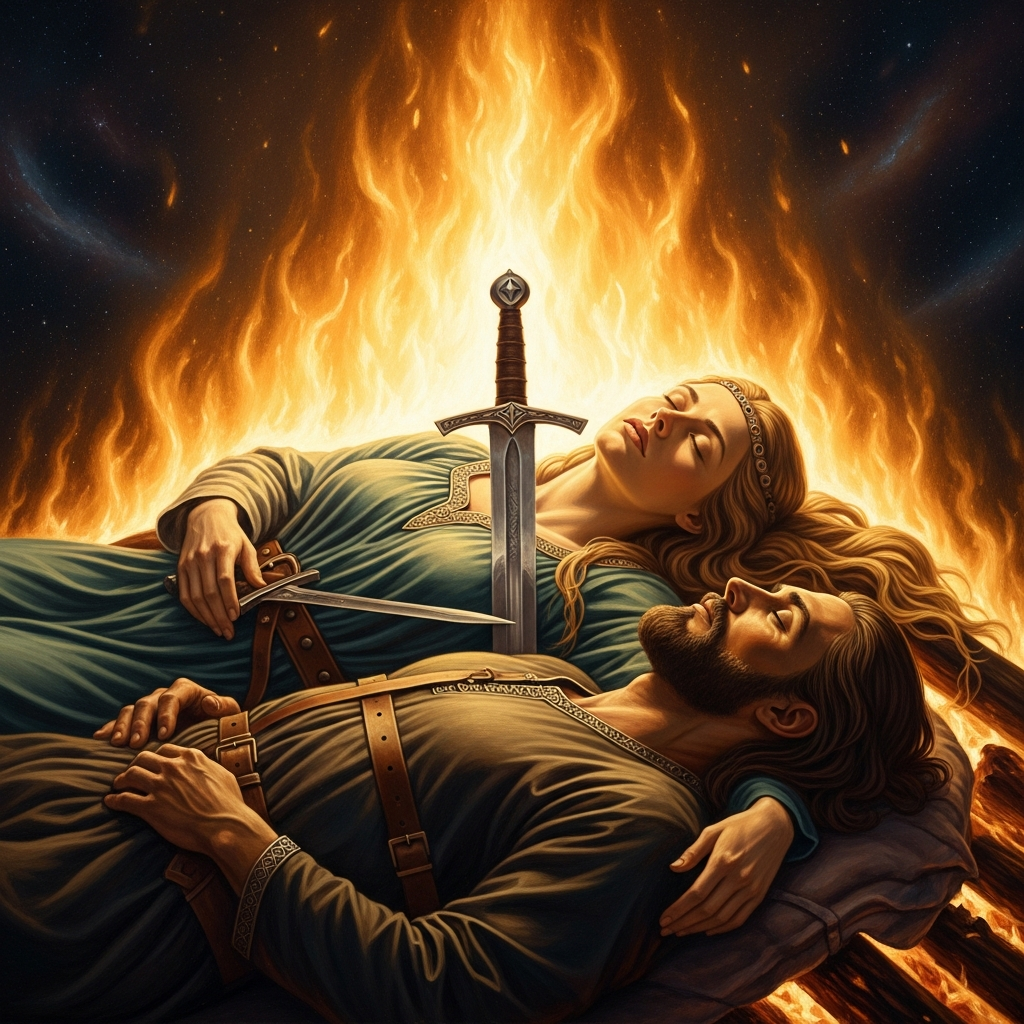
She asks to be burned with Sigurd on his pyre. She asks that Gram be laid between them, as it was on the mountain. She asks for the ceremony given to warriors.
Then she drives a spear into her own side.
She lies down beside Sigurd on the pyre. The attendants bring the sword and lay it between them. She begins to speak — she is still speaking when the fire is lit, telling the assembled hall what actually happened, the whole story from the mountain to the river, the potion and the deception and the ring and what was real and what was not — and her voice does not stop until the fire makes it stop.
She was put to sleep by a god and woken by the right man and then woken again by the wrong man wearing the right man’s face, and the thread between the two wakings was a potion and a forgotten oath and the structural necessity of men’s politics. She did not die because she was wronged. She died because the shape of the story had been set the night Odin pressed the sleep-thorn in, and the shape required that the only fearless man who could reach her was also the man that fate had already marked.
The Helreið Brynhildar — Brynhildr’s Ride to Hel — has her explaining herself to a giantess who challenges her right to take the road after death. She explains the whole story again, from the beginning, calmly, to a giantess who did not ask. She is still trying to make someone understand. This is the last thing the myth shows of her: a dead woman, riding, explaining.
Scenes
Odin presses the sleep-thorn against Brynhildr's skin
 Generating art…
 Sigurd on Grani, who does not flinch at fire
 Generating art…
 The armor has grown into her skin
 Generating art…
 Brynhildr and Gudrun at the river's edge
 Generating art…
 Brynhildr on the pyre
 Generating art…
 Echoes Across Traditions
Entities
- Brynhildr
- Odin
- Sigurd
- Gudrun
- Gunnar
- Gríðr
- the Norns

Sources
- *Völsunga saga* (c. 1200–1270 CE), ch. 21–32
- *Sigurðarkviða hin skamma* (Short Lay of Sigurd), Poetic Edda
- *Helreið Brynhildar* (Brynhildr's Ride to Hel), Poetic Edda
- *Grípisspá* (Prophecy of Grípir), Poetic Edda
- Richard Wagner, *Die Walküre* and *Götterdämmerung* (1870–1876)
- Jesse Byock (trans.), *The Saga of the Volsungs* (Penguin, 1990)