The Black Stone of the Great Mother
204 BCE · Rome, the Via Appia, the Palatine Hill · Rome — the sanctuary on the Palatine Hill, the heart of the Roman religious world
Contents
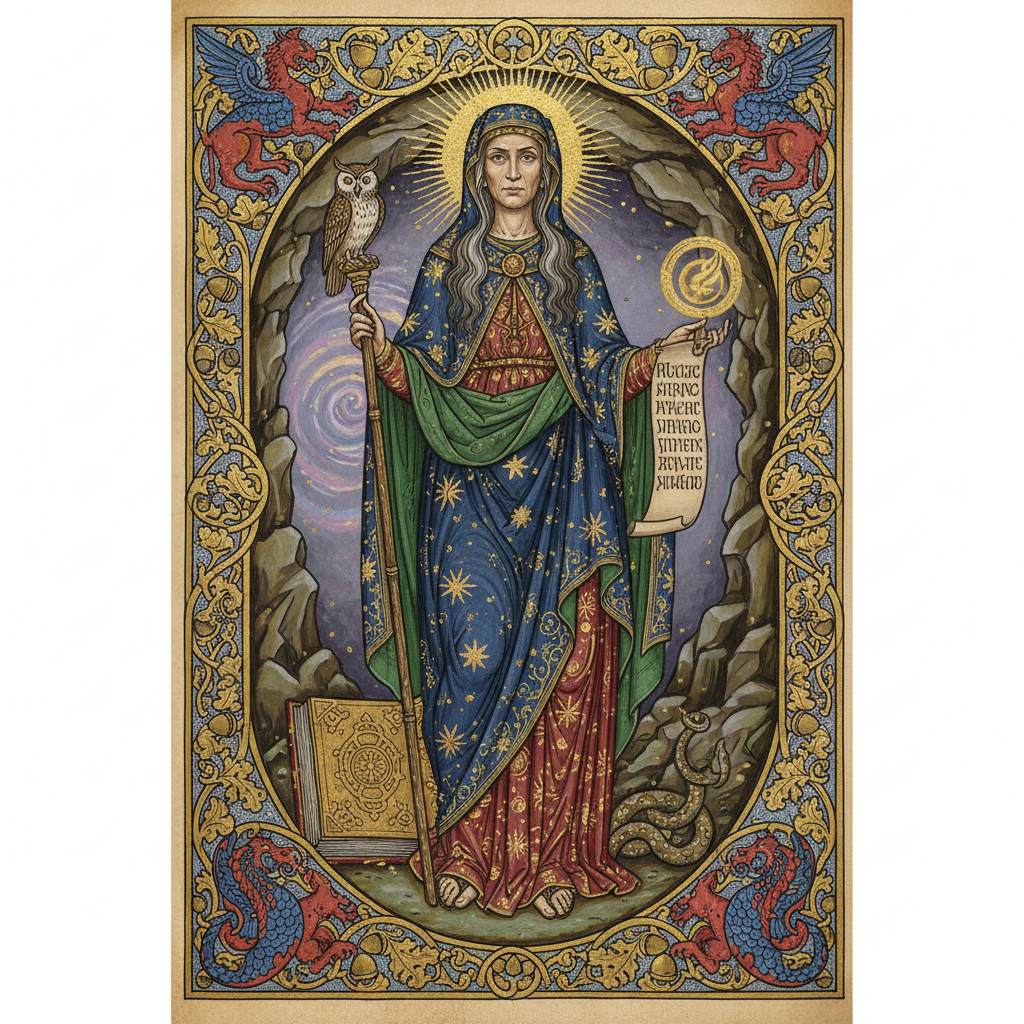
In 204 BCE, the Roman Senate sends its most virtuous citizen to receive a black stone from Pessinus — the body of Cybele, Great Mother of the Gods. Her priests, the Galli, castrate themselves in ecstatic devotion. Her lover Attis dies and rises in a three-day festival every March. The dates of his passion and Easter have never been satisfactorily explained.
- When
- 204 BCE · Rome, the Via Appia, the Palatine Hill
- Where
- Rome — the sanctuary on the Palatine Hill, the heart of the Roman religious world
The Romans go to war with Carthage and win every battle and still cannot win the war.
They have been fighting Hannibal for fourteen years. He has crossed the Alps with elephants and destroyed three Roman armies at the Trebia, at Trasimene, at Cannae — Cannae, where fifty thousand Romans died in an afternoon, the worst defeat in the Republic’s history. He is in Italy still, wintering in Capua, and the Romans have run out of ordinary explanations for why a general of moderate resources keeps defeating the most powerful military state in the Mediterranean world.
They consult the Sibylline Books.
The Books are Etruscan oracular texts kept in the Temple of Jupiter, consulted only in national emergencies, and they say — in the standard interpretation of the priests who read them — that Hannibal can be expelled from Italy if Rome brings the Great Mother of the Gods from her temple at Pessinus in Phrygia, and receives her properly, and installs her on the Palatine Hill.
The Senate debates this. The Great Mother of the Gods is not a Roman goddess. Her rites are Phrygian, her priests are Phrygian, her music is loud and her worship is ecstatic in ways that do not overlap comfortably with the Roman ideals of dignitas and gravitas. But Hannibal is in Italy, and the Books have spoken, and Rome sends a delegation to the east.
The goddess arrives as a black stone.
This is the oldest form of deity in the ancient Mediterranean — not a statue, not an icon, not an anthropomorphic representation, but a stone. A meteorite, most likely: the kind of rock that falls from the sky, that is visibly not from this world, that is therefore — in the religious logic of every culture that has encountered one — from somewhere else, somewhere above, somewhere divine. The black stone of Cybele is roughly conical or pyramidal, small enough to hold in both hands, ancient beyond anyone’s ability to estimate.
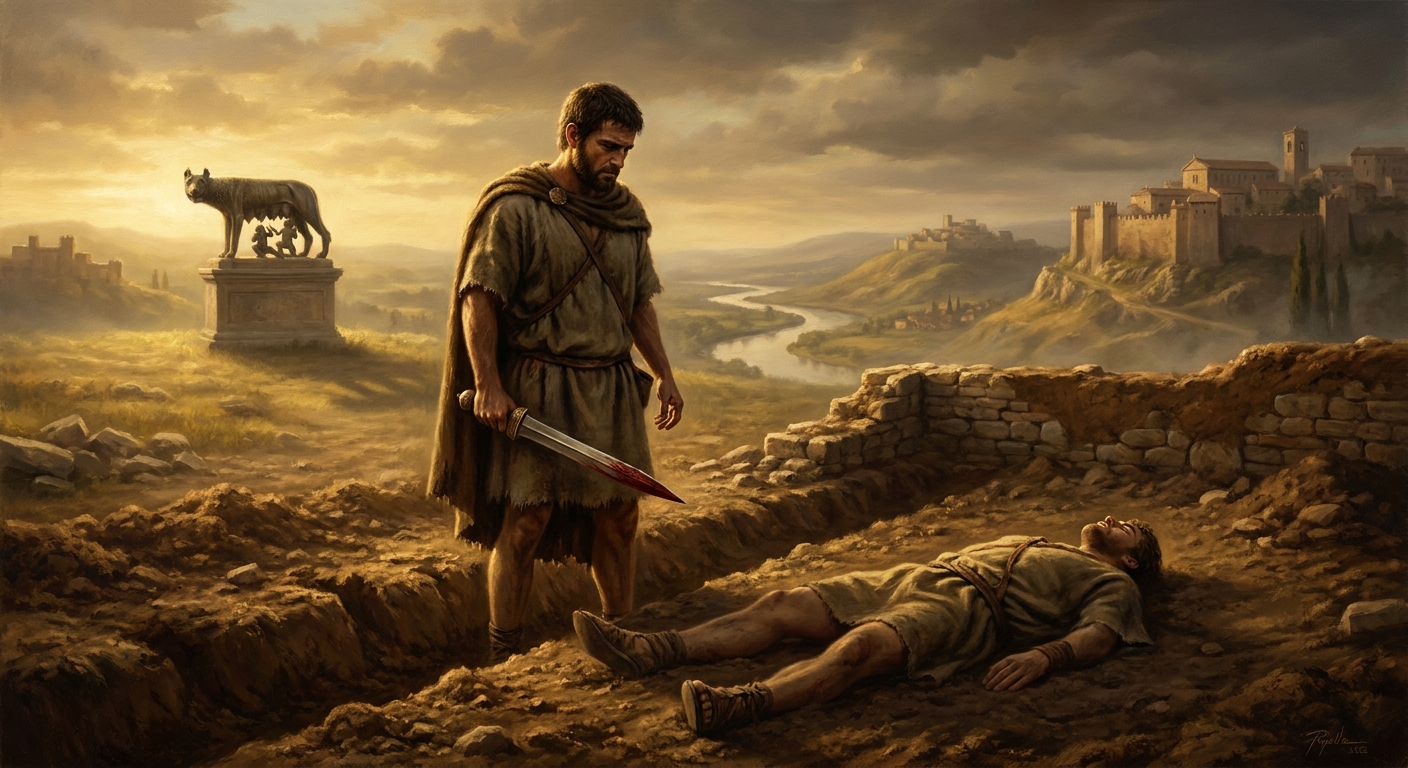
The Roman delegation receives it from the priests at Pessinus and carries it back across the Adriatic. The Senate has ordered that the most virtuous man in Rome must be the one to receive the goddess at Ostia, at the mouth of the Tiber. Publius Cornelius Scipio Nasica — later to command the army that will finally finish Carthage — receives her from the Phrygian priests and transfers her to the Roman matrons who will carry her to Rome.
This is where Claudia Quinta enters.
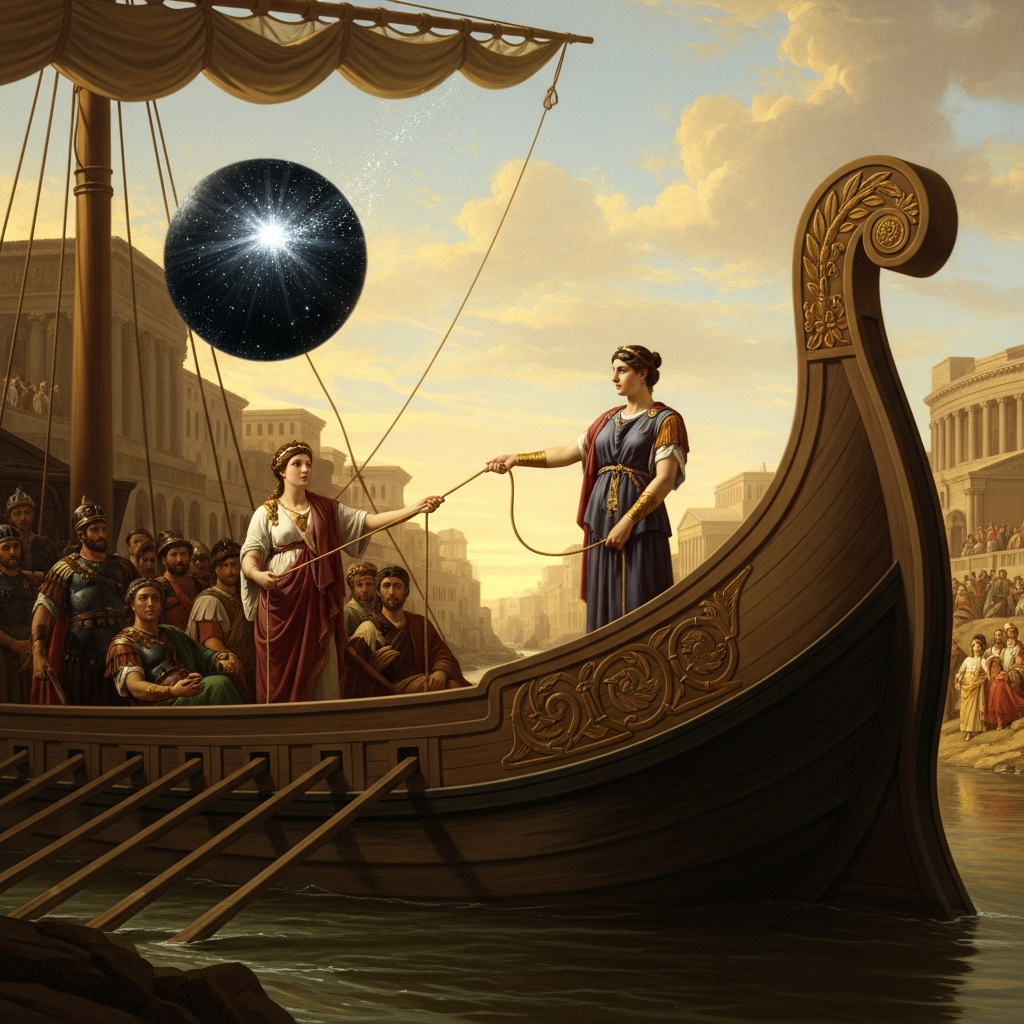
The ship carrying the stone runs aground in the Tiber.
It sticks on a sandbar and cannot be moved. The ropes are pulled by dozens of men and the ship does not shift. This is a bad omen — the goddess refusing entry, the stone too heavy for ordinary effort — and the assembled crowd on the banks knows it and the atmosphere acquires the specific quality of a moment when a catastrophe is about to become official.
A woman steps forward from the crowd of matrons.
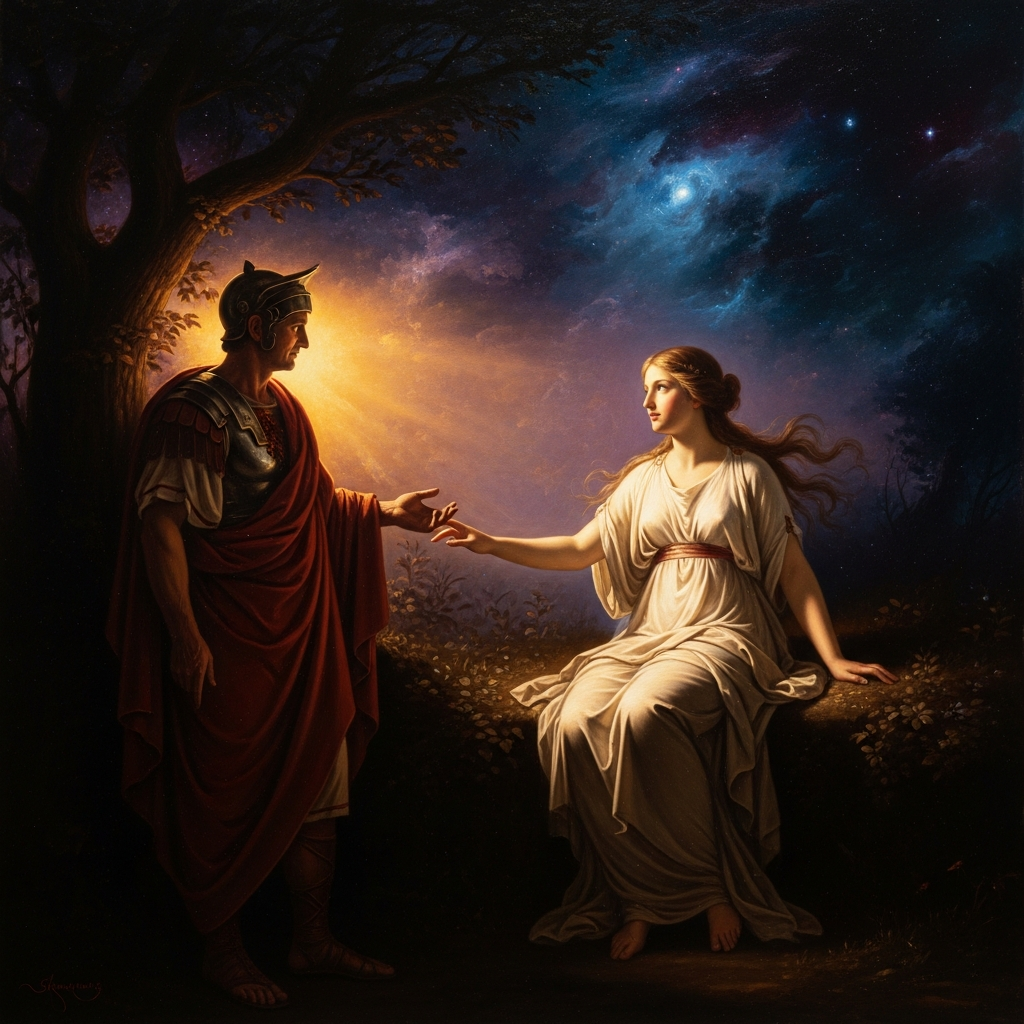
Claudia Quinta is — depending on which account you read — either a woman of impeccable reputation or a woman whose reputation has been questioned and who is present at this moment precisely because she needs the goddess to vindicate her. She approaches the priests. She prays. She takes the rope in her hands.
She pulls.
The ship moves.
It moves off the sandbar easily, smoothly, following Claudia Quinta up the river like a dog following its master, the great stone sitting in the hull, the rope in a woman’s hands. The crowd on the bank sees this. The story goes through Rome like a fever. Claudia Quinta’s reputation is established. The stone reaches the Palatine.
Rome wins the war. Scipio defeats Hannibal at Zama in 202 BCE.
The goddess is installed on the Palatine, adjacent to the house of Augustus, at the oldest and most sacred part of the city. She is given a temple. She is given Roman priests and Roman rites and Roman games — the Megalesia, in April, with theatrical performances that become some of the most popular entertainment in the city. The Roman Senate maintains control of these aspects of her cult. But they cannot control the other priests.
The Galli come with her.
The Galli are the priesthood of Cybele from Phrygia and Galatia, and they are unlike any other religious functionaries in the Roman world. They are men who have castrated themselves in ecstatic devotion to the goddess. The castration is performed — by Roman-era accounts — during the celebration of the Dies Sanguinis, the Day of Blood, in a state of Bacchic possession, using a sharpened stone or a potsherd, in imitation of the myth of Attis.
The Romans are horrified by this and cannot stop it.
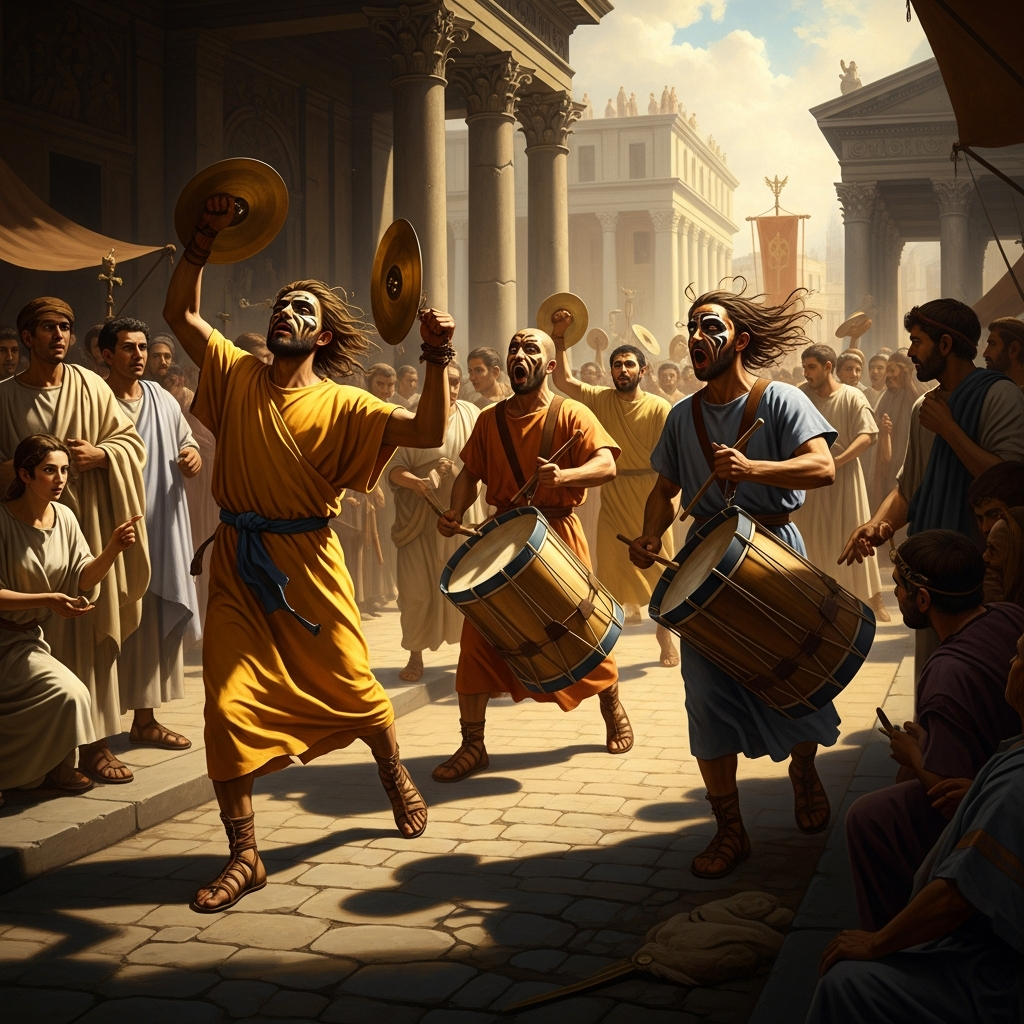
They cannot stop it because the Galli are the authentic priests of the authentic goddess, and the Senate has officially invited the goddess to Rome, and the price of the invitation is the priests who come with her. The Galli walk through Rome in saffron robes with long unbound hair and painted faces, crashing cymbals and beating drums, begging alms, prophesying, singing in Phrygian. Roman citizens are prohibited — by a law that has to be passed specifically to address the situation — from castrating themselves in honor of Cybele. But the Galli, who are technically Phrygian and not Roman citizens, are beyond the law’s reach.
For four hundred years, the most conspicuously foreign and the most publicly transgressive religious figures in the Roman city are the priests of the goddess the Senate brought home as a wartime expedient.
Attis is her lover who dies every year.
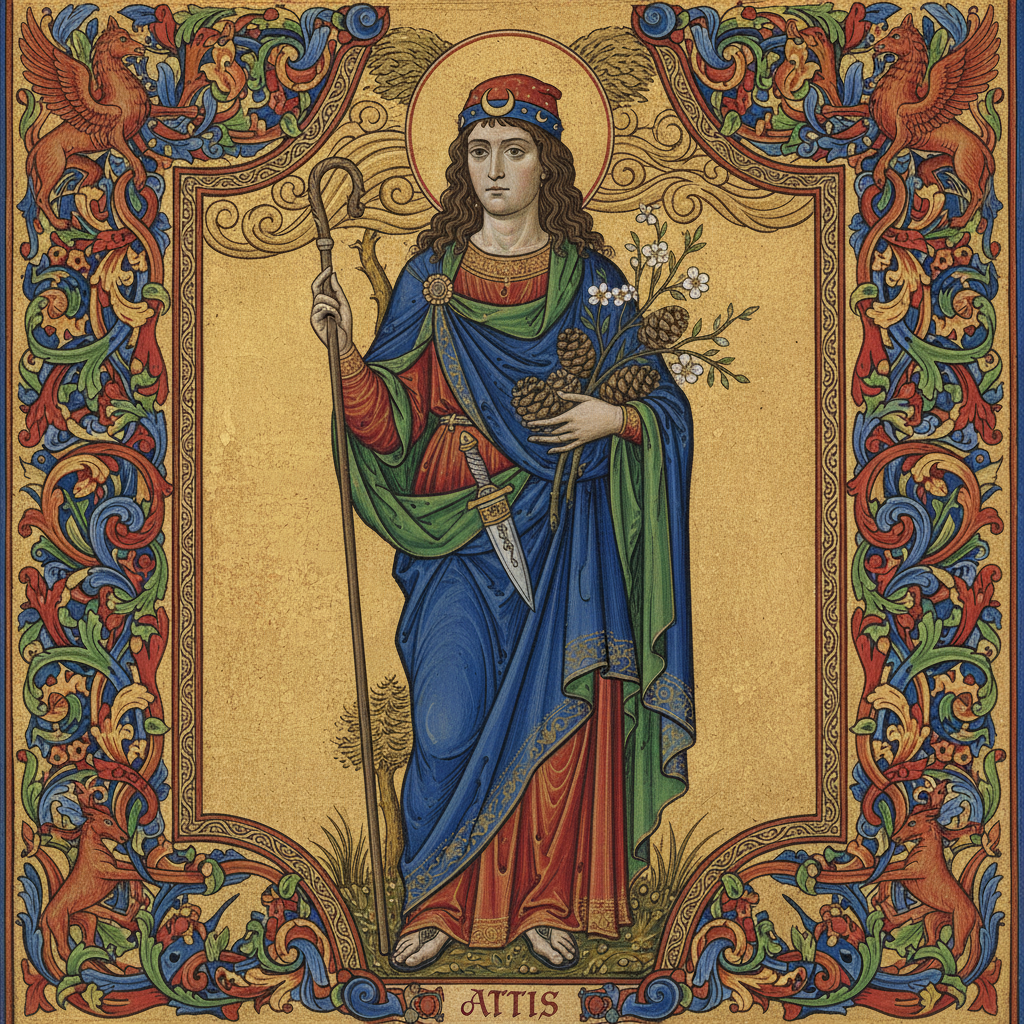
The myth has variant forms in different sources — Cybele and Attis are from Phrygia and the tradition evolved over centuries before the Romans codified any version of it — but the core is consistent. Attis is a young shepherd or a young man of unusual beauty. Cybele loves him. She demands exclusive devotion. He fails — he is tempted by a nymph, or by a mortal woman — and Cybele’s jealousy destroys him. He goes mad. He castrates himself under a pine tree. He dies.
He comes back.
The festival that re-enacts this in Rome runs for ten days in March, but the essential three days are at its center. On March 22, a pine tree is felled in the sacred grove and carried into the sanctuary of Cybele, wrapped in woolen bands like a corpse, the effigy of Attis bound to its trunk. On March 24 — the Dies Sanguinis, the Day of Blood — the Galli mourn and lacerate themselves and the atmosphere is one of communal grief, fasting, and ritual lamentation for the dead shepherd. On March 25, the Hilaria: the festival of joy. Attis is risen. The mourning is over. The city erupts in celebration, masks and games and the lifting of every prohibition, the world briefly suspended in the reversal of death.
March 22 to March 25. Three days from death to resurrection.
The Julian calendar places the spring equinox on March 25 in the era when the Roman festival was codified. The Christian calendar, fixed at the Council of Nicaea in 325 CE, places Easter on the first Sunday after the first full moon after the spring equinox. The calculations differ, but the date range is the same, and the structure — the mourning, the three days, the reversal, the celebration — is identical.
The Church Fathers knew about Attis.
They could not avoid knowing about him; the Cybele cult was active in Rome throughout the period of early Christianity’s expansion, and the two traditions competed for converts in the same neighborhoods of the same cities. The Fathers’ response was the doctrine of diabolical mimicry: the devil, they argued, knowing in advance what Christ would do, arranged for Attis to do it first, in order to confuse pagans and make them think Christianity was just another version of something they already had.
This argument has had a long career. It is still occasionally deployed. Its weakness is that it requires the devil to be more prescient than God is historically documented to have been, and that it acknowledges the resemblance while refusing to explain it by the more parsimonious hypothesis: that dying-and-rising gods, three-day passions, and spring resurrection festivals are a deep structure of human religious imagination that Christianity did not borrow from Attis any more than Attis borrowed from the Egyptian Osiris or the Mesopotamian Dumuzi — that all of them are expressions of the same observation, which is that grain dies in winter and returns in spring, and that the death and return of the god is the story the human mind tells about the death and return of the food.
The Hilaria and Easter occupy the same latitude in the calendar because they are both celebrations of the same agricultural fact, wrapped in theology appropriate to their traditions.
Cybele is one of the last pagan cults suppressed by the Christian emperors.
Her sanctuary on the Palatine survives into the late fourth century. The Taurobolium — the bull sacrifice in which the initiate stands in a pit while the animal is killed above them and is drenched in its blood, emerging purified for twenty years or, in some versions, forever — continues to be performed in Rome as late as 394 CE, a few years before Theodosius closes the pagan sanctuaries. The last known Taurobolium inscription is from that year.
The Galli disappear from the historical record in the early fifth century. The black stone is never mentioned again after the sack of Rome in 410. Whether it was destroyed or hidden or carried away or simply lost in the rubble of a city being remade is not established.
What is established is that the month of April keeps her name in the Roman calendar: the games she was given, the Megalesia, ran in April, and the mensis Aprilis — April — has been traced to Apru, an Etruscan version of Aphrodite, the Greek goddess of love who is in this tradition the same goddess as Cybele, or her closest equivalent. The Great Mother is in the calendar whether or not her stone remains.
Catullus wrote his sixty-third poem about Attis — a young man who crosses the sea to Phrygia and in a Bacchic frenzy castrates himself in service to Cybele, then wakes the next morning to mourn what he has done, then is pursued by the lions of the goddess back into her service when he tries to flee. The poem is in galliambic meter — the distinctive rolling rhythm of the Galli’s cult songs — and it is the most disturbing thing Catullus wrote, more disturbing than his love poems, more disturbing than his political invective. It describes the ecstatic self-destruction that the goddess demands, the way devotion can become annihilation, the way the self dissolved in religious passion cannot be fully reassembled afterward.
The poem has no resolution. Attis is running toward the mountain at the end. The goddess is behind him in the form of a lion. There is nowhere to run.
Cybele is the Great Mother, which means she is older than the arrangement of the heavens. She was worshipped on the mountains of Phrygia before the Greeks arrived, before the Trojans, possibly before the Hittites. She is the earth itself in its maternal aspect — the crags and the caverns and the wild places where nothing has been cultivated. Her lions are not pets. Her Galli are not eccentric performers. Her black stone is not a symbol of the earth. It is a piece of something that fell from the sky into the earth at a point before any human being was there to watch, and the Romans brought it home and built a temple for it on the hill where their city began and could not, for four hundred years, domesticate what they had invited in.
The Great Mother comes when she is called. She does not leave when she is told.
Scenes
Claudia Quinta standing at the prow of the ship on the Tiber, the black meteoric stone of Cybele behind her, the rope in her hands — the most virtuous Roman woman pulling the Great Mother into the city while the Senate watches from the bank
 Generating art…
 The Galli of Cybele in full procession through Rome: castrated priests in saffron robes, cymbals crashing, drums beating, their faces painted, their long hair unbound — the most foreign and the most visible religious cult in Roman public life
 Generating art…
 The pine tree of Attis borne into the sanctuary during the Dies Sanguinis — the Day of Blood — the effigy of the dying shepherd bound to the trunk, the Galli cutting their own flesh in mourning at the foot of the tree
 Generating art…
 Echoes Across Traditions
Entities
- Cybele
- Attis
- the Galli
- Claudia Quinta
- the Sibylline Books

Sources
- Livy, *Ab Urbe Condita* XXIX.10-14 (arrival of Cybele in Rome, 204 BCE)
- Lucretius, *De Rerum Natura* II.598-660
- Ovid, *Fasti* IV.179-372
- Catullus, Poem 63
- Lynn Roller, *In Search of God the Mother: The Cult of Anatolian Cybele* (California, 1999)
- Walter Burkert, *Ancient Mystery Cults* (Harvard, 1987)