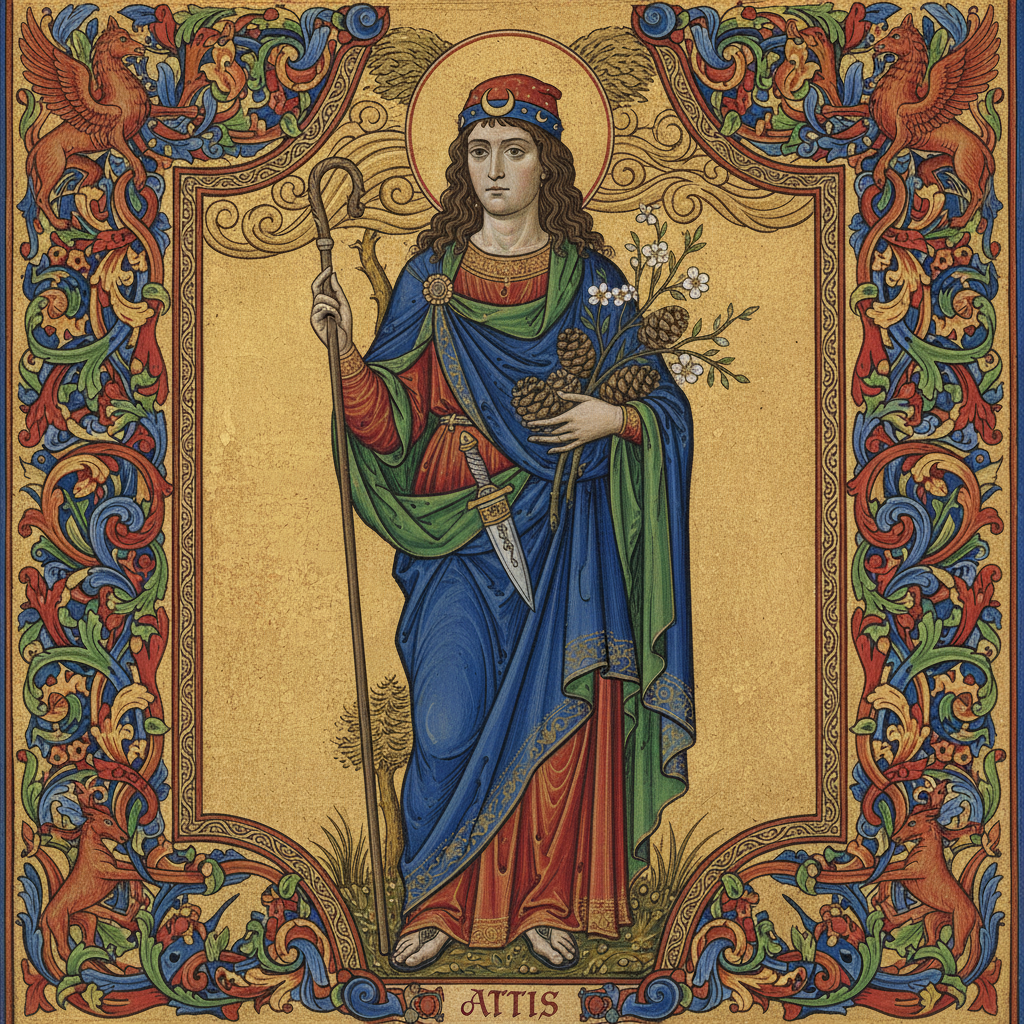
Dido and the Founding of Carthage
c. 814 BCE · traditional founding of Carthage; Virgil's telling woven into mythic time · Tyre in Phoenicia, and the coast of North Africa
Contents
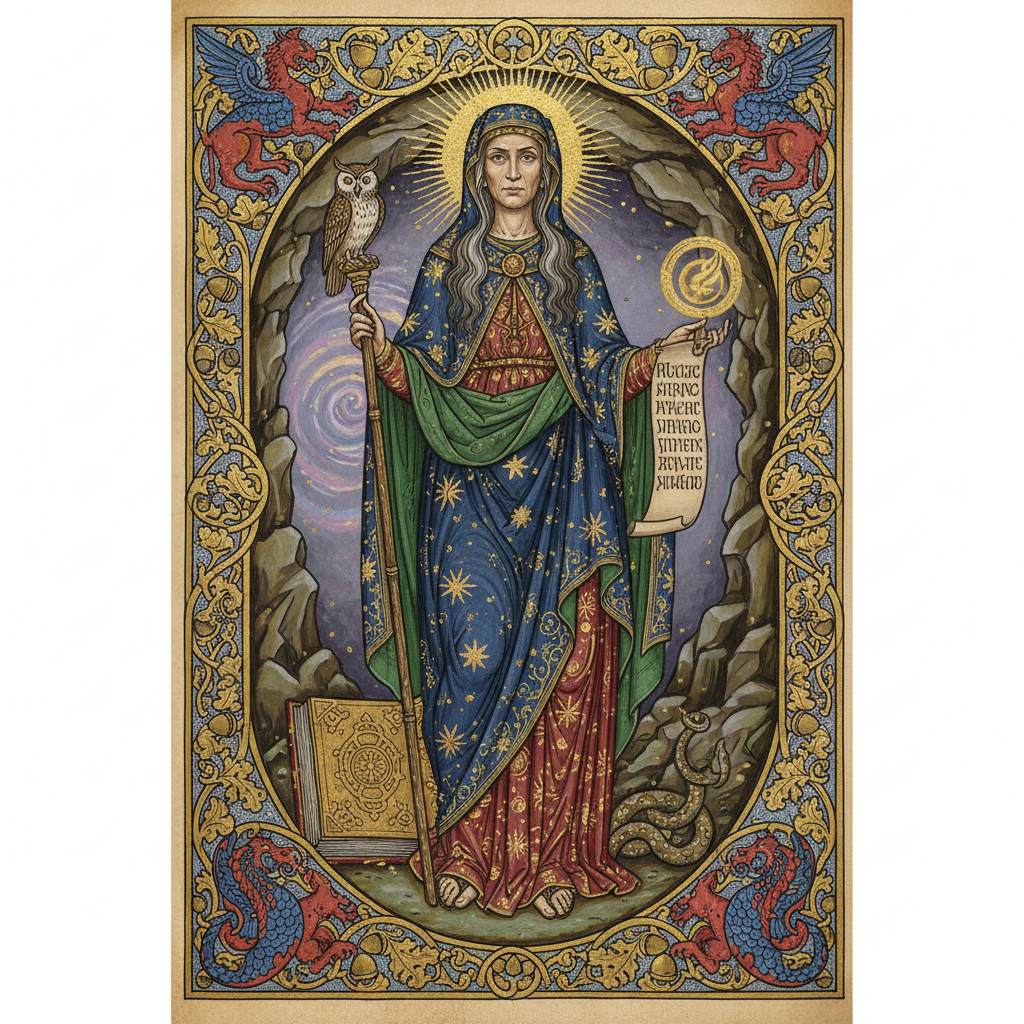
Dido flees the murder of her husband, crosses the sea, and founds a city on the North African coast by a trick so brilliant it is also an act of genius — cutting an ox hide into strips thin enough to encircle a hilltop. Then Aeneas arrives and ruins her. The story Rome told about the city it destroyed: that it was built by a woman of impossible resourcefulness, and that it burned for love of a Roman.
- When
- c. 814 BCE · traditional founding of Carthage; Virgil's telling woven into mythic time
- Where
- Tyre in Phoenicia, and the coast of North Africa
Her brother kills her husband for the gold.
This is the first fact about Dido: she is a woman who has already survived the worst thing. Pygmalion, King of Tyre, her brother, murders Sychaeus at the altar — temple murder, the most impious kind — and hides the body and lies about it and pretends for months that Sychaeus is simply away, traveling, expected back. He has already taken the gold. He is waiting for Dido to stop asking questions.
Sychaeus appears to her in a dream, pale and wound-opened, and shows her where the treasure is buried in the garden and tells her to run.
She does not hesitate. She has been asking questions for months and getting lies, and the dream of her husband with a sword wound is not a dream she needs to interpret. She goes to the garden. She digs. She finds what he said she would find. She goes to the harbor in the dark of a single night and she finds the people who hate Pygmalion — which, in a court built on murder and fear, is most people — and she puts them on ships with the gold and the household gods and she leaves Tyre behind before her brother has finished his morning.
This is Dido before Carthage, before Aeneas, before the pyre: a woman who can organize a clandestine mass departure in a single night and get it right.
The ships make land on the coast of North Africa, at a place the locals call the beach below the curving hill.
She needs land. The king of the region — Iarbas, son of a Libyan and a nymph, a man with opinions about refugees from Phoenicia — is willing to sell her exactly as much land as an ox hide can cover. This is his joke. This is him being generous while being ungenerous. An ox hide covers perhaps four square meters. You can build a house on four square meters, barely. You cannot build a city.
Dido takes the ox hide.
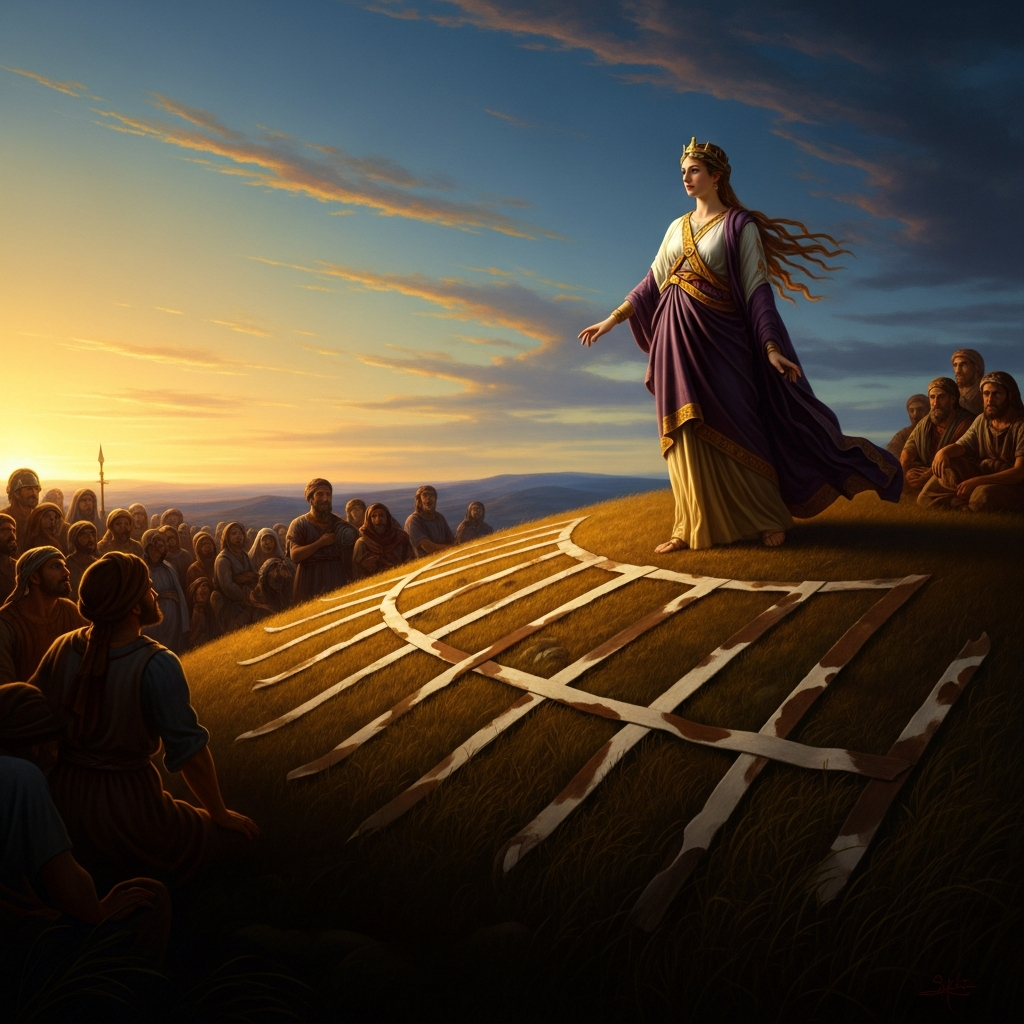
She cuts it into strips. The strips are thin — she keeps cutting — so thin that when she lays them end to end they stretch far enough to encircle the entire hilltop that overlooks the harbor. She walks the perimeter herself, the strips laid out in the grass, pacing the boundary of the city that is not yet a city. Iarbas watches. There is nothing he can do. She bought exactly as much land as an ox hide can cover. This is exactly as much land as an ox hide can cover.
The hill is called the Byrsa — which in Greek means hide. The city she builds on it is called Carthage.
She builds it well.
Justin’s account, preserved in the Epitome, describes the harbor, the citadel, the public buildings rising in the order a city needs them — walls first, then storage, then the markets, then the temples. She rules without a husband because she was married once and her husband was murdered at an altar by her own brother, and she does not need to be governed, she needs to govern. When Iarbas proposes marriage she refuses. When other local kings propose she refuses again, citing the vow she made to Sychaeus’s memory. Her sister Anna argues that the dead have no claims, that a living city needs alliances, that she should remarry for the sake of Carthage. Dido refuses this too.
She has built a city from an ox hide and a night departure. She does not need a husband. What she needs is what she will not say she needs, because she is Dido and she does not say such things, and what she needs does not arrive until the storm brings twenty ships to her harbor with a Trojan prince in them who has been wandering the Mediterranean for seven years looking for Italy.
She knows who he is before he speaks.
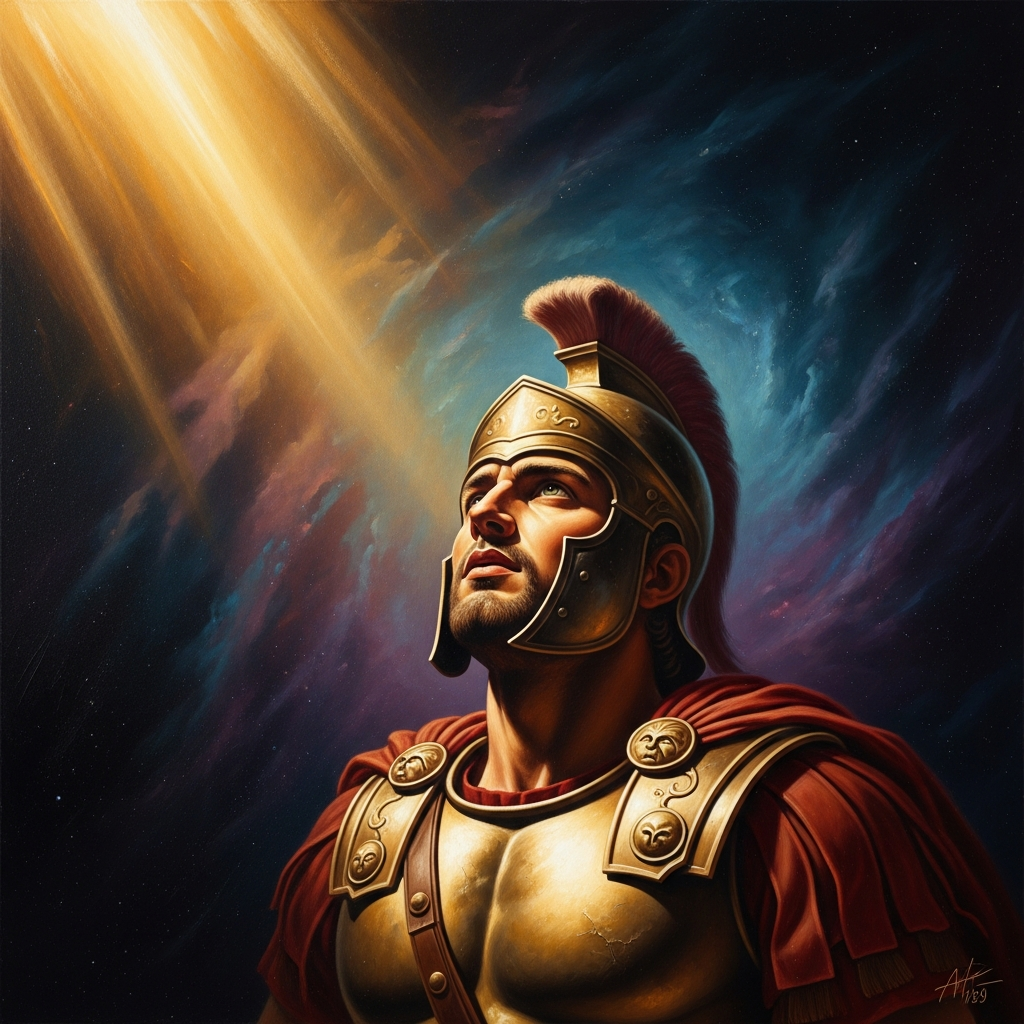
His mother is Venus. Even in exile and storm-wracked, even covered in the salt and the wear of years at sea, something in the way he stands inside the harbor is not quite like other men. Dido watches him from the city wall and Virgil writes the moment with the only simile large enough for it: as Diana stands among her nymphs on the slopes of Eurotas. She is the goddess in the scene. He is the one who does not yet know what he is looking at.
She receives him as she receives everything — with the authority of a woman who built the city they are standing in. She gives him the harbor, the warehouses, the feast. She listens to him tell the story of Troy, which takes three books of the Aeneid and an entire evening. She listens to all of it, and as she listens the thing she has kept at bay since Sychaeus’s ghost stood over her in the garden opens in her chest like a wound reopened.
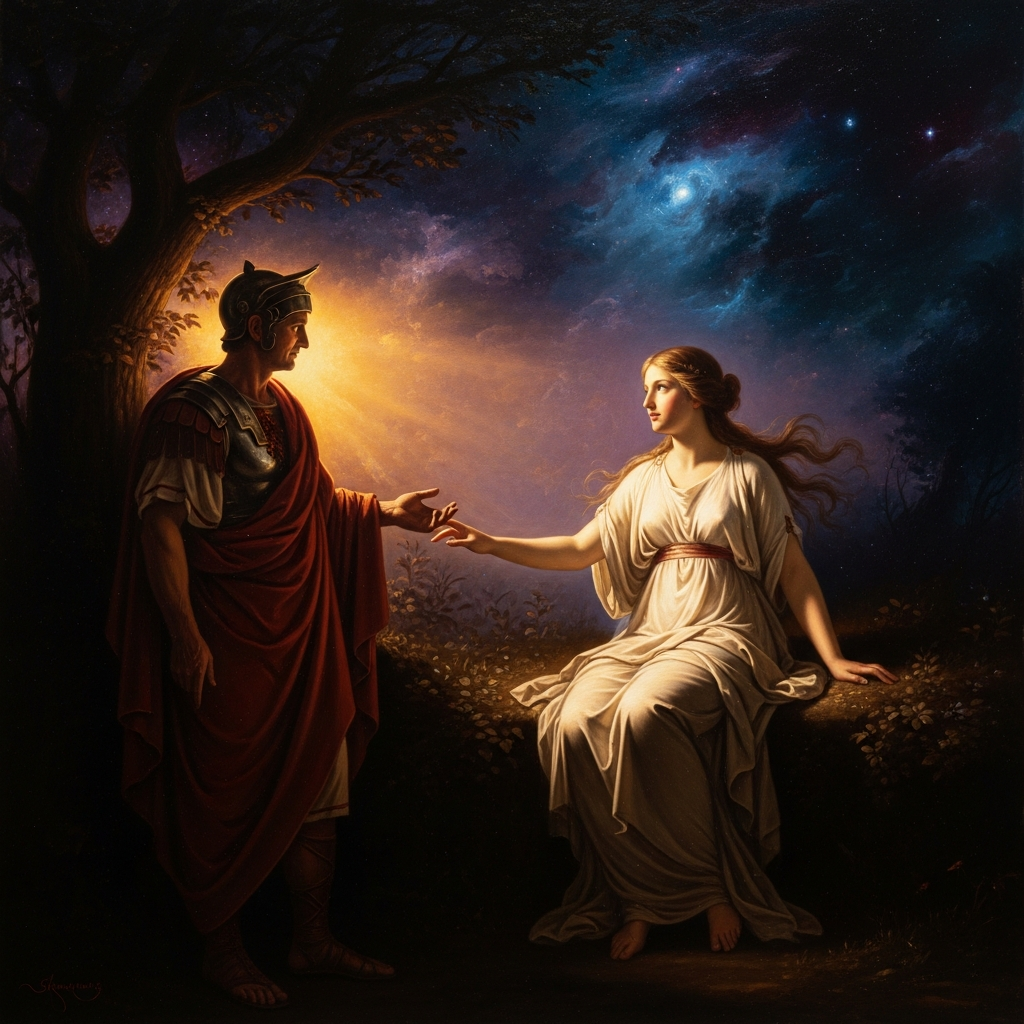
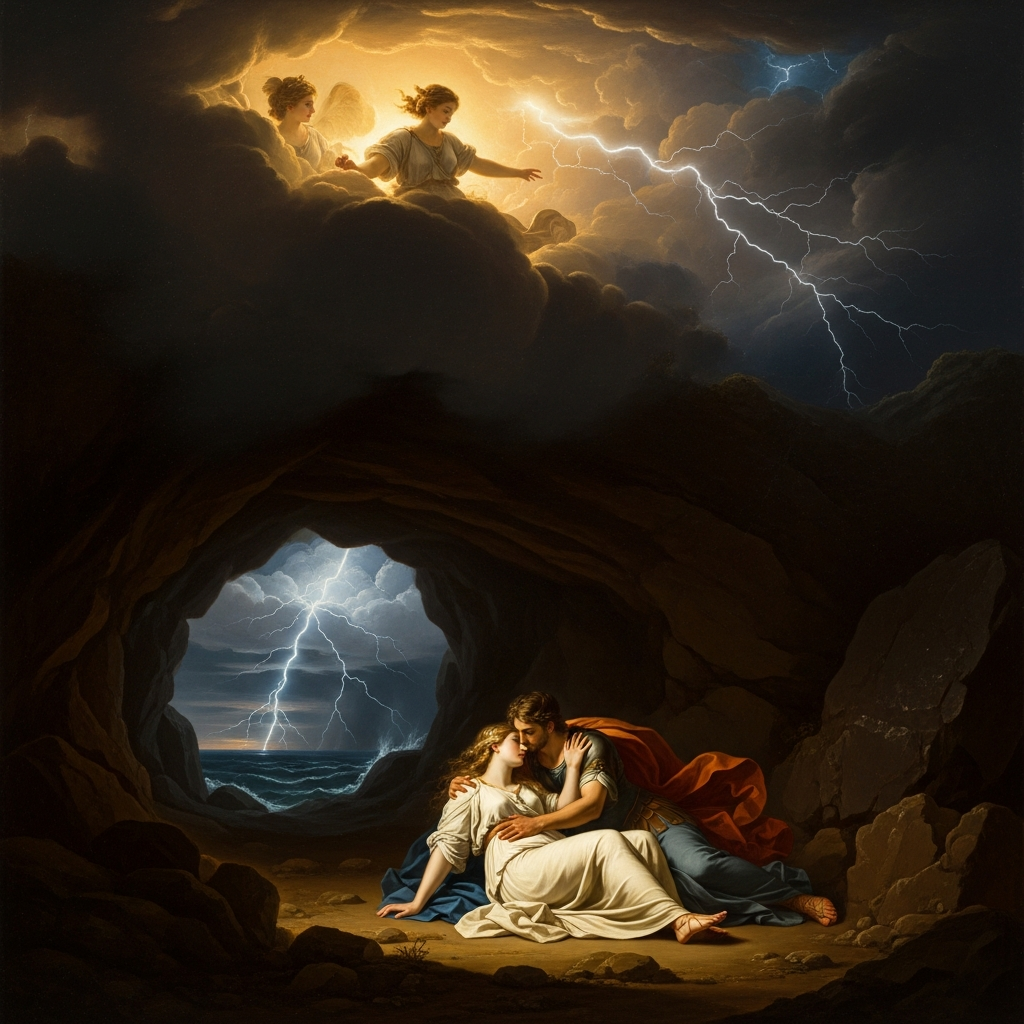
Juno and Venus are managing her. Both goddesses have their own reasons. Juno wants Aeneas stuck in Carthage so Rome is never built; Venus wants her son sheltered and fed. They manufacture a storm. They arrange that Aeneas and Dido, hunting on the North African hillside, are caught in it. They arrange a cave.
What happens in the cave, Dido will call a marriage. What Aeneas will call it is less clear.
He stays a year, or part of a year.
He is, according to Virgil, happy — happy enough to wear a Phoenician cloak, to help plan new buildings, to stand at Dido’s side at public events with his son Ascanius beside him. He is happy in the specific way a man is happy who has been at sea for seven years and found landfall with a beautiful and capable woman who makes no demands on his destiny because she is too busy running a city.
Jupiter notices.
He sends Mercury down to Carthage with a message that strips the scene of any ambiguity it might have had: Aeneas. Italy. Now. What are you doing? Mercury finds him inspecting new fortifications, a golden sword at his side that Dido gave him, and delivers the message with the contempt a divine messenger reserves for a demigod who has forgotten his mission for the sake of domestic comfort.
Aeneas is shaken. He tells Dido he has to leave. He uses the word destiny. He explains that Jupiter has commanded. He says — and this is the line that has angered readers for two thousand years — that he never promised her a marriage.
Ovid gives Dido her reply in the Heroides: the seventh letter, written from the city she built to the ship that is already being loaded in her harbor. She catalogs everything: the storms she took him in from, the feasts, the year, the word marriage that she used and he did not correct. She is not hysterical. She is systematic. She builds the case as she built the city — strip by strip, each piece laid down precisely, until the whole outline is visible. The argument is airtight. It does not help.
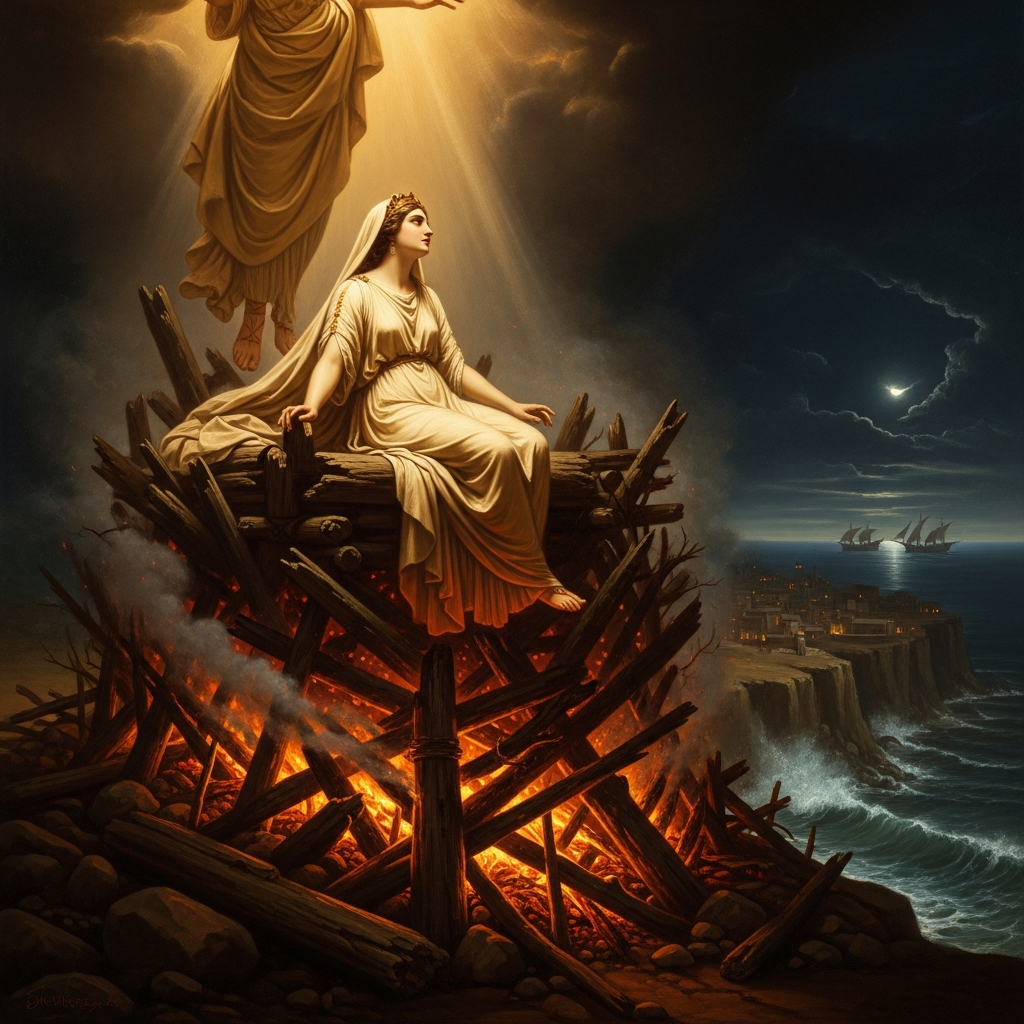
She goes to her sister Anna and asks for a pyre to be built on the highest point of the city. She says it is to burn his gifts — his weapons, his armor, his clothes — to undo the memory. Anna believes this. She oversees the construction of the pyre.
Dido watches Aeneas’s fleet leave the harbor at dawn. She stands on the rampart. She can see the sails. She watches until she cannot see them and then she mounts the pyre that is built from everything he left behind and she does the thing she has decided to do, and she dies with a view of the sea.
The Romans destroyed Carthage in 146 BCE.
They killed everyone they could not sell into slavery, demolished every building to its foundations, and salted the earth — or did not salt it, the sources argue, but either way the intent was clear. The city that Dido built by cutting an ox hide into strips was removed from the surface of the world so completely that the location of Byrsa Hill is still a matter of archaeological debate. They spent three years on the demolition. They were thorough.
This is the story Rome told about the city it destroyed: that it was founded by a woman who outwitted a king with a piece of leather and died burning on her own parapets for love of a Roman man who needed her to get to Italy and then needed Italy. The Romans had mixed feelings about this story. You can tell because they kept telling it.
Virgil makes sure that Dido’s last act, in addition to the dying, is a curse. Let there be war between my people and his people, between their children and our children, across all the generations that follow. She is talking about Hannibal. She is talking about every Punic War. She is cursing Rome with the future that actually happened, and Rome reads this and shivers slightly, and keeps reading, because Virgil understands that you cannot found an empire without the people you destroyed, without their ghosts attending every chapter, without their last words following you forward into history.
The Latin word for Carthage’s famous technique of cutting land rights finely — maximizing territory through the precise division of a constraint — does not exist, because there was no Latin word for what Dido did that the Romans were willing to use. They told the story instead. They put it in the most important poem they had. They let her be brilliant right up until the moment they decided she had to burn.
She built Carthage. Aeneas built Rome. Rome destroyed Carthage. The pyre was already prepared.
Scenes
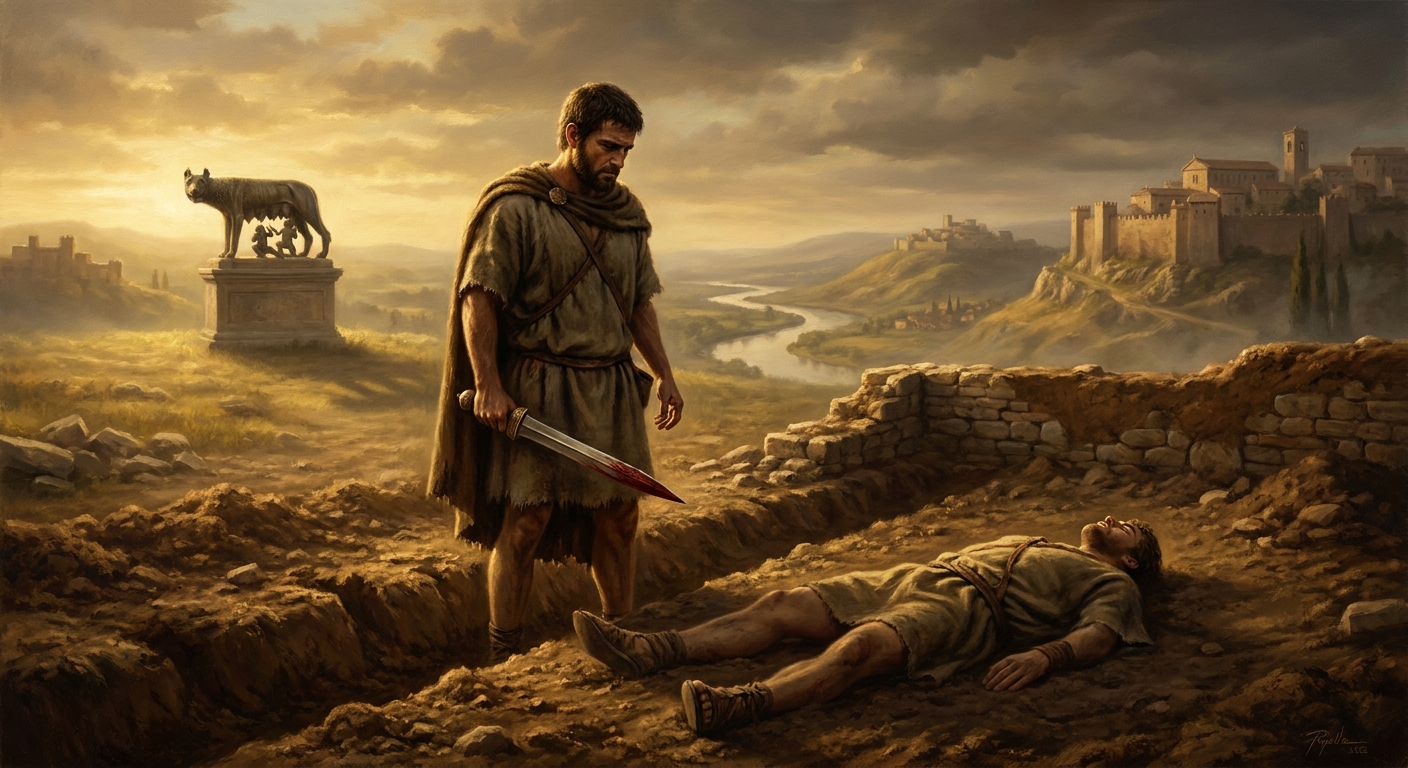
Dido on the North African hilltop, overseeing the laying of the ox-hide strips in a great arc across the ground
 Generating art…
 The cave in the storm: Dido and Aeneas alone while lightning tears the sky and Juno watches from the clouds
 Generating art…
 The pyre rises on Carthage's highest point
 Generating art…
 Echoes Across Traditions
Entities
- Dido
- Aeneas
- Pygmalion
- Anna
- Juno
- Jupiter
Sources
- Virgil, *Aeneid* I, IV (29-19 BCE)
- Justin, *Epitome of the Philippic History of Pompeius Trogus* 18
- Ovid, *Heroides* 7
- Anna Morpurgo Davies, *History of Linguistics* Vol. II (1998)
- Maria Wyke, *The Roman Mistress* (2002)