Elijah and the Chariot of Fire
Northern Kingdom of Israel · ~850 BCE · Gilgal, Bethel, Jericho, the Jordan crossing — and the sky above it
Contents
The old prophet walks to the Jordan with his disciple, strikes the water with his cloak, crosses on dry ground, and is taken up alive in a whirlwind by a chariot of fire — the only prophet in the Hebrew Bible who never dies.
- When
- Northern Kingdom of Israel · ~850 BCE
- Where
- Gilgal, Bethel, Jericho, the Jordan crossing — and the sky above it
Elijah knows the day.
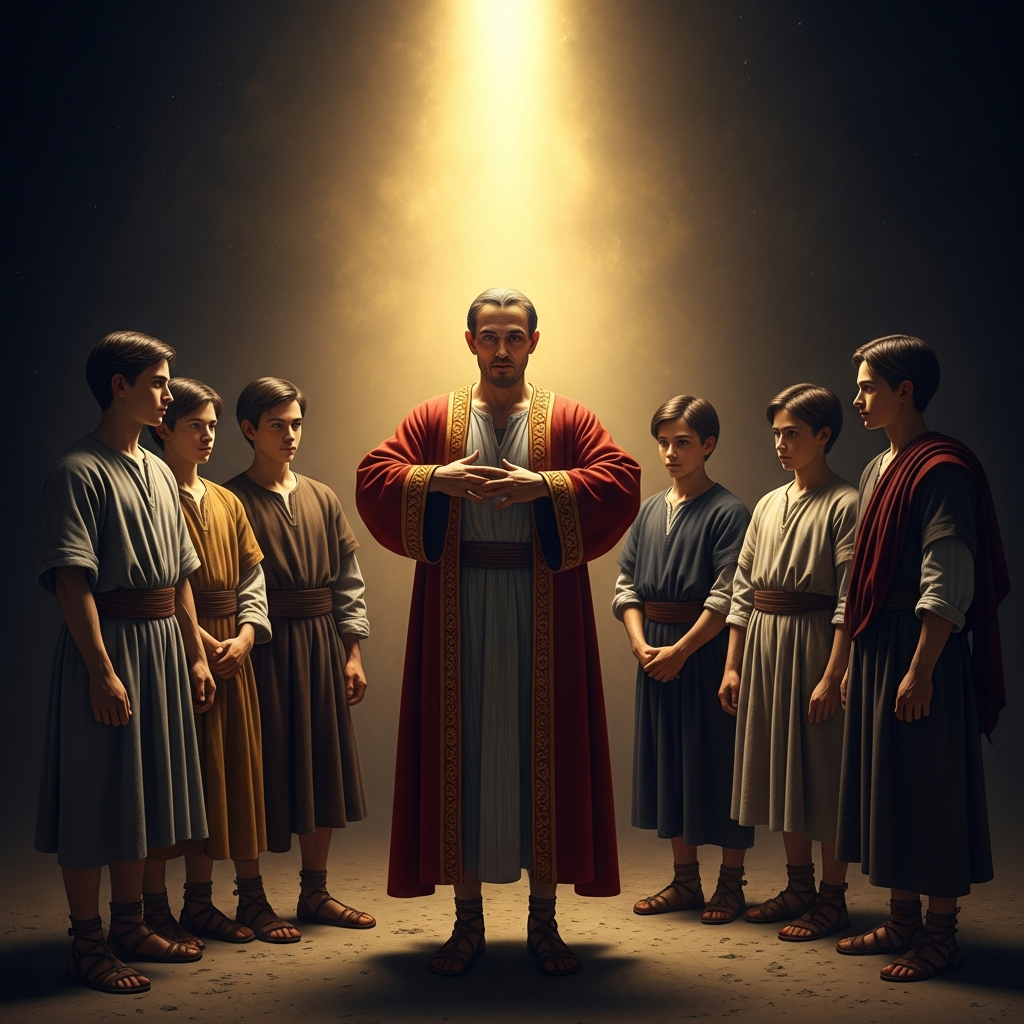
He has known it since morning. So has Elisha, his student of fifteen years, the farmer-boy he called from his plow with a thrown cloak. So have the bands of prophets at Bethel and Jericho — they whisper it to Elisha as he passes. Knowest thou that the Lord will take away thy master from thy head today? Elisha answers them flatly: Yea, I know it. Hold ye your peace.
The old man tries three times to leave the boy behind.
“Tarry here, I pray thee, for the Lord hath sent me to Bethel.”
“As the Lord liveth, and as thy soul liveth, I will not leave thee.”
They go down to Bethel together. He tries again. Tarry here, the Lord hath sent me to Jericho. The boy refuses. They go to Jericho. He tries a third time. Tarry here, the Lord hath sent me to the Jordan. The boy will not be sent away. They walk to the river side by side, two men, fifty prophets following at a distance to watch.
The Jordan is in flood.
It is the same river Joshua crossed dry-shod with the ark four hundred years earlier. The same river John the Baptist will work in eight centuries from now. The water is brown with silt, fast, impassable on foot. Elijah stops at the bank.
He takes off his cloak.
The cloak is the symbol of his prophetic office — the rough hair-mantle that has become his sign in every village in Israel. He folds it. He strikes the water with it.
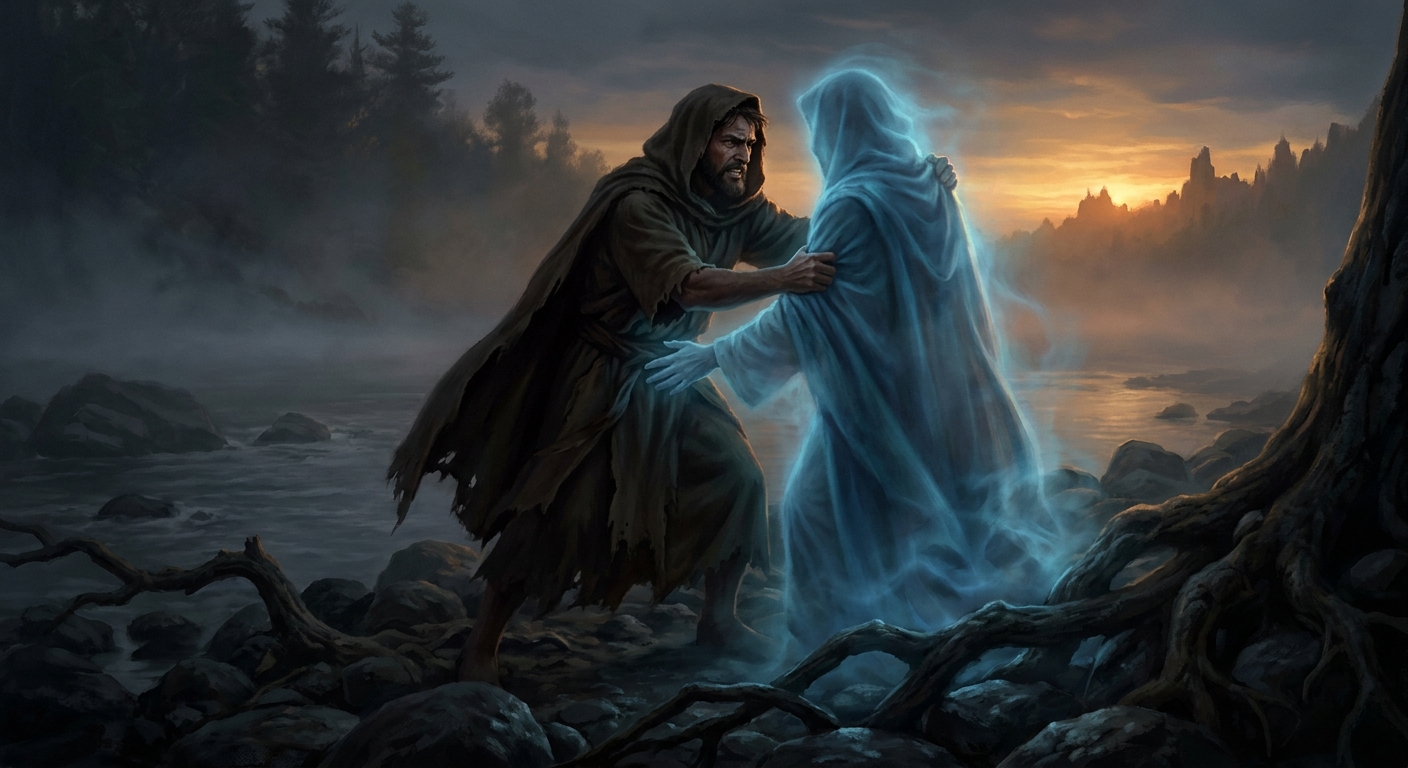
The river divides. The waters part to the right and to the left, and the riverbed lies bare in front of them, mud and stones and a dry path through. The fifty prophets watching from a distance see it and do not move. The two men walk across.
On the far bank Elijah turns to Elisha.
“Ask what I shall do for thee, before I be taken away from thee.”
“I pray thee, let a double portion of thy spirit be upon me.”
It is the firstborn’s share, in Hebrew law. The eldest son inherits twice what each younger son receives. Elisha is asking to be Elijah’s heir — not just a successor, not just a student carrying the master’s voice, but the eldest of the prophets, the one with twice the weight.
Elijah pauses.
“Thou hast asked a hard thing,” he says. “Nevertheless, if thou see me when I am taken from thee, it shall be so unto thee — but if not, it shall not be so.”
The condition is sight. The boy must watch the master leave. He must not turn his face. He must not flinch. He must keep his eyes on what is happening even when what is happening is not meant for human eyes. The Hebrew Bible is full of moments where seeing is forbidden — Lot’s wife, Moses on the cliff — but here, once, sight is the entire test. The double portion is paid for in the willingness to look.
They walk on, talking, the way old friends walk and talk at the end of a long day.
It comes apart in the air ahead of them.
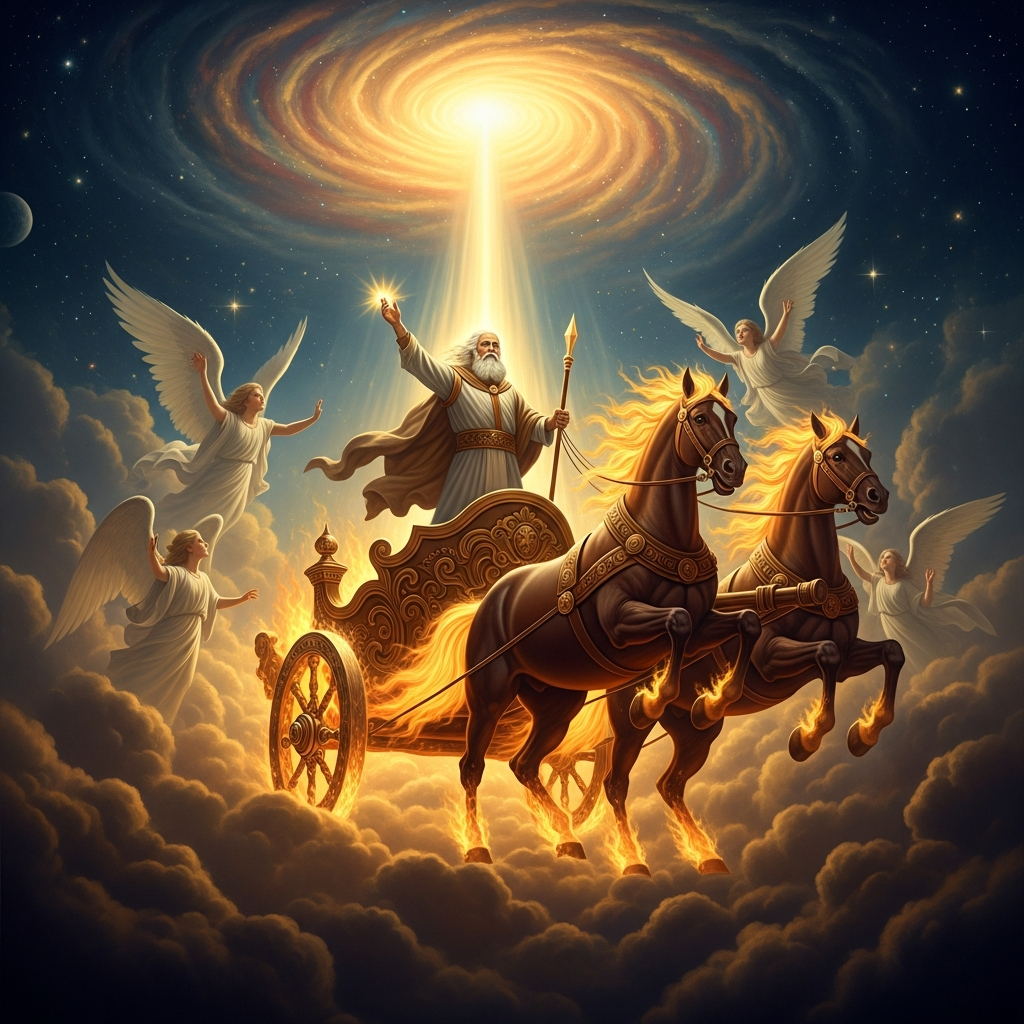
“And it came to pass, as they still went on, and talked, that, behold, there appeared a chariot of fire, and horses of fire, and parted them both asunder.”
The horses are not metaphor. The chariot is not metaphor. The text is precise — rekev esh, susei esh, chariot of fire and horses of fire. Something descends through the dry afternoon air on the eastern bank of the Jordan, real enough to drive the two men apart, bright enough to be seen by every prophet still standing on the western bank a half-mile back.
A whirlwind catches Elijah up. Not a gentle ascension — bə-sə’ārâ, a storm-wind, a tornado-pillar, the same word used for the wind out of which God will later answer Job. The cloak is torn from his shoulders by the force of it. He goes up.
Elisha keeps his eyes open. He keeps his eyes open the whole time.
He cries out — the first words that come, the words a son cries when his father is dying — “My father, my father! The chariot of Israel, and the horsemen thereof!”
Then the air closes. The chariot is gone. The whirlwind is gone. Elijah is gone.
The cloak falls.
It floats down through the afternoon sun and lands at Elisha’s feet, the rough hair-mantle the boy has watched the master wear for fifteen years. Elisha picks it up. He tears his own clothes in two — the gesture of mourning a dead father — and puts on Elijah’s cloak in their place.
He walks back to the Jordan alone. The river is in flood again, the path closed.
He stands at the bank and strikes the water with the cloak the way Elijah did an hour earlier. “Where is the Lord God of Elijah?”
The river divides. The waters part to the right and to the left. He crosses dry-shod.
The fifty prophets watching from the western bank see it, and they bow themselves to the ground before him, and they say: “The spirit of Elijah doth rest on Elisha.” They send fifty strong men to search the mountains for three days, in case the whirlwind set the master down somewhere — they do not yet trust that he is gone in the way he is gone. The men come back having found nothing.
Elisha begins his ministry that afternoon. He will heal the spring at Jericho before sundown. He will inherit the staff and the office and the work. He has the double portion. He has paid for it with his eyes.
Elijah does not die. The Hebrew Bible names two who do not — Enoch in Genesis, and Elijah here — and the rabbinic tradition is unanimous that this means he can come back. Malachi closes the prophets with the promise: behold, I will send you Elijah the prophet before the coming of the great and dreadful day of the Lord. Every Passover seder, for two and a half thousand years, sets a fourth cup for Elijah, opens the door for him at the appointed moment, and waits.
The Christian gospels make him appear at the Transfiguration, on the mountain with Moses, talking with Jesus about what comes next. The Muslim tradition keeps him as al-Khidr or Ilyas, the green prophet who walks the earth still. The Mormons claim he visited a Kirtland temple in 1836. Every tradition that knows the story leaves a place for him.
Because Elijah went up alive, the door he went through has never been closed. The chariot is still descending in the imagination of the people who remember it. The prophecy of his return is the longest unfulfilled promise in the Hebrew Bible — and the most patiently kept.
The cloak fell. Someone picked it up. That is the shape of every spiritual succession since.
Echoes Across Traditions
Entities
- Elijah
- Elisha
- the chariot of fire
- the Jordan
Sources
- *2 Kings* 2:1-15 (Hebrew Bible / Tanakh)
- Robert Alter (trans.), *The Hebrew Bible* (2018)
- Mordechai Cogan & Hayim Tadmor, *II Kings* (Anchor Bible, 1988)
- *Malachi* 4:5-6 — the prophecy of Elijah's return