Elijah on Mount Carmel
~870 BCE · 1 Kings composed ~6th century BCE · Mount Carmel, then the cave at Horeb
Contents
Three years of drought, four hundred and fifty prophets of Baal, two altars soaked in blood and water — and then a fire that eats stone. Then, after all of it, a still small voice in a cave.
- When
- ~870 BCE · 1 Kings composed ~6th century BCE
- Where
- Mount Carmel, then the cave at Horeb
The drought has lasted three years.
Not a dry season. Not a lean harvest. Three years of closed sky, cracked earth, livestock bones along the roads of Israel. Ahab is king — weak, ambitious, married to Jezebel of Sidon, who has brought her four hundred and fifty prophets of Baal and her four hundred prophets of Asherah into the royal court and installed them at the queen’s own table. The old altars of YHWH have been torn down. His prophets are hiding in caves, a hundred at a time, kept alive on bread and water by a court official named Obadiah who fears God more than he fears the queen.
Then Elijah comes out of hiding.
He walks into Ahab’s sight on the road, and the king, who has been searching three years for this man to blame, sees him first and calls him a troubler of Israel. Elijah does not flinch. You are the troubler of Israel, he says, you and your father’s house, because you have forsaken the commandments of YHWH and followed the Baals. Then he makes the offer: bring every prophet of Baal to Mount Carmel. Bring the people. We will settle this.
Ahab does it. He gathers Israel and four hundred and fifty prophets and he brings them all to the ridge above the sea.
Elijah stands alone on one side. Four hundred and fifty on the other.
He lays out the terms simply. Two bulls. Two altars. No fire. Each side calls on its god, and the god who answers by fire — he is God.
The prophets of Baal go first. They build their altar. They lay the bull on the wood. They begin to call on the name of Baal from morning until noon. They cry. They dance in their ritual limping circle around the altar. Nothing happens. No voice. No fire. No answer.
At noon Elijah begins to mock them.
Call louder, he says. Perhaps he is musing, or relieving himself, or away on a journey. Perhaps he is asleep and needs to be woken.
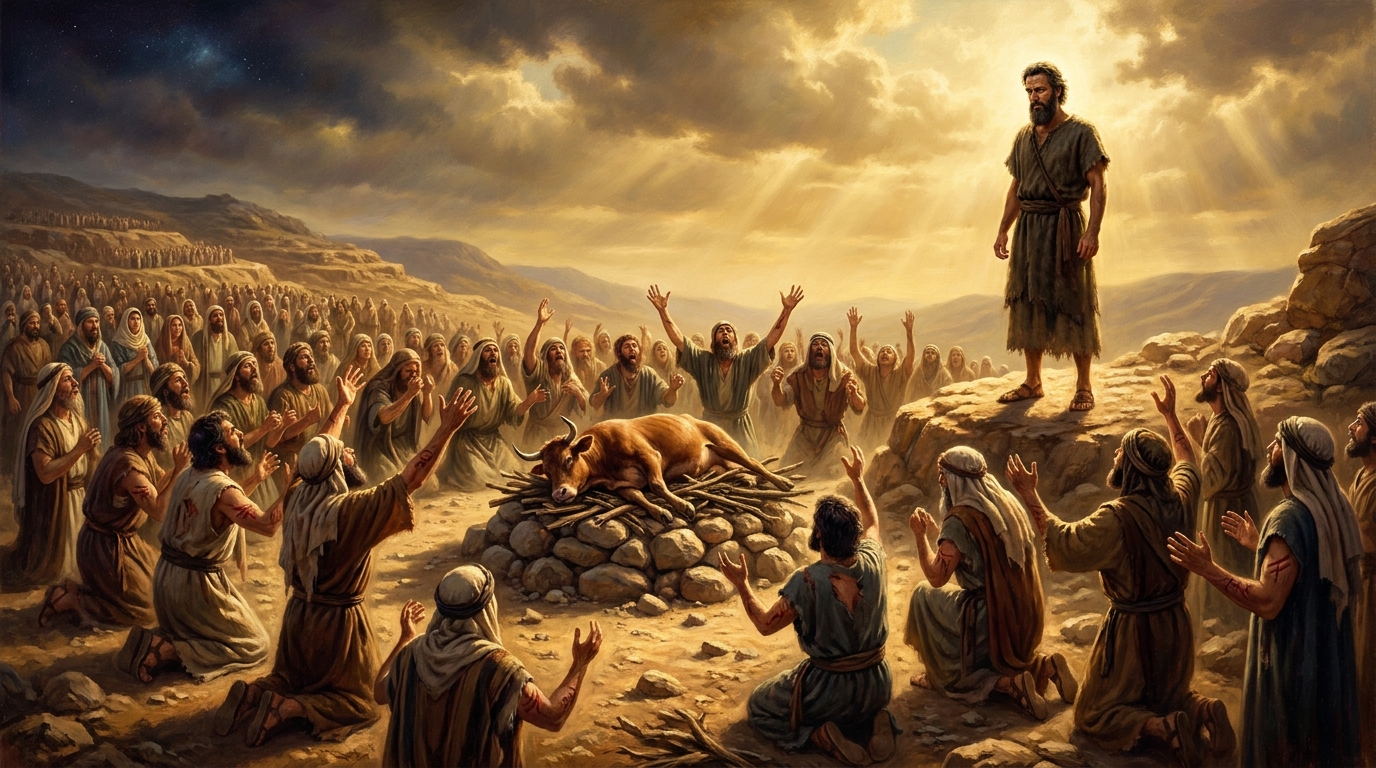
The prophets cry louder. They cut themselves with swords and spears, as their custom is, until the blood runs down. This is the full register of their devotion — noise, pain, blood, hours of it. The afternoon wears on. They rave. They prophesy. They do everything a god could require of his servants.
There is no voice. No one answers. No one is listening.
At the hour of the evening offering, Elijah says: Come near to me.
The people come near. He repairs the broken altar of YHWH — twelve stones, one for each of the twelve tribes. He digs a trench around it large enough to hold two seahs of seed. He lays the wood. He cuts the bull and places it on the wood.
Then he says: Fill four water jars and pour it on the offering and on the wood.
They pour. He says: Do it a second time. They pour again. He says: Do it a third time. They pour a third time. The water runs down and fills the trench. The altar is soaked. The wood is soaked. The bull on top of it is dripping.
This is not theater. This is testimony. If fire comes now, there will be no question of torch or ember or accident. There will be no possible explanation that does not include God.
Elijah steps up to the altar and prays. He does not dance. He does not cut himself. He uses forty words.
YHWH, God of Abraham, of Isaac, and of Israel, let it be known today that you are God in Israel, and that I am your servant, and that I have done all these things at your word. Answer me, YHWH, answer me, that this people may know that you, YHWH, are God, and that you are turning their hearts back.
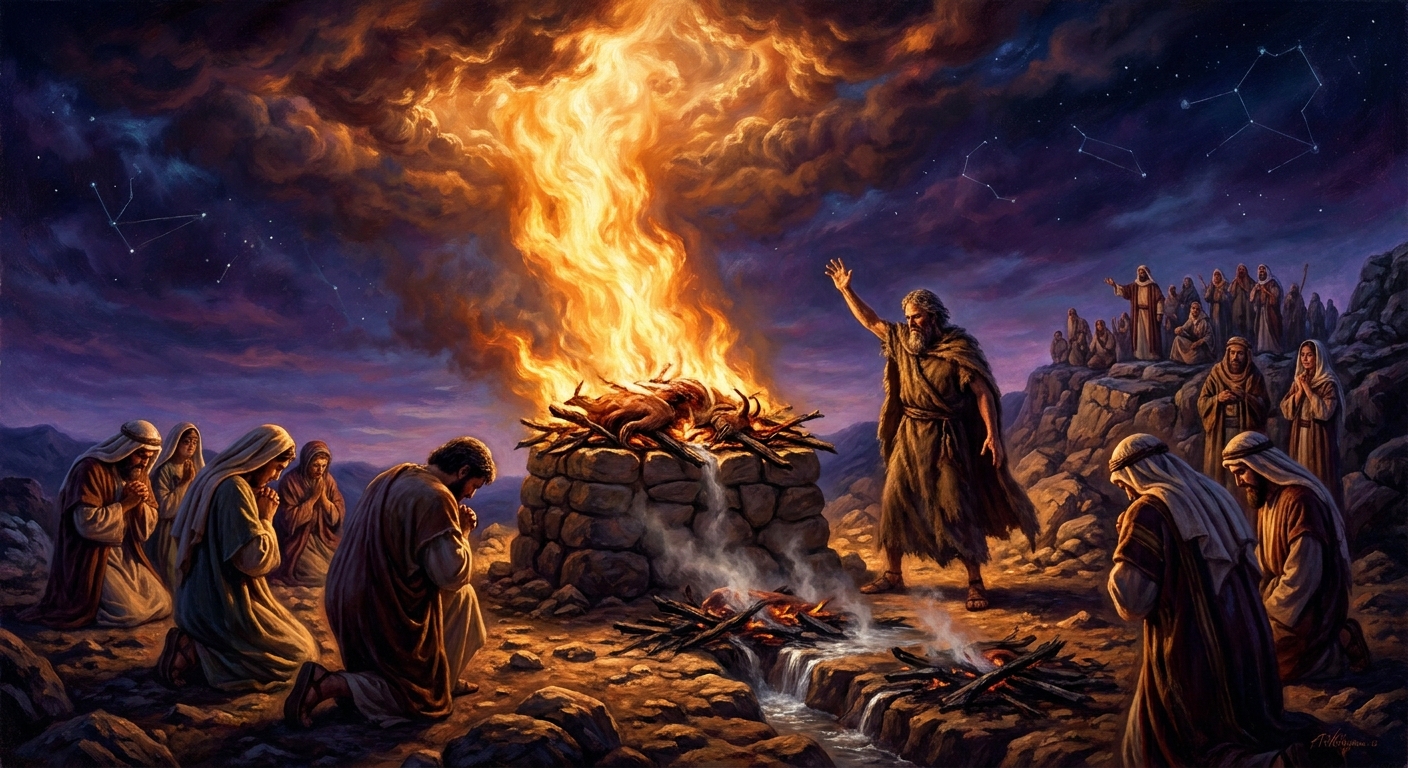
Fire falls from heaven.
It consumes the offering. It consumes the wood. It consumes the stones. It consumes the dust. It licks up the water in the trench.
The people see it and fall on their faces. YHWH, he is God, they cry. YHWH, he is God.
Elijah does not celebrate. He says: Seize the prophets of Baal. Let none of them escape. They are seized. He brings them to the Kishon valley and kills them there — all four hundred and fifty.
Then he tells Ahab to eat and drink, because there is the sound of a heavy rain. He climbs to the top of Carmel and puts his face between his knees. He sends his servant to look toward the sea seven times. Six times the servant comes back: nothing. The seventh time: a cloud, small as a man’s hand, rising from the sea. Elijah sends word: get your chariot down before the rain stops you.
The sky goes black with clouds. The wind rises. The rain falls. The drought is over.
Elijah’s hand is on him — the spirit of YHWH — and he girds his loins and runs before Ahab’s chariot the entire distance to Jezreel. Seventeen miles. A man on foot outrunning horses in a rainstorm.
Then Jezebel hears what he has done to her prophets, and she sends a messenger: May the gods do so to me and more also, if I do not make your life like the life of one of them by this time tomorrow.
And Elijah, who just called fire from heaven, runs.
He goes south through Judah, leaves his servant in Beersheba, walks another day into the wilderness alone, sits down under a broom tree, and asks to die. It is enough, he says. Now, O YHWH, take my life, for I am no better than my fathers.
He lies down and sleeps. An angel touches him and says: arise and eat. He looks up and finds a cake baked on hot coals and a jar of water. He eats, drinks, lies down again. The angel touches him a second time. Arise and eat, for the journey is too great for you.
He eats. He gets up. He walks forty days and forty nights to Horeb — the mountain of God, the mountain of Moses, the mountain where the covenant was first given. He finds a cave and spends the night there.
A word comes to him in the cave. What are you doing here, Elijah?
He says: I have been very jealous for YHWH, the God of hosts. For the people of Israel have forsaken your covenant, thrown down your altars, and killed your prophets with the sword. I alone am left, and they seek my life.
The word says: Go out and stand on the mountain before YHWH.
YHWH passes by.
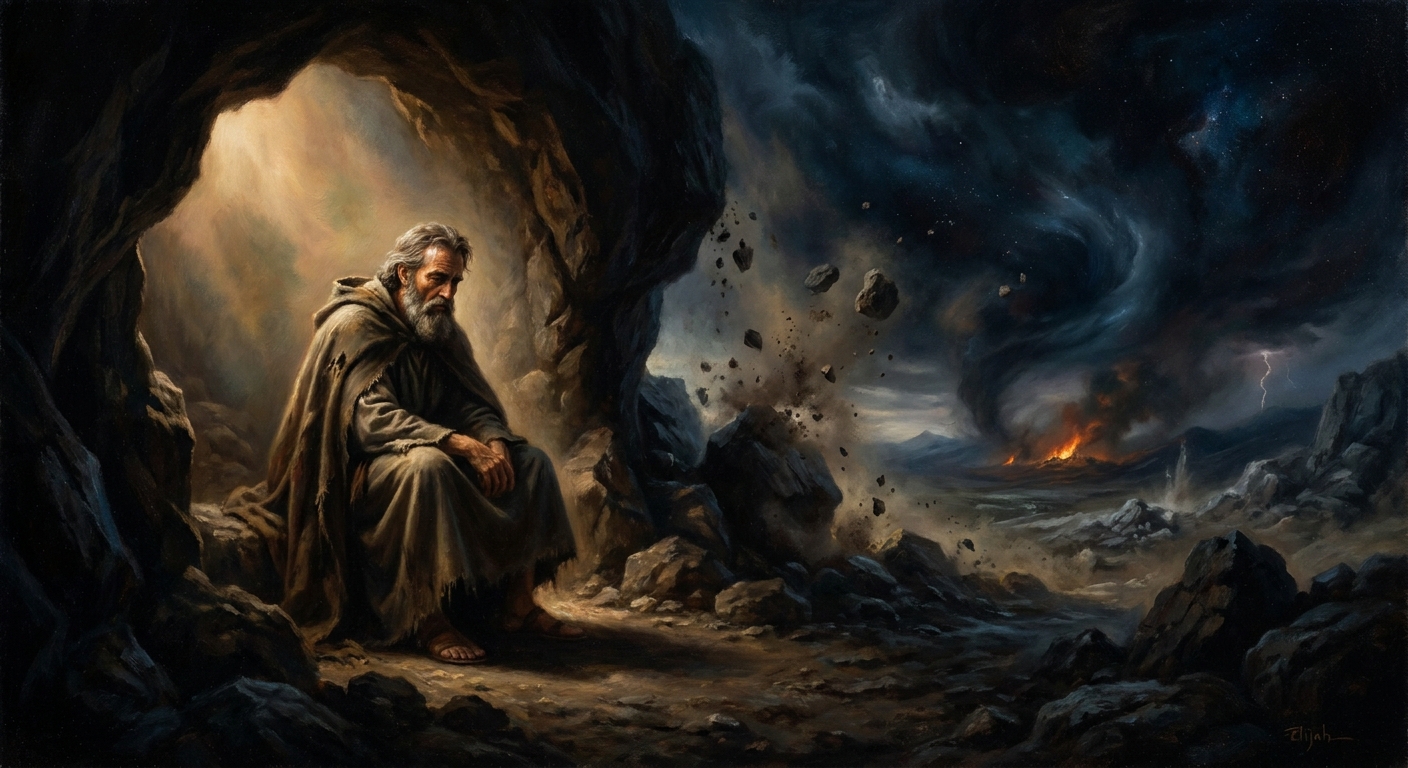
A great wind, strong enough to split mountains and shatter rock, comes before him. YHWH is not in the wind. After the wind, an earthquake. YHWH is not in the earthquake. After the earthquake, a fire. YHWH is not in the fire.
After the fire: a still small voice.
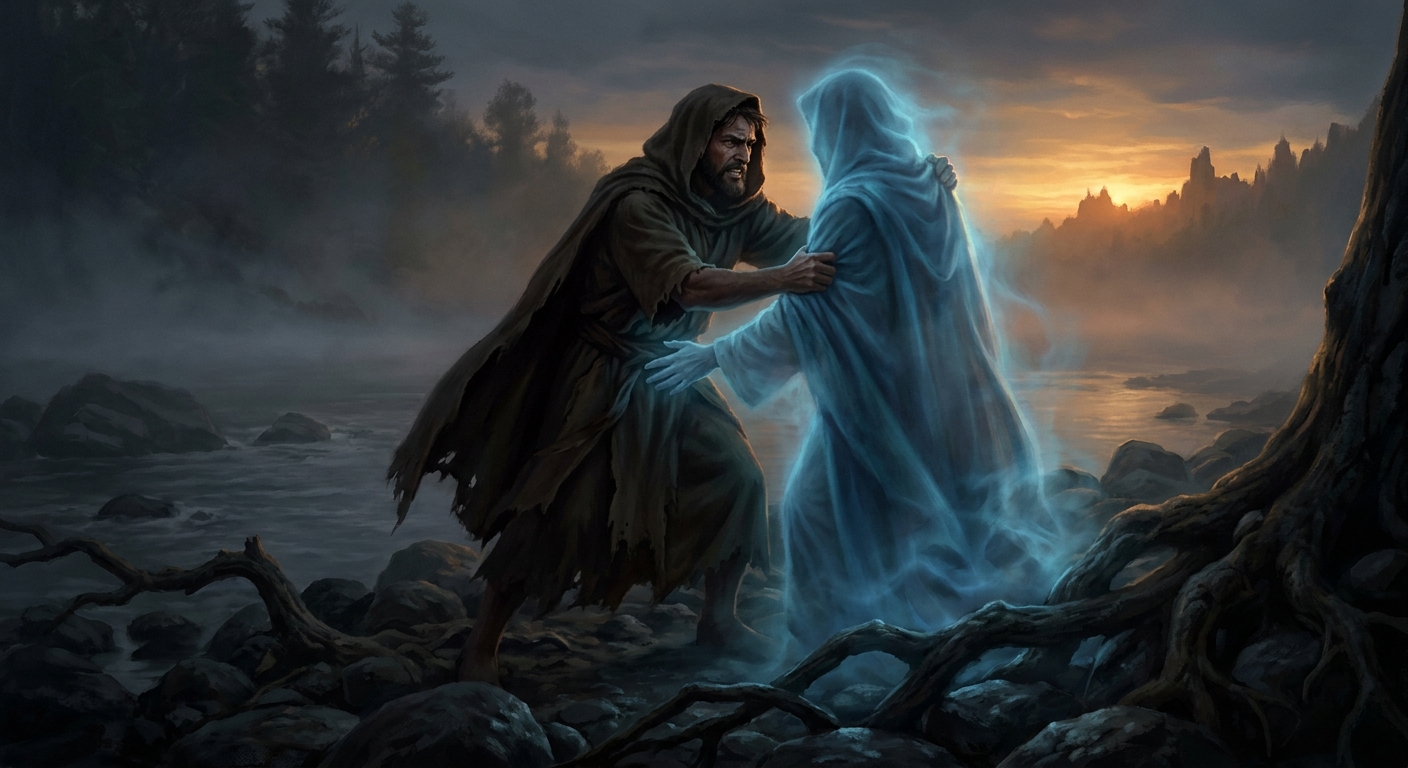
When Elijah hears it, he wraps his face in his mantle and goes out and stands at the mouth of the cave.
The voice asks again: What are you doing here, Elijah?
He gives the same answer. He has prepared no new speech. He is out of fire and out of courage and he says the only thing that is true: I alone am left, and they seek my life.
The voice gives him three assignments. Go back. Anoint a new king over Aram. Anoint a new king over Israel. Anoint Elisha son of Shaphat to be prophet in your place. And this: I will leave seven thousand in Israel, all the knees that have not bowed to Baal, all the lips that have not kissed him.
He is not alone. He never was. The seven thousand are invisible, hidden in houses and caves and fields, unnamed, uncelebrated, still faithful — and God knows exactly where each one of them is.
Elijah goes back. He finds Elisha plowing with twelve yoke of oxen. He throws his mantle over him. The succession has begun.
The fire on the altar proves that YHWH acts in history. The still small voice proves that he is not imprisoned by the spectacular. This is the double claim the story makes and refuses to let either side escape: the God who answers by fire is the same God who speaks in silence. The prophet who outran a chariot is the same man who asked to die under a broom tree.
Every tradition that has grappled with divine hiddenness lives inside this tension. The fire is real. The silence is realer. Elijah at the mouth of the cave — face wrapped in his mantle, emptied of every argument — is the image the text gives us of what it looks like when a human being finally stops performing and starts listening.
The journey, the angel says, is too great for you. It always is. That is not a reason to stop. That is the condition of the road.
Scenes
Elijah kneels at the rebuilt altar on Mount Carmel as fire falls from heaven, consuming the bull, the wood, the water in the trenches, and the stones themselves — the moment Israel stops dividing its allegiance
Generating art… The four hundred and fifty prophets of Baal cry and cut themselves from morning until the hour of the evening offering
 Generating art…
 Elijah wraps his face in his mantle and stands at the mouth of the cave at Horeb
 Generating art…
 Echoes Across Traditions
Entities
- Elijah
- Ahab
- Jezebel
- YHWH
- Elisha
Sources
- 1 Kings 18–19 (Robert Alter, trans., *The Hebrew Bible: The Prophets*, 2019)
- Mordecai Roshwald, *Elijah the Prophet* (1991)
- Joseph Blenkinsopp, *A History of Prophecy in Israel* (1996)