The Contest on Mount Carmel
~870 BCE · 1 Kings 18 composed ~6th century BCE · Mount Carmel, overlooking the Mediterranean; the Kishon valley below; Jezreel
Contents
The prophet Elijah challenges 450 prophets of Baal to a contest of fire on the ridge above the sea. They cry from dawn to noon. He mocks them. They cut themselves. Nothing answers. Then Elijah soaks his altar with twelve jars of water, prays forty words, and fire falls from heaven and eats the stones.
- When
- ~870 BCE · 1 Kings 18 composed ~6th century BCE
- Where
- Mount Carmel, overlooking the Mediterranean; the Kishon valley below; Jezreel
The drought has lasted three years.
Not a lean season. Not a bad harvest. Three years of sealed sky — no morning dew, no winter rains, no spring rains — so that the streams drying out of the Carmel ridge come down as ribbons of mud and then as cracks in the cracked earth, and Ahab the king of Israel has been searching the whole country for grass to keep his horses alive. This is what the prophet Elijah announced three years ago when he walked into the palace and said: As the Lord the God of Israel lives, before whom I stand, there shall be neither dew nor rain these years except by my word. Then he left.
He has been in hiding ever since. The ravens fed him. A widow in Zarephath kept him. He watched her oil-jar refill itself each morning and raised her son from the dead. He has been learning, for three years, that God provides in exactly the ways that cannot be anticipated.
Now the word comes: go out. Show yourself to Ahab. I will send rain.
On the road toward Jezreel, Elijah meets Obadiah.
Obadiah is the one honorable man in Ahab’s court — a man who fears God more than he fears the queen, and who has been hiding a hundred of YHWH’s prophets in caves and feeding them bread and water while Jezebel hunts them. The meeting is tense, because Obadiah knows what it costs to be associated with Elijah. He falls on his face. He says: Is it you, my lord Elijah?
It is. And Elijah tells him: tell Ahab I am here.
Obadiah protests. If he goes to Ahab and says this, and the spirit of God carries Elijah away somewhere else before Ahab arrives, Obadiah will be executed. He has worked too long and too carefully to die on a message. But Elijah swears: I will be here. And Obadiah goes.
Ahab arrives, and his first words are not a greeting but an accusation. Is this you, you troubler of Israel?
Elijah does not defend himself. I have not troubled Israel, he says. You have, and your father’s house — because you have forsaken the commandments of the Lord and followed the Baals. Then he makes the offer: gather Israel, and all the four hundred and fifty prophets of Baal, and the four hundred prophets of Asherah who eat at Jezebel’s table. Bring them all to Carmel. We will end this argument.
Ahab does it.
He can do it because he needs the rain more than he needs the argument. He gathers Israel. He gathers the prophets. He brings them all up to the ridge where Carmel juts above the coast and the Mediterranean is visible to the west and the valley of Jezreel to the east. The place has been sacred since before Israel came: high ground, sea air, the ridge the Canaanites always understood as the place where the storm god lived.
Elijah faces the assembly.
How long will you limp on two different opinions? he says. If the Lord is God, follow him. If Baal, then follow him.
The text records: The people did not answer him a word.
They know the question. They have been living the question. In Ahab’s Israel you can have YHWH and you can have Baal — the official theology of the unified monarchy always made room for the Canaanite weather deity whose name means lord and who sends the rain. The drought has not broken the compromise. It has just made everyone very quiet.
Elijah proposes the terms. Two bulls. Two altars. No fire. Each side calls on its god, and the god who answers by fire — he is God.
The people like this. It is clean. It is falsifiable. The prophets of Baal agree.
The prophets of Baal go first.
They choose their bull. They cut it and lay it on the wood. They call on the name of Baal from morning until noon. Baal, answer us! They cry it. They dance the ritual limping dance around the altar — the text uses the word passah, which will later become Pesach, Passover, but here means to limp or to leap, the ceremonial movement. They leap and cry from morning until noon.
Nothing happens.
At noon Elijah begins to mock them.
Call louder, he says. He is a god, after all. Perhaps he is meditating, or perhaps he has stepped aside to relieve himself. Perhaps he is on a journey. Perhaps he is asleep and must be wakened.
The mockery is so precise it is almost theological. He is listing the ways a powerful deity might be unavailable: distracted, traveling, sleeping. These are serious claims about the nature of Baal — he is the kind of deity who can be elsewhere, who can be busy, who can fail to notice. YHWH, by contrast, is the one who does not sleep or slumber, who is not localized, who cannot be out of reach.
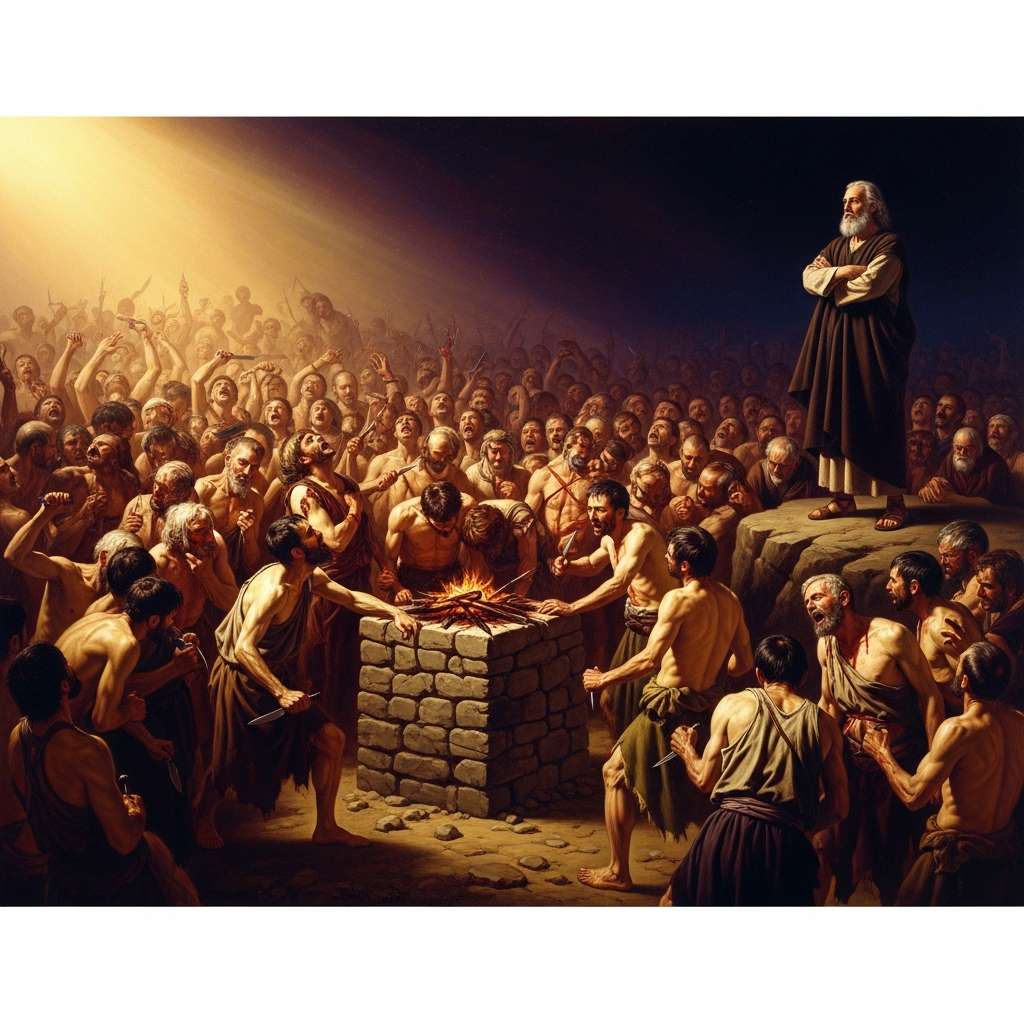
The prophets of Baal cry louder. They cut themselves with swords and lances, as their custom is, until the blood runs down them. This is not theater — it is their highest register of devotion, the proof that they have given everything. They rave. They prophesy in the afternoon, doing everything the cult has always required.
There is no voice. No one answers. No one is attending to them.
At the hour of the evening sacrifice — the same time the priests in Jerusalem were offering the daily lamb before the altar — Elijah calls the people near.
He rebuilds the broken altar of YHWH. It has been torn down — the previous generation’s altar, Jezebel’s work, the visible sign of what has happened to the old covenant. He takes twelve stones, one for each of the twelve tribes, the arithmetic of the nation as it was before the split. He builds the altar. He digs a trench around it wide enough to contain two seahs of seed.
He lays the wood. He cuts the bull. He places it on the wood.
Then he says: Fill four water jars and pour it on the offering and on the wood.
They pour. He says: Do it again. They pour again. He says: Do it a third time. Twelve jars of water total. The altar is soaked. The wood is soaked. The bull drips. The trench is full.
This is not ceremony. This is testimony. He is constructing the conditions under which the only possible explanation for fire is God. He is removing every alternative. He is standing in front of all Israel and the four hundred and fifty and the king himself, and he is making it impossible to claim accident or clever manipulation.
Then he steps up to the altar and prays. Forty words in the Hebrew. No dance. No self-laceration. No hours of repetition.
YHWH, God of Abraham, of Isaac, and of Israel — let it be known today that you are God in Israel, and that I am your servant, and that I have done all these things at your word. Answer me, YHWH, answer me, so this people may know that you, YHWH, are God, and that you are turning their hearts back.
Fire falls from heaven.
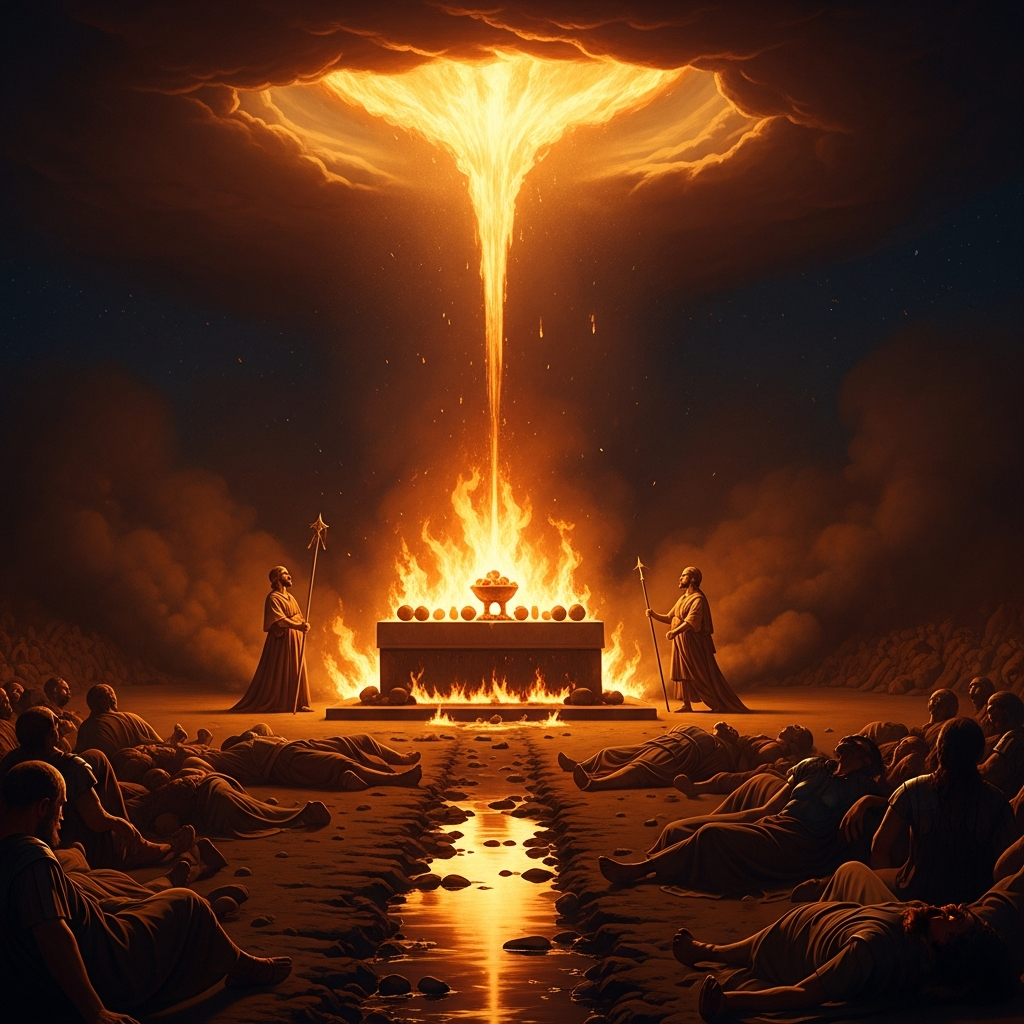
It consumes the offering. It consumes the wood. It consumes the twelve stones. It consumes the dust around the altar. It licks up the water in the trench.
The people see it. They fall on their faces. They cry: YHWH, he is God. YHWH, he is God.
Elijah says: Seize the prophets of Baal. Let none of them escape.
They are seized at the foot of Carmel. He brings them to the Kishon valley — the same valley where Deborah’s armies swept the Canaanite forces centuries before — and kills them all. All four hundred and fifty. The text does not pause for this. It does not comment on it. It moves immediately to the next scene.
Elijah tells Ahab: eat and drink. There is the sound of heavy rain coming.
He climbs to the top of Carmel. He puts his face between his knees — the posture of contraction, of withdrawal into prayer. He sends his servant to look toward the sea. Six times the servant comes back: nothing. The seventh time: a cloud rising from the sea, small as a man’s fist.
Go up, say to Ahab: Harness and go down, lest the rain stop you.
The sky goes black. The wind rises. The rain begins. The three-year drought ends in an afternoon.
Something comes upon Elijah — the text calls it the hand of YHWH — and he girds his loins and runs ahead of Ahab’s chariot all the way to Jezreel. Seventeen miles of mud and rain, the prophet outrunning horses.
Then Jezebel hears what happened to her prophets.
She sends a messenger to Elijah. The message is a death warrant with a deadline: May the gods do so to me and more also, if I do not make your life like the life of one of them by this time tomorrow.
One sentence from a queen who is not even there, and Elijah runs.
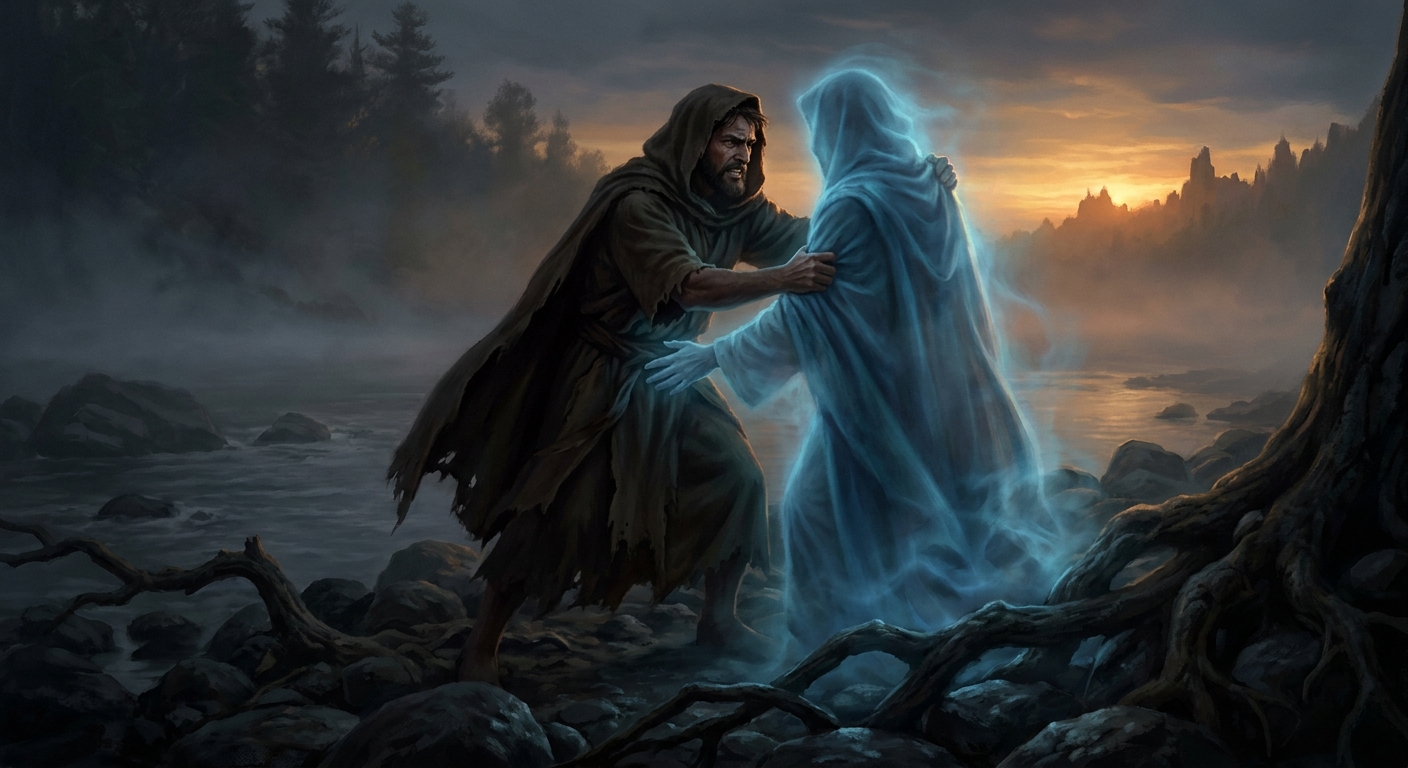
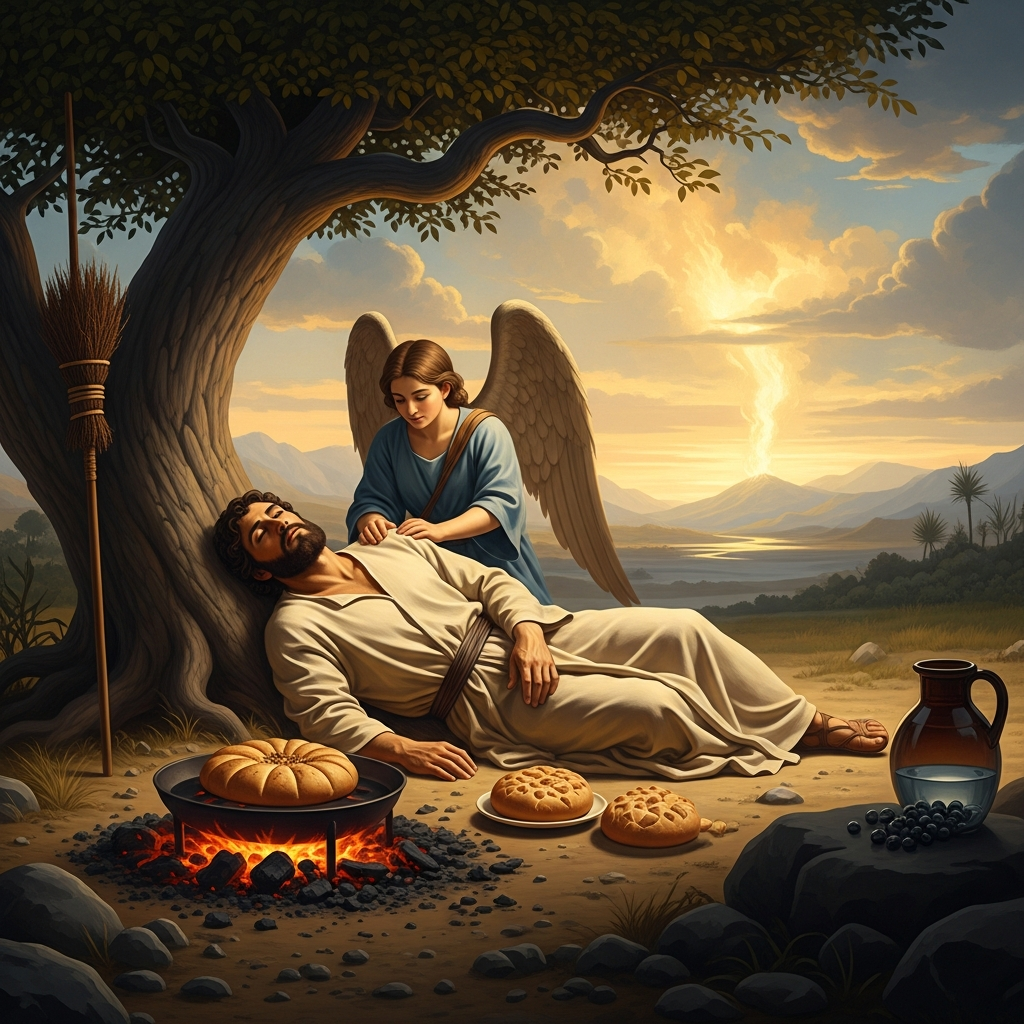
He runs south through Judah, deeper than any Israelite king’s reach, through Beersheba and then into the wilderness alone. He walks a day into the desert. He sits down under a broom tree — a low desert shrub, sparse shade, not even good shelter. He asks to die.
It is enough now, O Lord. Take away my life. I am no better than my fathers.
The man who called fire from heaven, who outran a chariot in a rainstorm, who killed four hundred and fifty prophets in a valley — he sits under a small tree in the desert and says: I cannot do this anymore.
He lies down and sleeps.
An angel touches him. Get up and eat. He looks up: a cake baked on hot coals. A jar of water. He eats. He drinks. He lies back down.
The angel comes a second time. Touches him again. Get up and eat. The journey is too great for you.
He eats, and on the strength of that food he walks forty days and forty nights to Horeb — the mountain of God, the mountain of Moses, the mountain of the covenant. He finds a cave and spends the night.
A word comes in the cave: What are you doing here, Elijah?
He gives his answer, and the answer contains the real story that was happening all along beneath the spectacle.
I have been very jealous for YHWH, the God of hosts. For the people of Israel have forsaken your covenant, thrown down your altars, and killed your prophets with the sword. I alone am left, and they seek my life.
He is alone. He has always been alone. The four hundred and fifty are dead and the four hundred are scattered and the prophets who were in caves are still in caves. The people on Mount Carmel cried YHWH is God and tomorrow they will go back to their divided loyalties. The fire proved nothing permanent.
God tells him to stand on the mountain.
A great wind comes — rock-shattering wind, the kind that tears mountains apart. God is not in the wind. An earthquake. God is not in the earthquake. A fire. God is not in the fire.
After the fire: a still small voice.
In Hebrew: qol demamah daqah — a voice of thin silence. The smallest possible sound. The anti-spectacle.
Elijah wraps his face in his mantle. He goes out and stands at the mouth of the cave.
The voice says: What are you doing here, Elijah?
He gives the same answer. He has not composed a new speech. The question God asked did not become easier because of the wind and the earthquake and the fire. He says the only thing that is true: I alone am left, and they seek my life.
God gives him three things to do. Anoint a new king over Aram. Anoint a new king over Israel. Anoint Elisha to be prophet in his place. And this, which is the gift disguised as information: I will leave seven thousand in Israel — all the knees that have not bowed to Baal, and every mouth that has not kissed him.
He is not alone. The seven thousand exist. They are hidden, unnamed, unspectacular, no fire calling attention to them — but they are there, and God knows every one of them.
Elijah goes back. He finds Elisha plowing with twelve yoke of oxen. He throws his mantle over him without a word. The succession begins.
The fire on Carmel proves that YHWH acts. The still small voice proves that YHWH is not trapped by the spectacular. The story refuses to let you hold either proof without the other.
Every generation of monotheism has the moment when the argument seems won — the fire falls, the crowd confesses, the numbers are undeniable. And every generation discovers what Elijah discovers under the broom tree: the argument won in public is not the same as the conviction settled in the cave. The four hundred and fifty are dead and Israel is still limp-dancing between two opinions.
The angel does not wake Elijah to triumph. The angel wakes him to walk. The journey is too great for you — this is not a warning or a reproach. It is the only honest statement of the human condition on the way to anything worth arriving at. Get up and eat. The road continues.
Seven thousand knees that did not bow. The hidden people, the ones who leave no fire or noise or spectacle behind them, who simply refused in the dark — they are the body of the covenant. Elijah will never meet most of them. They are his entire reason for surviving the broom tree.
Scenes
Fire drops from an open sky onto the soaked altar on Carmel — consuming the offering, the wood, the twelve stones, the dust, and all the water pooled in the trench around them
 Generating art…
 Four hundred and fifty prophets of Baal cry and dance and cut themselves from morning until noon, and Elijah stands apart watching, and no fire comes and no voice comes and nothing at all answers
 Generating art…
 Alone in the Judean wilderness, the prophet who just called fire from heaven lies under a broom tree and asks God to let him die
 Generating art…
 Echoes Across Traditions
Entities
- Elijah
- YHWH
- Baal
- Ahab
- Jezebel
Sources
- 1 Kings 18-19 (Robert Alter, trans., *The Hebrew Bible: The Prophets*, 2019)
- Joseph Blenkinsopp, *A History of Prophecy in Israel* (Westminster John Knox, 1996)
- Yair Zakovitch, *David: From Shepherd to Messiah* (1995) — on the poetics of biblical contest narratives
- Frank Cross, *Canaanite Myth and Hebrew Epic* (Harvard, 1973) — on the Baal-YHWH competition