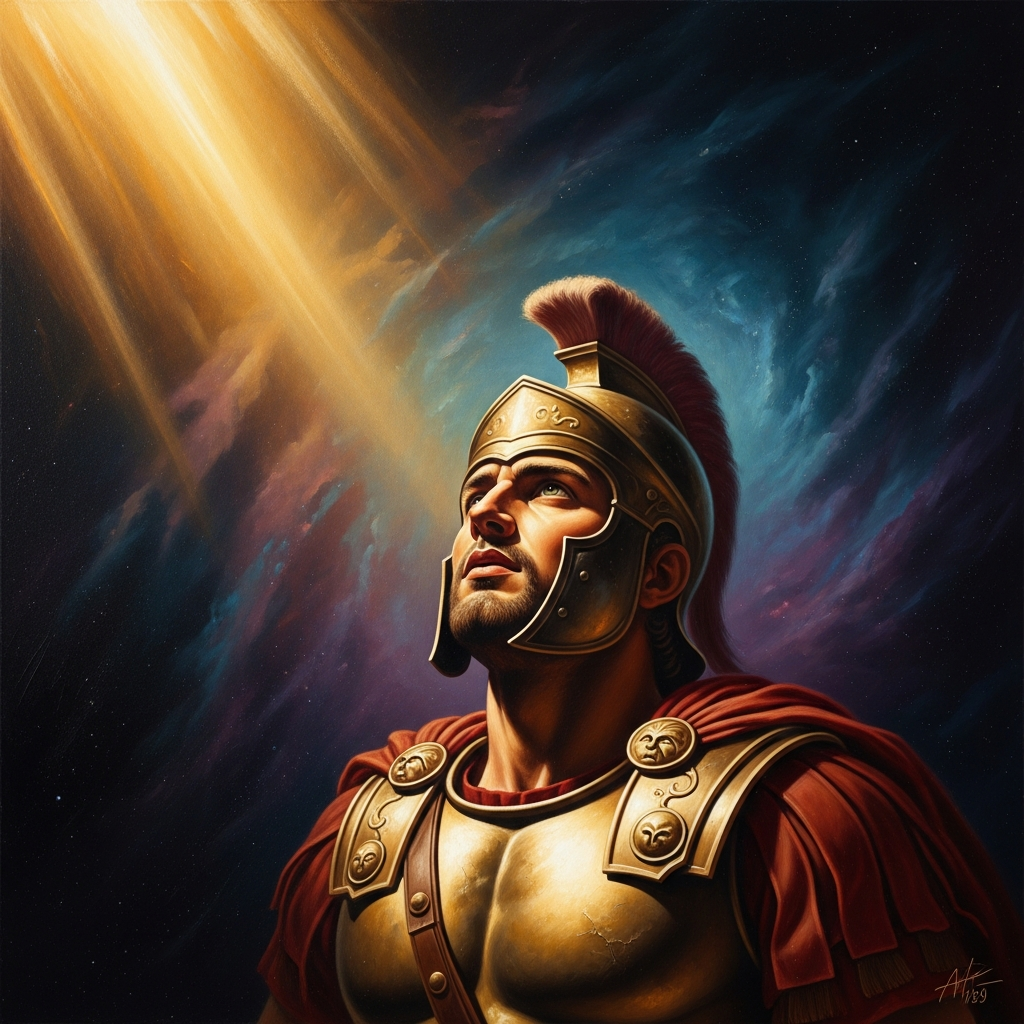
Aeneas Flees Troy
Mythic Time · traditional fall of Troy ~1183 BCE; Virgil composes the *Aeneid* 29-19 BCE · Troy in the Troad, the night the city falls — and the road south to the sea
Contents
Troy is burning. The Greeks are in the streets. A Trojan prince — son of Venus — straps his aged father across his shoulders, takes his small son by the hand, and walks out of the city. His wife is lost in the smoke. The gods give him a destiny he did not ask for: Italy, and the founding of Rome.
- When
- Mythic Time · traditional fall of Troy ~1183 BCE; Virgil composes the *Aeneid* 29-19 BCE
- Where
- Troy in the Troad, the night the city falls — and the road south to the sea
The horse has been inside the walls for three hours.
The Trojans are asleep. The wine has done its work. Sinon has opened the trapdoor in the wooden flank, and the Greeks have come out of the belly of the offering — Odysseus first, then Neoptolemus, then the rest, dropping silently onto the marble of the citadel and dispersing into the streets they have besieged for ten years and never entered.
Aeneas is in his father’s house when Hector comes to him in a dream.
Hector is dead. He has been dead for weeks. He stands at the foot of the bed in the form he had when Achilles dragged him three times around the walls — wounds, dust, the cord-marks at his ankles where the chariot rope was tied. His mouth opens. Flee, he says. Take the household gods. Found a city for them across the sea. Troy is finished.
Aeneas wakes. The roof of the city is already orange.
He runs to the rampart.
Below him, his city is being unmade. Houses he has known since childhood are collapsing inward. The temple of Apollo is full of women who will not be alive at dawn. He sees Priam at the altar in the palace — old, in armor he cannot lift, the king of a kingdom that no longer exists — and he watches Neoptolemus drag the king by the hair and put a sword through him at his own household shrine.
That is the moment Aeneas understands.
There is no defense to mount. There is no last stand to make worth making. Hector was right; the dream was true. He turns from the rampart and runs — not toward the fighting, but toward his father’s house, the household gods, the small son asleep upstairs, the wife in the bedchamber. The world he can still save is the one in his own walls, and only for as long as it takes him to get them out.
Anchises will not leave.
He is old. He is half-paralyzed. He sits on the edge of his bed and tells his son to go without him — I am finished, I lived through one Trojan war, I will not survive a second, leave me to be killed in my own house like a man. Aeneas argues. Creusa argues. The boy Iulus stands in the doorway not understanding why no one has picked him up.
Then the sky speaks.
A pure flame, no smoke, settles on Iulus’s hair without burning him. A star falls from the ceiling. Anchises, who has lived long enough to know an omen when one is delivered to his own bedroom, looks at his grandson with the fire on his head and stops arguing. Take me, he says. Whichever way the gods want.
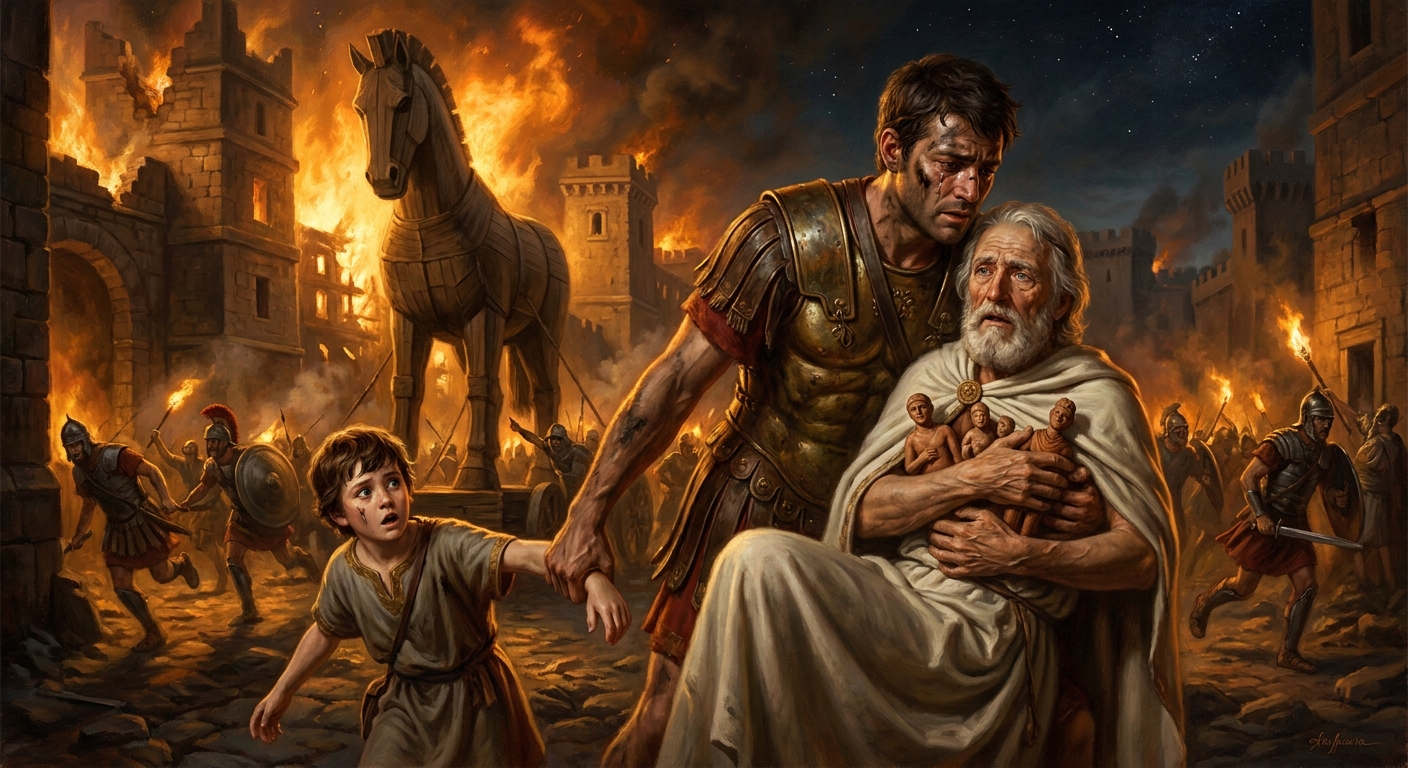
Aeneas kneels. Anchises climbs onto his back the way an old man climbs onto a horse he no longer trusts. Aeneas hooks his arms under his father’s knees. He picks up the household gods — small, heavy, irreplaceable — and hands them to Anchises to carry. He takes Iulus’s hand. He looks at Creusa.
Walk behind me, he says. Do not lose sight of my back.
He walks.
Through the side streets. Around the burning quarters. Past the bodies in the doorways of houses he ate dinner in last week. Anchises is heavy. Iulus’s legs are short, and Aeneas has to slow for him every few yards. The household gods on his father’s lap clack against each other in the rhythm of his stride.
Behind him — he hears it, then he does not hear it — Creusa’s footsteps.
He does not turn. He cannot turn. He has Anchises balanced on the curve of his shoulders and Iulus’s small hand crushed in his and the breath in his lungs that he is parceling out to keep them moving, and to look back is to break the line of the body that is holding three generations on its frame. He listens for her footsteps. He counts. He keeps moving.
He reaches the agreed meeting place outside the gate.
He turns to her. She is not there.
He goes back into the city.
He leaves Anchises and Iulus with the household gods at the rendezvous and runs back through the streets calling her name. Creusa! Creusa! He passes the same corpses going the other direction. He reaches their house. The roof is gone. The bedroom is open to the sky. He calls her name in the rooms of his own life and his own voice answers him out of the smoke.
Then she appears.
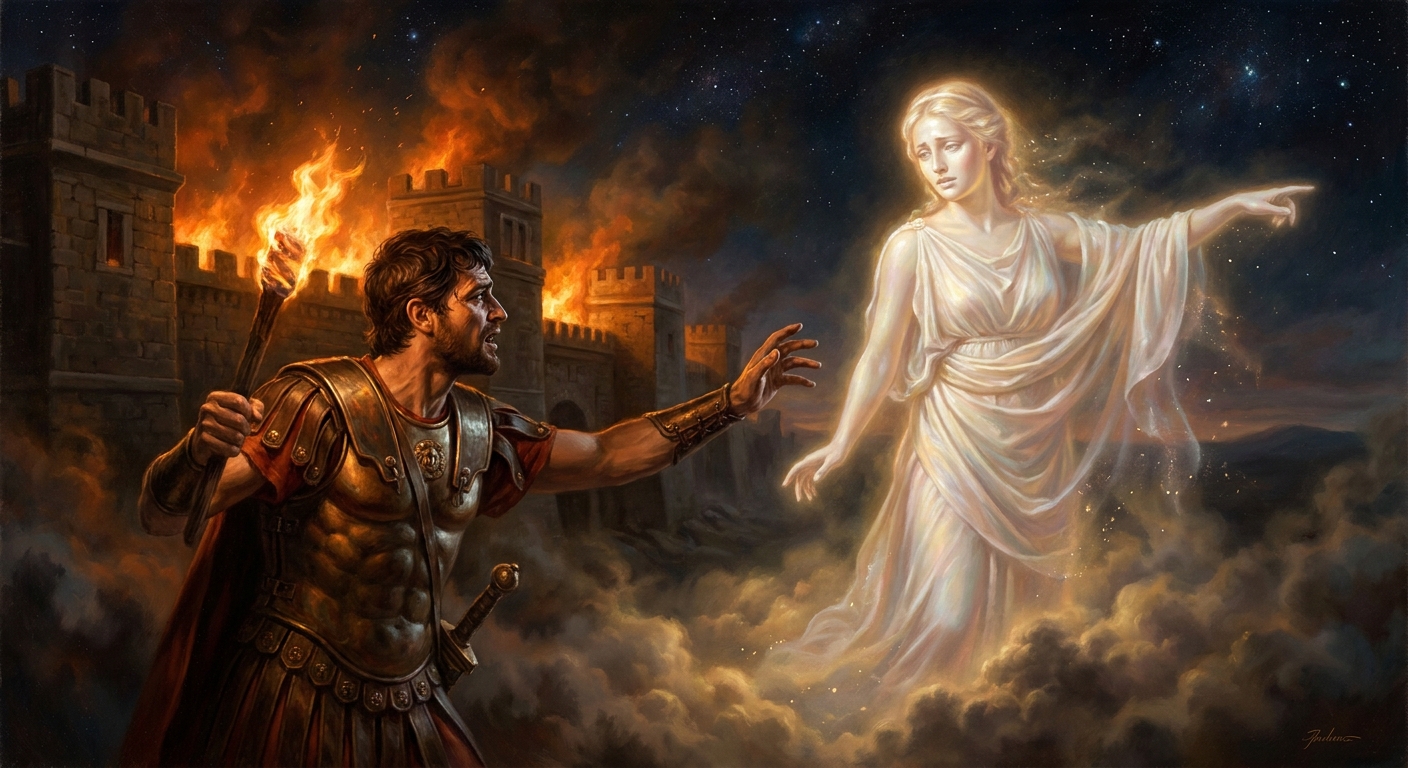
Not as flesh. As a shade — taller than she was in life, the way the dead are taller, her face calm in a way it never was when he was arguing with her. My husband, she says. Stop. The gods are not letting me come. There is a kingdom waiting for you in the West — Hesperia, where the Tiber runs. A new bride. A new throne. Carry our boy. Forget me.
He reaches for her. His arms close on smoke.
She is gone three times — three times he tries to hold her, three times she dissolves like a breath in cold air — and then she is gone permanently, and Aeneas is standing in the wreckage of his bedroom with no wife, a city dying around him, and a destiny he never asked for waiting in a country he has never seen.
He walks back to his father.
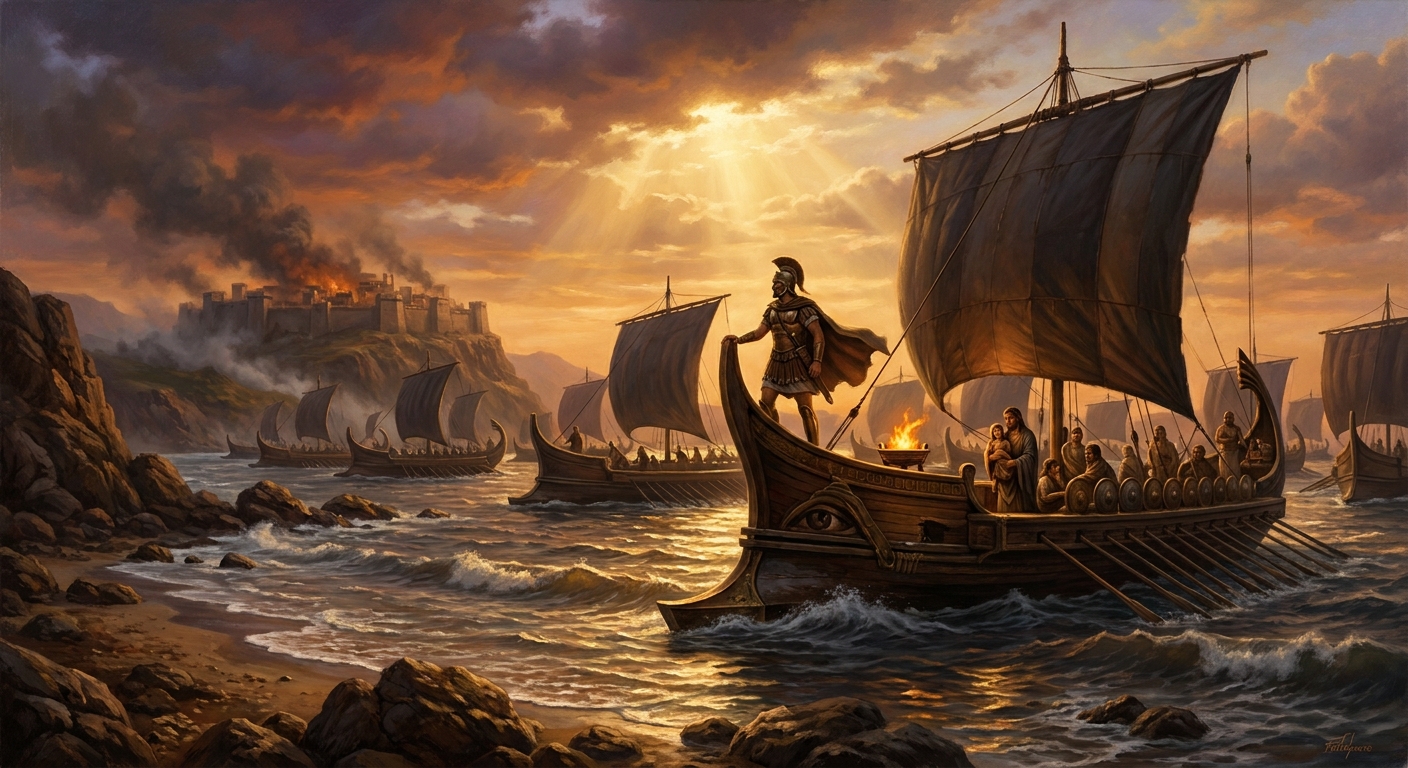
The road out of Troy is full of refugees by dawn — the survivors who have made it through the night gathering by the city wall, looking up the slope at what used to be home. Aeneas takes Anchises up onto his shoulders again. He takes Iulus’s hand again. The household gods are still in his father’s lap.
The mountain trail south leads toward the coast where the Greeks have not yet come. He starts to walk. The others fall in behind him because someone has to be in front, and pius Aeneas — the man who took his father out of the fire and his son to a future and listened to a ghost give him an address — is the one whose back they can see.
Behind him, Troy burns down to its foundations. Ahead of him, somewhere across the sea he has never crossed, lie Carthage, Sicily, the underworld of Cumae, the long war in Latium, a marriage with Lavinia, a son named after a city not yet built. He cannot see any of it.
He just walks.
Virgil wrote the Aeneid for Augustus’s Rome — a Rome that had just spent a century devouring itself in civil wars and needed a founding father whose virtue was not strength but pietas, not victory but bearing. Aeneas is what the Romans wanted to be when they were tired of being Achilles.
The image of him with Anchises on his shoulders, Iulus by the hand, the household gods in his father’s arms, became the central icon of Roman family piety. Bernini sculpted it. Renaissance painters returned to it. The figure compresses three generations into one body — the past hauled forward by the present, the future led by the hand — and asks the viewer the question Virgil asked Augustus: which one of these will you carry?
Abraham was called out of Ur. Moses was called out of Egypt. Aeneas is called out of Troy. The pattern is the same — the founder wrenched from the burning civilization, walking with his line and his god toward a country he has not seen — and the demand is the same: keep walking, do not look back, carry the ones who cannot carry themselves.
Creusa is the cost. Every flight has one.
Scenes
Aeneas lifts his aged father onto his shoulders, takes his son's hand, and walks into burning Troy
 Generating art…
 At the city gate: Creusa is gone
 Generating art…
 Twenty ships leave the Troad at dawn, carrying the gods of Troy toward an unknown shore
 Generating art…
 Echoes Across Traditions
Entities
- Aeneas
- Anchises
- Iulus (Ascanius)
- Creusa
- Venus
Sources
- Virgil, *Aeneid* II (29-19 BCE)
- Robert Fitzgerald (trans.), *The Aeneid* (1983)
- Robert Fagles (trans.), *The Aeneid* (2006)
- R.D. Williams, *The Aeneid of Virgil: A Commentary* (1972-1973)
- Sarah Ruden (trans.), *The Aeneid* (2008)