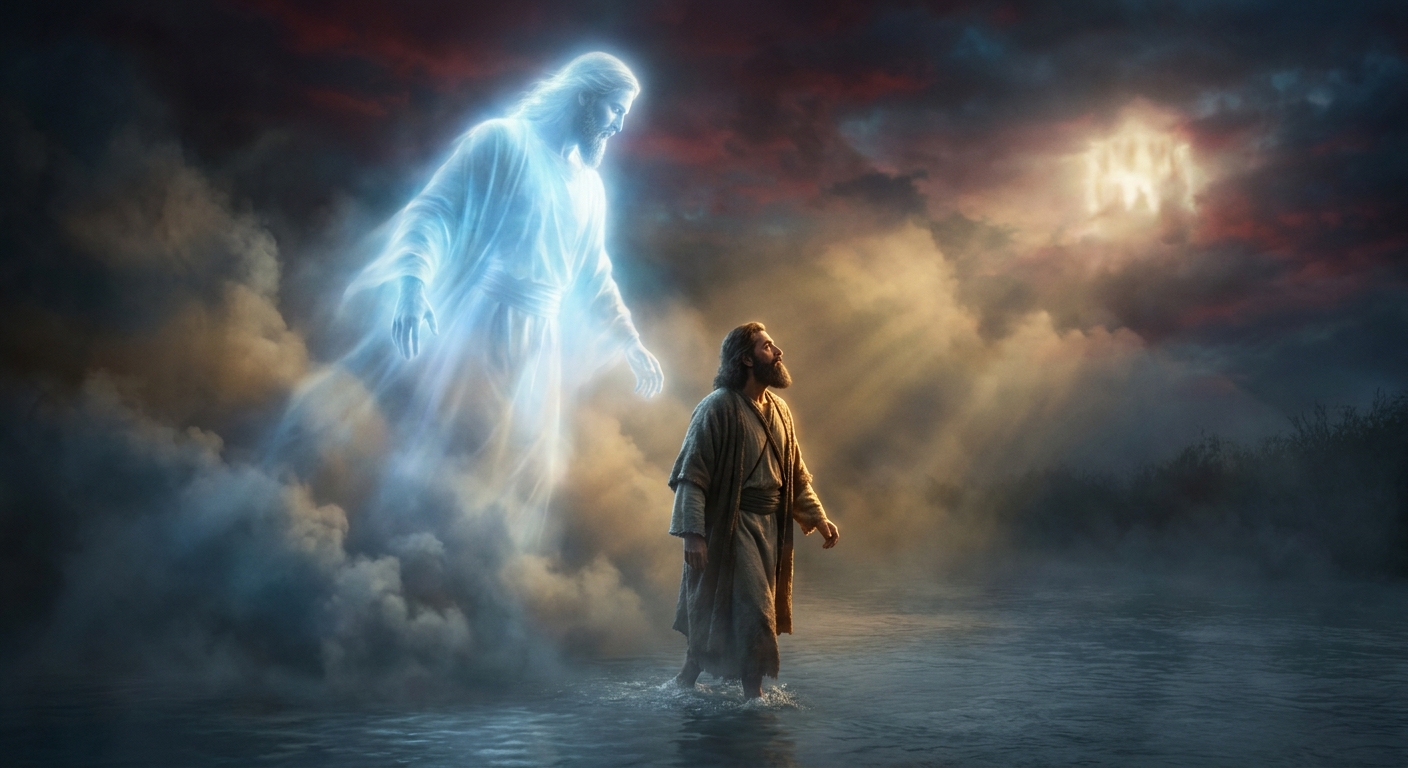
Zoroaster at the River
~1200 BCE · eastern Iran (debated 1500–600 BCE) · A river in eastern Iran
Contents
A priest walks to a river at dawn to draw water for a spring festival. He does not come back the same man. He comes back with a god, a devil, and the oldest ethical theology on earth.
- When
- ~1200 BCE · eastern Iran (debated 1500–600 BCE)
- Where
- A river in eastern Iran
He walks to the river before the sun clears the hills.
This is ordinary. He has done it every spring festival for as long as he has been a priest, which is most of his thirty years. Draw the water. Carry it back. Begin the ritual. The steppe is cold at this hour and the sky is the particular blue of places not yet touched by the day. His sandals leave prints in the mud at the bank. He wades in to his knees, lowers the vessel, and the river does what rivers do.
Then something is standing on the bank.
He does not hear it approach. It does not approach — it is simply there, the way a mountain is there when the fog clears, as though it has always been present and the world only now became able to hold it. Later, much later, when he is trying to give this thing a name, he will call it Vohu Manah: Good Mind. The first emanation of the Wise Lord, the nearest the divine comes to the human without burning it down.
It is nine times the size of a man. This is the tradition’s number, not poetry — the Gathas do not say it exactly but the later texts that remember him say it, and they are saying something true about the experience even if they are not saying something literal about the height. What stands on the bank is too large to be ordinary and too luminous to look at directly. He looks anyway.
Who are you? he asks.
He is a priest. He knows how to speak to the divine. He has done it in ritual a thousand times, with the proper words, at the proper distances, in the proper direction. This is not any of those things. This is something that does not need the ritual to be real.
Come, it says, or does not say — the distinction ceases to matter. Come and see.
He is led. Out of the river, through the riverbank, through something that is not space and not time but has the feeling of both, into a presence so large that the word presence fails immediately. The later texts call it Ahura Mazda: the Wise Lord. Uncreated. Self-existent. Wholly good — not good the way a king is good, or a father, or a generous man, but good the way light is light, the way fire is fire, constitutionally, without remainder, without the shadow of an opposite.
He understands, standing there, that this is the god his polytheist tradition did not know existed. Not one among the daeva — the shining ones, the gods of storm and fire and victory his people have been propitiating since before memory. Something else. Something prior. The source behind the sources, the light behind the lights.
He is thirty years old and the world cracks open like a riverbank in flood.
He sees the other thing too.
He does not want to see it. He does not seek it out. But the vision, once opened, shows him everything, and everything includes a shadow as original as the light. Angra Mainyu: the Destructive Spirit. Uncreated as the Wise Lord is uncreated, which is the piece of this that will haunt every theology that comes after. Not a fallen god. Not a subordinate. A genuine counter-principle — chaos against order, lie against truth, druj against asha. The cosmos is not a kingdom with a good king and occasional criminals. It is a war, and the war has always been happening, and it is happening now, and the river and the steppe and the sky and the thirty-year-old priest standing ankle-deep in the vision of it all are inside the war whether they chose to be or not.
The Wise Lord does not apologize for this. He explains it. You are a soul, he says, in the way the vision says things. Every soul chooses. Every choice feeds one side or the other. The war ends when enough souls choose truth.
It is not comfortable. It is the most honest cosmology anyone has ever been handed.
He comes back to the river. The vessel is still in his hand. He does not know if he was gone for a moment or for hours; the sun seems to have moved. The prints in the mud are where he left them. The steppe is the same steppe.
He is not the same priest.
Over the next years — decades — the hymns pour out of him. The Gathas, seventeen of them, composed in an archaic Avestan that his own contemporaries may have found old-fashioned, the way a prophet sometimes speaks in a register slightly outside his own time. They are not smooth. They are not liturgically polished. They sound like a man still shaking from what he saw, trying to build language capable of holding it.
“I will speak of the two primal Spirits,” he writes in Yasna 30. “The better and the evil, in thought, in word, in action. Between these two, the wise choose rightly.”
This is the sentence that changes everything. Not one spirit with a dark side. Two original spirits, equal in age, unequal in nature, and the human person — this is the innovation — genuinely free to choose between them. Free will and cosmic dualism in the same breath. Ethics given a metaphysical backbone. Good and evil made structural, not incidental.
He preaches. He is driven out of his first community. He finds a patron, King Vishtaspa, who hears the Gathas and converts. The religion spreads. It will outlive the steppe. It will become the theology of the largest empire the ancient world produces, the religion Cyrus the Great carries from Greece to the Indus, the framework that enters Jewish thought during the Babylonian exile and seeds the Second Temple with angels, demons, resurrection, judgment, and a savior still to come.
None of that happens yet. Right now, a man walks back from the river carrying a vessel of water and an entire new cosmology, and the spring festival is going to be late.
The world, he now understands, is a battlefield.
He understood this before, the way a person understands weather — something that happens around you, that you endure or enjoy. He understands it now the way a soldier understands a battle: you are in it, you are choosing a side with every action, and the side you choose matters beyond your own lifetime. The asha — truth, righteousness, cosmic order — is not automatic. It requires tending. Every honest word tends it. Every lie corrodes it. The fire on the altar is not a metaphor. It is a small victory in an old war.
He will spend the rest of his life saying this.
The Gathas survive. The empires built in their wake will not — the Achaemenids fall to Alexander, Alexander’s heirs fall to the Parthians, the Sassanids fall to Islam, the Sassanid Avestan archives burn at Persepolis before that — but the seventeen hymns, carried in the mouths of priests across thirty generations, make it through. Scholars who read them in the original Avestan hear something archaic and immediate at once, the voice of a man who has just seen something and cannot stop describing it.
He walked to a river. He drew water for a festival. He came back carrying the architecture of half the world’s theology, and he never fully explained what he saw on the bank, because some things exceed the vessel that tries to hold them.
The river is still there. Eastern Iran. The hills still clear before sunrise. The mud at the bank still takes a print.
The dualism he described — one wholly good God, one wholly evil counter-spirit, the cosmos as moral battlefield, the soul as the decisive front — enters Judaism through the Babylonian exile, Christianity through Second Temple theology, Islam as the background hum behind Iblis. The Final Judgment, the resurrection of the body, the world renewal at the end of time, the figure of the Saoshyant (savior) who will come at the last: all Zoroastrian first. The debt is almost never acknowledged. The architecture stands regardless.
Echoes Across Traditions
Entities
- Zoroaster
- Ahura Mazda
- Angra Mainyu
- Vohu Manah


Sources
- *Gathas* (Yasna 28–34, 43–51) — the seventeen surviving hymns attributed to Zarathustra, oldest religious poetry in any Indo-European language
- Mary Boyce, *Zoroastrians: Their Religious Beliefs and Practices* (1979)
- William W. Malandra (trans.), *An Introduction to Ancient Iranian Religion: Readings from the Avesta and the Achaemenid Inscriptions* (1983)
- *Avesta* — the surviving liturgical canon, compiled under the Sassanid dynasty from oral tradition after the Achaemenid originals burned at Persepolis (330 BCE)