Zarathushtra at the River
c. 1200 BCE (traditional dating; some scholars push to 1500-1000 BCE) · the spring festival of Hamaspathmaedaya · the bank of the Daitya river, in the steppe lands east of the Caspian (probably modern Uzbekistan or northeastern Iran)
Contents
A thirty-year-old priest wades into the Daitya river to draw water for the spring festival and walks back out carrying the world's first ethical monotheism.
- When
- c. 1200 BCE (traditional dating; some scholars push to 1500-1000 BCE) · the spring festival of Hamaspathmaedaya
- Where
- the bank of the Daitya river, in the steppe lands east of the Caspian (probably modern Uzbekistan or northeastern Iran)
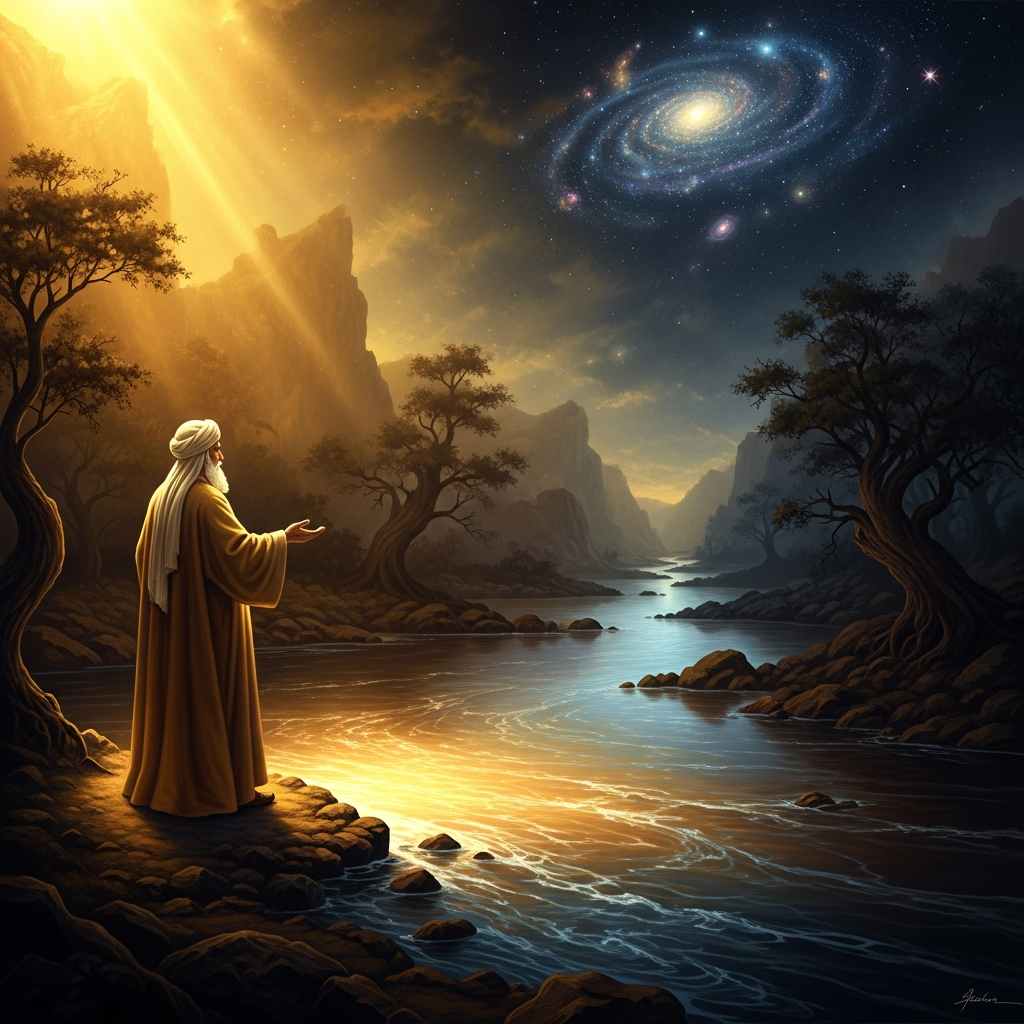
The river is high with snowmelt.
He is thirty years old, a priest of the old religion, the kind that sacrifices cattle to a hundred gods and pours soma to the daevas. His name is Zarathushtra Spitama. He has been troubled for years — the cattle-raids, the warlords, the daevas who demand blood and give nothing back, the priests who lie for a fee. He has walked out alone before dawn on the festival of Hamaspathmaedaya to draw the ritual water. The Daitya is cold enough to numb a man’s legs to the hip. He wades in to the middle of the channel.
He bends. He fills the vessel.
He turns to walk back to shore, and the shore is no longer where it was.
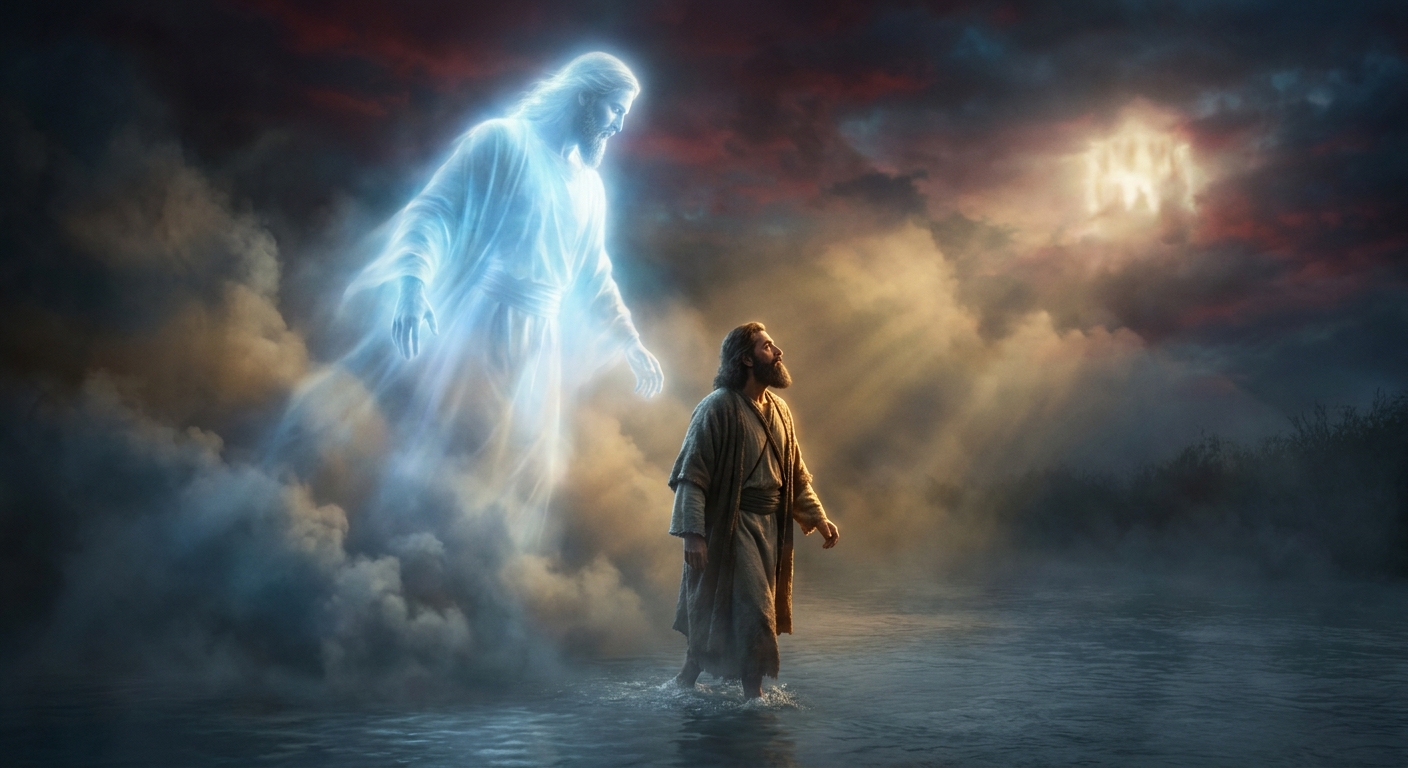
A figure stands on the bank.
It is taller than any man — nine times the height of a man, the Zand will later say, though the Gathas Zarathushtra himself composes only call it radiant. It is the color of morning. Its eyes do not catch the light; they make it. It does not speak in a language he has heard before, but he understands every syllable as if the syllables had been waiting inside him to be unlocked.
“Who are you,” the figure asks, “and what do you most desire?”
He answers — the Gathas record this as well, in his own meter, in his own voice — “Righteousness. I desire righteousness. I desire to know the truth of the cosmos and to do what is asked of one who knows it.”
The figure says: “Then come. I am Vohu Manah. I am Good Thought. The Wise Lord has been waiting for you.”
He does not remember walking.
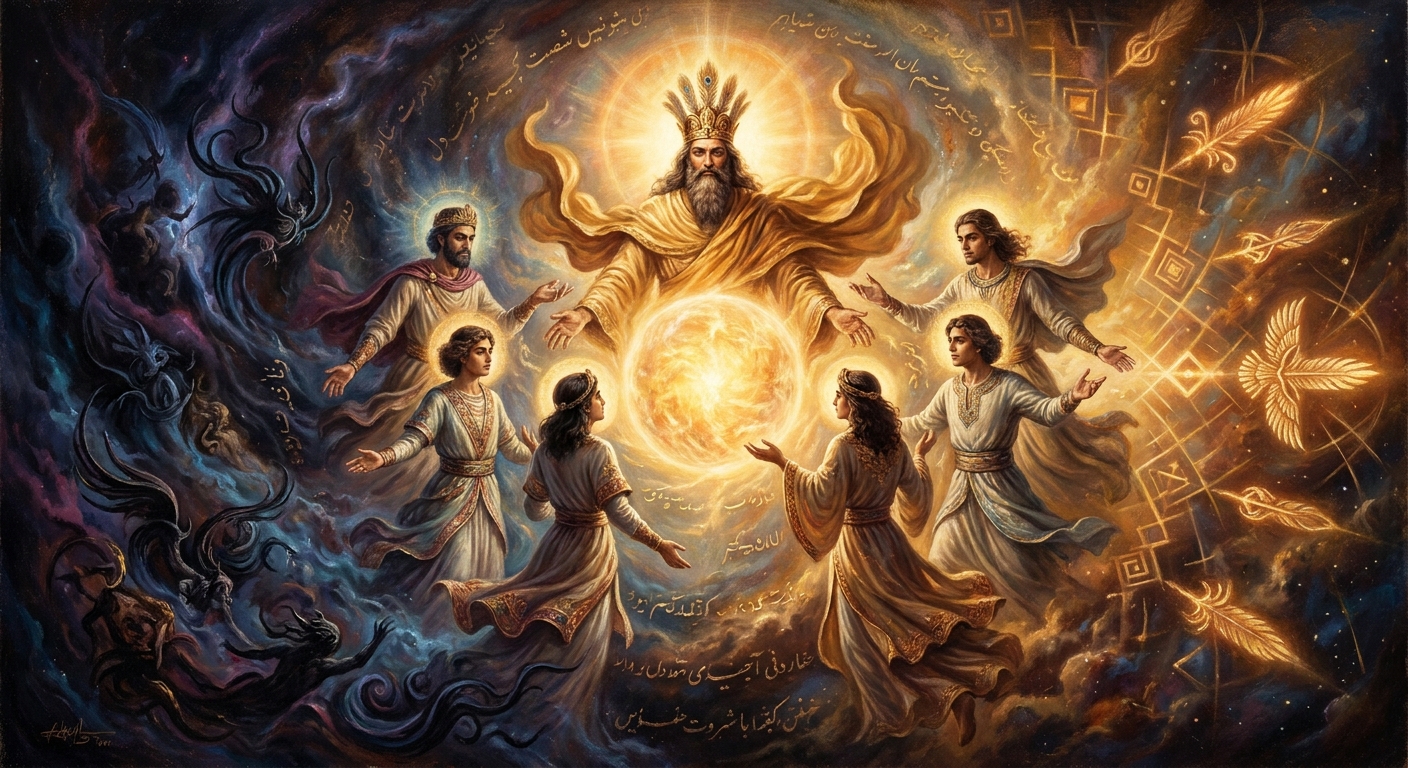
He is suddenly elsewhere — not in the steppe, not by the river — in a place where there are no cardinal directions because the directions themselves have not yet been spoken into being. Six other figures stand around a seventh. The seven are the Amesha Spentas, the Bounteous Immortals, though he does not know the name yet. He will give them names later, in the hymns: Asha Vahishta (Best Truth), Khshathra Vairya (Desirable Dominion), Spenta Armaiti (Holy Devotion), Haurvatat (Wholeness), Ameretat (Immortality). And Vohu Manah, who has brought him. They are aspects, attributes, modes of the seventh. They are how the seventh acts in the world.
The seventh is Ahura Mazda. The Wise Lord. The uncreated.
He looks at Zarathushtra without blinking and the cosmos arranges itself into a single proposition.
“There are two primordial Spirits,” Ahura Mazda says — and Zarathushtra will quote this back, almost verbatim, in Yasna 30 — “twins, who in the beginning, in vision, declared themselves the better and the worse. Between these two the wise chose rightly; the foolish did not. And when these two Spirits met, they established at the first life and not-life, and that at the last the worst existence shall be for the followers of the Lie, but the best dwelling for him who follows Truth.”
He sees it then. He sees the entire cosmos as a courtroom.
On one side: Asha. Truth, order, the right arrangement of things. The fire that burns clean. The cattle that calve at the proper season. The promise kept. The word spoken straight.
On the other side: Druj. The Lie. Not merely falsehood — a force, an active corrosion at the seam of reality. The cattle-raid. The oath broken. The priest who knows better. Behind it, sustaining it, an enemy: Angra Mainyu, the Hostile Spirit, the twin who chose worse.
Every soul ever born is in this courtroom. Every soul has to choose. There is no third option. There is no neutrality.
“The choice is yours,” Ahura Mazda says.
Not predestination. Not fate. Not the will of the daevas. Yours. The Wise Lord is not omnipotent in the later monotheist sense; he does not author evil and he does not prevent it. He has set the contest. He cannot win it without you.
Zarathushtra understands, then, what he has been brought here to be told. The old religion is over. The hundred gods are reduced to one God and his attributes. The blood sacrifices are reduced to a fire kept clean. The priest’s monopoly on truth is broken; every farmer with cattle and a clean tongue is now a participant in the cosmic contest. Good thoughts. Good words. Good deeds. The triple formula every Zoroastrian child still recites. It is not piety. It is enlistment.
At the end of time, he sees, the Saoshyant will come — the savior born of a virgin from Zarathushtra’s own preserved seed — and the dead will rise, and a river of molten metal will pour over the world, and the righteous will pass through it as through warm milk, and the wicked will be purged, and even Angra Mainyu will at last be unmade. Frashokereti. The Renovation. The world made fresh.
He comes back to himself standing in the Daitya river.
The water vessel is still in his hand. The sun has not moved. The festival on the bank is still being prepared. He could believe none of it had happened, except that he can no longer un-know what he has been shown.
He walks out of the river and tells his cousin first. His cousin believes him. No one else does, not for ten years. He is driven from his clan. The karpans — the old priests — call him a liar and try to kill him. He wanders. He preaches. He sleeps in barns. At forty-two he finally finds a king, Vishtaspa, who listens, and from that one royal court the new religion begins its slow conquest of the Iranian plateau, then the Achaemenid empire, then — through the Babylonian exile of the Jews and the long Persian centuries — the entire structural imagination of the Western religious mind.
The man who walked into the Daitya was a priest of the old religion. The man who walked out of it was the architect of every monotheism that would follow.
Heaven and hell. Final judgment. The resurrection of the body. The cosmic battle between Light and Darkness. The savior who comes at the end of time. The single Wise Lord. The free will of the human soul to enlist on one side or the other. None of these existed in writing before Zarathushtra. All of them existed after him.
The Hebrew prophets borrowed during the Exile. The Greeks borrowed through Plato. The Romans borrowed through Mithras. The Christians inherited the entire architecture and renamed the rooms. The Muslims kept the Sirat bridge and the angels and the day of resurrection.
Three and a half thousand years later, on a fire-temple altar in Mumbai or Yazd or a Parsi household in London, a flame still burns that has not been allowed to go out. The vessel filled at the Daitya river is still being poured.
Scenes
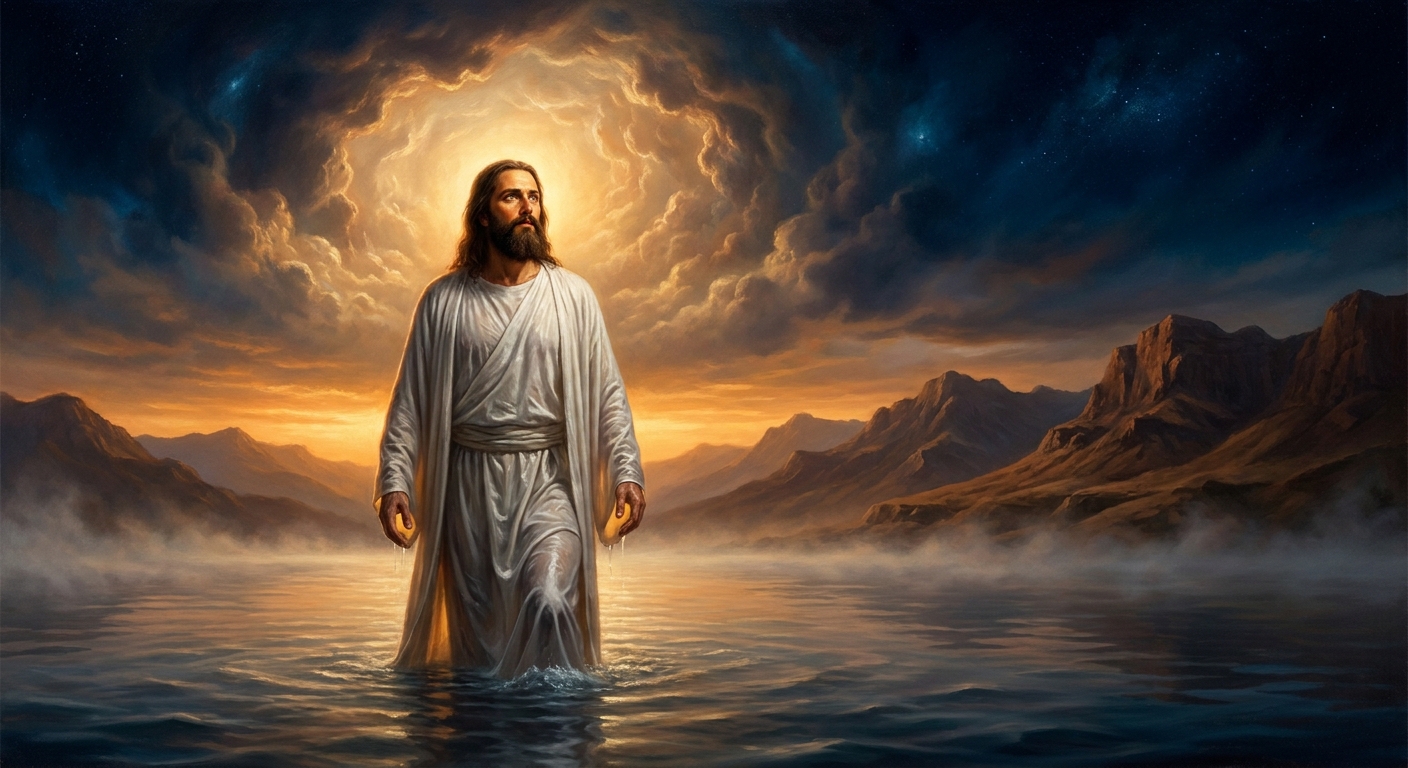
At dawn on the spring festival, Zarathushtra wades into the Daitya river to draw the ritual water
 Generating art…
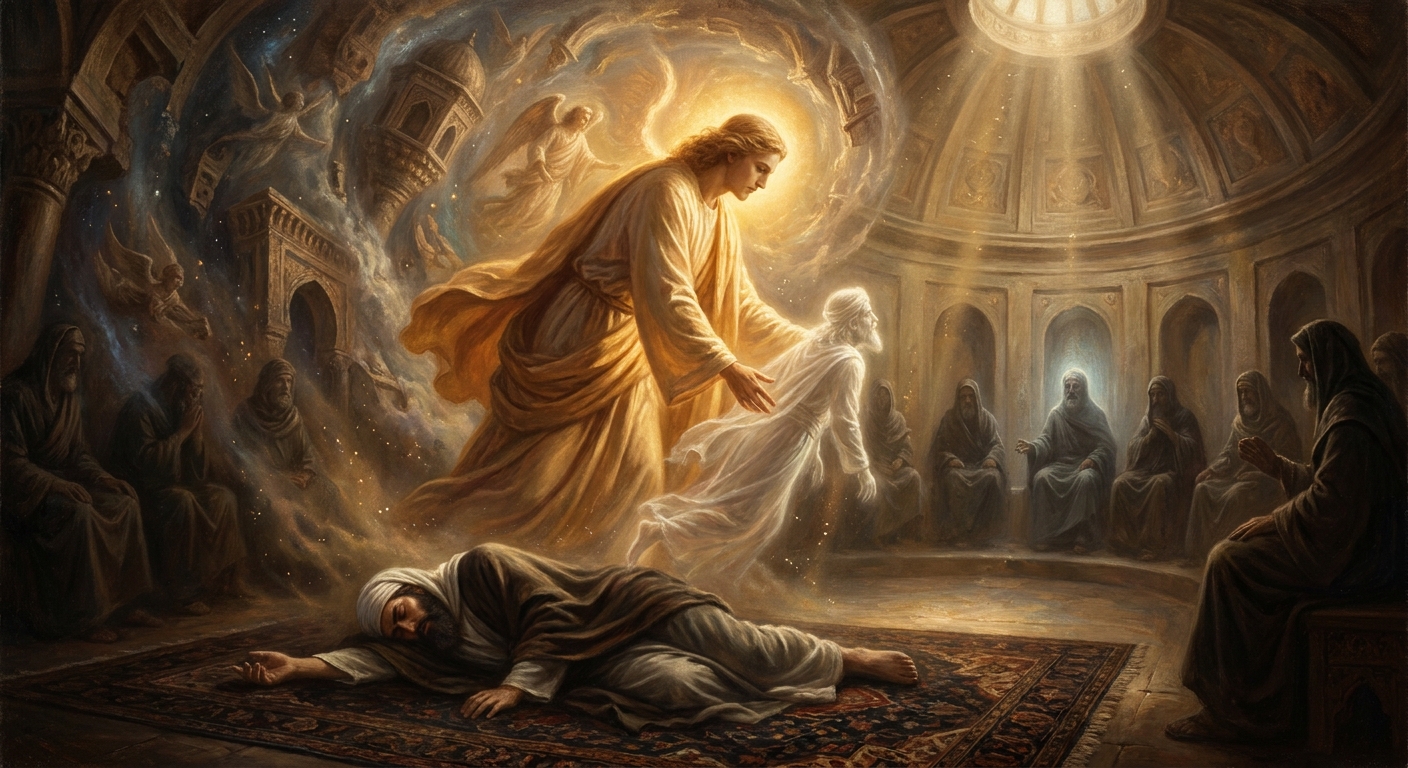
 Vohu Manah — *Good Thought*, nine times the height of a man — leads him out of his body and into the council of the Wise Lord
 Generating art…
 Ahura Mazda surrounded by the Amesha Spentas: the cosmos revealed as a battle between Truth (Asha) and the Lie (Druj)
 Generating art…
 Echoes Across Traditions
Entities
- Zarathushtra
- Vohu Manah
- Ahura Mazda
- Angra Mainyu
- the Amesha Spentas


Sources
- *Yasna* 30, 43-46 (the Gathas — hymns Zarathushtra is held to have composed himself; the oldest layer of the Avesta)
- Mary Boyce, *Zoroastrians: Their Religious Beliefs and Practices* (Routledge, 1979; rev. 2001)
- Mary Boyce, *A History of Zoroastrianism*, vols. 1-3 (Brill, 1975-1991)
- Padideh Pakpour, *Zoroastrian Cosmology and Greek Philosophy* (2018)
- Jenny Rose, *Zoroastrianism: An Introduction* (I.B. Tauris, 2011)