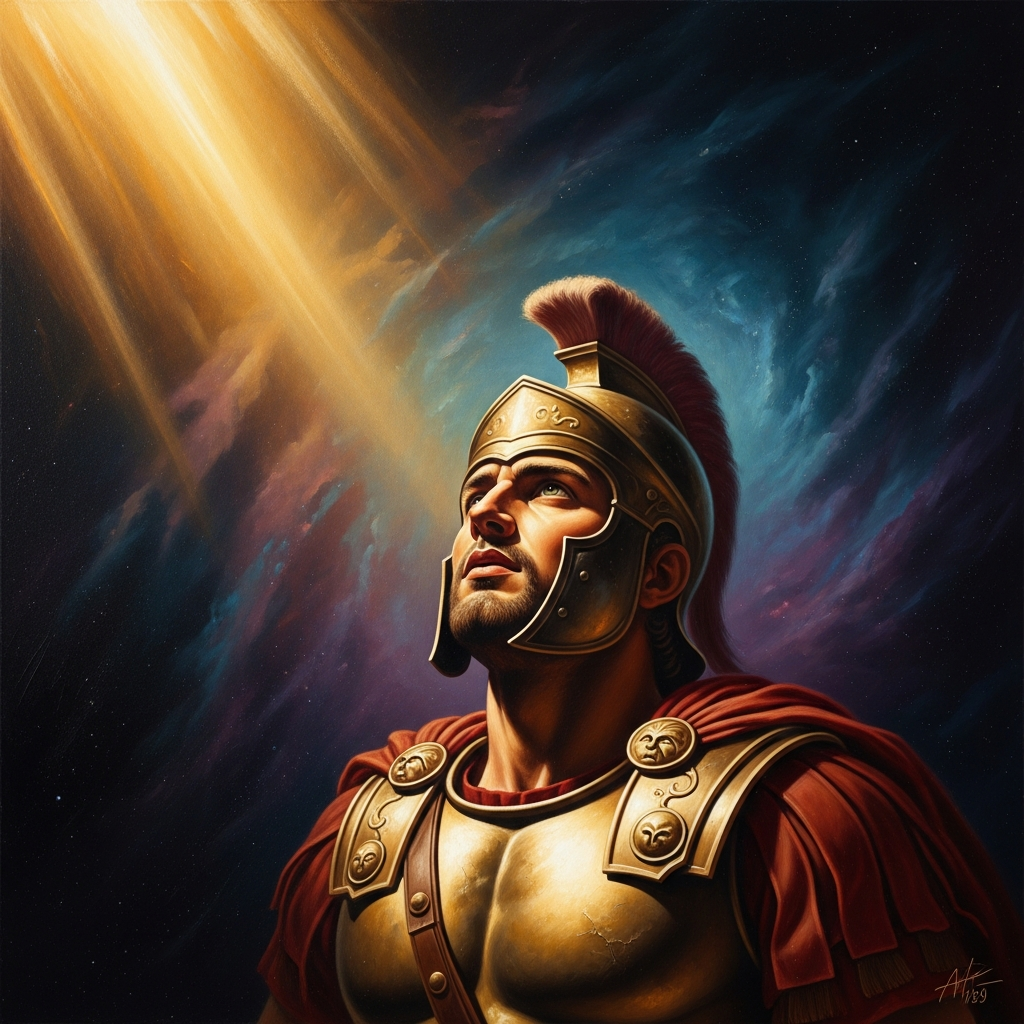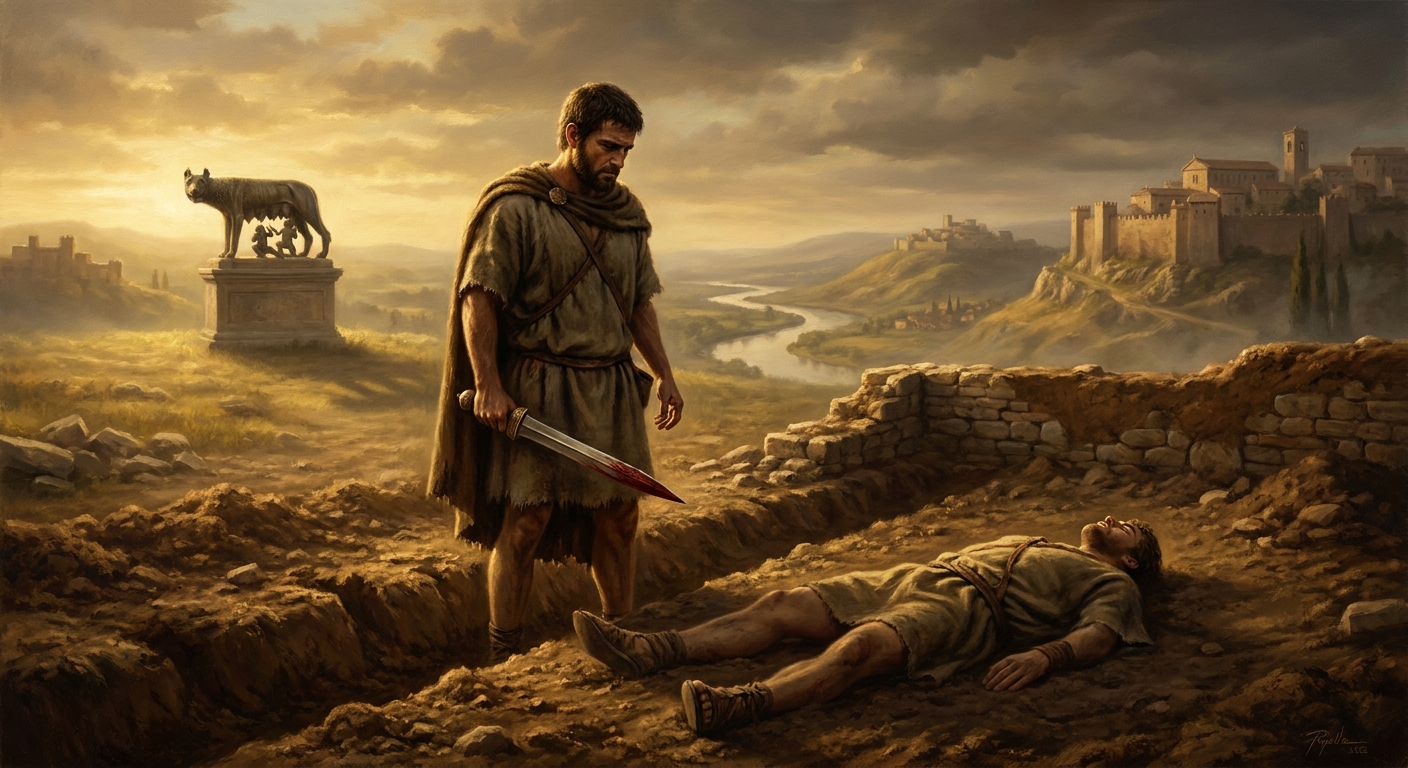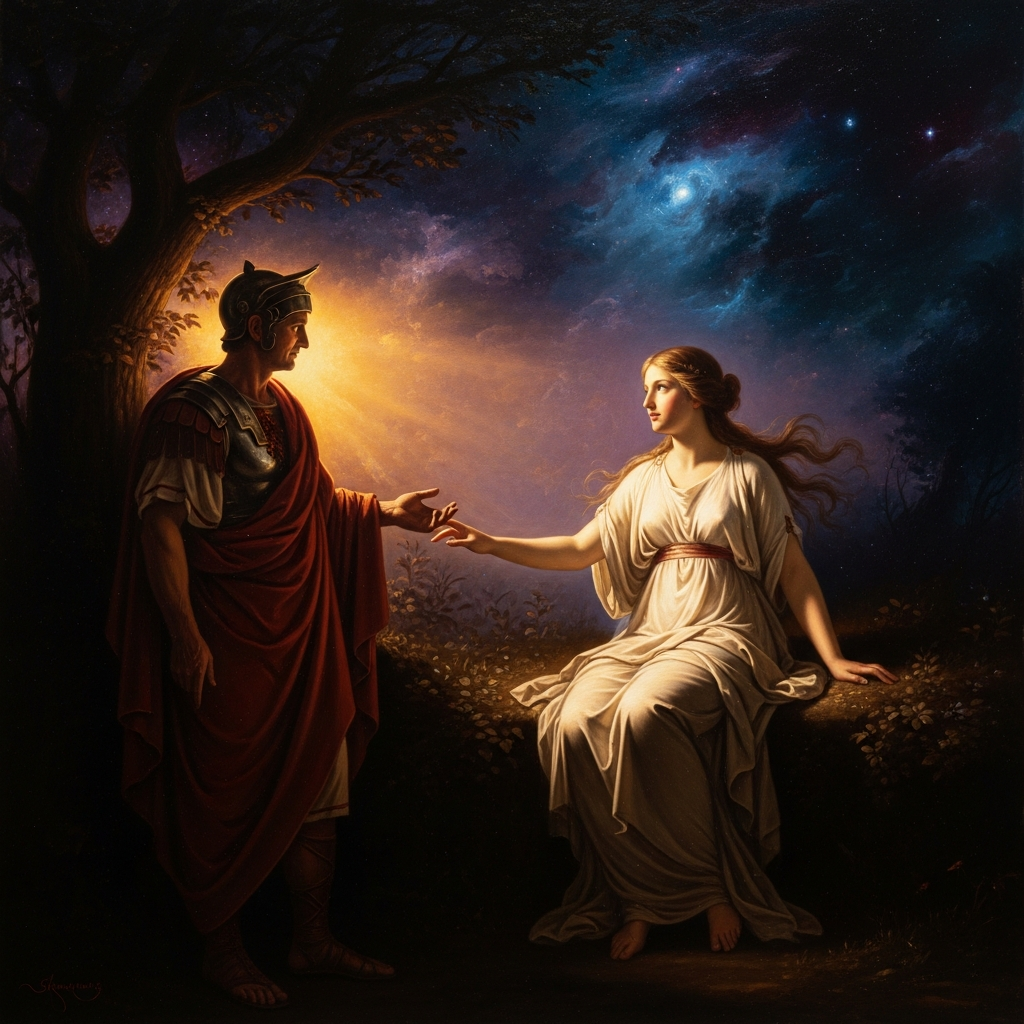
Numa and the Nymph
Reign of Numa traditionally 715-673 BCE; recorded by Livy 1st c. BCE and Plutarch ~100 CE · Rome and the grove of the Camenae outside the Porta Capena, where a spring rose at the foot of the Caelian hill
Contents
Rome's second king, the Sabine philosopher Numa Pompilius, slips out of the city at night to a grove outside the walls. There he meets Egeria, a water-nymph who becomes his wife and his oracle. From her, dictated in the dark beside a spring, comes the entire architecture of Roman religion: the calendar, the priesthoods, the Vestals, the rites that will hold the Republic together for a thousand years.
- When
- Reign of Numa traditionally 715-673 BCE; recorded by Livy 1st c. BCE and Plutarch ~100 CE
- Where
- Rome and the grove of the Camenae outside the Porta Capena, where a spring rose at the foot of the Caelian hill
Romulus is gone.
He has been gone for a year. He vanished in a thunderstorm on the Field of Mars in front of his army — taken up by the gods, the patricians explained, though the slaves muttered that the patricians had simply torn him apart and hidden the pieces. The throne is empty. The city he founded by murdering his brother is governed, briefly, by a rotating committee of senators, none of whom can hold it.
The Senate sends to the Sabines.
There is a man in Cures — Numa Pompilius — who is famous for the wrong virtues. He is forty years old. He lives outside the town in a small house. He has refused public office for two decades. He spends his days reading Pythagorean texts that may or may not exist yet. His neighbors say he speaks with the gods, though no one can specify which ones.
The delegation arrives. Would he consider becoming king of Rome.
He says no. They press. He goes to consult the auspices. The augur tracks the flight of the birds across the sky over Cures and reports that the gods agree: yes. Numa accepts the throne with the air of a man taking a job he did not apply for.
He walks south to a city that has just been governed by murderers.
Rome smells of war.
Romulus’s Rome is a barracks. The army drills in every public space. The temples — what temples there are — were built for victory and not for thought. The calendar is ten months long, agricultural and rough, with the winter unaccounted for because the founder did not see why a soldier would need to count the months he spent indoors.
Numa walks the city. He attends to it the way a doctor attends to a body: looking for what is missing.
He closes the gates of the temple of Janus, which Romulus had kept open as a sign that war was the city’s permanent state. He disbands the king’s bodyguard. He proposes a new calendar — twelve months, including January and February, named for the god of doorways and the rite of purification. He divides the year into festival days, market days, and forbidden days, on which no public business may be conducted because the gods are doing their business.
The patricians are confused. The plebeians are relieved. The army does not know what to do with itself.
Then Numa starts going out at night.
The grove of the Camenae is outside the walls.
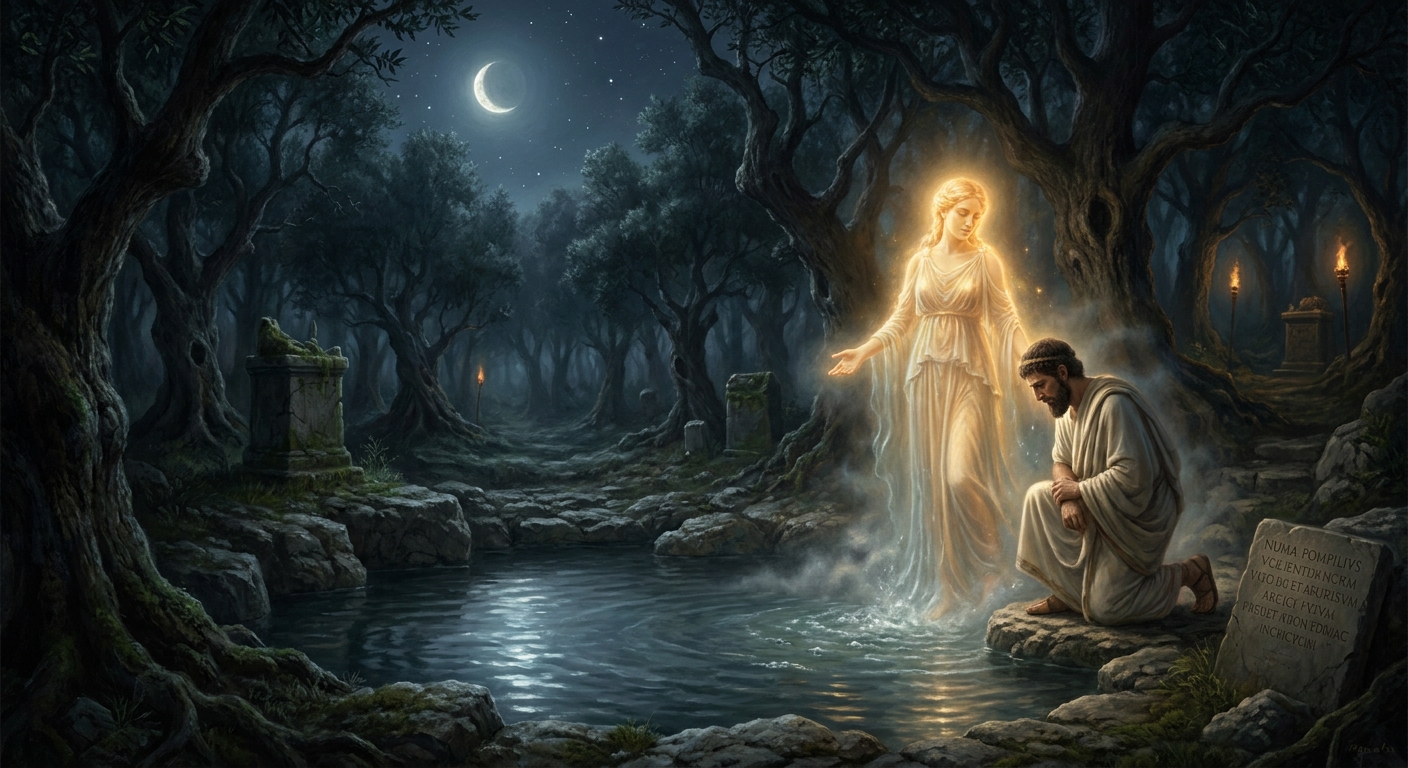
It sits at the foot of the Caelian, where a spring rises from a fissure in the rock and runs through a stand of oaks the city has not cleared because no one has needed the wood. It is unconsecrated. It is dark. The Romans do not go there.
Numa goes there at the second hour after sunset, alone, on foot, with no torch.
What he meets there, he tells no one for a long time. When the patricians finally ask — when they begin to wonder whether their philosopher-king is mad, or sleeping with a woman of the wrong class, or both — he answers them simply. Egeria, he says. A nymph. She is my wife.
He says it with the casualness of a man identifying his cook.
Egeria is older than the city.
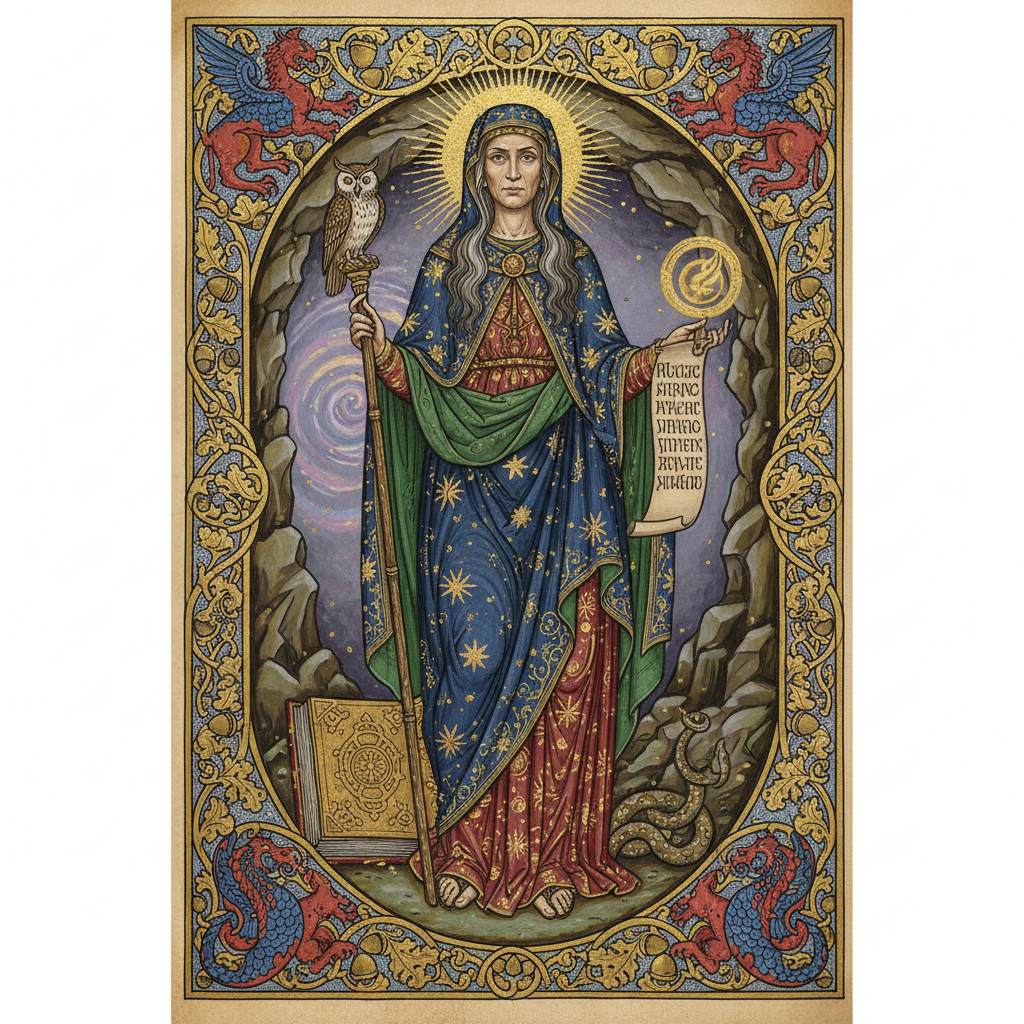
She has been at the spring since before the Sabine villages on the seven hills consolidated into a market. She is not a goddess; she does not require temples; she is what the Romans called a numen — a presence, a small focused power of place — and she has been waiting for someone to ask the right questions of her.
Numa asks them.
He sits on the stones beside the spring and asks her, night after night, the questions a king of a barracks-city would not have known to ask. How shall the months be ordered? Which gods require which rites at which seasons? Who shall keep the fires of the city burning? What is the difference between a sacrifice that the gods accept and one they refuse? When may a man kill an ox, and when may he not? What is the formula by which a treaty is binding upon both parties even after the men who swore it are dead?
She answers him.
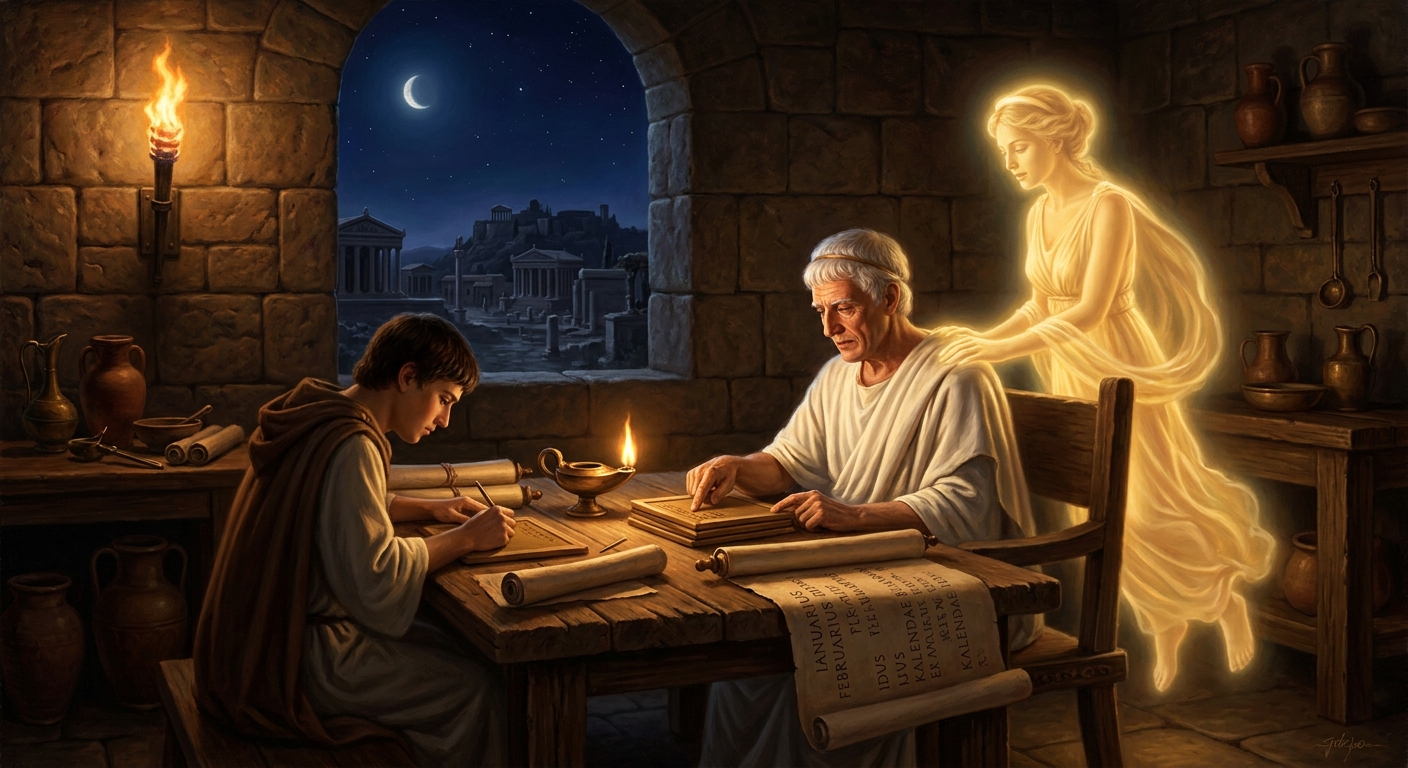
She answers him slowly, in the rhythm of the spring, with the patience of a being for whom centuries are a comfortable measure. He brings wax tablets. He writes down what she says. By dawn he is back inside the walls with the tablets covered, and he gives the day’s instruction to the priests as if it had come from his own meditation.
The institutions form.
He establishes the flamines — the priests of Jupiter, Mars, and Quirinus — and gives each of them robes, restrictions, and the daily rituals that will tie those gods to the city’s continuance. He institutes the Salii, the leaping priests of Mars, who will dance through Rome each March with the sacred shields, the ancilia, one of which fell from the sky into Numa’s own hand during a plague (Egeria told him to expect it; Egeria told him to make eleven copies so no thief would know which was the original).
He founds the college of pontiffs — the bridge-builders, the men who maintain the formulas that bridge the human and divine — and places at their head the Pontifex Maximus, a title the Roman state will keep for a thousand years and the Roman Catholic Church will inherit when the state collapses.
He founds the Vestals.
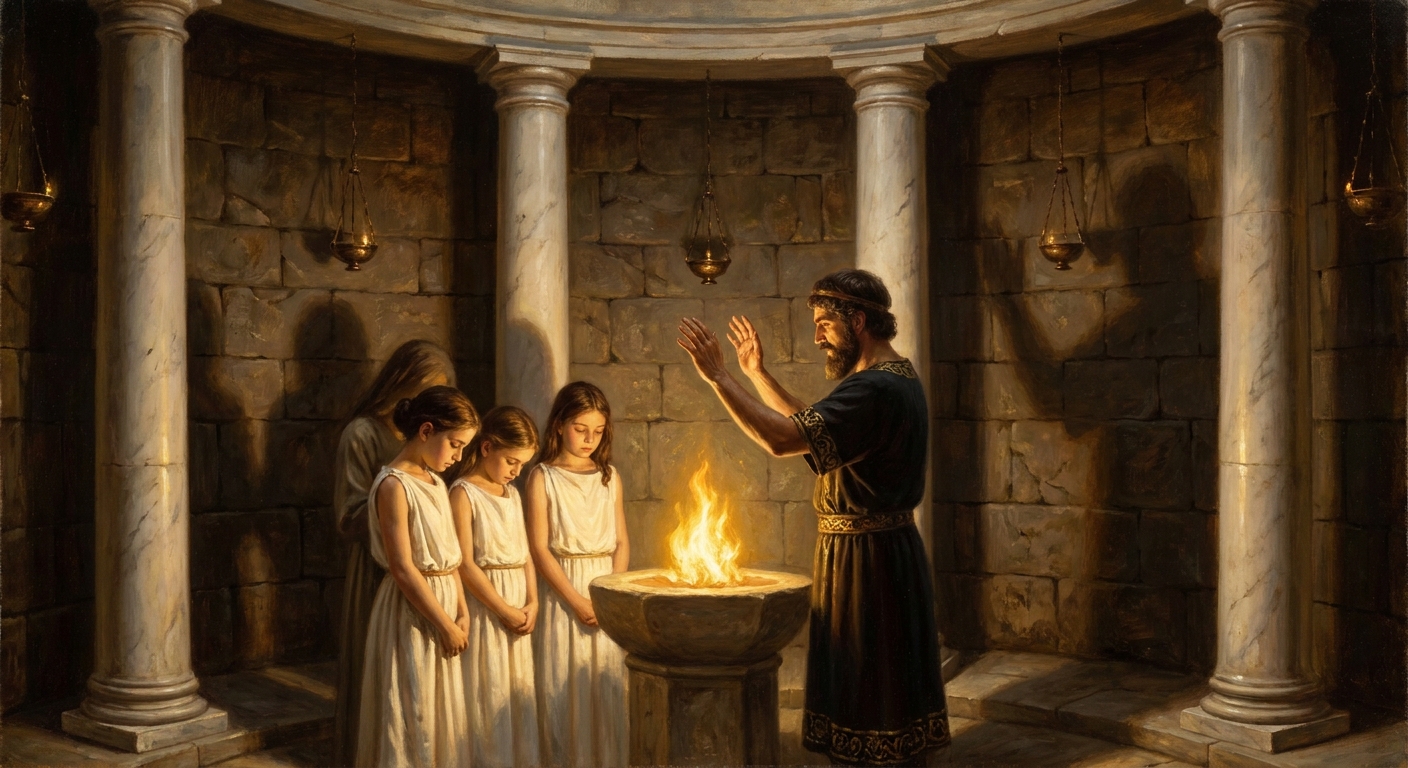
Six women — virgin, unmarried, drawn from the patrician families — to keep the fire of the city burning at the hearth of Vesta, the goddess of the household flame extended to the household of Rome itself. If the fire goes out, the city ends. If a Vestal breaks her vow, she is buried alive in a small chamber outside the walls with bread and water for one day, and the city’s pollution is removed with her.
The institutions are severe. They are also, for the first time in Roman history, coherent.
He does not tell the people about Egeria for years.
The patricians see the king walking out at night and assume the worst — that he is consulting some witch, or sleeping with a slave, or sneaking off to compose treasonous letters. They confront him in the council. Where do you go?
He invites them to a feast. He has set the table with wooden bowls and stale bread. The patricians sit down to eat, suspicious. Numa walks to the door. He says: my wife is coming.
The room transforms.
The wooden bowls become silver. The bread becomes a feast. The walls of the simple house glow. Egeria does not appear in person — she is not, the texts insist, the kind of being who appears at dinner parties — but the patricians eat from her abundance for an hour and leave the house quieter than they entered it. The next morning the council passes Numa’s proposed religious reforms unanimously.
After that, no one asks where the king goes.
He reigns for forty-three years.
Rome does not fight a single war during his reign. The gates of Janus stay closed. The calendar is observed. The fires are kept. The pontiffs preserve the formulas. Children grow up never having seen the smoke of an army.
Then he dies.
He has given instructions: he is not to be cremated, in the Etruscan fashion, but buried in two stone coffins on the Janiculum — one for his body, one for the books he has written, the books of his religious reforms in his own hand. The books are buried beside him. They will remain in the ground for four hundred years, until a peasant ploughs them up in the second century BCE and brings them to the Senate, which reads them, panics, and orders them burned. The contents are too philosophical, the Senate decides. They will damage the religion they founded.
The institutions outlive the books.
Egeria mourns him.
She weeps at her spring with such grief that the water rises and rises and threatens to flood the grove. Diana, the goddess who has watched over Egeria for centuries, takes pity. She turns the nymph herself into the spring — body into water, voice into the sound of water, the whole grief reorganized into a flow. The Romans keep going to her there. They drink from her on the Ides of March. Pregnant women bring offerings, because Egeria — by the etymology of her name, e gerere, to bring forth — has become the patron of safe delivery.
The grove is still there in Plutarch’s day.
It is still there in Juvenal’s, two centuries later, though Juvenal complains it has been spoiled by Greek immigrants who have built a marble bath where the simple spring used to be. We do not know how to be poor at our own holy places anymore, he writes. The grief in the line is a grief for Numa’s whole project — the Roman religion that received itself in a quiet grove and ended up paving the grove with marble.
Plutarch, writing in the second century CE, did not believe the Egeria story literally. He treated it the way Plutarch treated all such stories — as a way of saying that Numa’s reforms were too coherent, too whole, too unified for any one man to have invented in a generation. He must have been receiving them. The receiving figure is mythic; the reforms are real.
Livy, writing in Augustan Rome, was franker. The Egeria story is, he admits, a useful fiction Numa invented to give his reforms divine authority — because a barracks-city would not accept religious instruction from a philosopher unless that philosopher could claim a divine consort. Livy is suspicious of the goddess and admiring of the politician.
Both readings are right. Both readings have been the standard readings since.
Moses came down from Sinai with the Law. Muhammad came out of the cave at Hira with the Qur’an. Numa came out of a grove outside Rome with a calendar and a priesthood. The pattern is identical: the founder withdraws to a lonely place, meets a divine informant, returns with the architecture of his community. Whether the informant exists is the question every revelation tradition has had to answer for itself, and none of them — including the Roman, including the Numa story — has answered it more honestly than to say: the institutions hold the city for a thousand years. Judge by the fruit.
The Roman fruit was a thousand years.
The grove is still there. The spring still runs. The Catholic Church still has a Pontifex Maximus, in a different city across the river, sitting on a chair he traces back through Numa’s college of pontiffs to a nymph by a spring under an oak.
Scenes
The grove of the Camenae at moonrise: Numa kneels at the spring where Egeria speaks from the water
 Generating art…
 Numa writes by torchlight — the calendar, the feast-days, the rites — as Egeria dictates each word
 Generating art…
 The first Vestal Virgins take their vows before Numa: keepers of Rome's eternal flame
 Generating art…
 Echoes Across Traditions
Entities
- Numa Pompilius
- Egeria
- Jupiter
- Vesta
- the Pontifex Maximus
Sources
- Plutarch, *Life of Numa* (~100 CE)
- Livy, *Ab Urbe Condita* I.18-21
- Ovid, *Fasti* III.261-392; *Metamorphoses* XV.479-551
- Cicero, *De Re Publica* II.13-15
- Mary Beard, John North, Simon Price, *Religions of Rome* (1998)