Aeneas in the Underworld
Mythic Time · *Aeneid* Book VI completed c. 22 BCE · Cumae, on the Bay of Naples — and the underworld beneath it
Contents
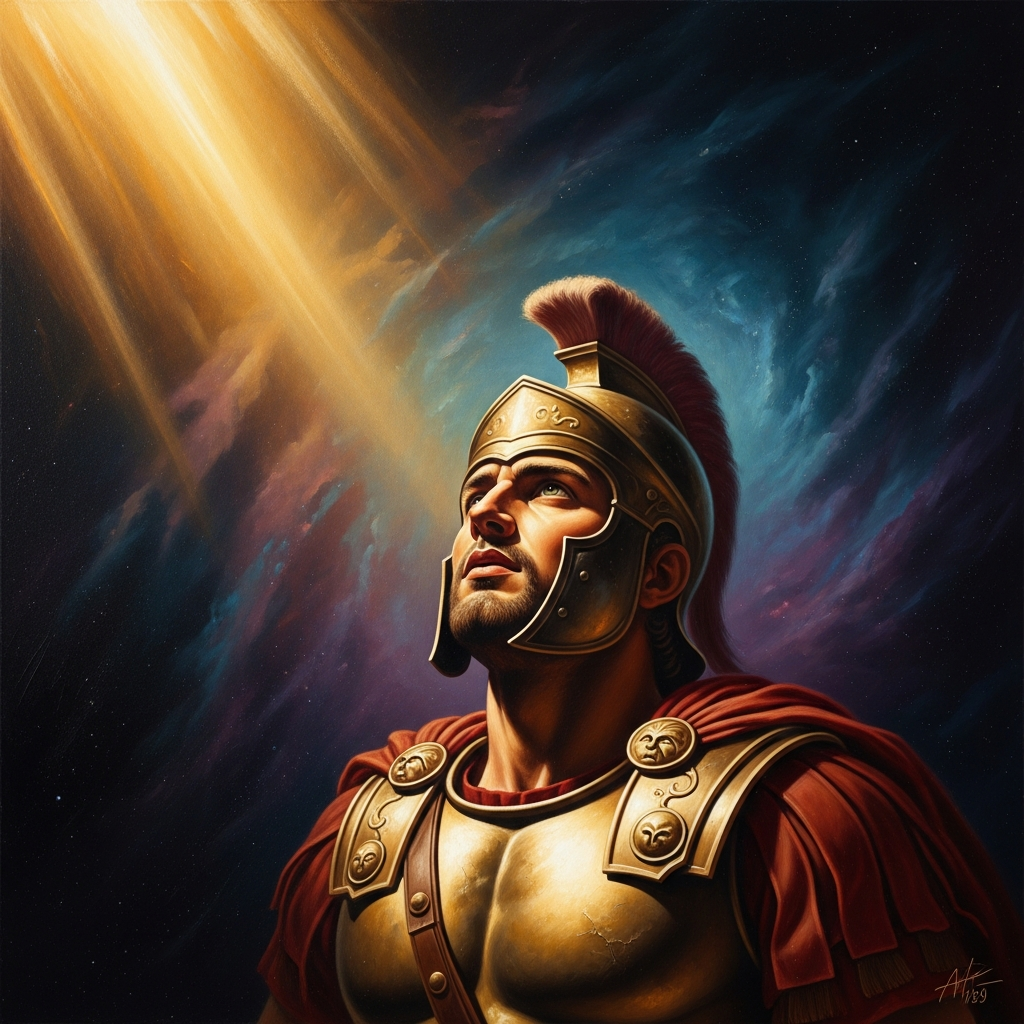
In Book VI of the Aeneid, Aeneas descends into the underworld guided by the Sibyl of Cumae. He crosses the Styx, passes through the fields of the dead, and arrives in Elysium, where his father Anchises shows him the souls of Rome's greatest men waiting to be born. This is Virgil's theology of empire: the cost of what Aeneas has built — every body left behind — is justified by the Romans those bodies will eventually produce. The question the vision raises has never been satisfactorily answered.
- When
- Mythic Time · *Aeneid* Book VI completed c. 22 BCE
- Where
- Cumae, on the Bay of Naples — and the underworld beneath it
The golden bough does not want to come free.
Aeneas has been searching the forest for it since the Sibyl told him what he needs: a branch that grows in the wood near Cumae, gold-leaved, sacred to Proserpina, the queen of the dead’s tribute. Without it he cannot pay his passage. Without passage he cannot cross. He has been here since dawn in the oak forest above the cave, looking at leaves, looking at light through canopy, trying to find the specific shimmer that means gold and not sun.
Two doves appear. His mother’s birds — Venus’s birds, snow-white, dropping from the sky into the path in front of him and walking in the way birds walk when they want to be followed. He follows. They lead him through the forest to a different shade, a different angle, and there: a tree with one branch entirely gold, catching the light off the water below the hill, trembling in the afternoon air.
He breaks it. It comes free with the resistance of a living thing and then releases all at once.
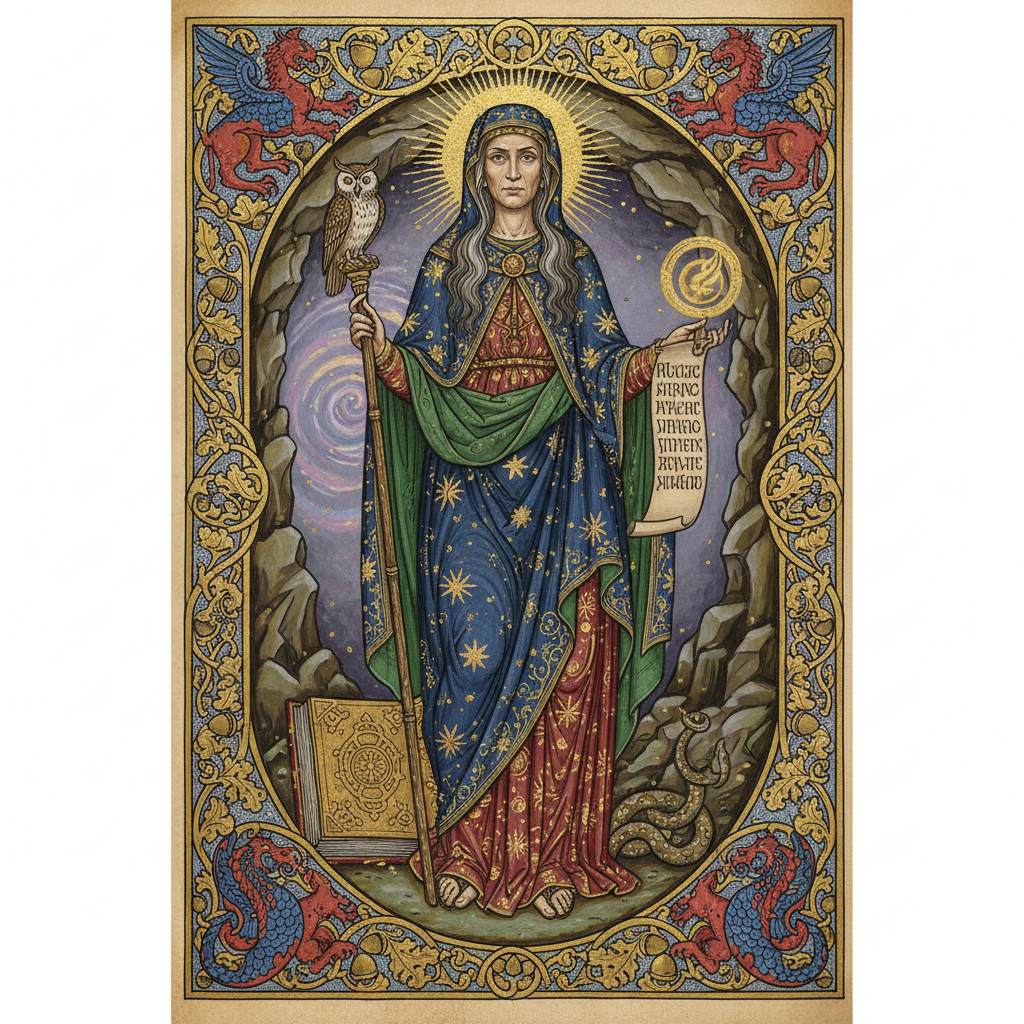
The descent begins at the cave of the Sibyl, the ancient prophetess of Cumae who has guided him this far. She is old — Apollo gave her as many years as grains of sand she could hold in her hand, and she took the sand, and forgot to ask for youth with the years. She is withering into her centuries. She knows the underworld better than the living world by now. She takes the bough and she leads Aeneas down into the cave’s throat and then deeper, into the dark that is not cave-dark but the dark of the region below all caves, where the air thickens and the light from the surface is a memory.
They pass the vestibule of the dead first: the place just inside the entrance where the newly dead gather and the demons they carried in life cluster around the door. Grief, Anxiety, Disease, Old Age, Fear, Hunger, Poverty, Toil, Death, Sleep — Virgil places them here with the attention of a man who has thought carefully about which of the things that make life terrible are primordial enough to live at death’s border. He names them. They line the walls.
Beyond the vestibule: the Styx.
Charon is ancient.
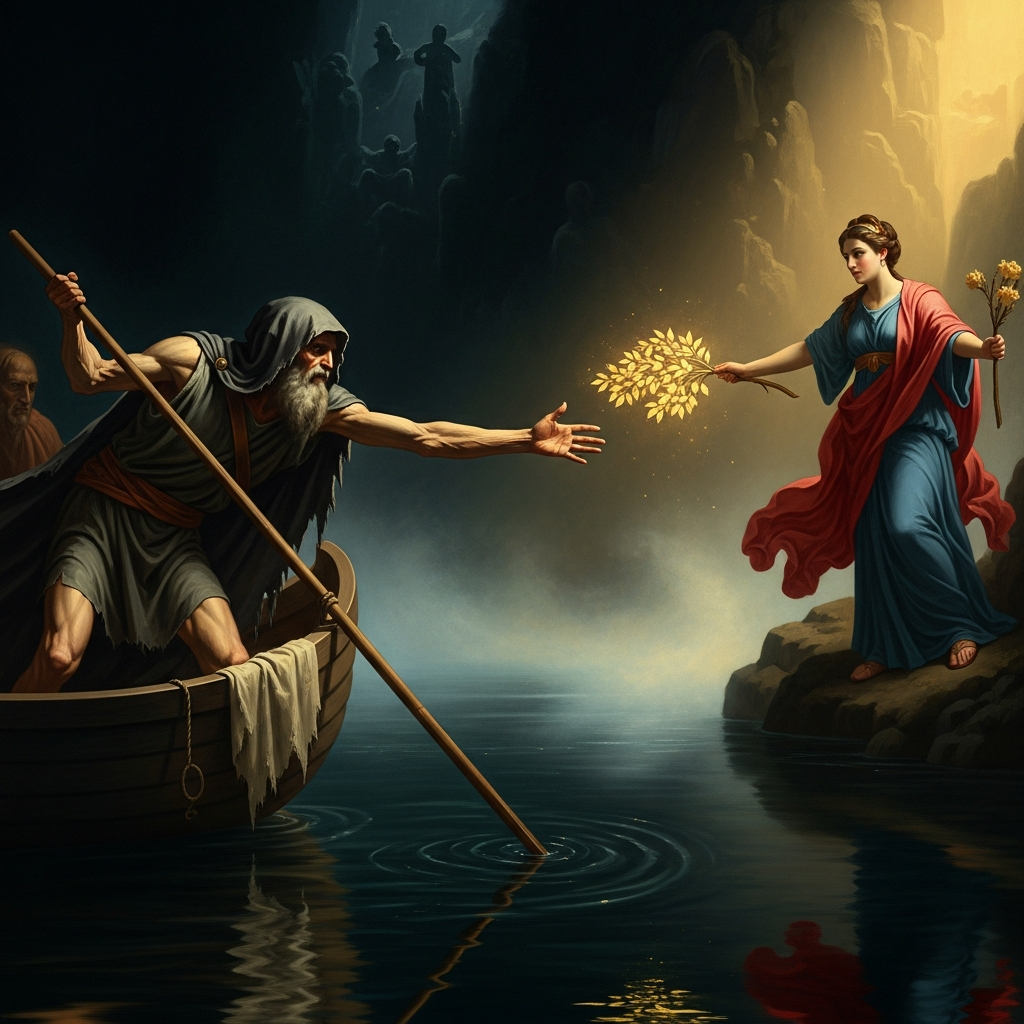
He is ancient in the way that service makes a thing ancient — worn into the function, the body of the ferryman subsumed by the centuries of ferrying. He poles his boat on the black river and looks at Aeneas and looks at the Sibyl and looks at the living breath still coming out of the man’s mouth. He hesitates. The living do not cross.
The Sibyl holds up the golden bough.
Charon reaches for it before she finishes extending it. He has seen the bough twice before in all his centuries — Hercules and Orpheus, the only others who came down breathing and convinced the ferryman — and he knows what it means: this one has permission. He puts them in the boat. He poles them across the Styx in the dark.
On the other shore, Cerberus. The three-headed dog who guards the gate from the dead side, who prevents the dead from returning the way Charon prevents the living from entering. The Sibyl throws him a drugged cake. He sleeps. They pass.
The first region is the Fields of Mourning, Lugentes Campi, and it is here that Aeneas sees Dido.
She is among those who died of love — the field is full of them, famous names, men and women who were killed by attachment: Phaedra, Procris, Eriphyle, Laodamia, Caeneus. Their shades move through the myrtle grove in a particular twilight, not punished exactly but not at peace. They died of love and they are still here, still carrying the weight of what they died of, still in the grove where the myrtle grows.
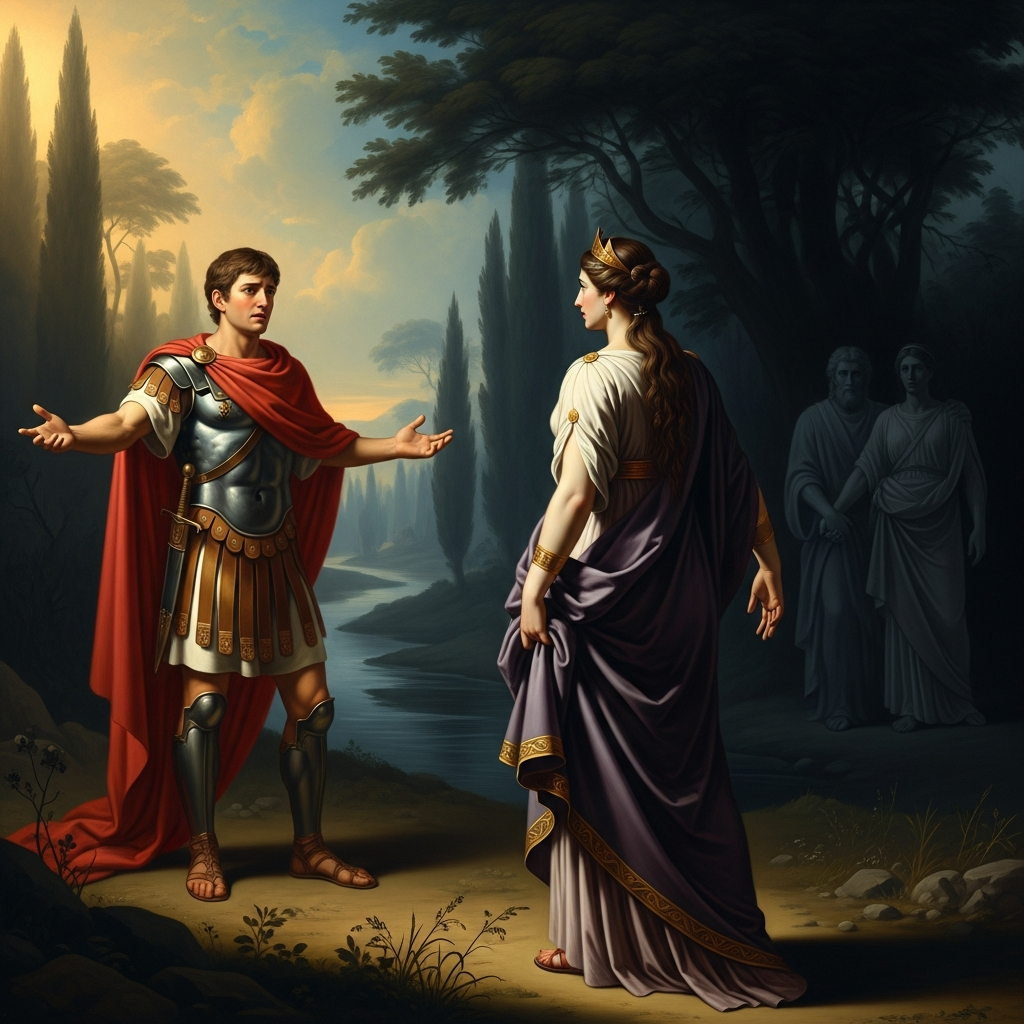
Dido’s shade is recognizable even in the dark, the way a new moon is recognizable even when you can barely see it — by shape, by position, by the quality of the dark around it. Aeneas sees her and stops.
He speaks to her.
He tells her his departure was not his choice. He tells her that the gods ordered it, that he did not want to leave, that if he could have stayed he would have. He tells her these things and they are true and they do not help. He is weeping. His voice breaks on her name.
She does not look at him.
Virgil writes this with nine words in Latin: illa solo fixos oculos aversa tenebat. She kept her eyes fixed on the ground, turned away. She turns and walks back into the shadow, back toward the shade of Sychaeus, her first husband, the husband her brother murdered, the husband she is with again now in the dark. Aeneas watches her go. He stands there longer than the Sibyl thinks wise.
The passage is brief and devastating and it does not resolve anything. It is not meant to resolve anything. The Sibyl pulls Aeneas gently back onto the path, and the path goes down.
Elysium opens like a country.
The light here is different — not sunlight exactly but something analogous to sunlight, softer, the light that good people get when they have done enough. The air smells like fresh grass and the distance is not threatening. The Sibyl and Aeneas walk through it toward the sound of music and find the heroic dead in their fields: athletes, priests, the poets whose songs were worthy of Apollo, the men who built civilization and improved it. They are going about the business of being happy in the specific and slightly abstract way that the blessed dead can be happy.
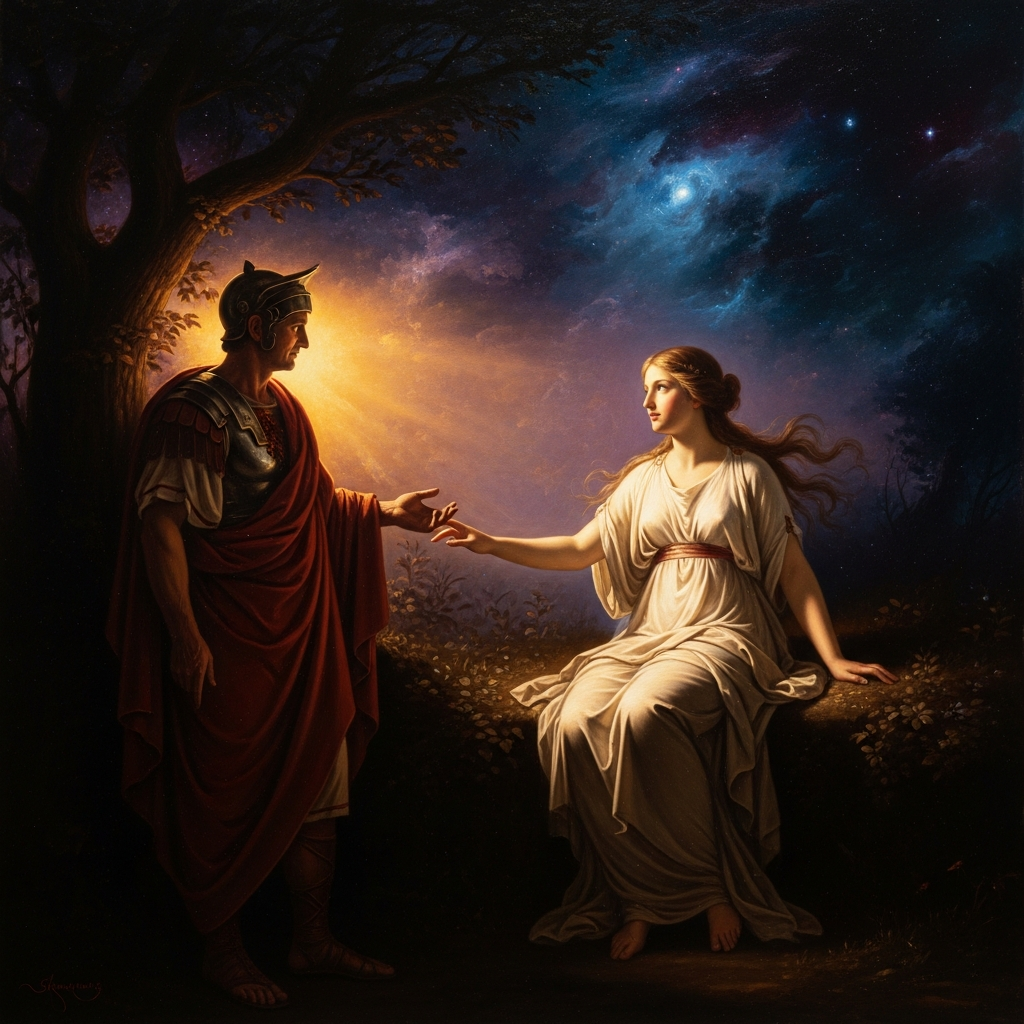
Anchises, Aeneas’s father — carried on his back through burning Troy, bearing the household gods, borne out of the city that night and then lost to plague before they reached Italy — is here. He is standing in a green valley, counting something, going over a long list. The list is souls.
They are the souls of Romans not yet born.
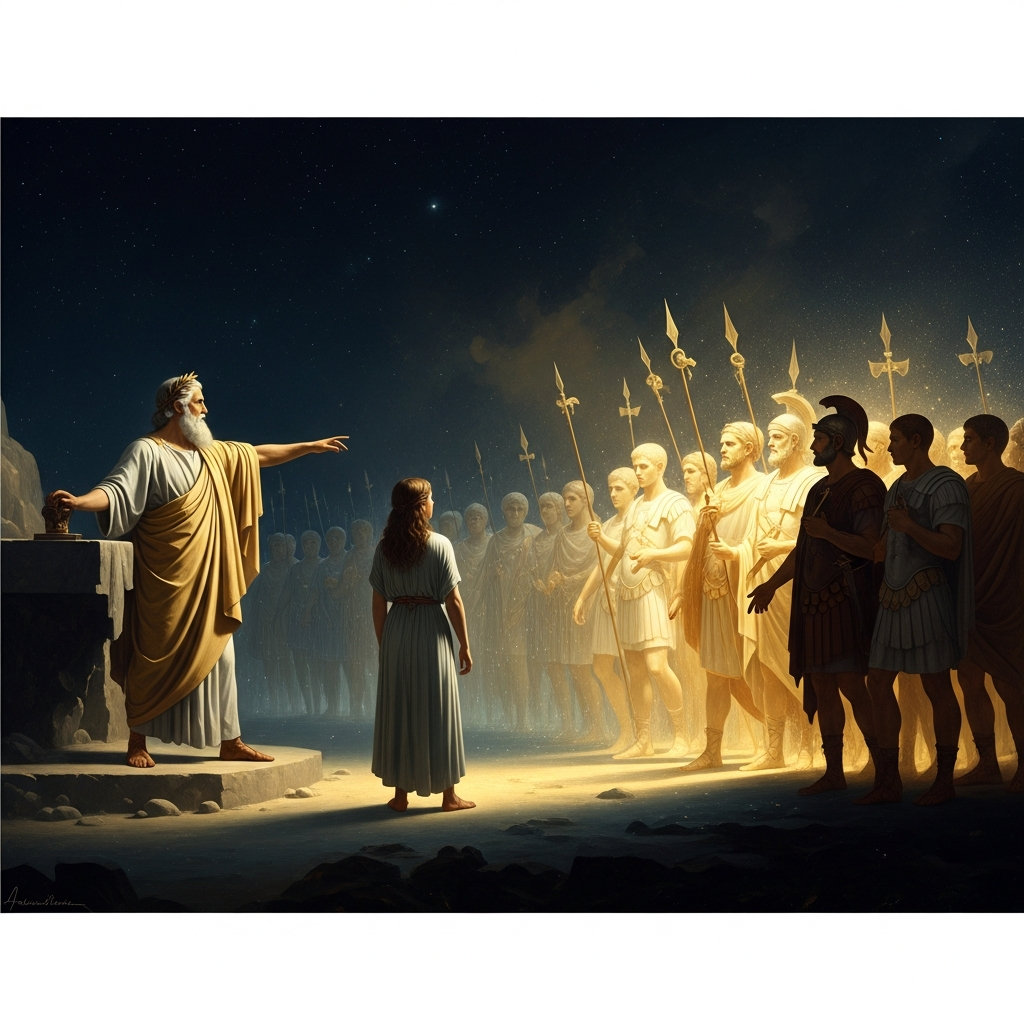
Anchises shows his son the future.
He points at each soul in the procession and names it and gives its date and its glory. Silvius, the first of the Alban kings. The Silvii who follow. Romulus, son of Mars, bearing the double-plumed helm, whose city will be the world’s city. Then the Caesars — the Julian line, Augustus’s lineage — and Augustus himself: a man who will bring back the golden age, extend the Roman empire beyond where Hercules went, beyond where Alexander went, make the world Roman. And after Augustus the long procession continues: Numa, Tullus, Ancus; the Tarquins (briefly, grimly); the Brutus who expelled them; the consuls and dictators; Fabius Maximus, the one who saves Rome by delay; the Marcellii; and then, at the end of the list, a young man with downcast eyes whom Anchises cannot name without grief — Marcellus, Augustus’s nephew, dead young, who could have been everything.
This is the parade of Roman greatness. Unborn. Waiting. Already, in Elysium, organized into history.
Anchises delivers the founding address: Roman, remember by your strength to rule earth’s peoples — for your arts are to be these: to pacify, to impose the rule of law, to spare the conquered, battle down the proud. This is Rome’s mission statement, delivered by a dead man to his son in the underworld, addressed to a people who have not yet been born.
The bodies are not in Elysium.
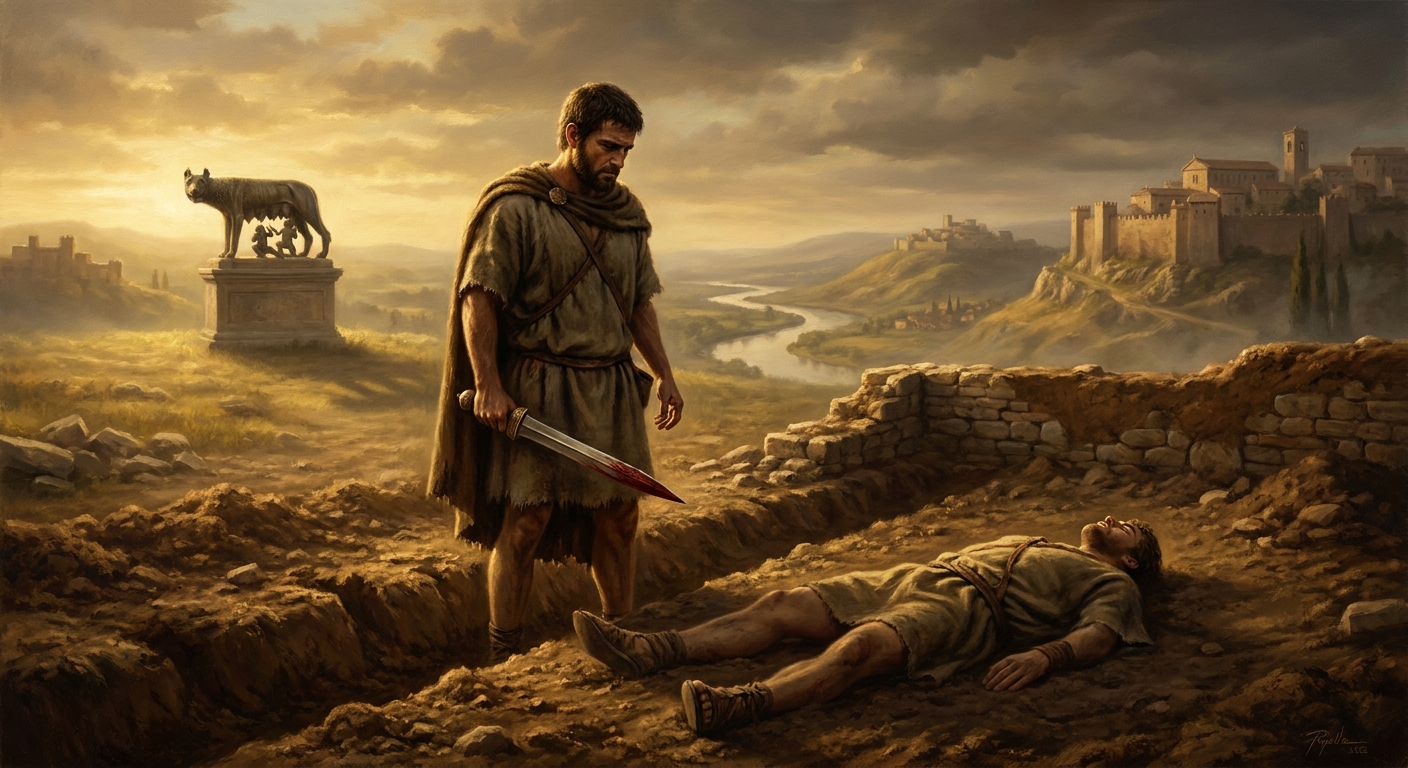
Dido is in the Field of Mourning. The Carthaginians who died in the wars with Rome — the wars Dido cursed into being with her last breath — are somewhere in the underworld also, their specific locations unspecified, their deaths having been the cost of the civilization whose great men are lined up in this valley waiting for their birth. Turnus, whom Aeneas kills at the end of the Aeneid in a moment of rage that Virgil makes deliberately uncomfortable, is not here. The Latins who fell in the founding war are not here. The women of Troy who walked into the sea rather than be enslaved after the fall are not here.
The underworld contains all of this. It contains the dead who died well and the dead who died in the service of Rome and the dead who died as the service of Rome — as the material from which empire is made. Anchises does not show his son those sections. The tour is of Elysium, of the procession of glory. The rest of the underworld is the rest of the underworld.
Aeneas receives the vision. He stands in the valley of unborn Romans and he feels, Virgil tells us, the love of the coming glory — the passion for the future that is the justification for the path he has walked and the people he has left behind and the war he is about to start in Latium. He understands, finally, what he is building toward.
He leaves the underworld through the gate of ivory.
This detail has kept commentators occupied for two thousand years. There are two gates of sleep in the underworld: the gate of horn, through which true shades and true visions pass; and the gate of ivory, through which false visions and deceptive dreams pass. Aeneas leaves through ivory. Virgil put this in deliberately and then died before anyone could ask him why.
The question the ivory gate raises is the question the whole of Book VI raises, which is the question the Aeneid raises on every page under the official narrative: what exactly is being justified by the vision of greatness? Anchises points at unborn Romans the way a prophet points at a promised land. The bodies underfoot — Dido’s ash in Carthage, Turnus’s wound still open at the poem’s last line — are the price of the Romans in the procession.
Virgil does not say this is wrong. Virgil does not say this is right. Virgil puts Aeneas through the ivory gate and leaves him standing in the morning light above Cumae, ready for the war in Latium that will cost more.
Whether the vision justifies the cost is the question the poem has been building to since the first line. The poem ends before it answers. This may be the answer.
Augustus read the Aeneid before it was finished — Virgil recited parts of it to him — and wept at the Marcellus passage. He built Rome. He built it on the ground where all the bodies were.
Scenes
Charon at the Styx, his pole in the black water
 Generating art…
 Aeneas sees Dido in the fields of those who died of love
 Generating art…
 Anchises in Elysium, his arm extended, showing Aeneas the procession of unborn Romans — Romulus, the Caesars, Augustus — waiting in the Elysian light
 Generating art…
 Echoes Across Traditions
Entities
- Aeneas
- The Sibyl of Cumae
- Anchises
- Dido
- Charon
- Palinurus

Sources
- Virgil, *Aeneid* VI (29-19 BCE)
- Robert Fagles (trans.), *The Aeneid* (2006)
- W.F. Jackson Knight (trans.), *The Aeneid* (1956)
- Nicholas Horsfall, *Virgil, Aeneid 6: A Commentary* (2013)
- Sarah Ruden (trans.), *The Aeneid* (2008)
- Adam Parry, 'The Two Voices of Virgil's Aeneid,' *Arion* 2.4 (1963)