Combat Profile
Aeneid's Revelation
grants visions of destiny and hidden futures, piercing through mortal comprehension to unveil what gods decree
Liminal Sight
exists between worlds and ages, perceiving truth across the boundary of pagan and Christian, life and death, past and future
Cursed with immortality without eternal youth -- she withered to a voice in a jar
“The Sibyl, with raving mouth, uttering things not to be laughed at, unadorned and unperfumed, reaches over a thousand years with her voice, through the god.” — Heraclitus, Fragment 92
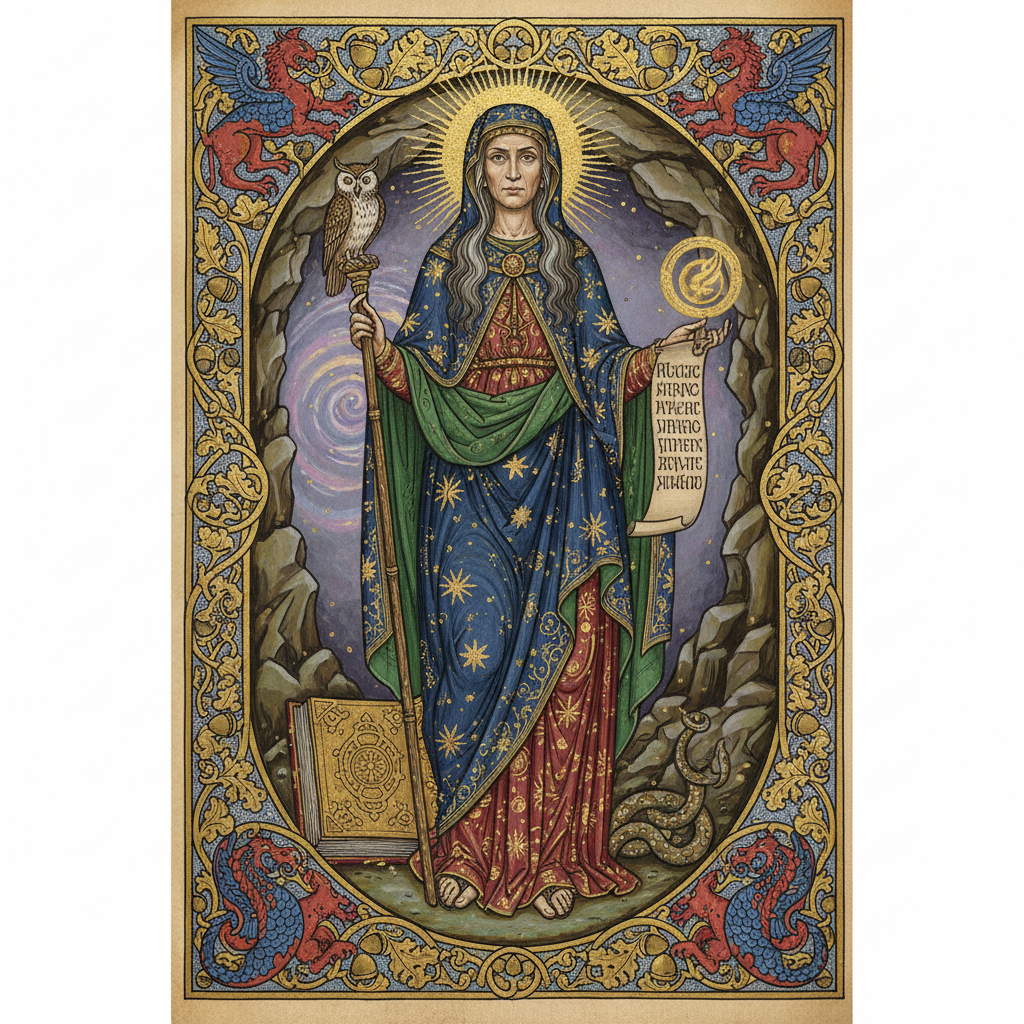
Apollo offered the Sibyl of Cumae as many years of life as she could hold grains of sand in her hand. She forgot to ask for youth. Over centuries, she withered until only her voice remained, sealed in a jar, whispering prophecies. When Aeneas sought passage to the underworld to meet his dead father, the Sibyl guided him through the gates of Avernus, past the Fields of Mourning, through Tartarus, to the Elysian Fields. The journey is the Roman template for every subsequent underworld descent — including Dante’s Inferno, where Virgil (who told the Sibyl’s story) guides the poet through Hell.
The Sibyl’s afterlife is as remarkable as her mythology. Augustine of Hippo quoted her as a pagan prophetess of Christ, arguing that her prophecies (contained in the Sibylline Books) predicted the coming of a divine king. The medieval Dies Irae — the great hymn of the Last Judgment — opens: “Dies irae, dies illa / Solvet saeclum in favilla / Teste David cum Sibylla” (“Day of wrath, that day / shall dissolve the world in ashes / as David and the Sibyl testify”). David and the Sibyl, side by side, as witnesses to the end of the world. Michelangelo painted her on the Sistine Chapel ceiling alongside Isaiah, Jeremiah, Ezekiel, and Daniel — a pagan prophetess among the biblical prophets, by order of the Pope. No other pagan figure achieved this.
Compare: The Delphic Oracle (Greek prophetic tradition); the Volva (Norse seeress who prophesies Ragnarok in the Voluspa); Cassandra (the prophetess cursed to be disbelieved); Samuel’s ghost at Endor (1 Samuel 28).
1 min read
Apollo (who cursed her); time itself (her punishment was the cruelty of endless aging)
Virgil, *Aeneid* VI; Ovid, *Metamorphoses* XIV.130-153; Augustine, *City of God* XVIII.23; the *Dies Irae* (medieval hymn)