Combat Profile
Threshold Vision
See all possible futures and pasts simultaneously, allowing strategic manipulation of outcomes at critical junctures.
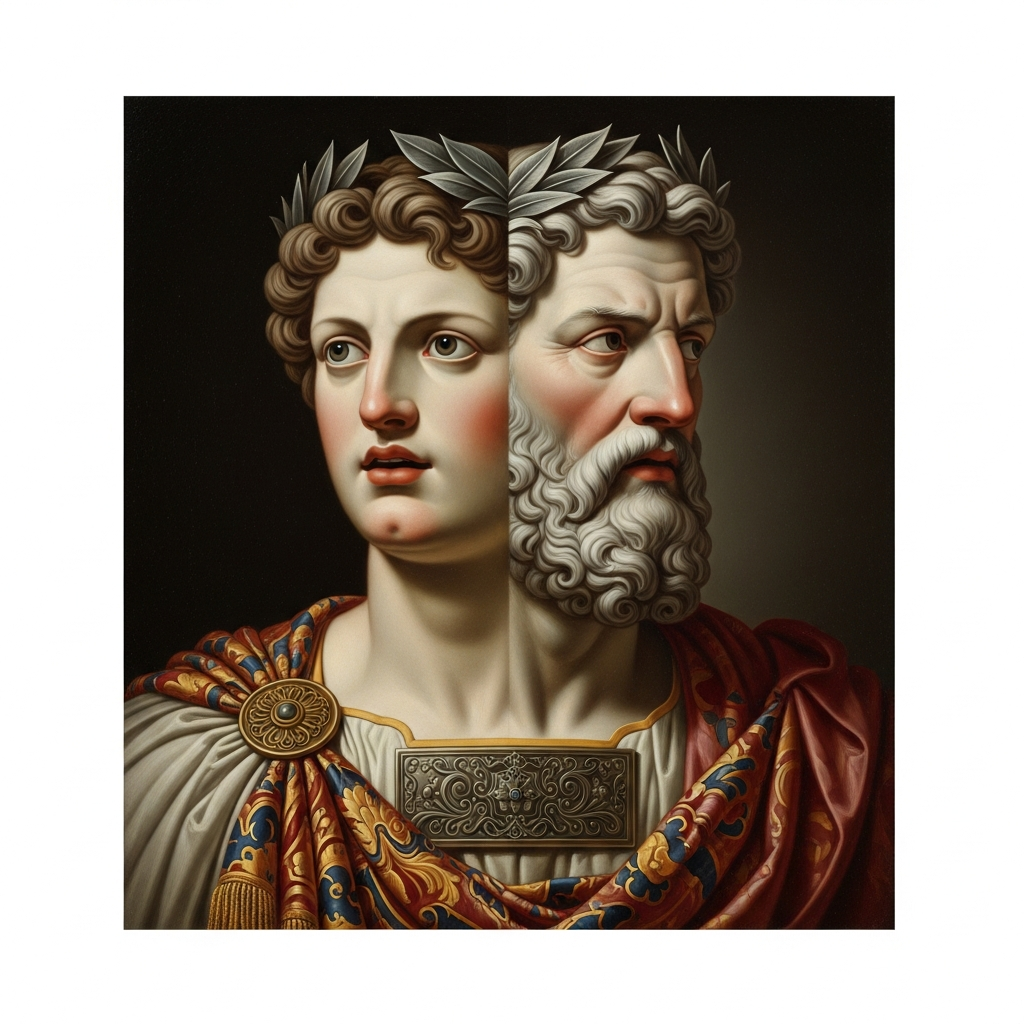
Dual Perspective
Perceive both the beginning and end of all things at once, granting immunity to surprise and deception.
No mythology of his own -- purely functional; faded as Rome Christianized
“I sit at the gate of heaven. I control the comings and goings of both gods and men.” — Ovid, Fasti I.117-18
Janus is the oldest and most distinctly Roman of all the gods — he has no Greek equivalent. His two faces look simultaneously forward and backward, into the past and future, at entrances and exits. January is named for him. Every Roman prayer began with Janus, regardless of which god was being addressed — he was the opener of all things, the god who had to be invoked first. The gates of his temple in the Forum were open in wartime and closed in peace (they were almost never closed). He presided over every transition: the beginning of the day, the beginning of the year, the beginning of any enterprise. In the deepest sense, Janus is the god of liminality — the sacred in-between.
As a threshold god, Janus belongs to a cross-cultural family of divine gatekeepers. He shares his function with Eshu/Elegba (Yoruba — the trickster of the crossroads who must be propitiated before any other orisha), Papa Legba (Vodou — the gatekeeper between the human and spirit worlds), and Ganesh (Hindu — the remover of obstacles invoked at the beginning of any undertaking). The pattern is consistent: before you can reach the gods, you must pass through the gate. Someone guards the gate. That someone must be honored first.
Compare: Eshu/Elegba (Yoruba crossroads god); Papa Legba (Vodou gate-opener); Ganesh (Hindu remover of obstacles); St. Peter (who holds the keys to heaven’s gate).
1 min read
Christianity (which replaced his calendar functions with saints' days)
Ovid, *Fasti* I; Macrobius, *Saturnalia* I.9; Varro, *De Lingua Latina*