Combat Profile
Sparagmos
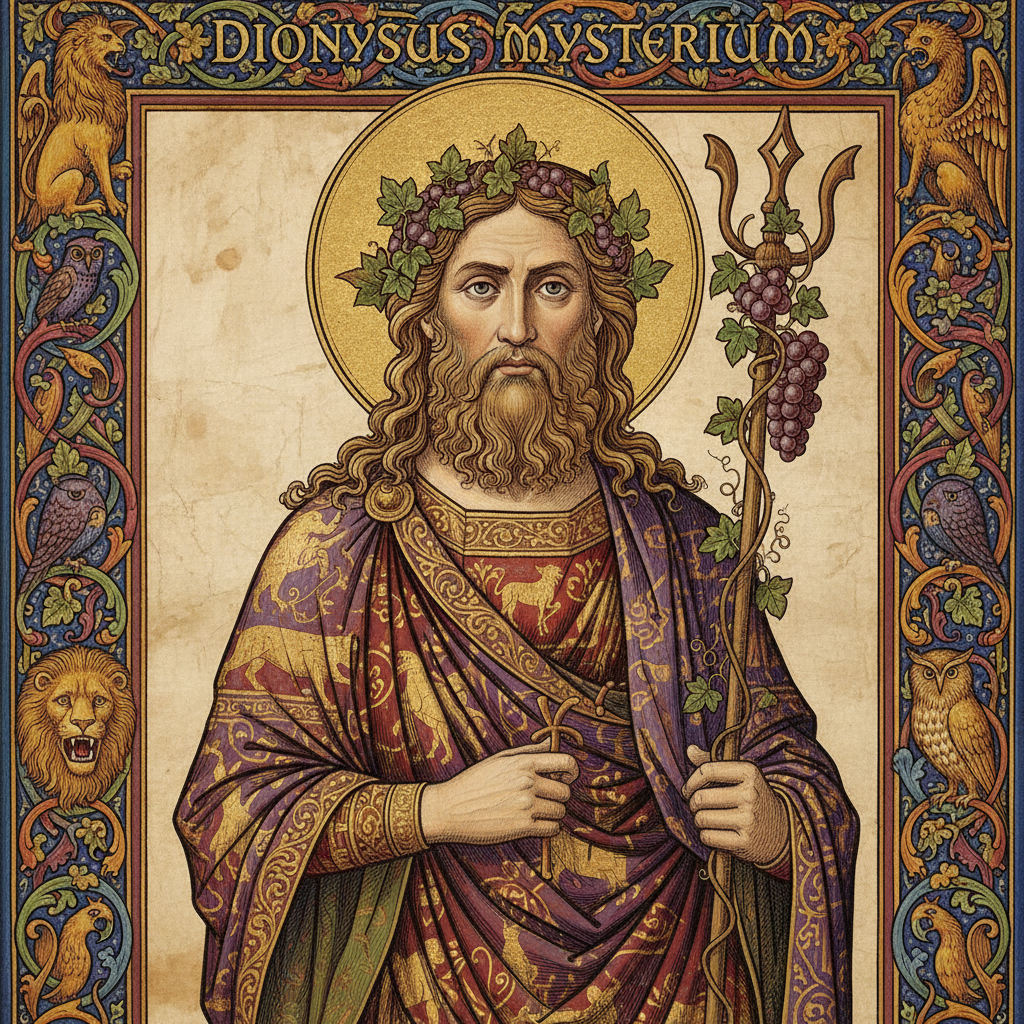
Dionysus tears reality and his enemies asunder, only to resurrect them transformed and bound to his ecstatic will.
Divine Madness
All who perceive Dionysus experience intoxicating euphoria and loss of rational control, making them unpredictable allies or enslaved thralls.
The Romans feared his cult's social disruption -- the Bacchic suppression of 186 BC
“He who does not eat of my body and drink of my blood, so that he will be made one with me and I with him, the same shall not know salvation.” — Attributed to Dionysus in Orphic tradition
This is not the jolly wine god of popular imagination. The mystery cult version of Dionysus is one of the most disturbing and theologically significant figures in the ancient world. As an infant, the Titans dismembered and devoured him (sparagmos). Athena saved his heart. Zeus reconstituted him — hence “twice-born” (dithyrambos). In the Bacchic mysteries, initiates reenacted this through the ritual tearing apart and consuming of raw flesh (omophagia) — symbolically consuming the god to achieve union with him. Wine was understood as the god’s blood. Drinking wine in the ritual context was drinking the divine.
The parallels to the Eucharist are the most direct of any mystery cult: wine as the blood of a god who died, was torn apart, and rose again; consuming the god’s body to achieve mystical union; ecstatic spiritual experience as proof of divine indwelling. The Bacchic mysteries were so threatening that the Roman Senate banned them in 186 BC — the Senatus Consultum de Bacchanalibus is one of the earliest recorded religious suppressions, with thousands arrested and many executed. Dionysus was the god who could not be controlled, the god of boundary-crossing, the god who dissolved the line between human and divine. The early Church claimed the same power — and managed to institutionalize it.
Compare: The Eucharist (wine = blood of God who was killed and rose); Pentecostal ecstasy (divine madness, glossolalia); Soma/Haoma (the divine intoxicant of Vedic/Zoroastrian tradition); Christ (the god who was consumed by his followers).
1 min read
The Roman Senate (*Senatus Consultum de Bacchanalibus*); Pentheus (who tried to suppress him and was torn apart)
Euripides, *The Bacchae*; Ovid, *Metamorphoses*; Livy XXXIX.8-19; Walter Burkert, *Ancient Mystery Cults*