Combat Profile
Threshold Covenant
grants the petitioner a single transformative skill or forbidden knowledge in exchange for a binding spiritual debt or sacrifice
Liminal Anchor
exists simultaneously in the physical and spiritual realms, enabling all forms of contact between the living and the dead
The crossroads does not give freely. Everything acquired there has a price, even if the price is not immediately apparent. The deal is always binding. The crossroads remembers
“You go to the crossroads at midnight. You bring your guitar. A big black man will come and take it from you. He’ll tune it. He’ll hand it back. You can play anything. But you don’t ask what it costs.”
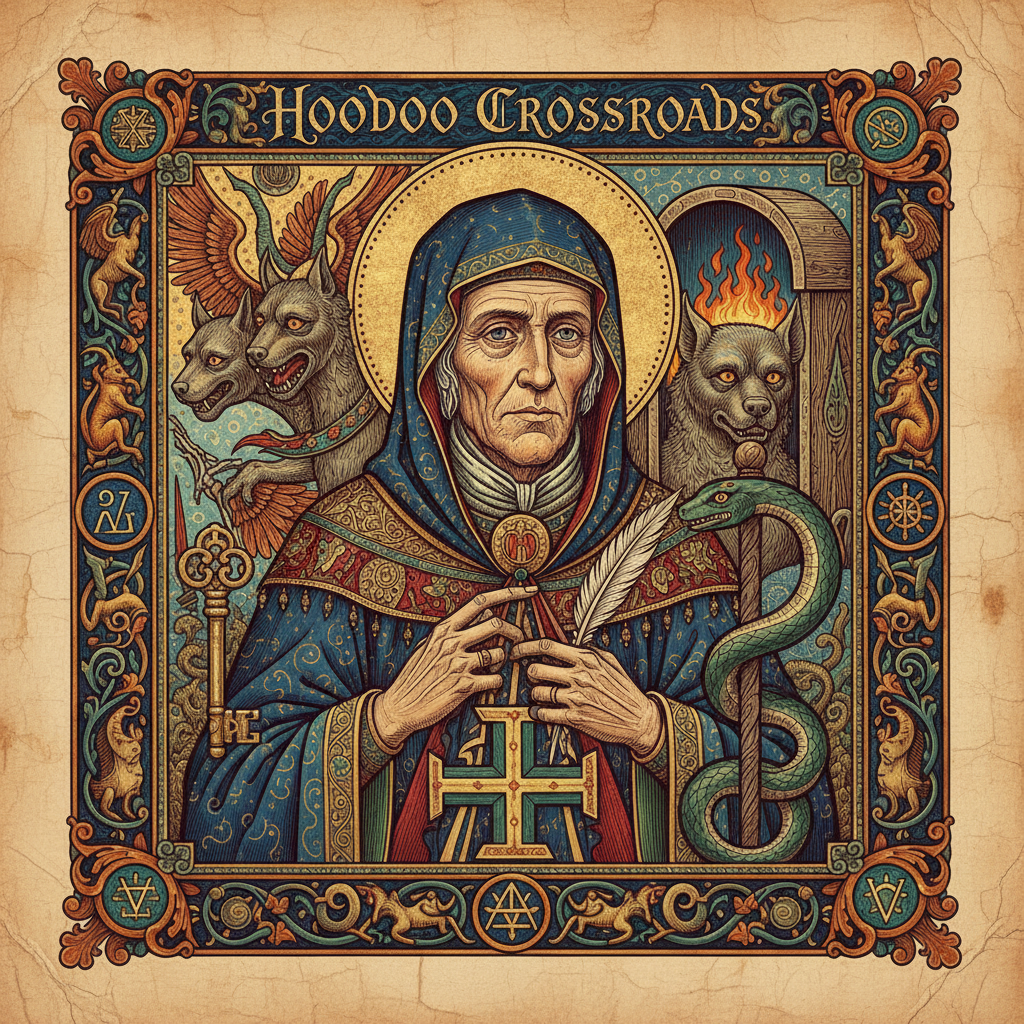
Lore: The crossroads in Hoodoo is the most charged point in the spiritual landscape — the place where two roads meet and the boundary between the human world and the spirit world thins to nothing. The practice is specific: you go to a crossroads at midnight, alone, for nine consecutive nights (some say thirteen). On the final night, a figure appears — “the man in black,” “the devil,” or simply “him” — and offers you mastery of whatever skill you desire. Guitar, fiddle, cards, dice, preaching, healing, gambling. He takes the instrument from your hands, tunes it, and hands it back. You can play anything. The price is your soul, though the transaction is never that simple in practice — the crossroads deal is less a Faustian contract and more a transformation. You leave something of yourself at the intersection and walk away changed.
The most famous crossroads story is Robert Johnson’s. The Mississippi Delta blues guitarist, whose 29 recordings between 1936 and 1937 are among the most influential in American music history, was said to have acquired his supernatural guitar skill through a midnight crossroads deal. Johnson himself encouraged the legend. His music — “Cross Road Blues,” “Me and the Devil Blues,” “Hellhound on My Trail” — is saturated with crossroads imagery. He died at 27 under mysterious circumstances (poisoned, most likely, by a jealous husband). The crossroads legend made him immortal.
But the crossroads in Hoodoo is far older than Robert Johnson and far more complex than a “deal with the devil.” The concept descends directly from Kongo cosmology (Chireau, Black Magic), where the crossroads (yowa) represents the intersection of the world of the living and the world of the dead — a cosmogram that is one of the most important symbols in Central African spiritual thought. It is also cognate with Eshu’s crossroads in Yoruba tradition and Papa Legba’s gate in Haitian Vodou. The “man in black” at the Hoodoo crossroads is NOT Satan in any Christian theological sense — he is a survival of the African spirit of the threshold, filtered through centuries of American reinterpretation. But the identification with the devil was useful: it gave the practice the charge of the forbidden, which made it more powerful.
Parallel: The crossroads maps across nearly every tradition in this compendium. Eshu/Elegba (Yoruba) is the divine guardian of the crossroads who must be honored before any spiritual work can proceed. Papa Legba (Haitian Vodou) opens the gate between worlds at the crossroads. Hecate (Greek) is the goddess of the crossroads, associated with magic, witchcraft, and the liminal. Hermes (Greek) is the god of roads and boundaries, the guide of souls. The Faust legend (European) is the crossroads deal in its Germanic form — knowledge in exchange for the soul. But the Hoodoo crossroads is distinctive because it is democratic: you don’t need a priest, an initiation, or special knowledge. You just need to show up, alone, at midnight, and be willing to pay the price.
2 min read
Daylight and community. The crossroads works in darkness, at midnight, alone. Its power is the power of the threshold, and thresholds lose their charge when the boundary between here and there dissolves
Hyatt, *Hoodoo-Conjuration-Witchcraft-Rootwork*; Chireau, *Black Magic*; Adam Gussow, *Seems Like Murder Here: Southern Violence and the Blues Tradition* (2002)