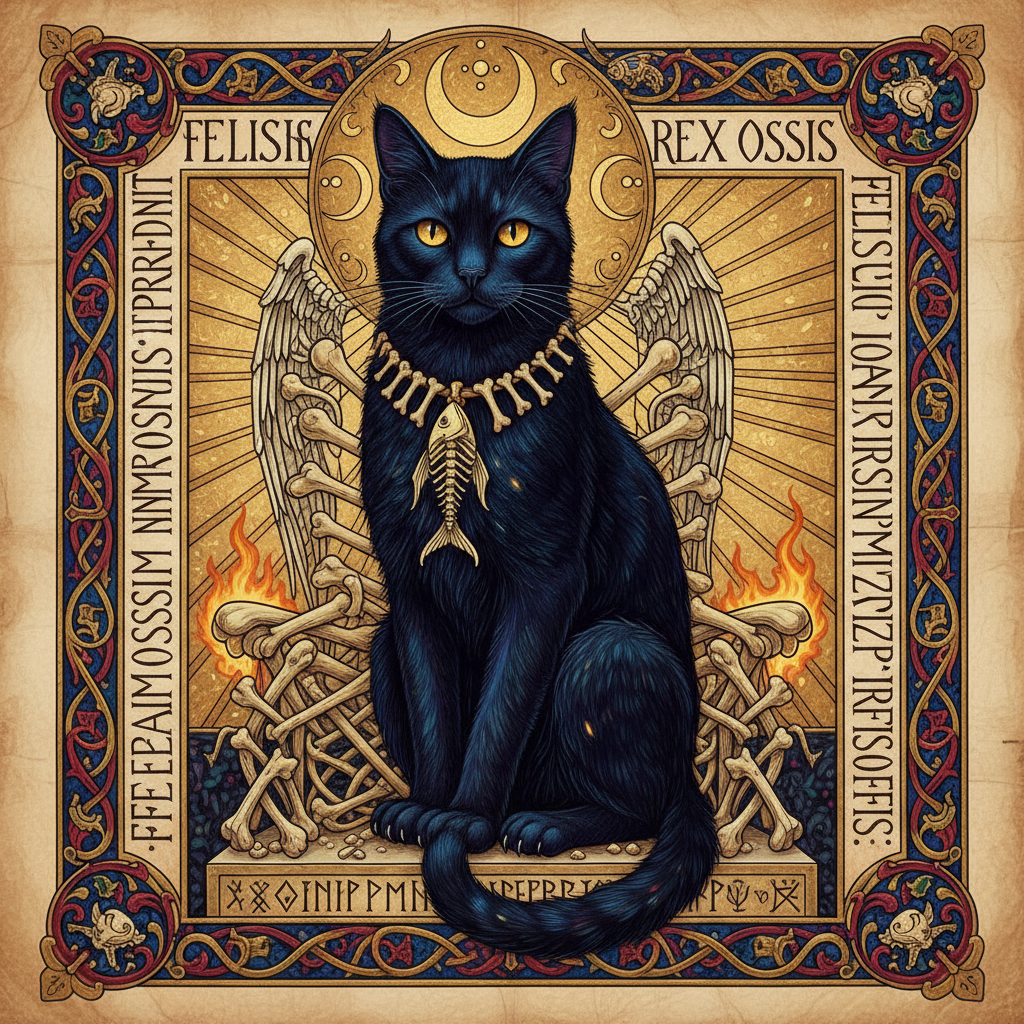
Combat Profile
Unseen Fortune
grants the wielder invisibility to detection and supernatural luck in games of chance, tipping odds toward their favor
Dark Magnetism
constantly emanates an aura that draws desire and obedience from those nearby, making persuasion and seduction nearly impossible to resist
The moral cost. The ritual requires the death of a black cat, which many modern practitioners refuse to perform. The power is said to come with a spiritual debt that eventually comes due. The bone must be identified correctly during the ritual -- choosing the wrong bone gives nothing
“There’s a bone in that cat that’ll make you invisible. But you got to find the right one, and finding it costs more than most people want to pay.”
Lore: The Black Cat Bone is the most infamous ritual object in Hoodoo, and it represents the tradition’s willingness to go where respectable religion will not. The traditional ritual is brutal: a black cat is killed (in the most commonly recorded versions, boiled alive — though many modern accounts insist the cat should be found already dead), and the bones are taken to a stream at midnight. Each bone is placed in the running water. Most float downstream, as bones do. But one bone — one specific bone — floats upstream, against the current. This bone, defying natural law, carries supernatural power. It is the Black Cat Bone, and the person who possesses it gains abilities: invisibility (not literal, but the ability to pass unnoticed, to be overlooked, to move through the world without attracting attention), luck at gambling, sexual magnetism, and the power to dominate others.
The practice is recorded extensively in Hurston’s fieldwork in the 1930s and in Hyatt’s massive multi-volume survey of Hoodoo practitioners. It is also one of the most controversial aspects of the tradition. Many modern rootworkers refuse to perform the ritual, considering it unnecessarily cruel, and substitute commercially available “black cat bones” (which are not cat bones at all but small carved talismans or raccoon bones). The debate mirrors a broader tension in Hoodoo: how far are you willing to go? Hoodoo is not a tradition that flinches from difficult spiritual work — it was born in slavery, and survival sometimes required ruthlessness. But it is also a tradition that recognizes costs. Power acquired through cruelty carries a debt.
Parallel: The Black Cat Bone maps onto a cross-cultural pattern of ritual objects acquired through transgressive acts. Solomon’s Ring (Hebrew/Islamic) gave the king power over all demons but was obtained through an angelic transaction that carried divine consequences. The Tarnkappe (Norse mythology) was Siegfried’s cloak of invisibility, taken from the dwarf Alberich by force. The Hand of Glory (European folk magic) was a dried and pickled hand of a hanged man, used as a candle to freeze everyone in a household while the bearer robbed them. In all these cases, the power object is obtained through an act that crosses a moral boundary, and the crossing is part of what charges it. The Black Cat Bone is Hoodoo’s version of this universal pattern: power that costs something terrible.
2 min read
Spiritual sight. The invisibility is not physical but social -- the bearer passes unnoticed, overlooked, forgotten. Anyone with strong spiritual discernment can see through it. Protection work (Psalm 91, uncrossing) can break its effects on a target
Hurston, *Mules and Men*; Hyatt, *Hoodoo-Conjuration-Witchcraft-Rootwork*; Chireau, *Black Magic*