Deborah Under the Palm
Judges 4–5 · c. 1150 BCE traditional · The hill country of Ephraim; Mount Tabor; the tent of Jael
Contents
A prophet named Deborah sits under a palm tree between two cities and adjudicates for all Israel. She summons a general, tells him God has ordered him to march, and when he refuses to go without her she goes — and warns him: the glory of this battle will belong to a woman. She is right. Just not the woman he expects.
- When
- Judges 4–5 · c. 1150 BCE traditional
- Where
- The hill country of Ephraim; Mount Tabor; the tent of Jael
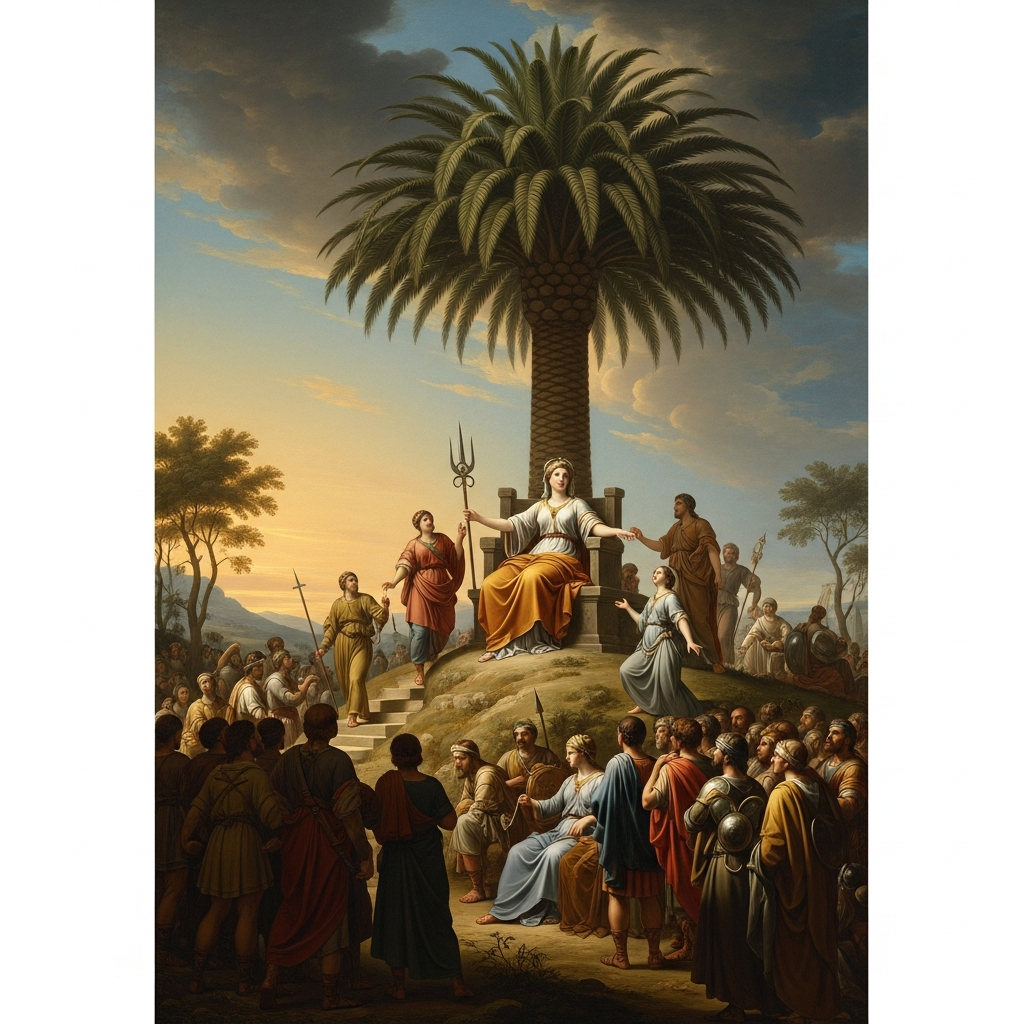
She sits under a palm tree and all Israel comes to her.
This is stated as a simple fact: the palm of Deborah, between Ramah and Bethel in the hill country of Ephraim, and the Israelites come up to her for judgment. The verb is not past tense; it is ongoing, imperfective — they keep coming. She has been here before today. She will be here tomorrow. The palm is hers the way a throne room belongs to a king, except she has no walls around her and no guards at a gate. The road comes to her and she adjudicates.
She is prophetess — the word is neviiah, feminine form of navi, and the text applies it without qualification or explanation. She is woman of fire — eshet lappidot, another possible translation, woman of torches — and she is shofet, judge, the same title given to Gideon and Samson and all the rest of the judges in this book, except none of them are also prophets, and none of them explicitly govern the whole of Israel. Deborah does both. The text records neither surprise nor controversy at this arrangement.
Then she summons a general.
His name is Barak son of Abinoam, from Kedesh in Naphtali. She calls him to her under the palm and delivers a military oracle with the confidence of someone who has checked her information with the highest authority available:
Has not YHWH the God of Israel commanded? Go, deploy to Mount Tabor and take ten thousand men from Naphtali and Zebulun. And I will draw Sisera, the commander of Jabin’s army, to you at the Kishon River — his chariots, his troops — and I will give him into your hand.
Sisera commands nine hundred iron chariots. Iron is the new technology. The Israelites in this period do not yet reliably smelt it. Nine hundred iron chariots on flat ground is an overwhelming advantage, the ancient equivalent of mechanized armor against infantry. The valley of Jezreel is flat ground. Barak is being told to go fight iron chariots with ten thousand foot soldiers on terrain that favors the chariots, and the authority ordering him is a woman under a palm tree in the hill country.
He says yes. With a condition.
If you go with me, I will go. If you do not go with me, I will not go.
There are centuries of argument about what this means.
Is Barak showing cowardice, needing a prophet’s presence to steel his nerve? Is he showing wisdom, refusing to advance without divine guidance? Is he showing respect for Deborah’s authority, insisting that the source of the oracle be present at its fulfillment? The text does not judge him directly. It lets Deborah judge him.
I will certainly go with you. But the road you are traveling will bring you no glory, for YHWH will give Sisera into the hand of a woman.
She says this evenly, as a statement of fact, and then she gets up. She does not add commentary. She does not linger on the rebuke, if it is a rebuke. She gets up and goes with Barak to Kedesh, and Barak musters Zebulun and Naphtali — ten thousand men — and goes up with ten thousand at his heels, and Deborah goes up with him.
She does not carry a weapon. The text does not suggest she fights. She is the instruction made present, the divine mandate walking at the head of the column in human form.
Sisera gets the intelligence report: Barak has deployed to Mount Tabor.
He mobilizes his nine hundred iron chariots and all the troops at his command from Harosheth-hagoiim to the Kishon River. He is coming down the valley to destroy ten thousand men on foot, exactly as he has done before. He is experienced. He is equipped. He is reasonable to be confident.
The moment is Deborah’s.
Get up. For this is the day YHWH gives Sisera into your hand. Has not YHWH gone out before you?
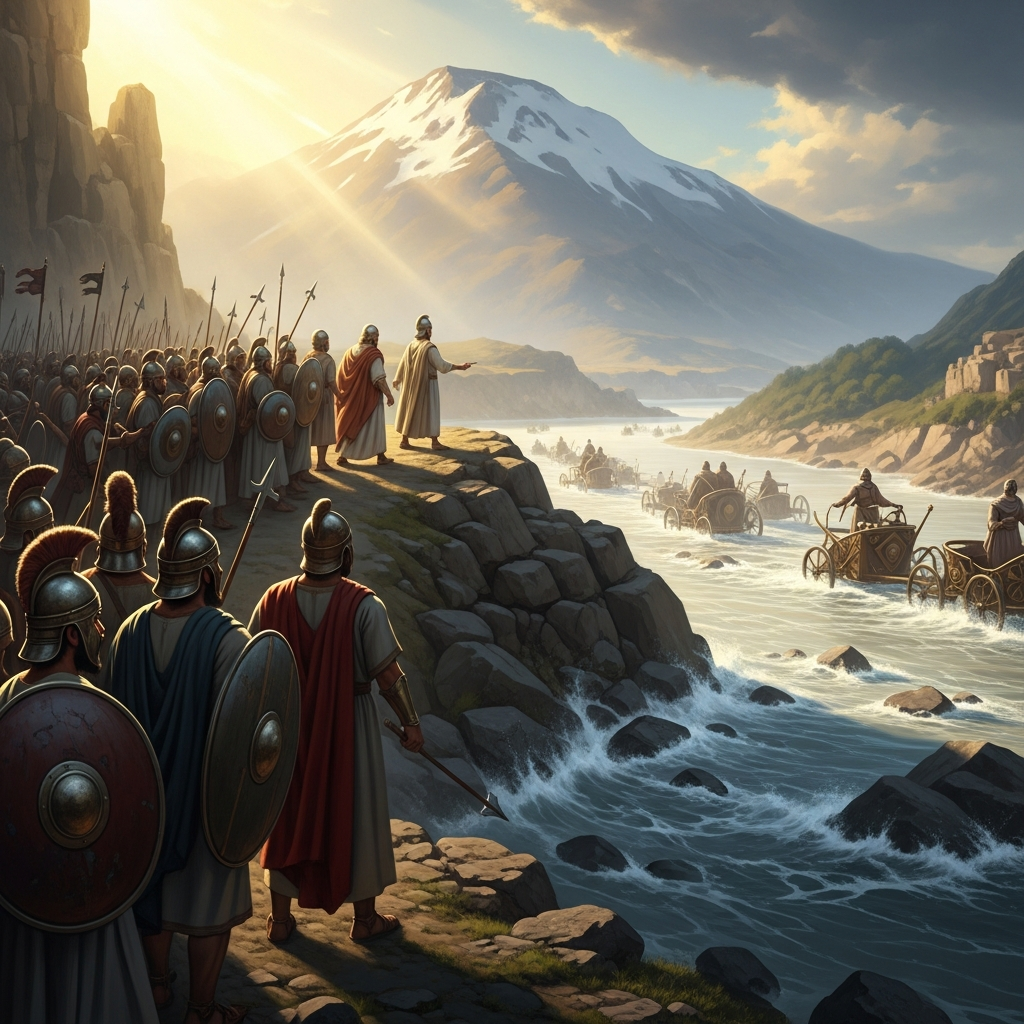
Barak goes down from Mount Tabor with ten thousand men behind him. Something happens at the Kishon River that the prose account does not fully explain and the Song of Deborah explains in its own way: From heaven the stars fought, from their courses they fought against Sisera. The river Kishon swept them away, the ancient river, the river Kishon.
The chariots are in the mud. Iron chariots that ruled the valley are now bogged in the swollen riverbed, the technological advantage erased by water and timing. Sisera’s army breaks. Barak’s forces pursue them all the way to Harosheth-hagoiim. Every last one falls by the sword. Not one is left.
Except Sisera.
The general flees on foot.
He runs until he reaches the tent of Jael, the wife of Heber the Kenite. There is a peace treaty between her household and the king Sisera serves. He considers this a safe harbor. He turns in at her tent.
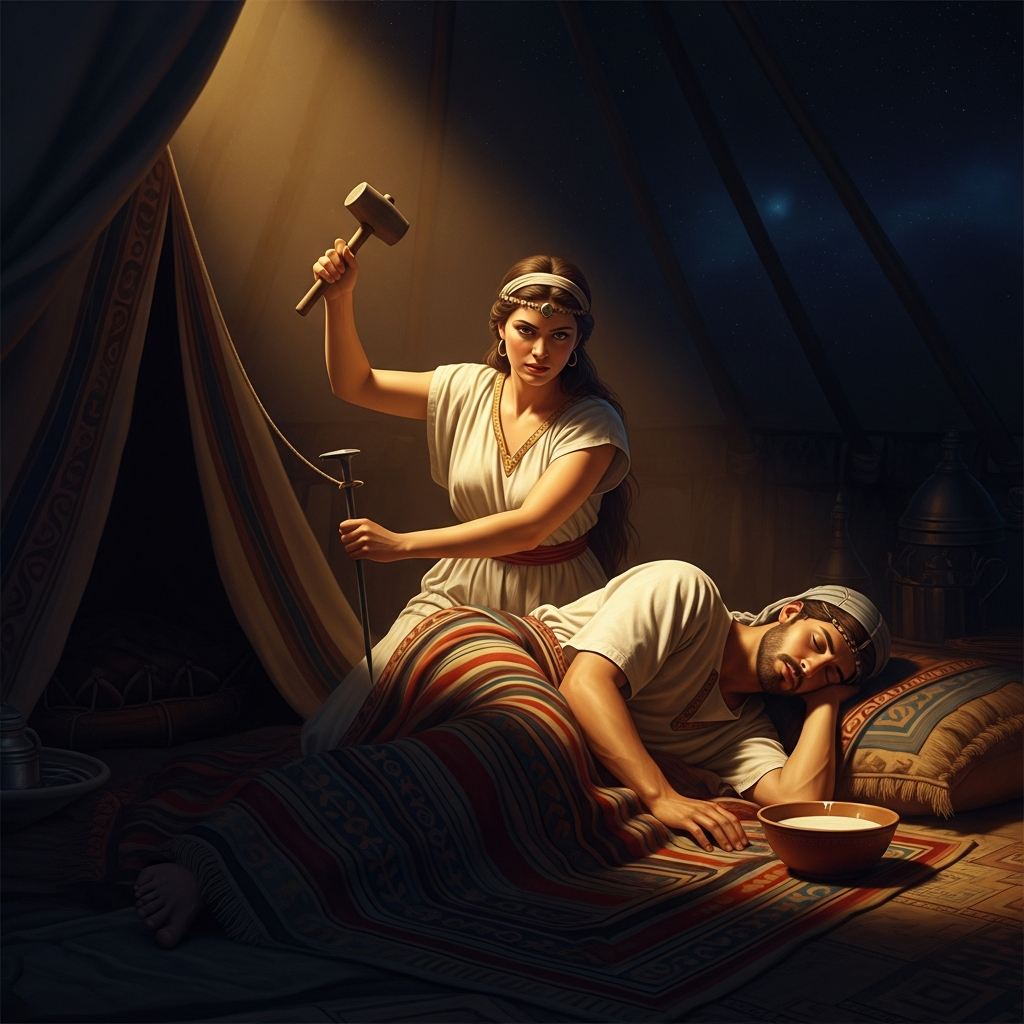
Jael comes out to meet him. Turn in, my lord. Turn in to me; do not be afraid. He turns in to her tent and she covers him with a rug. He asks for water; she opens a skin of milk and gives him a drink and covers him again. He tells her: stand in the door of the tent. If anyone asks if there is a man here, say no. He is asleep before she answers.
She takes a tent peg. She takes a mallet in her hand. She comes to him quietly and drives the tent peg through his temple and into the ground. He dies.
When Barak comes past in pursuit, Jael goes out to meet him: Come and I will show you the man you are looking for. He enters the tent and there is Sisera, dead, with the tent peg through his temple.
The Song of Deborah is old.
Scholars date it among the oldest texts in the entire Hebrew Bible — possibly tenth or eleventh century BCE, possibly earlier, a piece of archaic poetry that predates the prose account in Judges 4 by centuries. It was sung before it was written. It was memorized before it was scrolled. The Song does not soften Jael. The Song celebrates her with specific and startling intensity:
Most blessed of women is Jael, the wife of Heber the Kenite. Most blessed of women in the tent. He asked for water; she gave him milk. In a princely bowl she brought him curds. Her hand reached for the tent peg, her right hand for the workman’s mallet. She struck Sisera; she crushed his head; she shattered and pierced his temple.
Then the Song does something remarkable. It cuts to Sisera’s mother, waiting at the window, looking for her son’s chariot through the lattice. Her attendants find reassuring words: he is dividing the spoil — women for every man, embroidered cloth. He is delayed by the magnitude of his victory. He will come.
He does not come.
The Song holds both women in the same frame. The tent peg and the lattice. Jael with the mallet and the mother at the window. The woman who acts and the woman who waits for news that will not arrive as she expects it. It is one of the oldest pieces of writing in the world and it understands things about war that have not changed in three thousand years.
Deborah did not pick up a weapon. She sat under a palm tree and spoke the word of God and then walked beside a general who would not march without her. The battle was decided before anyone drew a sword. The glory went to women, as she said it would, because the shape of the story had been determined by a woman before the first soldier left camp.
The palm tree is still there, in the oldest layers of the text, the place where all Israel came for judgment — not to a palace, not to a temple, but to a woman who sat in the open air and knew what God had decided.
Scenes
She sits under the Palm of Deborah between Ramah and Bethel in the hill country of Ephraim
Generating art… Ten thousand men of Zebulun and Naphtali march to Mount Tabor
 Generating art…
 Sisera, the greatest commander in Canaan, sleeps in a woman's tent
 Generating art…
 Echoes Across Traditions
Entities
- Deborah
- Barak
- Jael
- Sisera
- YHWH
Sources
- Judges 4–5 (Robert Alter trans., *The Hebrew Bible: The Early Prophets*, 2013)
- Phyllis Trible, *Texts of Terror* (1984)
- Adele Berlin and Marc Zvi Brettler, eds., *The Jewish Study Bible* (2nd ed., 2014)
- Susan Niditch, *Judges: A Commentary* (OTL, 2008)