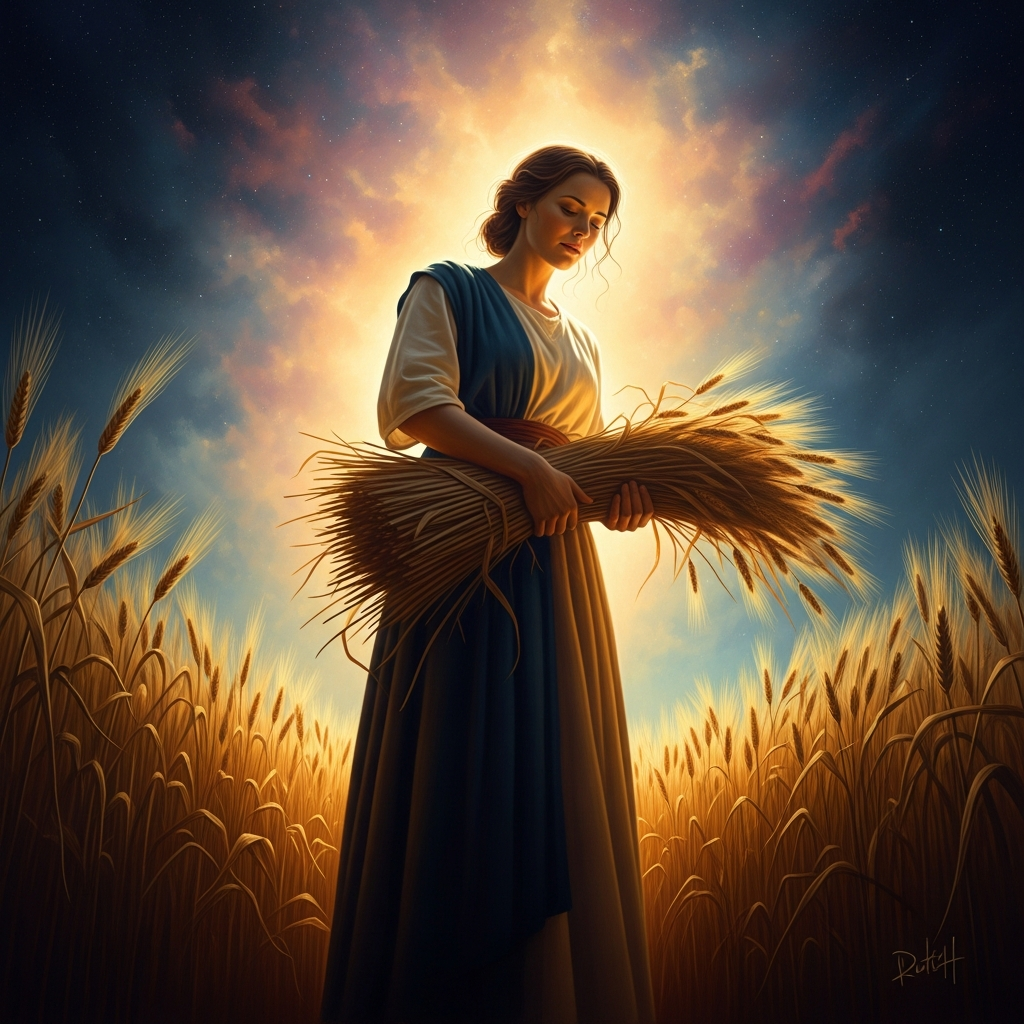
Ruth and Naomi
The era of the Judges · ~12th-11th century BCE · Moab and Bethlehem in Judah, during the barley harvest
Contents
A widowed Moabite refuses to leave her widowed mother-in-law, follows her into a foreign country, gleans grain in the field of a kinsman she has never met, and walks into the bloodline of David and the Christ.
- When
- The era of the Judges · ~12th-11th century BCE
- Where
- Moab and Bethlehem in Judah, during the barley harvest
Naomi loses everything in Moab.
She came as a refugee — famine had emptied Bethlehem, and she crossed the Dead Sea with her husband and two boys looking for grain. The boys grew up in Moab and married Moabite women, Orpah and Ruth. Then her husband died. Then both her sons died. Three women in one house, all of them widows, all of them childless, no men left to feed them.
Naomi hears the famine has lifted in Judah. She rises to go home. Orpah and Ruth start out with her on the road, and Naomi turns and tells them to go back. “Return each of you to your mother’s house. The Lord deal kindly with you, as you have dealt with the dead.”
Orpah weeps and goes. Ruth does not.
“Entreat me not to leave thee.”
The most quoted sentence in the book. Ruth says it on the road in Moab, with her husband three months in the ground, the empty country of her mother-in-law lying across the Salt Sea ahead, and nothing waiting for her there but more poverty.
“Whither thou goest, I will go; and where thou lodgest, I will lodge: thy people shall be my people, and thy God my God: where thou diest, will I die, and there will I be buried.”
It is a marriage vow with no husband. Naomi cannot offer her a future, a son, a roof — she has none of these. Ruth swears to her anyway. The word the Hebrew uses is hesed: covenant-loyalty beyond what the contract requires. The book of Ruth is the longest commentary on that word in the Bible.
They walk to Bethlehem together. Naomi tells the women at the gate: “Call me not Naomi, call me Mara — bitter.”
Ruth goes out to glean.
The Torah commands that the corners of every field be left for the poor, and that fallen sheaves not be picked up. Ruth is a Moabite, a foreigner, a widow — three reasons to be turned away — and she walks into a field at random and starts gathering what the reapers leave behind.
The field belongs to Boaz.
He notices her by mid-morning. He asks his foreman who she is. The foreman tells him. Boaz walks across the stubble to her and tells her not to glean anywhere else — to stay in his field, to drink from his water jars, to eat at his table at noon. “Why have I found grace in your eyes, that you should take notice of me, seeing I am a foreigner?”
He has heard about her. The whole town has heard about her. The Moabite who would not leave the bitter old woman from Bethlehem.
“The Lord recompense your work,” he says, “under whose wings you have come to take refuge.”
Naomi sees the grain Ruth carries home and recognizes the man’s hand in it.
“Boaz is our kinsman,” she says — and a kinsman, by the Levirate law, can redeem the family. He can marry the widow, raise a son in the dead husband’s name, and keep the family land in the family. Naomi sends Ruth to the threshing floor at night, washed and anointed, in her best clothes, to lie at Boaz’s feet while he sleeps after the winnowing.
Boaz wakes at midnight to find a woman at his feet.
“Who art thou?”
“I am Ruth thine handmaid: spread therefore thy skirt over thine handmaid; for thou art a near kinsman.”
He covers her with his cloak. He tells her there is a kinsman closer than he is, and the law must be honored — but if that man will not redeem her, he himself will, as the Lord lives. He sends her home before dawn with six measures of barley so she will not return to Naomi empty-handed.
The closer kinsman declines at the gate the next morning.
He cannot afford to redeem the field and the widow both — taking Ruth would mean raising a son who would inherit in the dead man’s name, not his own. He pulls off his sandal in the customary gesture and gives the right of redemption to Boaz. The elders at the gate witness it. “The Lord make the woman that is come into thine house like Rachel and like Leah, which two did build the house of Israel.”
Boaz marries Ruth.
She bears a son. The women of Bethlehem come to Naomi, who only a year ago had told them to call her Bitter, and they say: “Blessed be the Lord, which hath not left thee this day without a kinsman. He shall be unto thee a restorer of life, and a nourisher of thine old age. For thy daughter in law, which loveth thee, which is better to thee than seven sons, hath born him.”
Naomi takes the child. She lays him in her bosom. The women name him Obed.
The book closes with a genealogy.
Obed begat Jesse. Jesse begat David.
The Moabite girl who would not leave her mother-in-law is the great-grandmother of the king who unites the tribes, and a thousand years later Matthew opens his gospel with her name in the line of Christ. The despised eastern tribe, the foreigner, the convert, the woman who chose loyalty when there was no contract requiring it — God’s covenant runs through her, openly, with the receipt printed at the back of the book.
The Hebrew Bible is full of dynasties built on conquest. The book of Ruth is the one that says the Davidic line was built on kindness — hesed, covenant-kindness, the loyalty that does not have to be there. A foreign widow swore it on a road in Moab. Three generations later there was a king. Three thousand years later we still read her name first, before his.
The corners of the field belong to the poor. That is the law. The book of Ruth is what happens when someone actually leaves them.
Echoes Across Traditions
Entities
- Ruth
- Naomi
- Boaz
- Obed
Sources
- *Ruth* 1-4 (Hebrew Bible / Tanakh)
- Robert Alter (trans.), *The Hebrew Bible* (2018)
- Tikva Frymer-Kensky, *Reading the Women of the Bible* (2002)
- Phyllis Trible, *God and the Rhetoric of Sexuality* (1978) — chapters on Ruth