Hannah at Shiloh
1 Samuel 1 · c. 1075 BCE traditional · Shiloh; the temple of YHWH
Contents
Hannah is childless and mocked, year after year, by her husband's other wife. At the temple at Shiloh she prays in such silent fury that the priest thinks she is drunk. She makes a vow: give me a son and I will give him back to you. Samuel is born. She hands him to the temple at age three. Then she sings — and seven centuries later, Mary will borrow almost every word.
- When
- 1 Samuel 1 · c. 1075 BCE traditional
- Where
- Shiloh; the temple of YHWH
Every year the family goes up to Shiloh.
Elkanah of Ephraim takes his wives — Peninnah and Hannah — to the temple of YHWH at Shiloh to sacrifice and worship. And every year at Shiloh, Peninnah provokes Hannah. The text is precise about the mechanism: Peninnah has children. Hannah does not. And Peninnah, year after year at the moment of the sacrifice, uses this difference like a blade. She irritates her — the Hebrew verb implies sustained goading, applied repeatedly to a raw place — to provoke her to anger, because YHWH has closed Hannah’s womb.
Elkanah tries. He gives Hannah a double portion of the sacrifice because he loves her. He says to her: Am I not more to you than ten sons? He means this tenderly. He does not understand that the question has no good answer. The grief of childlessness in the ancient world is not a wound that a husband’s love can close, because it is not only personal — it is social, theological, ontological. To be without children is to be cut off from the future, from the covenant, from the proof that you are blessed. Peninnah knows this. She twists the blade at the annual worship, when Hannah is already open.
Hannah weeps. She cannot eat.
She rises from the meal and goes to the temple.
Eli the priest is sitting on his seat by the doorpost of the temple of YHWH. Hannah comes in and stands before God and prays. She is in bitterness of soul. The text uses the word marah — bitterness, the same root as Naomi’s self-renaming after her losses. She weeps greatly.
And she makes a vow.
YHWH of hosts, if you will look upon the affliction of your servant and remember me and not forget your servant and give to your servant a male child, then I will give him to YHWH all the days of his life, and no razor shall touch his head.
The vow is a Nazirite dedication — the consecrated life of someone set apart for God’s service, which prohibits cutting the hair, drinking wine, touching the dead. She is promising to give God a son she does not have, consecrated in a manner she cannot fully foresee the consequences of, in exchange for the existence of that son. It is the most absolute transaction the human side of prayer can offer: everything I am asking for, given back, before the asking is answered.
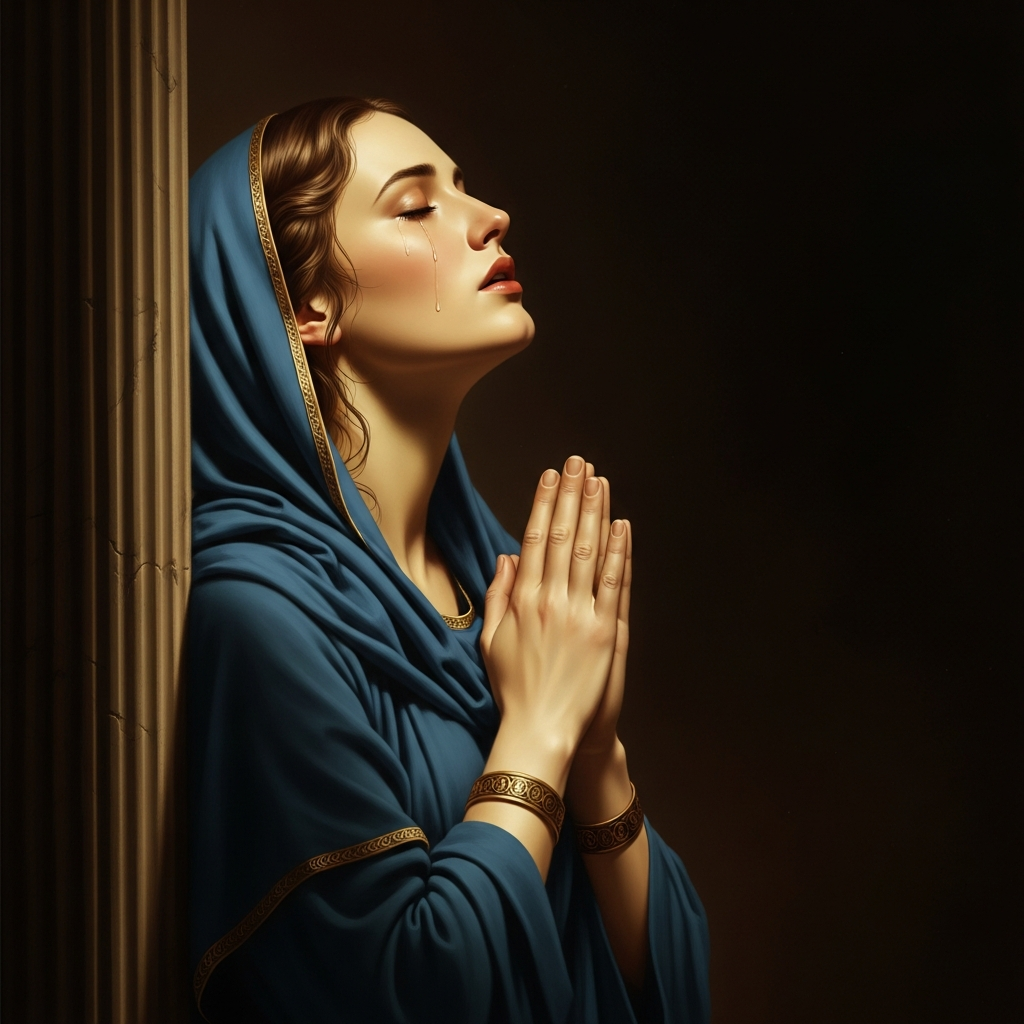
She prays this way a long time. Her lips move. No sound comes out.
Eli watches her from his seat and reads the situation incorrectly.
How long will you be drunk? Put your wine away from you.
This is not a minor mistake. Eli is the chief priest of the central sanctuary of Israel. He is the religious authority of his generation. He is watching a woman in the most intense private prayer the Hebrew Bible will ever record, and he mistakes it for public intoxication.
Hannah does not lose her composure.
No, my lord. I am a woman of troubled spirit. I have drunk neither wine nor strong drink. I have been pouring out my soul before YHWH. Do not take your servant for a worthless woman. I have been speaking all this time from the greatness of my anguish and my vexation.
The Talmud will spend centuries with this scene. The tractate Berakhot (31a) derives from Hannah’s silent prayer the entire Jewish law of kavvanah — interior intentionality in prayer, the requirement that the words of the heart precede and exceed the words of the mouth. Rabbi Elazar says: from Hannah we learn that a person who prays must direct their heart to heaven. From Hannah’s lips moving without sound, we learn that the essential act of prayer is interior. She invented, the rabbis say, the form. Not by instruction but by grief so urgent it outran her own voice.
Eli recalibrates. Go in peace. The God of Israel will grant what you have asked of him.
She goes back to the table. She eats. Her face is no longer the same.
Samuel is born.
She names him herself. The name means heard by God, or name of God, or — she explains — I asked him of YHWH. Because I asked him of YHWH. The name is the answer to the prayer embedded in a word the child will carry his whole life, so that every time someone calls him they are also saying: this is the child who was asked for, this is the child who was given.
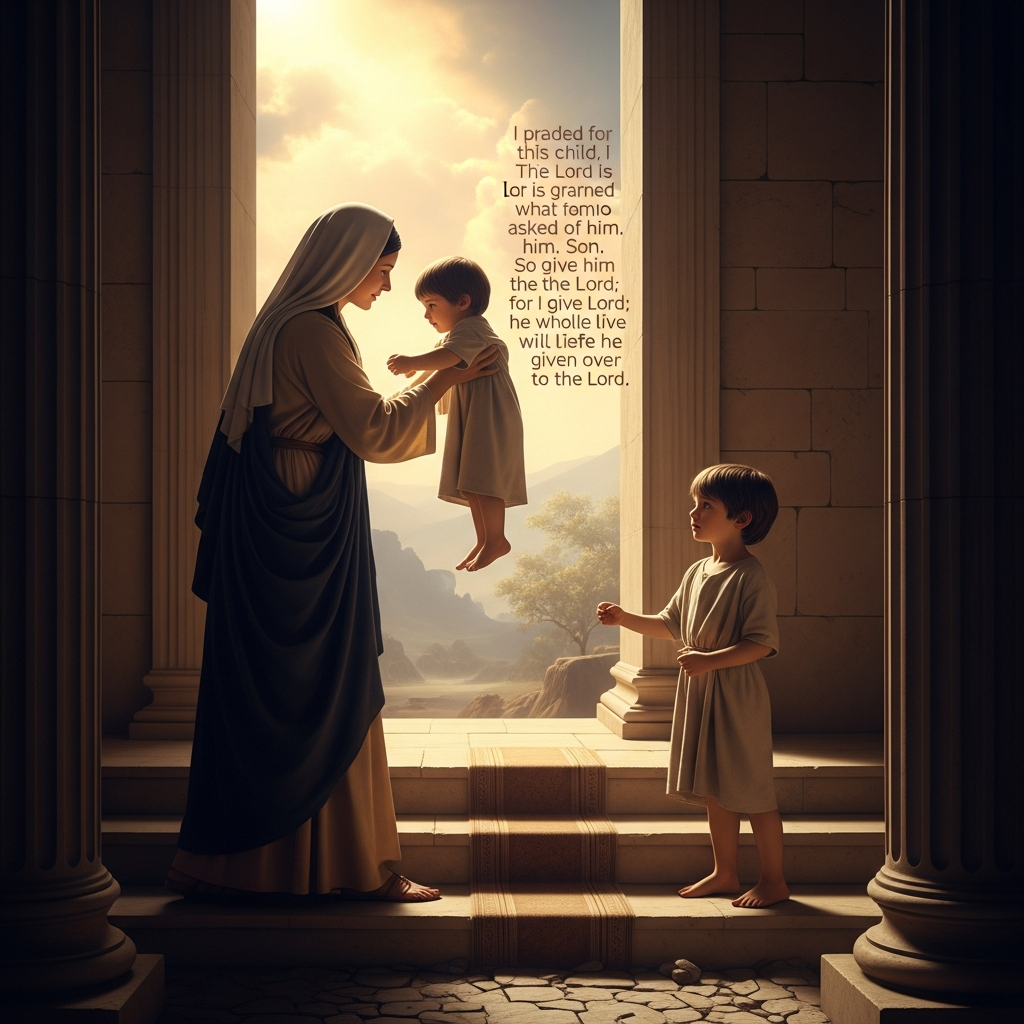
She does not go back to Shiloh the next year. She tells Elkanah: when the child is weaned I will bring him and he will appear before YHWH and dwell there forever. Elkanah says: do what seems good to you. She stays home and nurses Samuel until he is weaned — perhaps two or three years old — and then she brings him to Shiloh.
She brings a three-year-old bull, flour, a skin of wine. She slaughters the bull. She brings the child to Eli. She says:
As your soul lives, my lord, I am the woman who was standing here in your presence, praying to YHWH. For this child I prayed, and YHWH granted me what I asked of him. And I, for my part, have lent him to YHWH. All the days that he lives he is lent to YHWH.
She leaves him there. He is too young to understand what is happening. She goes home without him.
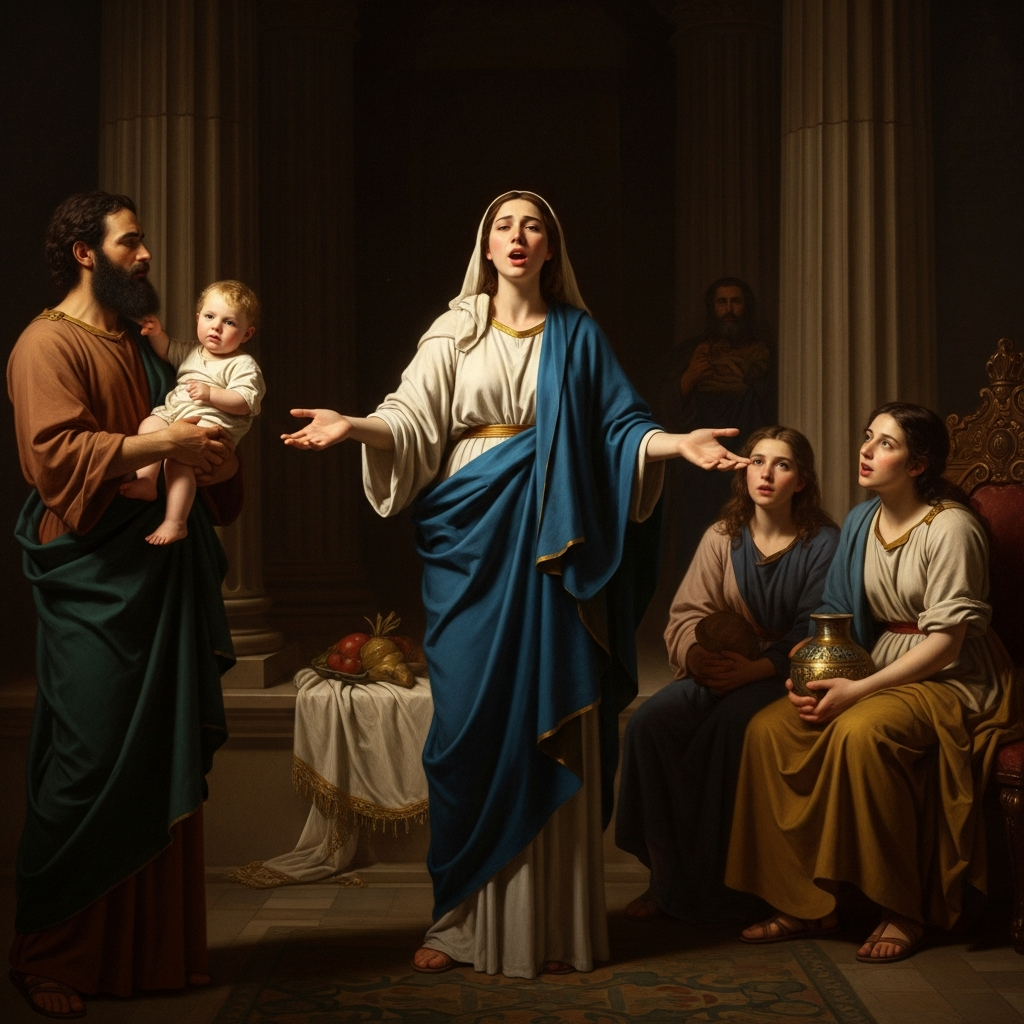
Then she sings.
The Song of Hannah is ten verses. She sings it at the temple, in public, before she goes home — before she walks back to Ramah without the child she nursed and asked for and gave away. She sings it in the present tense, in exultation, as if the grief of departure has already been subsumed into something larger.
My heart exults in YHWH. My horn is raised high by YHWH. My mouth is wide against my enemies, for I rejoice in your salvation. There is none holy like YHWH, for there is none beside you, and there is no rock like our God.
She sings about reversals. The proud are shattered. The feeble are girded with strength. The full hire themselves out for bread; the hungry cease to hunger. The barren woman bears seven; she who has many children is forlorn. YHWH kills and gives life. He brings down to Sheol and raises up. He raises the poor from the dust. He seats them with princes.
It is a revolutionary song. It is a theology of overturning — the insistence that God’s characteristic act is to reverse the arrangements that power has made permanent. The Song does not ask for this to happen. It declares that it happens. It is a proclamation, not a petition.
The song ends: YHWH will judge the ends of the earth. He will give strength to his king and raise the horn of his anointed one.
This is the first time the word messiah — anointed one — appears in the Hebrew Bible. It is in the mouth of a woman who has just surrendered her child to a temple. Seven hundred years later, a young woman named Mary, pregnant and terrified, will stand in her cousin Elizabeth’s house and sing almost the same words. Luke’s community knew exactly what they were doing. Mary is Hannah. The Magnificat is the Song of Hannah, updated for a new birth that will also be given away, consecrated before it begins, surrendered to a purpose larger than any mother planned for.
Hannah goes home.
Every year she comes back to Shiloh to worship. Every year she brings Samuel a small robe she has made for him. Every year Eli blesses Elkanah and Hannah: may YHWH give you children from this woman in place of the one she lent to YHWH. She has three more sons and two daughters.
Samuel grows up in the temple. He ministers before YHWH. He learns the work of the sanctuary. He will become the last of the judges and the first of the prophets, the man who anoints both Saul and David, the man through whom the monarchy comes into being. He will be the hinge between one era of Israel and the next.
He got to the temple because his mother prayed without speaking.
Hannah asked for a child and received one and gave him back. The rabbis say this is the shape of prayer — not the acquisition of what you need but the circulation of what you have been given. She poured out her soul at Shiloh and what came back was not simply a son but the form of prayer itself: lips moving, heart open, the grief that has nowhere else to go directed toward the only address that has always been there.
Seven centuries later Mary will borrow her words. The borrowing is the tradition’s way of saying: the same thing is happening again. A woman is giving away what she loves most. A child is being consecrated before he knows what consecration means. The song is the same. Only the name changes.
Scenes
Her lips move but no sound comes out
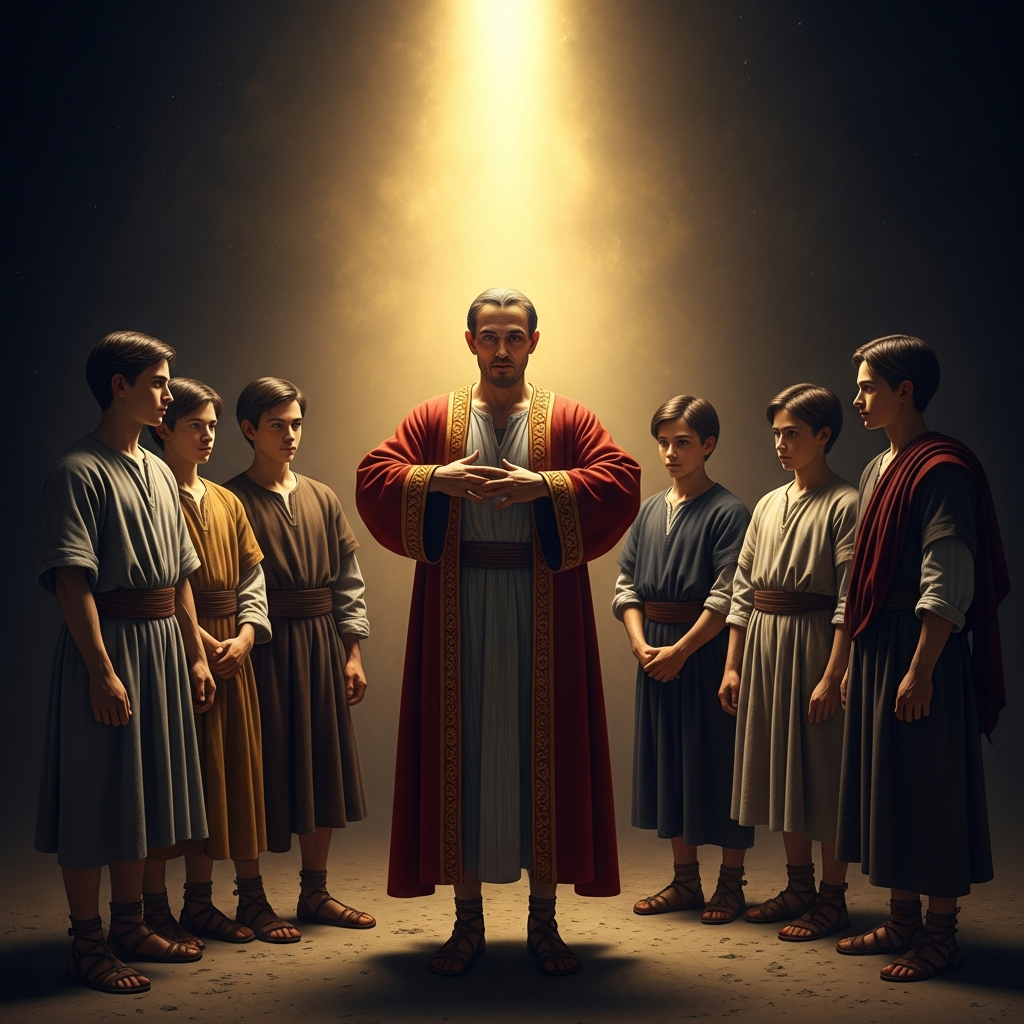
Generating art… The boy is perhaps three years old
 Generating art…
 She sings before she goes home
 Generating art…
 Echoes Across Traditions
Entities
- Hannah
- Elkanah
- Peninnah
- Eli
- Samuel
- YHWH
Sources
- 1 Samuel 1–2 (Robert Alter trans., *The Hebrew Bible: The Early Prophets*, 2013)
- Talmud Bavli, Berakhot 31a
- Avivah Gottlieb Zornberg, *The Hidden Order of Intimacy: Reflections on the Hebrew Bible* (2022)
- Raymond Brown, *The Birth of the Messiah* (1977)