David and Goliath
~1010 BCE · 1 Samuel composed ~6th century BCE · The Valley of Elah, Judea
Contents
A shepherd boy with five smooth stones and no fear of giants walks across the Valley of Elah and ends a forty-day standoff in under a minute.
- When
- ~1010 BCE · 1 Samuel composed ~6th century BCE
- Where
- The Valley of Elah, Judea
For forty days, the giant stands at the edge of the valley and shouts.
This is what forty days of silence looks like from the Israelite side: tents in the morning sun, men eating, men sharpening blades they will not use, King Saul pacing with the weight of a crown that has suddenly grown very heavy. The Philistines are across the wadi. Goliath of Gath is in the middle. Nine feet of him, armored in bronze from greave to helmet, carrying a spear whose iron head alone weighs twelve pounds. He comes out every morning and every evening, and he says the same thing: Send me your champion. Winner takes everything.
No one moves.
David arrives on an errand.
His father Jesse sends him from Bethlehem with bread and roasted grain for his brothers who are serving in Saul’s army, and ten cheeses for their commander. He is not a soldier. He tends sheep. He is described in the text as na’ar, a young man or boy, ruddy, bright-eyed, and — the Hebrew is exact — yafeh mar’eh, beautiful of appearance. He is bringing lunch to men who are frozen in place by a giant.
He hears Goliath’s morning challenge and he asks the obvious question: What do you get for killing that man?
His brother Eliab snaps at him. Go back to your sheep. You’re just here to watch. There’s pride and a little cruelty in it — the way an older sibling manages a younger one who has wandered somewhere he does not belong. David does not argue. He just turns and asks someone else.
The answer comes back: the king’s daughter. Wealth. Honor. The house of your father made free in Israel.
David says: I’ll go.
They bring him to Saul.
Saul looks at him the way everyone looks at him — this small thing, this shepherd — and says, You can’t fight Goliath. You’re a boy and he’s been a soldier since his youth. It is not cruelty; it is arithmetic.
David does not argue with the arithmetic. He tells Saul about the lion. When a lion came for the flock, he went after it, grabbed it by the jaw, and killed it. Same with the bear. The Lord delivered me from the paw of the lion and from the paw of the bear. He’ll deliver me from this Philistine.
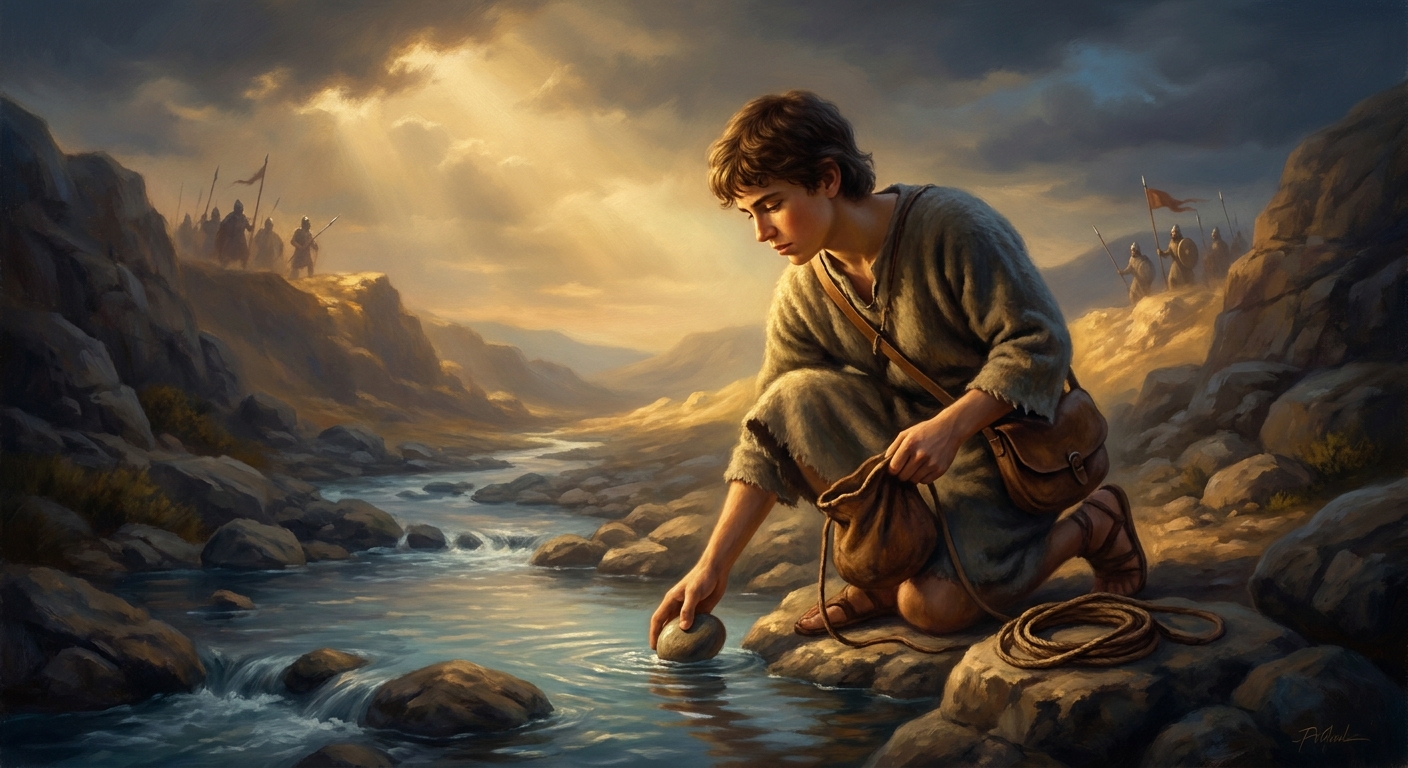
Saul runs out of objections. He offers David his own armor: bronze helmet, coat of mail, sword belted over everything. David puts it on. Takes a step. Another. He cannot move in it — he has never worn armor — so he takes it back off. He picks up his staff, his sling, and he goes down to the brook at Elah and he chooses five smooth stones and drops them into his shepherd’s bag.
Five stones. Not one. This detail survives four thousand years because it is so thoroughly human. He wants options.
He runs at the giant.
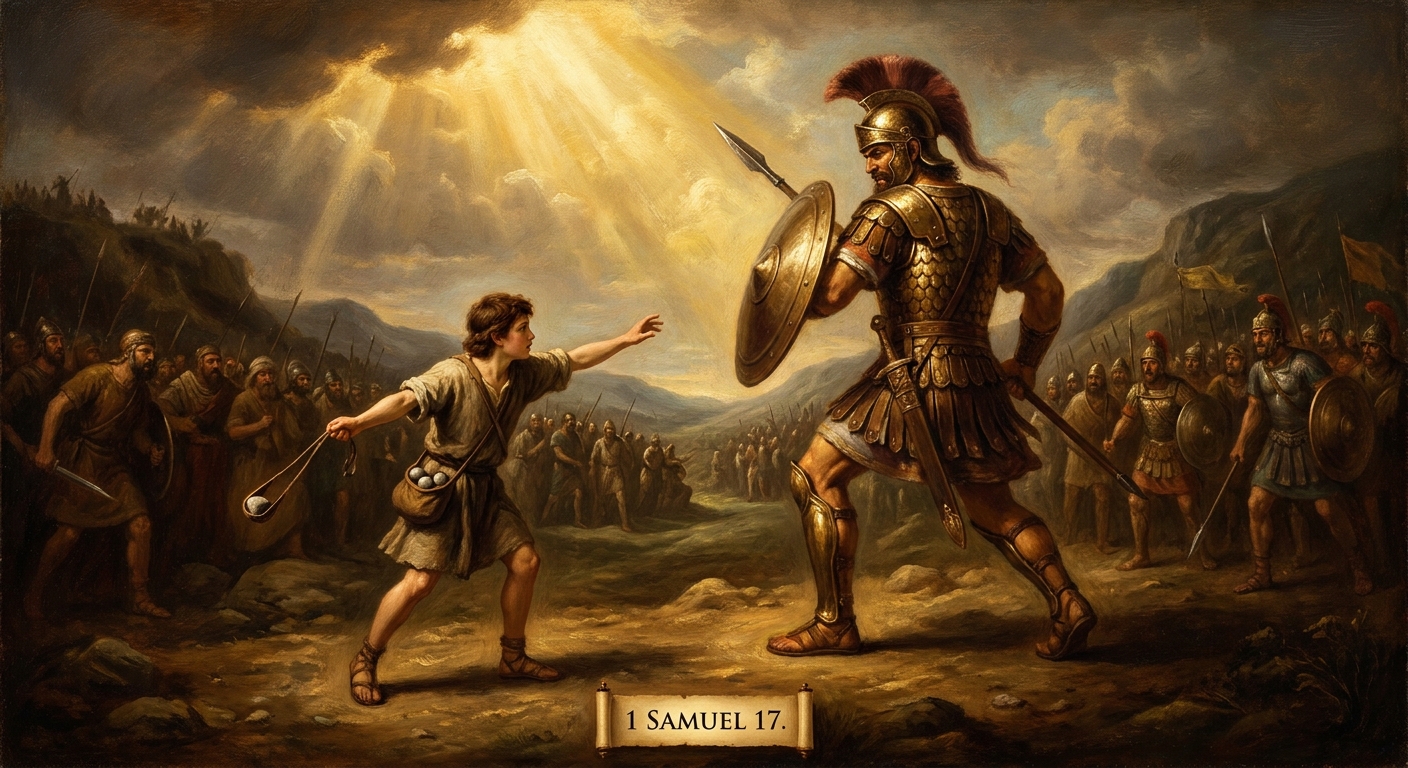
This is what the text says. Not walks. Runs. The Hebrew is vayarats, he hastened, he ran. The forty-day standoff, the paralyzed army, the shouting at dawn and dusk — David arrives and accelerates toward it. Goliath comes forward too, cursing, calling down his gods. Come here and I’ll give your flesh to the birds and the beasts. Standard ancient combat taunting. David shouts back that he is coming in the name of the Lord of Hosts, that today the Lord will deliver Goliath into his hand, that the whole earth will know there is a God in Israel.
Then he reaches into his bag.
One stone. The sling spinning. The release. The stone strikes Goliath in the forehead — the one place the armor does not cover, the one place a slinger at distance can reach that a swordsman at arm’s length cannot — and it sinks in. Vayipol al panav artzah. He fell on his face to the ground.
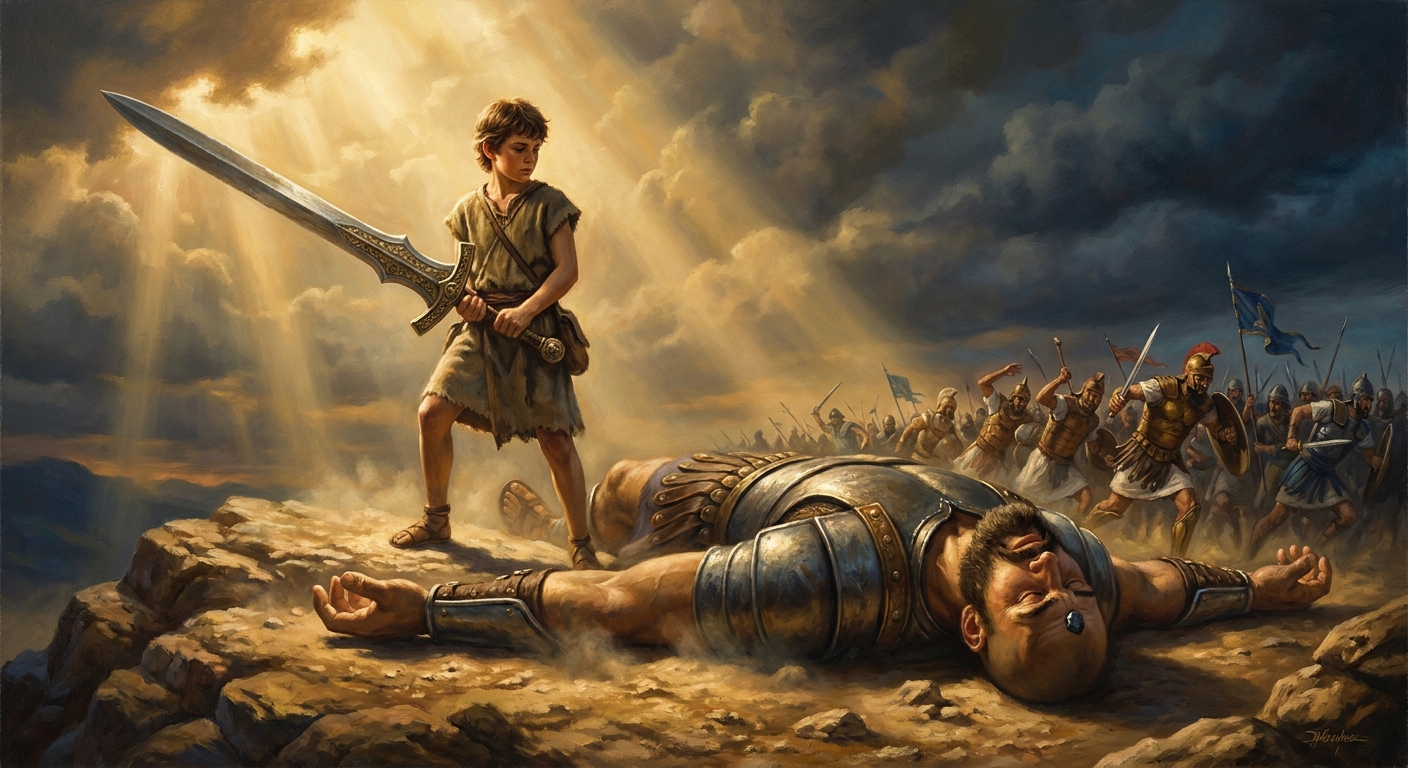
The Philistine falls and David runs to him and draws Goliath’s own sword — David does not have a sword — and with it he cuts off his head.
The Philistine line breaks. They run. Israel pursues them all the way to the gates of Gath and Ekron, which is to say: all the way home.
What is actually happening here is a matter of some dispute.
Robert Alter notes the scene’s careful literary architecture — the three-part telling, the repeated challenge, the gradual narrowing of focus to one boy — and reads it as a masterwork of biblical narrative rather than a soldier’s after-action report. Baruch Halpern reads the historical David as a more complicated figure: a mercenary, a bandit king, a man whose legend was constructed by court scribes who needed the dynasty to have a good origin story.
Malcolm Gladwell reads it as a case of misunderstood advantage: a trained slinger at range is not an underdog against a heavy infantryman. The sling is a precision weapon, lethal at distances a sword cannot close. Goliath’s armor and size are close-combat advantages. David never intends to fight close. What looks like innocence is actually a tactical mismatch that favors the boy.
All three readings are true. The story contains all of them. This is what makes it last.
What survives is not the military analysis.
What survives is the image: a boy, a brook, five stones, a giant falling forward onto his own face. It survives because every tradition that has ever told it has a giant of its own — an empire, a system, a tyrant, an enemy that the official army dare not face. The story gives the powerless a grammar. It says: the giant can fall. It says: run toward it. It says: the stone you need is already in the river.
David is not yet king in this story. He is not yet the adulterer, the general, the man who will arrange the death of Uriah to cover what he has done with Uriah’s wife. He is not yet the complicated, magnificent, broken figure of 2 Samuel. He is just a boy who carried bread to his brothers and came home with a giant’s head.
The founding image of the underdog is not an abstraction. It has a specific weight: twelve pounds, for the iron spear tip alone. It has a specific sound: the giant cursing, then falling. It has a specific smell: the brook at Elah on an autumn morning, cold water over smooth stones, a boy’s hand choosing.
Five stones. He needed one.
The Valley of Elah still exists. It is in the Judean foothills, between Jerusalem and the coast. The brook still runs in winter. The smooth stones are still there.
The giant’s name does not appear in Akkadian, Egyptian, or any contemporary record. David’s does — in the Tel Dan Stele (~870 BCE), where an Aramean king boasts of defeating the “House of David.” The dynasty outlived its origin story long enough to be worth mentioning by enemies.
That is the other thing the story says: the boy becomes something the giants have to name.
Scenes
David stands in the valley floor, sling in hand, facing the bronze giant who has silenced an army for forty days
Generating art… Five smooth stones from the brook at Elah — chosen by touch, pocketed with the calm of a boy who has already killed a lion
 Generating art…
 David draws the giant's own sword
 Generating art…
 Echoes Across Traditions
Entities
- David
- Goliath
- Saul
- Jonathan
Sources
- 1 Samuel 17
- Robert Alter, *The David Story* (1999)
- Malcolm Gladwell, *David and Goliath* (2013)
- Baruch Halpern, *David's Secret Demons* (2001)