Fionn and the Salmon of Knowledge
Mythic time · Fenian Cycle, written down c. 8th–12th century CE · The pool of Fec (Linn Féic) on the River Boyne, County Meath, Ireland
Contents
The poet Finnegas has fished for the Salmon of Knowledge for seven years on the River Boyne. He catches it. He gives it to his student to cook with strict instructions: do not taste it. The boy burns his thumb on a blister of fat. He puts the thumb in his mouth. The wisdom of the world enters him sideways, through the burned skin of an accident, and the old poet looks at the boy and knows the salmon was never meant for him.
- When
- Mythic time · Fenian Cycle, written down c. 8th–12th century CE
- Where
- The pool of Fec (Linn Féic) on the River Boyne, County Meath, Ireland
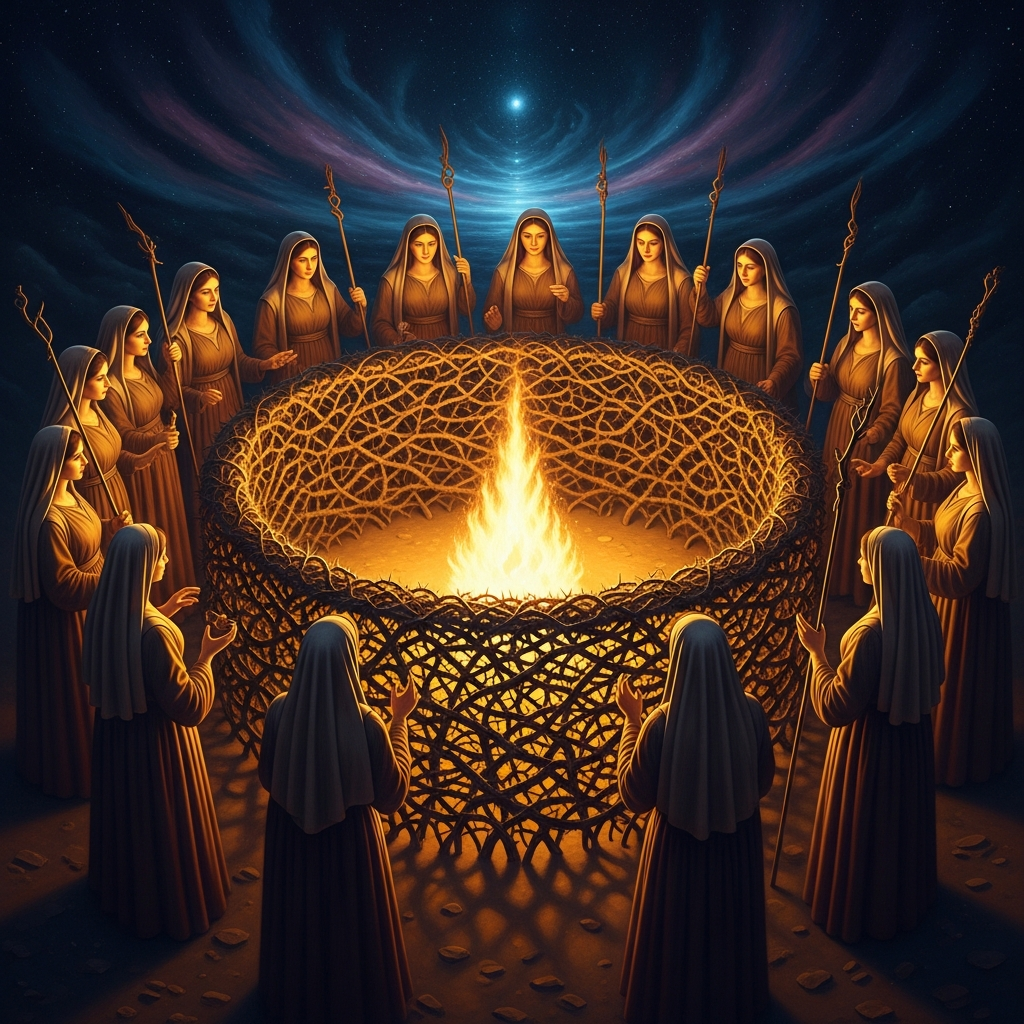
There are nine hazel trees at the source of the River Boyne.
The text does not say where exactly. It says they stand at the well of Segais — the hidden spring from which the Boyne rises — and that the well is in the country of the sídhe, the Otherworld of Ireland, the realm beyond the world that occasionally surfaces inside the ordinary landscape. The nine hazels are the trees of wisdom. Their nuts hold the imbas — the inspiration, the encompassing knowledge, the gift of seeing into things and knowing what they mean.
The nuts fall into the well.
They are eaten by a salmon.
The salmon swims down the Boyne, away from the source, and stops at a deep pool called Linn Féic, the Pool of Fec, somewhere in the kingdom of Mide. The Boyne is now an ordinary river. The pool is now an ordinary pool. The salmon is now the only place in the world where the wisdom of the nine hazels has been concentrated into a single body. Whoever eats the salmon will know everything that knowledge knows.
The poet Finnegas knows this.
He has known it for seven years.
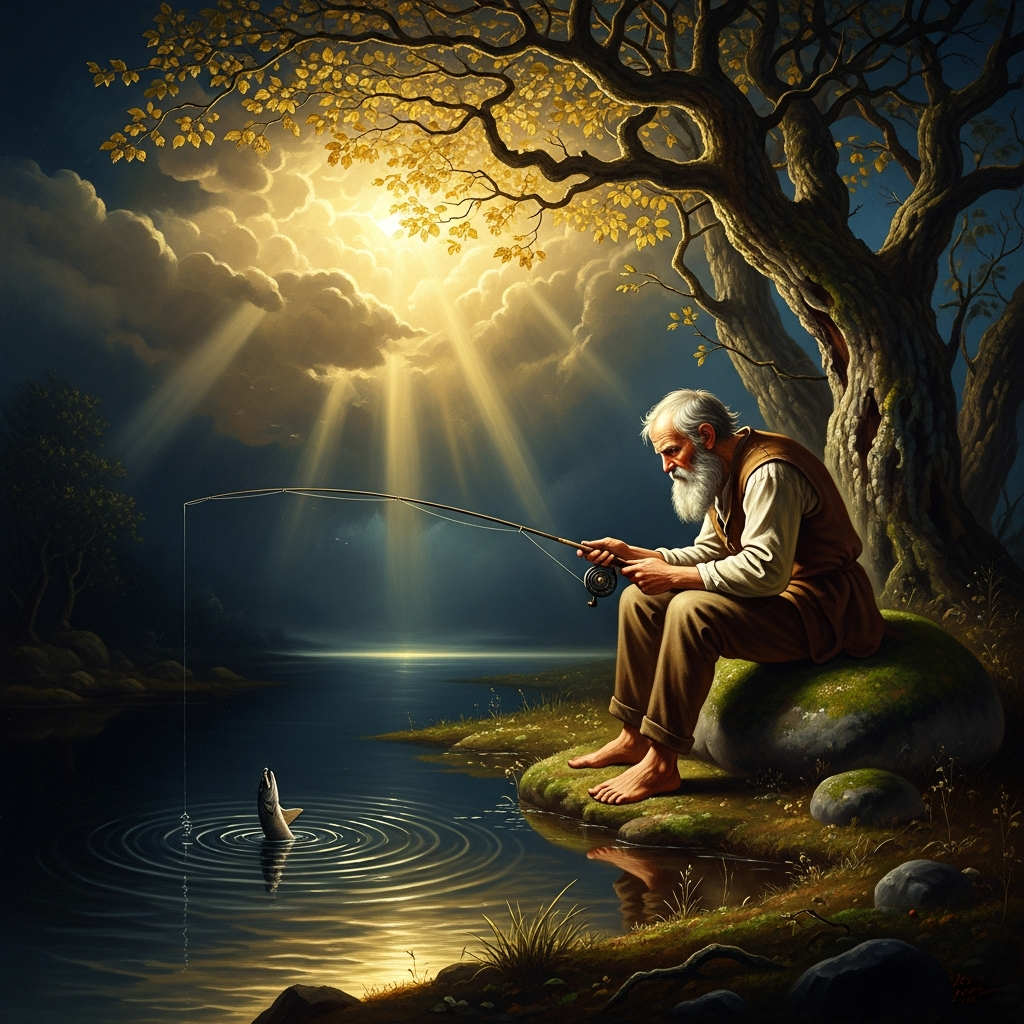
Finnegas is an old man. He lives in a small hut beside the pool. He fishes every day. He casts his line in the morning and again in the evening. He waits. He does not catch the salmon. He has waited so long that the seasons have become indistinguishable to him. Spring follows winter follows autumn follows summer. The hazels at the source of the Boyne drop their nuts into the well. The salmon eats them. The salmon stays in the pool. Finnegas stays in the hut. The years pass.
He is a poet — a fili in the Old Irish sense, which is closer to seer than to versifier. The fili are the educated class of pre-Christian Ireland, the inheritors of the druidic tradition after Christianity reorganizes the religious landscape. They are trained in twelve years of memorized verse. They can produce poems on command in twenty-three meters and seven hundred kinds of structure. They keep the genealogies. They know the histories. They are also, by the older tradition that lives underneath the formal training, supposed to have access to the imbas forosnai — the knowledge that illumines, the gift of seeing the truth about a thing without having to be told it.
Finnegas wants to perfect his gift. The salmon is the way to perfect it.
The salmon does not bite his line.
A boy comes to the door of the hut.
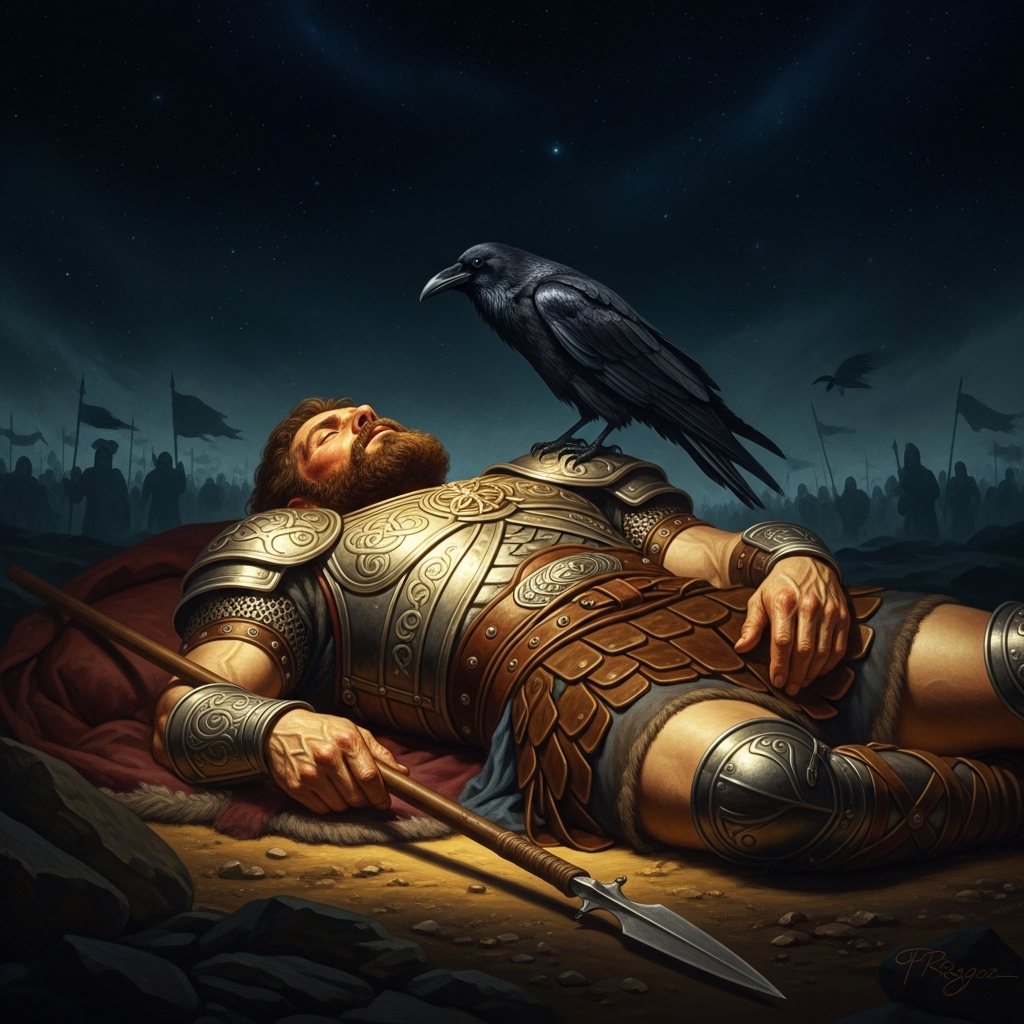
He is twelve years old. He has been raised in secret in the forest — his father, Cumhall, was killed by Goll mac Morna and the rival clan, and his mother sent him into hiding because the clan that killed his father would kill the son too if they found him. He has been raised by two women, druidesses of the older school, who have taught him to run, to swim, to fight, to hunt, to recite verse. They have taught him everything except the final stage of the fili’s craft, because they cannot. They are not poets. They send him to Finnegas to finish his education.
He is not yet called Fionn. His birth-name is Demne. He is fair-haired, which is how he will get the name that sticks — Fionn meaning fair, bright, the white one.
He arrives at the hut and asks the old poet to take him on.
Finnegas looks at the boy. Finnegas can see things. He has trained his whole life to see things. He sees something in the boy that he does not understand and does not particularly want to understand. He takes the boy on anyway.
The boy lives in the hut. He learns the meters. He learns the genealogies. He learns to write the ogham letters on the edges of sticks. He runs errands. He cooks. He cleans. He listens. Finnegas continues to fish for the salmon.
One morning, the salmon takes the line.
The fight in the water is brief. The salmon is old. It has eaten the wisdom of the hazels for so long that it is heavy with the weight of what it knows. Finnegas brings it onto the bank. It lies there gasping. Its scales catch the light in a way no other fish catches the light. Finnegas sits down beside it on the bank and breathes for a long time.
He is shaking.
The boy comes down from the hut to see what has happened. Finnegas tells him: cook this fish. Do not taste it. Do not put your hand to your mouth. Do not let any part of this fish touch your lips. When it is cooked, bring it to me and I will eat it.
The boy nods. He takes the fish to the cooking-fire.
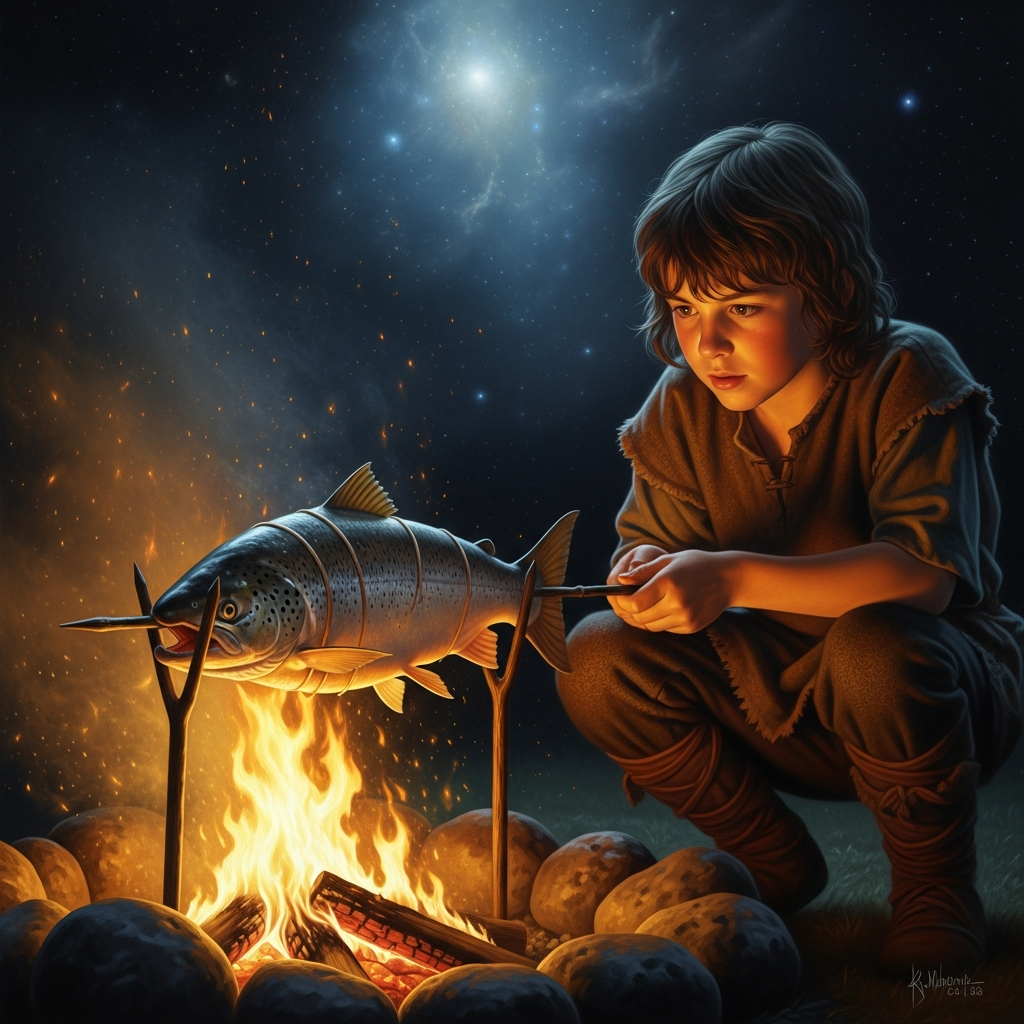
He sets up the spit. He skewers the fish. He builds the fire to the right heat. He turns the fish slowly over the flame. He has cooked fish a hundred times. He knows what he is doing. The salmon turns. The skin crisps. The flesh becomes opaque. Drops of fat begin to gather under the skin and run down the sides.
A blister rises on the skin.
It is a small blister. It is the kind of thing that happens to a fish on a fire. The boy reaches out with his thumb to press it down — to keep the skin from splitting unevenly, the way any cook would.
The blister bursts.
The hot fat strikes his thumb. The pain is sharp and immediate. Without thinking — without any kind of intention, in the pure reflex of a body that has been burned — he puts his thumb in his mouth.
The world changes.
The text does not say it changes spectacularly. The text says he sucks his thumb and the imbas enters him. The change is interior. The boy stands beside the fire holding the spit and he understands, suddenly and completely, things he did not understand thirty seconds earlier. He understands what the fire is doing to the fish. He understands what the river is doing under the ground. He understands what his own face looks like to the old man sitting on the bank. He understands what the next year of his life will require of him. He understands, distantly, things about a battle that will not be fought for forty years.
He does not say anything. He keeps cooking.
When the salmon is done, he carries it carefully on a wooden plank to where Finnegas sits and sets it down before the old poet.
Finnegas looks at the salmon. Finnegas looks at the boy.
Something has happened in the boy’s eyes.
Finnegas asks him: did you taste any of the salmon?
The boy thinks for a moment. He says: no, but the blister rose and burst on the skin, and the fat burned my thumb, and I put my thumb in my mouth.
Finnegas closes his eyes.
The text gives him a long silence. Then he says, in a voice that is partly grief and partly something else — partly the recognition that the wisdom of the world is sometimes given to the person it is meant for and not to the person who has earned it — then it is yours. The salmon was prophesied to come to a man named Fionn. I thought it was me. My name was once Finnegas. But the prophecy meant a Fionn who is not yet Fionn. Eat the rest of it. The wisdom is yours now.
The boy eats the salmon.
He becomes Fionn mac Cumhaill on the spot.
The wisdom Fionn gets from the salmon is not encyclopedic. It is not that he knows everything all the time. The mechanism of the gift, as the texts describe it later, is specific and slightly strange: whenever Fionn faces a question he cannot answer, he sucks his thumb. The contact with the burned skin — the place where the wisdom entered — gives him access to the answer. He chews on the thumb. He thinks. The answer arrives.
This is how he tracks. This is how he hunts. This is how he reads the future of a battle. This is how he detects the man who has come into camp pretending to be a friend. The wisdom is at his fingertips, literally — a single thumb, the one that was burned when he was twelve years old, that retains forever the imprint of the moment when the salmon’s fat broke against him.
He will become the leader of the Fianna — the warrior-band that protects Ireland from invaders, the elite mobile force whose deeds fill an entire cycle of Irish literature. He will perform a hundred and a thousand feats with that thumb at his lip and the answer arriving as he chews. He will live a long life. He will lose men. He will love women. He will see his son Oisín ride away with Niamh of the Golden Hair into the country of the sídhe, the same country where Pwyll once spent a year in another king’s body. He will, in the latest layer of the tradition, be said not to have died at all — to be sleeping in a cave under an Irish hill with the Fianna around him, waiting for the horn of Ireland to call him back.
Finnegas does not appear again in the cycles.
The text dispenses with him cleanly. The old poet has been rendered narratively unnecessary by the success of his student. He has fished for seven years and has caught the fish he was supposed to catch and has not eaten it. He has given the wisdom of the world to the boy because the prophecy required it and he was the kind of poet who could see the prophecy clearly even as it took the wisdom away from him.
What happens to him after he releases his claim on the salmon is not part of the story.
What happens to the boy is the rest of Irish mythology.
The pool at Linn Féic is identifiable on a modern map.
It is in County Meath, on the Boyne, near the town of Slane. The river is still there. The pool is still there. The hazels at the source of the Boyne are not there in any literal sense, but the source itself — the Well of Segais, the axis mundi of the Irish world-system — is mapped to a real spring above Carbury Hill in County Kildare. The Boyne rises there. The water moves east through Meath. The pool sits in the middle of the river’s run.
Whether there is still a salmon in the pool is not the kind of question the tradition allows you to ask.
The wisdom of the world has already been given. The boy has already burned his thumb. The old poet has already gone home, or wherever poets go after the prophecy they have served has used them up.
What you can do, if you are a Fenian-cycle reader walking the Boyne in the rain, is sit by the pool for a while and put your thumb in your mouth and see if anything occurs to you.
The story does not say it works for everyone.
It does not say it does not.
Scenes
Fionn at the cooking-fire, the salmon turning on its skewer, the moment before the blister of fat rises and bursts
Generating art… The boy puts the burned thumb in his mouth without thinking — the smallest gesture, the largest consequence, the knowledge of the world entering through a place no instruction reaches
 Generating art…
 Finnegas at the pool of Fec — seven years of fishing, the hazels overhead, the certainty that the salmon will rise and the certainty that it has just risen for someone else
 Generating art…
 Echoes Across Traditions
Entities
- Fionn mac Cumhaill (as a young boy)
- Finnegas (the old poet-fisherman)
- the Salmon of Knowledge
- Linn Féic (the pool of wisdom on the Boyne)
- the nine hazels of wisdom
Sources
- *Macgnímartha Finn* (The Boyhood Deeds of Fionn), in *Revue Celtique* V (1882), ed./trans. Kuno Meyer
- Eleanor Hull, *Folklore of the British Isles* (Methuen, 1928)
- T. W. Rolleston, *Myths and Legends of the Celtic Race* (Harrap, 1911)
- Alwyn Rees and Brinley Rees, *Celtic Heritage: Ancient Tradition in Ireland and Wales* (Thames & Hudson, 1961)
- James MacKillop, *Dictionary of Celtic Mythology* (Oxford UP, 1998)