Nü Wa Repairs the Broken Sky
Mythic Time · earliest textual record: *Huainanzi* c. 139 BCE · The broken northwest corner of the sky · the banks of the Yellow River
Contents
The creator goddess who molded humanity from yellow earth patches the sky itself after the water god Gong Gong, defeated and ashamed, butts his head against Mount Buzhou and shatters the pillar holding up the heavens. She melts five-colored stones in a celestial furnace, cuts the legs from a cosmic tortoise, and seals the wound — but the sky remains slightly tilted, and rivers still run east.
- When
- Mythic Time · earliest textual record: *Huainanzi* c. 139 BCE
- Where
- The broken northwest corner of the sky · the banks of the Yellow River
Before the break, the sky was held up by four pillars.
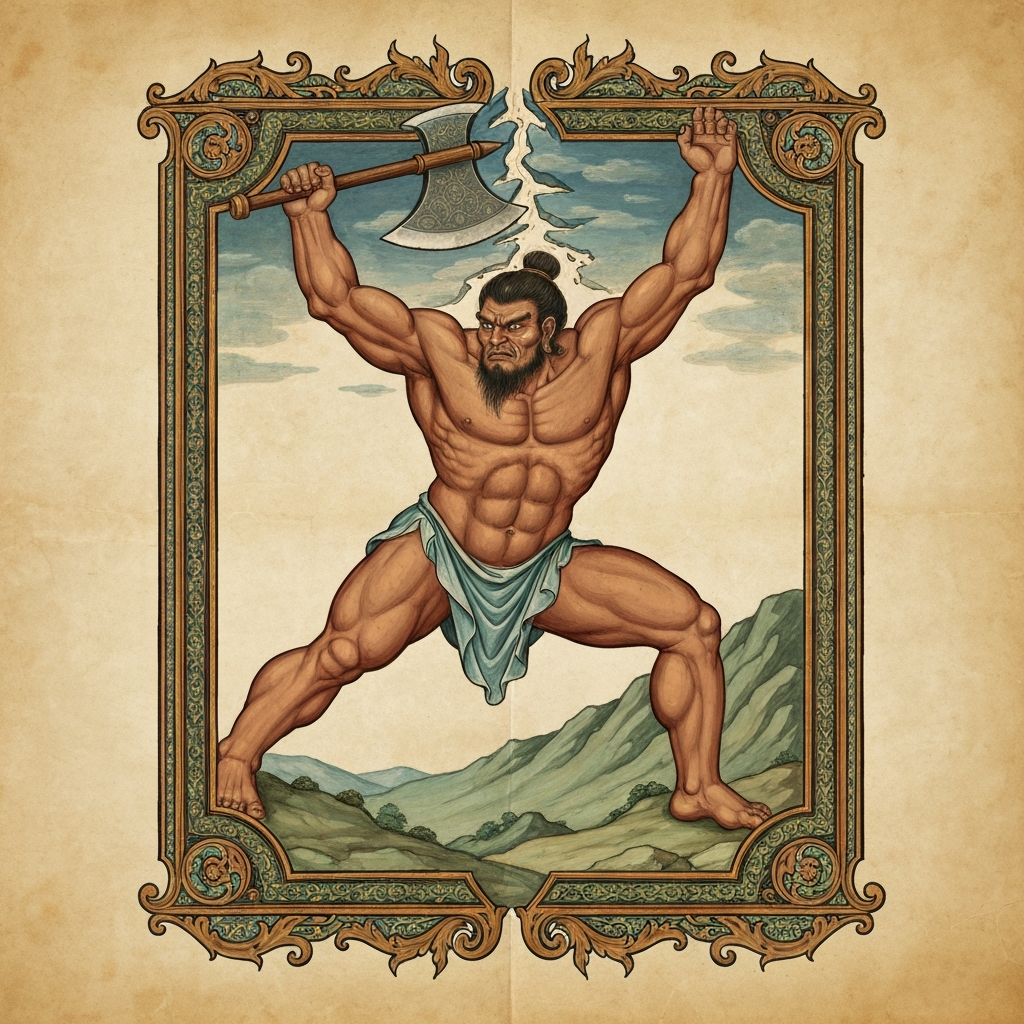
This is not a metaphor. In the cosmology of the Huainanzi and the older texts it assembles, the heavens are a physical structure, not an abstraction — a dome of something harder than stone, curved above the flat earth, held at its corners by four mountains of sufficient height and density to bear the weight. The northwest corner rests on Mount Buzhou, which is not the tallest of the four pillars but is the one whose name means, simply, Incomplete.
Gong Gong is the god of water and floods, and he has just lost a war.
The war is against Zhurong, the fire god, and the sources differ on what the war was about — a dispute over cosmic governance, a challenge to primordial authority, a contest that became a conflict in the way that contests between powerful beings tend to. What matters is that Gong Gong loses, and losing is the one thing the god of floods cannot metabolize. He is a being who has always moved where he wanted to move, flooded what he wanted to flood, overflowed every boundary that was placed in his path. Defeat has no grammar in him.
He flies northwest in his shame. He finds Mount Buzhou. He butts his head against it.
The pillar breaks.
What follows is geological and immediate. The northwest corner of the sky drops. The sun and moon, which travel along the inside of the dome, begin to slide toward the gap, which is why they now set in the west instead of vanishing straight down through the floor. The earth itself tilts in response — the southeast corner rises, and all the rivers and lakes that had been resting level begin to slide toward the low side. They are still sliding. Every river in China runs east to the sea because of one god’s inability to accept his loss with any grace.
Fire erupts through the cracks where the pillar shattered. Floodwaters pour through the tears in the earth where the roots of Mount Buzhou pulled loose. Dragons rise in the steam. The black dragon of the north, one of the great ones, begins to swim through the chaos in a way that suggests it considers the ruin an opportunity rather than a catastrophe. Animals driven out of their territories devour people. People, finding no order to appeal to, devour each other.
Nü Wa sees all of this.
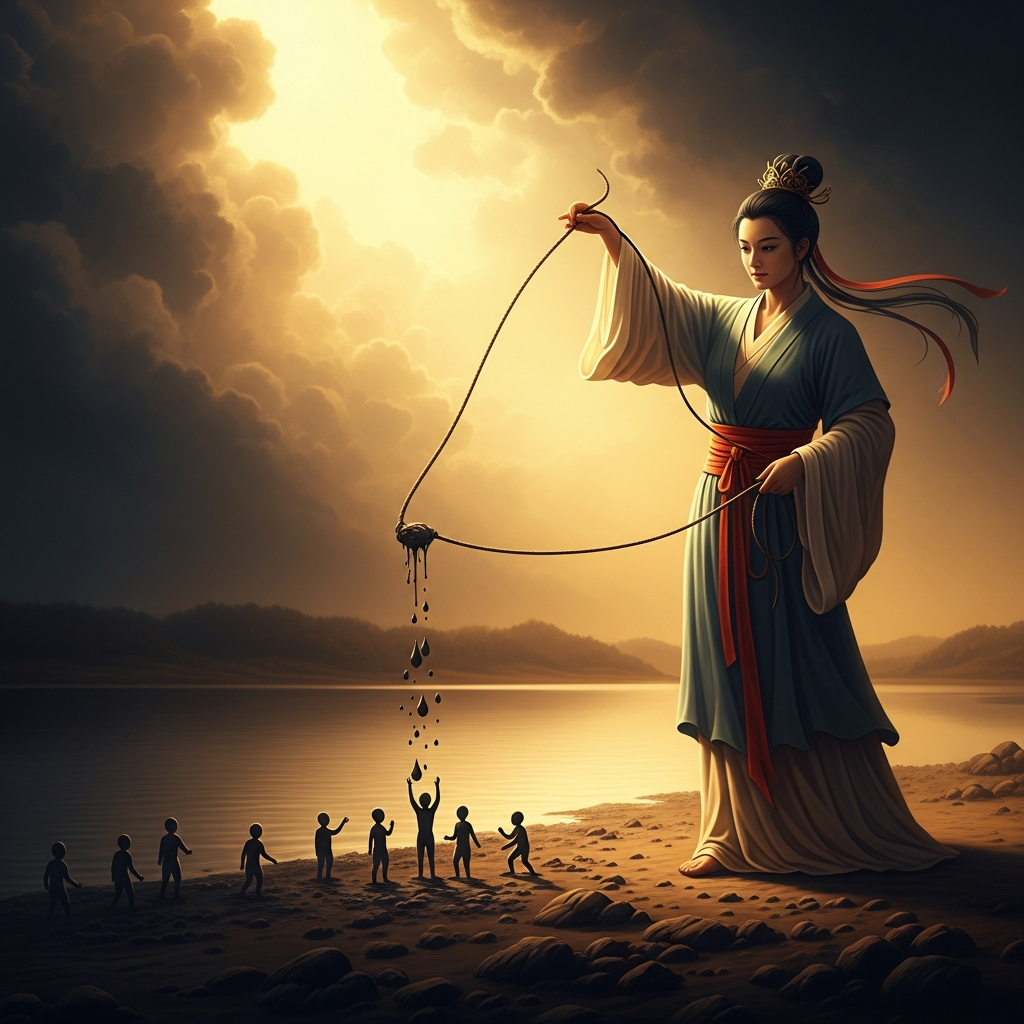
She was there before Gong Gong, before Zhurong, before the humans she shaped from the Yellow River’s clay. She was there when the sky was first raised and the earth was first settled. She has a human face and a serpent body and she is older than the category of old. She is not a goddess who exists at a comfortable remove from the work — she is the one who bends down to the river bank, who picks up the mud, who rolls it between her palms until it has the right weight. She made the humans because she was lonely, and she made too many of them to make each one by hand, so eventually she dipped a cord in the clay and flung it and let the droplets be the common people.
She is, in every version of this story, practical.
She builds a furnace.
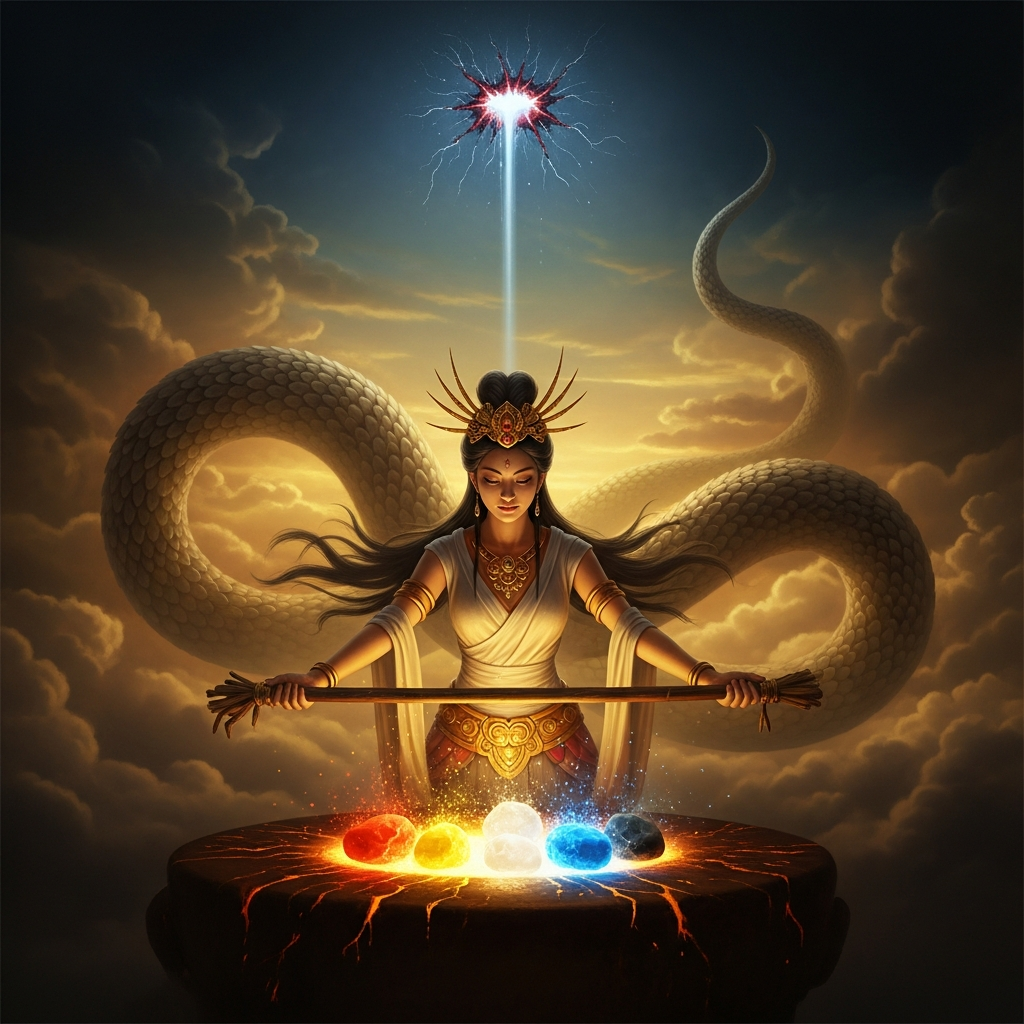
The five-colored stones come from riverbeds and mountain faces where the original creative energies of heaven are concentrated — red stone that holds fire, yellow that holds earth, blue that holds wood and water together, white that holds metal, black that holds the deep water below the sea. Each color is a direction and a phase and a quality. In their melted state, they become something that has no name because nothing had needed a name for it before: the substance that sky is made of, reducible back into sky when applied correctly.
She tends the furnace. She is not impatient. The stones take the time they take.
When the compound is ready she rises with it to the wound in the northwest corner of the dome. The hole is not a clean hole — it is a tear, edges jagged, cold light and void pouring through it the way water pours through a cracked hull. She applies the five-colored compound the way a craftworker applies sealant to a joint, with attention to the edges, without ceremony, without announcing what she is doing in the way that a god performing a miracle would announce it. She is not performing. She is working.
The sky closes. Not perfectly — the northwest corner remains lower than the southeast, and it will remain lower forever, and the rivers will run east forever, and the sun and moon will continue to travel from east to west in their eternal westward slide toward the place where the break almost was. The repaired sky is a repaired sky, not a new one. Repair is visible in ways that original construction is not.
She cuts the legs from the black tortoise.
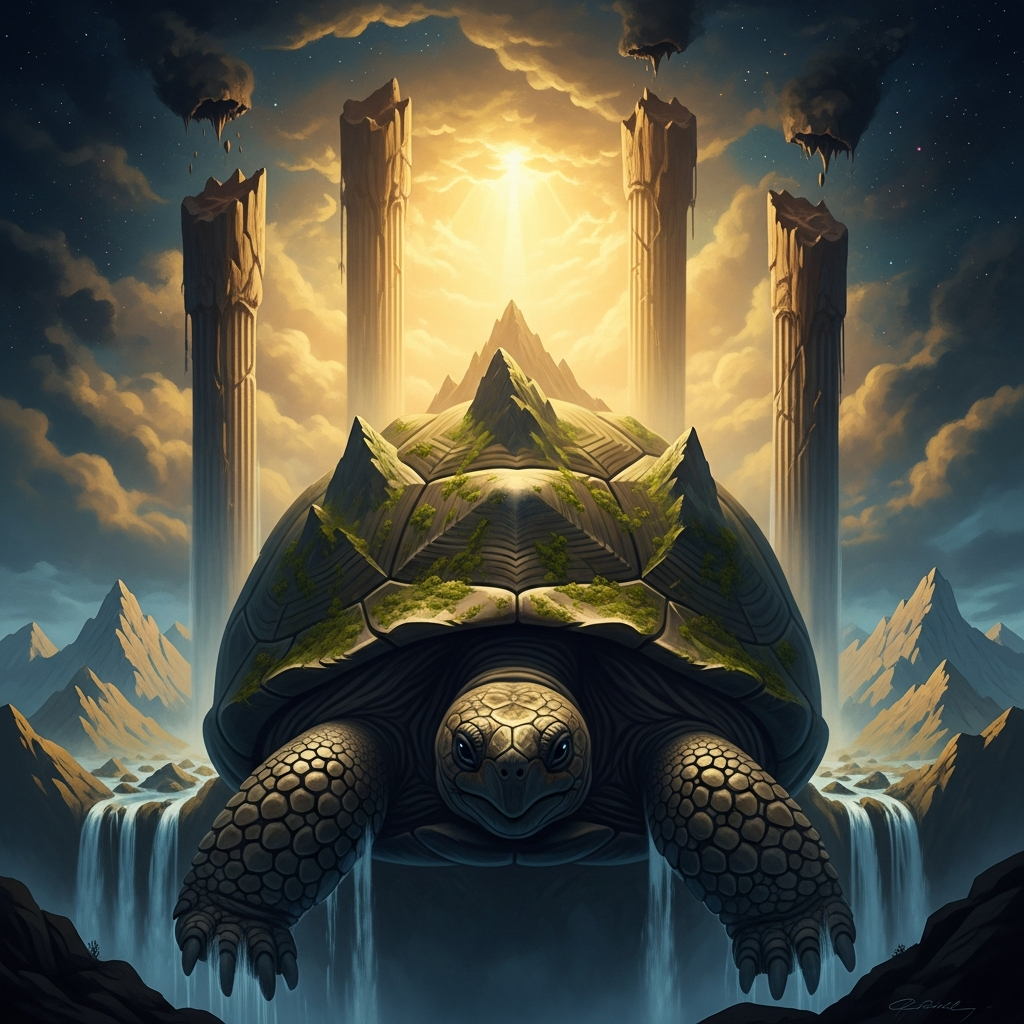
This is the part that makes the story different from comparable creation myths in other traditions. The tortoise — one of the four sacred animals, the one that carries the world on its back in multiple East Asian cosmologies — is not a resource or a raw material. It is a being. Nü Wa takes its four legs anyway and plants them at the four corners of the earth as new pillars, because the legs of the black tortoise are the most durable thing available and the sky needs corners.
The tortoise lives. This is not merciful — it is simply a fact that tortoises survive without legs. The tortoise continues to exist at the center of things, legless, carrying what it was always carrying, in the sources that mention it at all.
Nü Wa burns a pile of reeds into ash and uses the ash to dam the floodwaters. She kills the black dragon of the north, which has been making itself too comfortable in the wreckage. She does not kill Gong Gong, who is somewhere in the northwest, past the broken place where his head hit. She does not repair Gong Gong. Some things that break do not repaired.
The humans she made from the Yellow River clay are still alive through all of this. They hide under rocks. They eat what they can find. Some of them eat each other. They are not dignified in the emergency. They are not meant to be.
When the sky is whole again, Nü Wa does not address them.
She does not explain what happened or issue instructions for what to do now that the world is slightly crooked and the rivers have a permanent lean. The people will have to figure out what the tilt means for agriculture and for navigation and for the angles at which they build their houses. They will figure it out.
The tilt is a permanent record of Gong Gong’s rage and Nü Wa’s repair. The rivers are a permanent record of which corner dropped. The fact that the stars in the northwest rise at a slightly different angle than they should is a record of where the pillar was. The whole sky is an archive of a structural crisis that occurred before recorded time, and every person who has ever navigated by the North Star or watched the sun set or felt a river pulling east is reading that archive without knowing its title.
The sky she patched is still the sky. The tortoise she disassembled is still somewhere beneath the earth, doing its original work without the parts she needed. Gong Gong is still in the northwest, past the mountains, where the defeated go. She did not make the world perfect. She made it continuous — which is a different and more durable achievement.
She went back to the river afterward. There was more clay. There was always more to make.
Scenes
Nü Wa at her celestial furnace, the five-colored stones — red, yellow, blue, white, and black — glowing at their melting point in the forge
 Generating art…
 The great black tortoise of the north, its four legs severed and planted at the sky's corners as new pillars
 Generating art…
 Nü Wa at the Yellow River bank, lifting a cord dipped in mud
 Generating art…
 Echoes Across Traditions
Entities
- Nü Wa
- Gong Gong
- Zhurong
- Mount Buzhou
- the Black Dragon
Sources
- Anne Birrell, *Chinese Mythology: An Introduction* (Johns Hopkins University Press, 1993)
- Birrell (trans.), *The Classic of Mountains and Seas* (Penguin Classics, 1999)
- Yuan Ke, *Dragons and Dynasties: An Introduction to Chinese Mythology* (Penguin, 1993)
- Wolfram Eberhard, *A Dictionary of Chinese Symbols* (Routledge, 1986)
- Jordan Paper, *The Spirits are Drunk: Comparative Approaches to Chinese Religion* (SUNY Press, 1995)