Sun Wukong Declares War on Heaven
Mythic Time · *Journey to the West* compiled by Wu Cheng'en, c. 1592 CE · The Jade Emperor's heavenly court · Laozi's Tushita Palace · the Buddha's Western Paradise
Contents
The Monkey King accepts the Jade Emperor's appointment as Keeper of the Horses, discovers what the job actually is, and refuses it — demanding instead the title Great Sage Equal to Heaven. When the celestial army fails to subdue him, Laozi's divine furnace is used to try to incinerate him. It gives him eyes of gold instead. The Buddha then bets him that he cannot escape his open palm.
- When
- Mythic Time · *Journey to the West* compiled by Wu Cheng'en, c. 1592 CE
- Where
- The Jade Emperor's heavenly court · Laozi's Tushita Palace · the Buddha's Western Paradise
The first title is Keeper of the Horses.
The Jade Emperor offers it because his court advisors have convinced him that bringing the Monkey King inside the hierarchy is safer than fighting him, and they are correct, though the solution they have found will turn out to be far more expensive than they calculate. The title sounds official. The title sounds like a step onto the career ladder that extends from the stables to the ministries to the celestial bureaucracy’s upper reaches. It sounds like recognition.
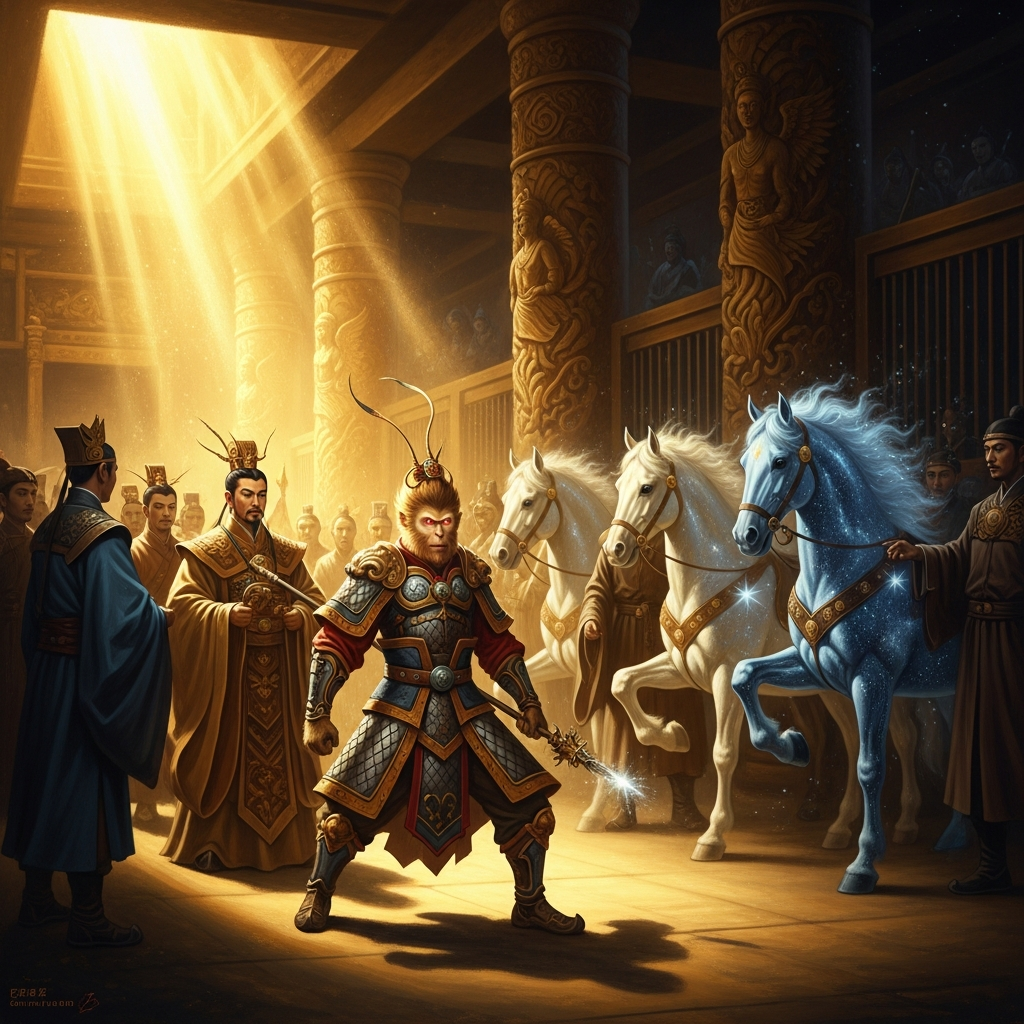
Sun Wukong accepts. He is escorted to the divine stables.
The divine stables contain horses. The job of Keeper of the Horses is to feed, water, and exercise the horses, keep the stables clean, and file the appropriate paperwork with the Bureau of Celestial Livestock. The position carries no rank. It carries, in the celestial hierarchy’s classification system, the designation bi-pin, which means no pin — no rank at all, the category below the lowest category on the scale.
He learns this from a minor official who tells him with the specific tone of someone who has been looking forward to this conversation.
He leaves. He returns to Flower-Fruit Mountain. He gives himself a title.
This is the move that the Jade Emperor’s advisors had not modeled: a being who, when denied recognition by the existing hierarchy, simply generates his own. The title he chooses is Qi Tian Da Sheng — Great Sage Equal to Heaven. He has a banner made. He has the banner planted on Flower-Fruit Mountain. He tells every demon and monkey in his domain that this is now who he is.
The Jade Emperor sends an army.
The army is one hundred thousand celestial soldiers under the command of the Heavenly King Li Jing and his son Nezha, who is himself a formidable warrior, born from a lotus, capable of transformation, armed with a Universe Ring and fire-tipped spears. Nezha is the kind of fighter who wins. He fights Sun Wukong for three days and cannot win. Li Jing’s full army cannot win. They have better weapons and more of them and the full endorsement of the celestial bureaucracy, and they cannot subdue one monkey.
The Jade Emperor’s advisors caucus. They determine that the cheapest solution is to give the monkey what he wants.
The Jade Emperor creates the title Great Sage Equal to Heaven.
He creates it the way imperial courts create titles when they need to satisfy someone without actually giving them power: the designation is elaborate, the ceremony is official, the office has a building and a staff and a salary, and the office has no responsibilities whatsoever. A Great Sage Equal to Heaven does nothing. He attends no meetings. He reviews no petitions. He is, in the celestial government’s operational terms, a beautifully dressed piece of furniture.
Sun Wukong is content with this for some time. He makes friends with the gods of the five directions. He plays chess. He visits the Peach Garden, where the Queen Mother of the West grows the peaches of immortality that ripen every three thousand years, and he discovers that he is not on the guest list for the feast where the peaches will be served.
He eats every peach in the garden. He goes to Laozi’s Tushita Palace and drinks the five gourds of immortality elixir that were aging there for the gods’ private use. He finds the feast already in progress and eats what remains. He is now, by any pharmaceutical accounting, essentially indestructible: the peaches, the elixir, and his own previous immortality treatments have combined in him into something the celestial pharmacopeia has no precedent for.
The Jade Emperor sends another army. This army includes Erlang Shen, the divine warrior with the third eye in his forehead, the nephew of the Jade Emperor and the greatest fighter in heaven. Erlang Shen and Sun Wukong fight an extended shape-shifting battle — each transforming into animals, elements, landscapes, architectural features — that ends in a draw close enough that Erlang Shen’s divine hound bites Wukong’s leg and the combined forces manage to bind him in chains.
They cannot kill him. Every weapon they try either breaks against him or passes through him. His neck refuses the executioner’s axe. Fire does not burn him. Lighting does not stun him. He yawns through the ordeal.
Laozi has a suggestion.
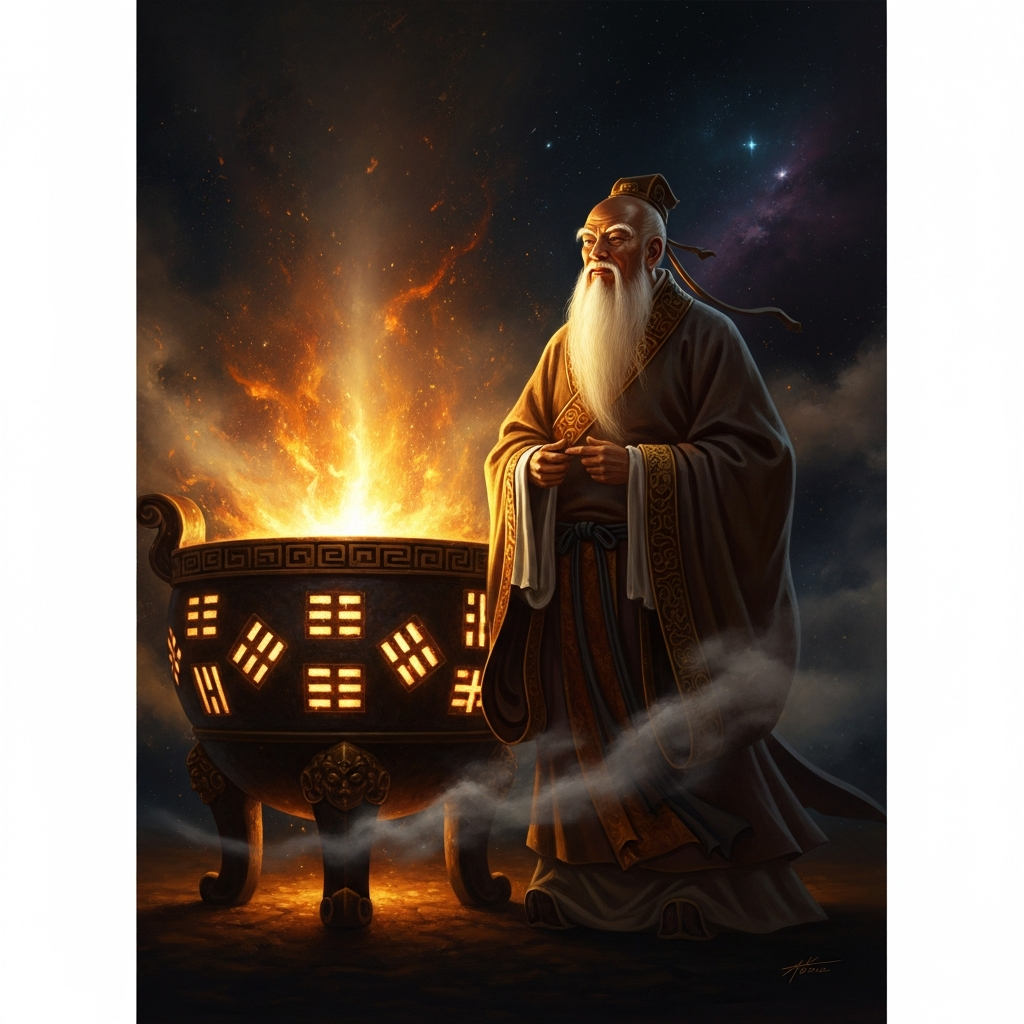
The Bagua Furnace is the device in which Laozi refines his immortality elixir — eight chambers arranged according to the eight trigrams of the I Ching, each chamber burning at a different spiritual temperature, each corresponding to a different element and force. Ordinarily it is used to purify and concentrate the elixir over years of careful tending. Laozi proposes to use it differently: put the monkey inside, burn at maximum temperature for forty-nine days, reduce the immortal materials he has consumed back to base elements. This should, in theory, destroy what the executioner’s axe could not.
They seal Sun Wukong in the furnace. Forty-nine days pass.
What they have not accounted for is the wind. The Bagua Furnace’s wind chamber — the xun position, corresponding to the fourth trigram — produces a gap in the fire. Sun Wukong, inside the furnace and very hot but not destroyed, navigates to the wind chamber and shelters in it for the full forty-nine days. The fire, unable to reach him in that corner, does what fire does when its intended target is unavailable: it works on whatever it can reach. What it can reach are his eyes.
When Laozi opens the furnace lid on the forty-ninth day, Sun Wukong leaps out. His eyes have been transformed by seven weeks of smoke and divine flame into huoyan jinjing — eyes of fire and gold, the fiery golden eyes that see through every illusion, every disguise, every demonic transformation. He will use these eyes for the rest of the novel. The furnace that was supposed to destroy him has instead given him a power he did not have before.
He hits Laozi with his staff. Laozi falls down. Sun Wukong fights his way through the entire heavenly court, and this time the celestial army does not merely fail to subdue him — it routes. The Jade Emperor and his court retreat to the innermost halls and barricade the doors and send a message to the Western Paradise.
The Buddha arrives unhurried.
He does not arrive with an army. He arrives as a being who has already done the arithmetic on the situation and found that arithmetic is the wrong tool. He listens to the Jade Emperor’s complaint — the monkey, the title, the peaches, the elixir, the routing of heaven — with the expression of someone hearing a problem they solved a long time ago and in a different context.
He goes to find Sun Wukong.
The negotiation is brief. Sun Wukong makes his case: he has mastered the seventy-two transformations, he has mastered the somersault cloud that covers a hundred and eight thousand li in a single leap, he cannot be killed by heaven’s weapons or refined in heaven’s furnace, he has drunk the elixir and eaten the peaches, he is Equal to Heaven by definition because nothing heaven possesses can diminish him. The Jade Emperor has held this position for a hundred and twenty-nine thousand six hundred years. Sun Wukong has been cultivating for only a fraction of that. But cultivation time, he argues, should not be the measure if the result is the same.
The Buddha listens. Then he makes a bet.
If Sun Wukong can somersault out of his open palm, the Buddha says, then heaven is his. The Jade Emperor will vacate. Sun Wukong will have what he wants by the cleanest possible demonstration — proof that his powers exceed even the Buddha’s containment.
Sun Wukong looks at the palm. The palm is human-sized. He has traveled a hundred and eight thousand li in a single somersault. He takes the bet.
He leaps. He travels. At the far edge of the world, at what feels like the absolute boundary of everything, he finds five great pillars of red stone rising into a pinkish void. This must be the edge — the place where the sky meets what is beyond the sky. He writes his name on the largest pillar: The Great Sage Equal to Heaven Was Here. He adds, for bureaucratic completeness, a yellow mark at the base of the pillar.
He somersaults back.
He lands in the Buddha’s palm and reports his success: he has traveled to the very pillars of the sky and signed his name, and the Buddha’s hand was not large enough to contain his journey.
The Buddha raises his hand so Sun Wukong can see the five fingers. On the largest finger, in the Monkey King’s own handwriting, is the inscription The Great Sage Equal to Heaven Was Here. At the base of the finger is the yellow mark.
The five pillars were the Buddha’s five fingers.
He had never left the palm.
The hand closes. Five Elements Mountain rises from the Buddha’s fingers and pins Sun Wukong beneath it — not killing, since killing remains impossible, but containing, for exactly five hundred years, until a monk from the Tang dynasty comes walking west and needs a disciple who can fight, and who has been waiting long enough to have reconsidered, if not yet to have understood, what the bet was actually about.
The furnace gave him golden eyes that see through every illusion. The palm gave him five hundred years to think about what he had failed to see. This is the pedagogy of the story: it is not enough to be undefeatable. You have to understand what you are inside.
He will spend the rest of the novel learning the difference.
Scenes
Sun Wukong in the divine stables of heaven, surrounded by the Jade Emperor's horses
 Generating art…
 The Bagua Furnace at Laozi's Tushita Palace, flames in all eight trigram chambers
 Generating art…
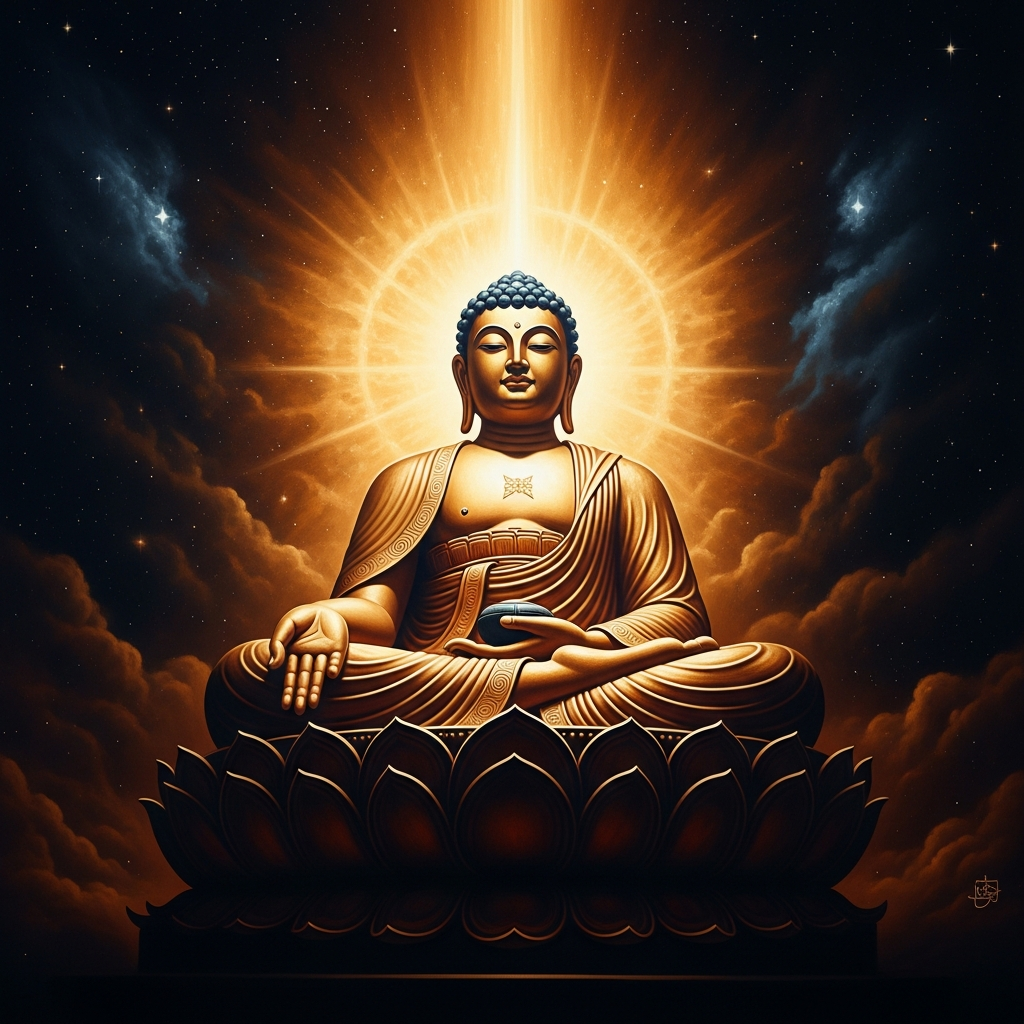
 The Buddha's open palm, vast as a continent, the five pillars at its edge in the far distance
 Generating art…
 Echoes Across Traditions
Entities
- Sun Wukong
- Jade Emperor
- Laozi
- Erlang Shen
- the Buddha
- the Heavenly Kings

Sources
- Wu Cheng'en, *Journey to the West* (Anthony C. Yu trans., University of Chicago Press, 4 vols., 1977-1983)
- Arthur Waley (trans.), *Monkey: Folk Novel of China* (George Allen and Unwin, 1942)
- Anne Birrell, *Chinese Mythology: An Introduction* (Johns Hopkins University Press, 1993)
- Wolfram Eberhard, *A Dictionary of Chinese Symbols* (Routledge, 1986)
- Whalen Lai, 'From Protean Ape to Handsome Saint: The Monkey King,' *Asian Folklore Studies* 53.1 (1994)